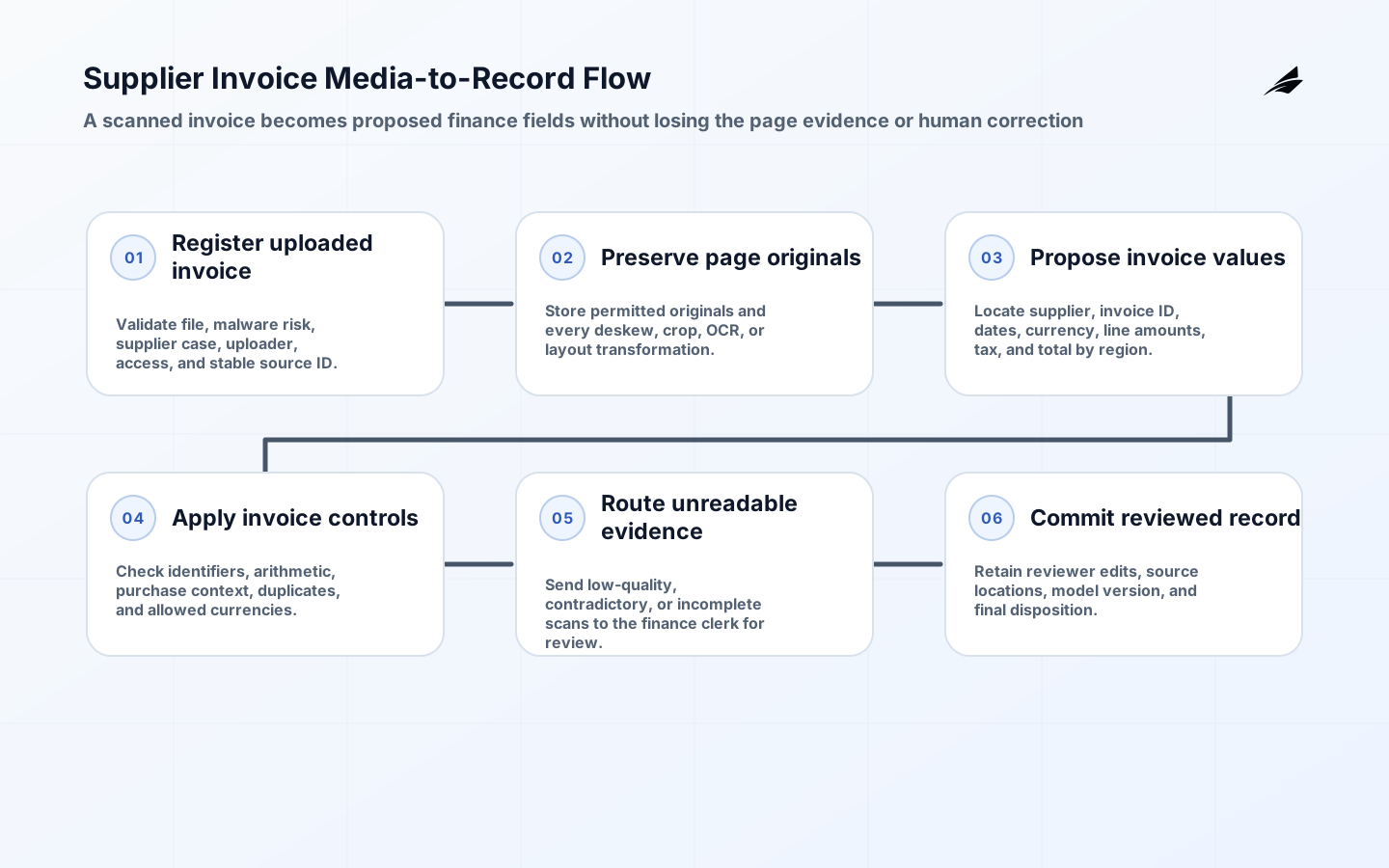
Multimodal AI combines more than one kind of input or output, such as text, scanned documents, images, audio, tables, or video. Its value is usually practical: extracting invoice fields from a scan, locating a safety detail in a photograph, or connecting a spoken service note to a work order. The risk is equally practical: a visual detail may be unclear, a page may be rotated, a table cell may be misread, or sensitive media may be retained too broadly. A useful multimodal AI system preserves the original evidence and makes it clear which claims were extracted, inferred, or confirmed. This guide concentrates on bounded workflows rather than a general-purpose media assistant.
Define the multimodal AI boundary
Describe the input types, target decision, permitted output, and conditions that require human verification. For example, a document-intake service may classify an uploaded supplier invoice and extract proposed fields for a finance clerk; it does not approve payment, infer a missing tax treatment, or expose the file outside its case. Name how media arrives, where it is stored, which transformations are allowed, and what evidence a reviewer needs. The NIST AI Risk Management Framework provides a useful structure for considering context-specific risk before a capability grows beyond its initial job.
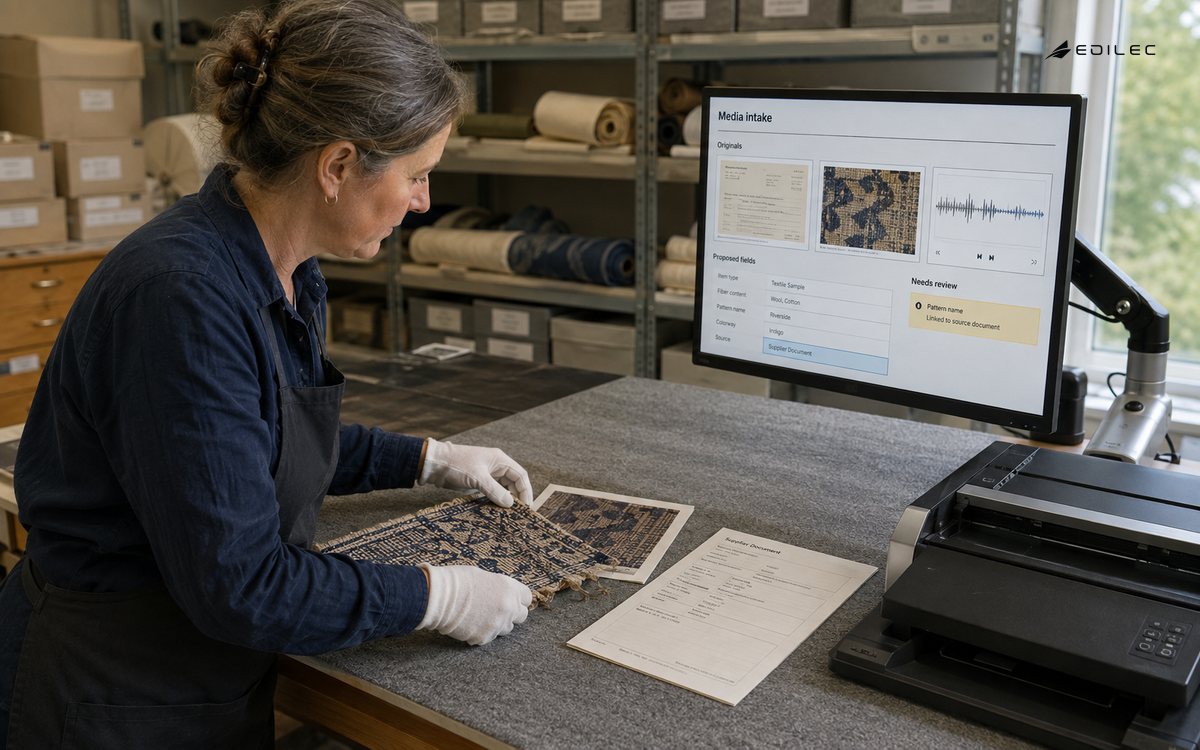
| Input | Bounded task | Required evidence |
|---|---|---|
| Scanned document | Extract declared fields. | Original page, region, and confidence. |
| Image | Identify a defined visual condition. | Image version and reviewer confirmation. |
| Audio note | Create a transcript and task draft. | Recording reference and correction history. |
| Mixed record | Summarize evidence across sources. | Links to each source and disagreement state. |
Make media intake attributable and safe
Media requires a stricter intake path than ordinary text. Validate file type and size, scan for malware where relevant, assign a stable source identifier, preserve the original, record uploader and case context, and apply access rules before analysis. Capture transformations such as rotation, OCR, cropping, or compression so a reviewer can understand what the model saw. Redact or minimize sensitive content before it enters broader processing. Do not treat embedded instructions in a document or image as trusted commands; they are content to be interpreted under application policy.
- Store originals and derived artifacts with clear retention and access rules.
- Record page, timestamp, image region, or audio segment for extracted claims.
- Quarantine malformed, encrypted, or unsupported media for a known manual route.
- Separate upload permissions from permission to view extracted or generated results.
Select models and representations through the task
Choose a path based on what the workflow needs: OCR may be enough for typed forms, while visual understanding may help with photographs or complex layouts. Multimodal representations described in CLIP research show how text and images can be related, but product decisions should follow evaluated cases, not broad claims about modality. Preserve layouts, units, and labels when they affect meaning. For a table, a correct number in the wrong column can be more harmful than an obvious extraction failure. Define which fields can be proposed automatically and which always need a visual check.
| Design choice | Benefit | Failure to test |
|---|---|---|
| OCR first | Fast, inspectable text extraction. | Layout loss and character substitutions. |
| Vision analysis | Can use visual context. | Invented or overlooked visual details. |
| Field schema | Makes output actionable. | Valid-looking values in wrong fields. |
| Source citations | Supports review. | Citation pointing to irrelevant region. |
Evaluate difficult media, not only clean samples
Build a test set with low-resolution uploads, skewed scans, handwriting, unusual layouts, multiple languages, partially obscured images, conflicting text and image evidence, and files that should be refused. Label the expected extraction, the source region, and when a reviewer must intervene. Measure field-level accuracy, source-region correctness, abstention quality, processing time, and reviewer correction. Inspect errors by media source and condition; a system that works on vendor PDFs may fail on phone photographs. The important result is a safer operational decision, not a single benchmark for media understanding.
- Review extraction and provenance together; a correct value with no trace is hard to operationalize.
- Test access isolation across cases, tenants, and derived media artifacts.
- Compare pre-processing changes against the same difficult-media set.
- Use reviewer corrections to improve intake rules, schemas, and evaluation labels.
Protect downstream decisions and privacy
Use structured output validation before extracted values enter a system of record. Check dates, currencies, identifiers, totals, and allowed categories against known rules; route contradictions to a person. Limit who can download originals, derived crops, transcripts, and traces. The NCSC secure AI guidance supports considering data and dependencies across the lifecycle. A useful audit trail records the source, transformation, model configuration, validation result, reviewer decision, and final business outcome without turning sensitive media into a broadly visible debug artifact.
Release one media workflow at a time
Start with a case type that has an existing manual process and clear acceptance criteria. Run extracted proposals alongside current handling, compare correction rates, and make sure the manual route can absorb exceptions. Add media types or decision authority only after evidence shows the current path is reliable and operators can investigate problems. Changes to preprocessing, model configuration, schemas, or retention rules should be traceable and reversible. Multimodal systems become dependable through this operational restraint, not by accepting every file type on day one.
Operate multimodal AI with provenance first
Create a case record that joins the original media, derived artifacts, proposed fields, validation outcomes, reviewer changes, and final disposition. This record lets an operator answer a simple but essential question: where did this value come from? For a scanned form, that may mean page two and a bounding region; for an audio note, a time span and transcript version; for an image, the original upload and a review annotation. Make the case record available to the people responsible for correction, while keeping the underlying media protected according to its sensitivity. Provenance is particularly important when two modalities disagree. The system should expose the disagreement rather than silently choosing the most fluent interpretation.
Track media quality as an operational input. A sudden increase in blurry photos, a changed scanner format, or a new supplier template can degrade extraction even when the model configuration has not moved. Report failure and correction rates by source channel, document type, language, and preprocessing version. Work with the process owner to improve upstream collection where possible: a required photograph angle, a clearer upload instruction, or a machine-readable form may be more reliable than a more complex model. Keep a sampled review process after release so the team detects silent errors in apparently successful cases. Multimodal AI is strongest when it improves the whole evidence path, including how media is created and received.
Multimodal AI implementation checklist
- Define the supported media types, bounded task, permitted output, and required human verification for each case.
- Validate upload type, size, source, malware risk, and access before processing media content.
- Preserve the original file with a stable identifier and record every transformation applied to it.
- Retain page, region, timestamp, or segment references that let reviewers locate extracted evidence.
- Keep upload permission separate from permission to view originals, derivatives, transcripts, and generated results.
- Treat hidden text, document instructions, and visual prompts as untrusted content under application policy.
- Use schemas and business validation for fields extracted from images, scans, audio, or mixed records.
- Test low resolution, rotation, handwriting, unusual layouts, languages, and contradictory multimodal evidence.
- Measure field accuracy, provenance correctness, abstention quality, processing time, and reviewer correction by source channel.
- Route unreadable, unsupported, or consequential cases to a documented manual intake or review path.
- Set retention and deletion rules for originals, crops, OCR text, transcripts, and diagnostic traces.
- Review media-quality changes from scanners, suppliers, or mobile capture that can degrade extraction silently.
- Run preprocessing and model changes against the same difficult-media set before releasing them broadly.
- Limit downstream authority until an extracted result has passed the validation appropriate to its consequence.
- Keep a case record that joins media, evidence, validation, review, and final business disposition.
A practical acceptance test asks a reviewer to reproduce a final field from the original media without relying on the model's prose. If they cannot locate the relevant page, region, timestamp, or annotation, the result is not sufficiently attributable for a consequential workflow. Run this test across clean and difficult samples, including material that the system should refuse. It helps teams distinguish a useful extraction interface from an impressive description of a document. The test also improves incident handling: when an incorrect value reaches a downstream record, operators can identify whether the failure began at capture, transformation, extraction, validation, review, or integration.
Key takeaways
- Bind every extracted claim to an original, permitted source and location.
- Choose OCR, vision, and validation methods by a bounded work task.
- Test difficult, ambiguous, and sensitive media before expanding scope.
- Keep consequential verification, retention, and access decisions outside model output.
Multimodal AI FAQ
Can multimodal AI replace document review? It can reduce repetitive preparation, but replacement depends on consequence and evidence quality. Begin with proposed fields and clear source links, then assess whether any low-consequence category can be completed automatically.
What should we store for an extracted field? Retain the original source reference, location, transformation and model version, validation result, and final reviewer disposition. This is more useful than a confidence value alone.
How do we handle unreadable uploads? Return an explicit failure or route to manual intake. Do not invent missing fields or quietly accept a partial extraction when the business record requires complete evidence.
Conclusion
Multimodal AI becomes useful when it respects the difference between media and evidence. Design a narrow intake-to-review path, preserve provenance through transformations, validate outputs against the business context, and evaluate the cases most likely to mislead a system. That gives a growing team a practical way to use images, documents, and audio without losing accountability.