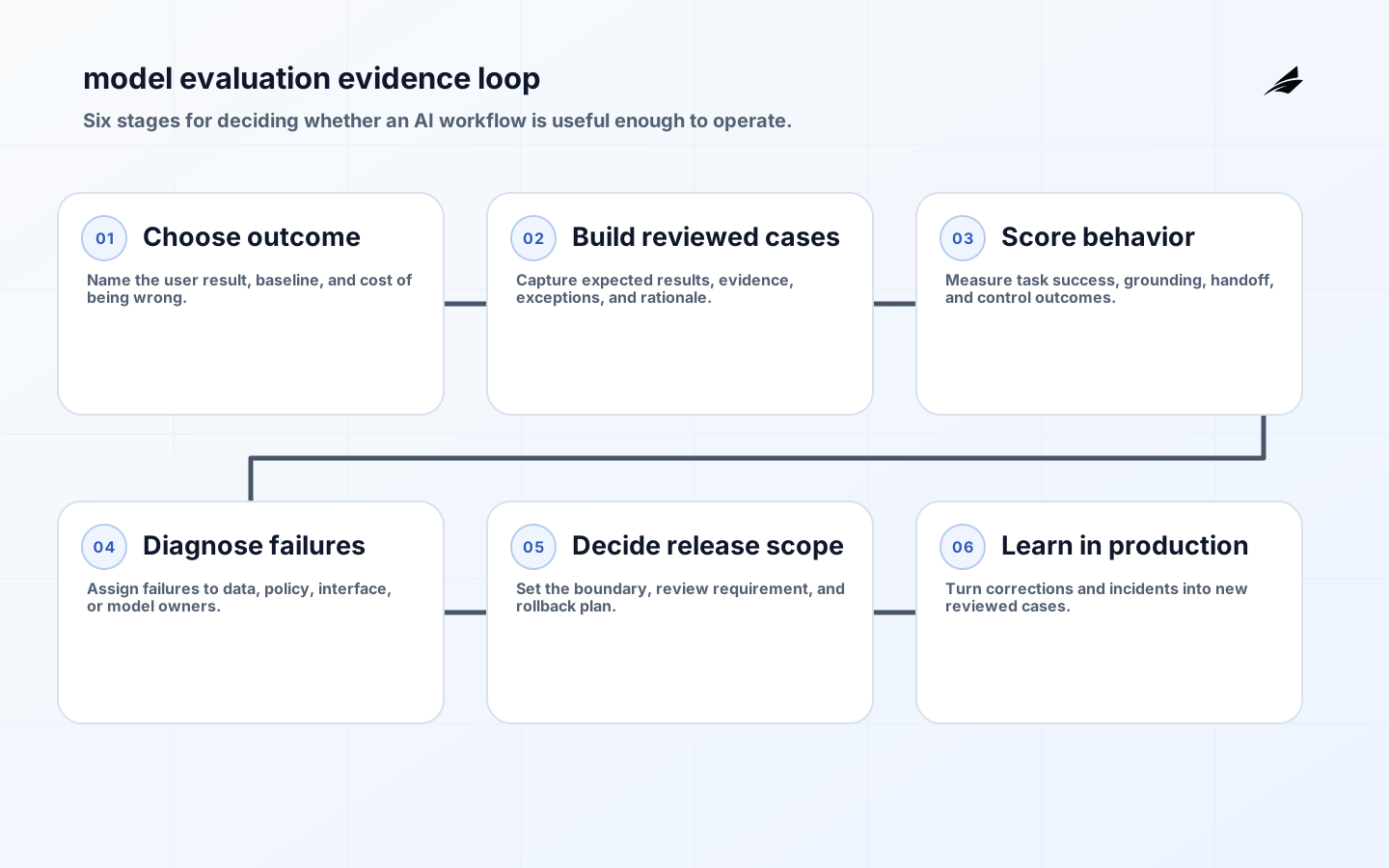
Model evaluation is the practice of checking whether an AI-enabled workflow performs the job the business actually cares about, under conditions it will actually encounter. For a founder, it is less about winning a benchmark and more about deciding whether a feature is safe and useful enough to support, sell, and improve. A high average score can conceal a costly failure: an incorrect eligibility explanation, leaked account detail, useless escalation, or a tool call that reaches the wrong record. The NIST Generative AI Profile recommends framing risks in context. Evaluation gives that framing teeth by turning promised behavior into reviewed evidence.
Choose A Business Outcome
Begin with the decision or experience that the product is trying to improve. A support assistant might aim to route requests accurately and explain the next step from approved policy. A document workflow might aim to extract a small set of fields for a reviewer. Write the baseline, the expected improvement, the user harmed by an error, and the recovery route. Avoid an objective such as “make answers better” because it makes tradeoffs impossible to discuss. Different businesses can rationally choose different thresholds: a drafting aid may tolerate an occasional stylistic miss, while a financial or access-control workflow may need an almost entirely deterministic path. Evaluation should reflect that consequence.

| Measure | Question it answers | Business use |
|---|---|---|
| Task success | Did the workflow reach the correct, useful outcome? | Shows whether the feature solves the intended job. |
| Grounded accuracy | Were factual claims supported by approved evidence? | Protects trust where the product explains policy or status. |
| Escalation quality | Did uncertain cases reach the right person with enough context? | Measures whether automation reduces or creates operational work. |
| Cost of error | Who bears the impact when the result is wrong? | Sets thresholds and tells the team where human review belongs. |
Build Reviewed Cases
Create a compact, durable set of cases from real work. Each case needs an input, relevant allowed context, expected outcome or acceptable range, failure condition, and reviewer rationale. Include ordinary cases, but concentrate on ambiguity: similar products, missing fields, stale source material, conflicting facts, requests outside the service scope, and adversarial wording. Separate a development set used to improve the system from a holdout set used to judge a release. The set does not need thousands of examples on day one. It needs enough representative cases that a team can detect whether a change improved the intended behavior or merely made a demo smoother. Link these cases to the model evaluation guide as they mature.
- Record who reviewed each case and why the expected outcome is defensible.
- Include no-answer and handoff cases, not only answerable questions.
- Keep high-consequence errors visible even when they are rare.
- Version the case set, prompt, retrieval configuration, and model together.
- Refresh examples after real incidents without deleting the stable baseline.
Score What Users Experience
Use automated checks where the answer has a clear structure or known source, then combine them with targeted human review. Schema validity, correct record selection, citation presence, and policy filters can often be checked deterministically. Subjective dimensions such as helpfulness need a rubric and examples, otherwise reviewers will grade style instead of the actual task. Do not let a model judge itself without calibration. Sample disagreements, compare them with an accountable human review, and inspect the error categories. A low overall score can be acceptable if the system safely hands off difficult cases; a high score can be unacceptable if the remaining errors affect security, money, or protected information.
Turn Failures Into Decisions
A failed case should lead to a diagnosis, not an endless request to improve the model. Was the source incomplete? Did a policy rule belong in code? Was the task ambiguous? Did the retrieval filter hide the right record? Did the interface invite the user to rely on an answer that should have been presented as a draft? Categorize failures and assign an owner. The remedy might be a better source record, a narrower scope, a validation rule, a human checkpoint, or a decision not to automate. OWASP guidance is a useful counterweight to feature pressure: security and control failures need architectural remedies, not confidence wording.
| Result | Interpretation | Founder decision |
|---|---|---|
| High task success, weak citations | The product may be useful but cannot explain critical claims. | Restrict the use case or add evidence requirements before expansion. |
| Good routine results, poor edge cases | The boundary is too broad for unattended operation. | Route defined exceptions to review and measure that handoff. |
| Improved score, higher operating cost | The gain may not justify latency or review burden. | Compare the full workflow economics, not model quality alone. |
| Regression after source update | The model may be stable while context changed. | Treat data and retrieval releases as evaluation events. |
Run Evaluation As An Operating Routine
Make evaluation part of the release process and the service review. Before a material change, run the standing cases, inspect failures, and compare against the current version. After release, monitor the real-world measures that matter: completion, override, escalation, complaint, correction, latency, and cost. Preserve privacy by limiting who can inspect inputs and by redacting where possible. A small weekly review of meaningful samples is more valuable than a dashboard nobody can tie to action. The NCSC guidance supports this operational posture: development, deployment, and monitoring all contribute to secure behavior.
Use Evaluation To Guide Investment
Founders should use evaluation results to decide where the next engineering dollar goes. If reviewers repeatedly correct the same source fact, improve the source or retrieval layer before paying for more model experimentation. If the product succeeds on the intended cases but fails whenever a customer enters an unsupported condition, narrow onboarding language and build a clean handoff. If latency causes users to abandon a useful response, investigate caching, parallelism, or workflow design before assuming a more expensive model is the answer. The evaluation report should make those alternatives visible, with error counts, consequence, and ownership rather than a single headline score.
Set decision thresholds in business language. A release might require no critical access-control failures in the reviewed set, a defined minimum rate of correct routing, and a demonstrated handoff for uncertainty. A broader rollout might require stable production correction rates over a period, not merely an impressive launch-day sample. Be prepared to decide that a task is not yet a good automation candidate. Stopping at a bounded draft assistant can be the right product choice when the evidence says that unattended completion would create more risk than value. Evaluation gives a founder permission to make that call early and with specificity.
| Evaluation review | Evidence to bring | Decision enabled |
|---|---|---|
| Scope review | Task definition, user segment, baseline, and known exclusions. | Whether the feature should expand, narrow, or remain a pilot. |
| Quality review | Case-level results, error taxonomy, and reviewer disagreements. | Which failure classes need product or engineering work. |
| Control review | Access, citation, validation, refusal, and escalation results. | Whether the operating boundary is safe for the proposed use. |
| Economics review | Latency, inference, tool, and human-review cost per completed task. | Whether the feature’s value survives production scale. |
Keep evaluation reports concise enough to influence a real decision. A founder should be able to see the release candidate, current baseline, population tested, high-consequence errors, major tradeoffs, and recommended next step. Link the summary to detailed cases for those who need to challenge the interpretation. This also helps avoid metric theater: a team cannot claim a model is improving when the task definition, source corpus, or review rubric changes at the same time without disclosure. Stable reporting makes it easier to celebrate genuine gains and to recognize when a proposed capability is simply not mature enough for the risk it would carry.
Evaluation work should be funded like the product capability it protects. Reviewers need time, examples require stewardship, and test infrastructure needs an owner. Those costs are modest compared with discovering, after a wide launch, that the team cannot explain which customer cases the system was prepared to handle.
As the product changes, preserve examples from earlier releases that represent promises already made to customers. They are valuable regression tests because a new feature can inadvertently degrade a routine behavior that has become part of daily work. Evaluation is most useful when it protects both the next ambition and the reliability users already depend on.
Share material evaluation findings with customer-facing teams before a rollout. They need accurate language for what the feature does, its known limits, and the escalation route. This prevents marketing, sales, and support from promising a level of autonomy or accuracy that the reviewed evidence does not support.
Key Takeaways
- Evaluate a business outcome and error consequence, not generic intelligence.
- Use reviewed cases that include abstentions, ambiguity, and failures.
- Combine deterministic checks with calibrated human review.
- Classify failure causes so the remedy reaches the right owner.
- Use release and production evidence to decide whether to expand scope.
Frequently Asked Questions
How many examples are enough to start? Enough to cover the main workflow, known exceptions, and the errors whose cost would change a launch decision. Quality and traceable rationale matter more than a large unreviewed pile of examples.
Can customer feedback replace formal evaluation? It is essential production evidence, but it arrives late and unevenly. Use it to enrich a reviewed set, then test future changes before customers become the only safety net.
Conclusion
Evaluation is a founder’s mechanism for trading excitement for evidence. Define the outcome, expose the costly failure modes, review representative cases, and use the results to shape scope and controls. That makes an AI feature something the business can responsibly promise, operate, and improve.