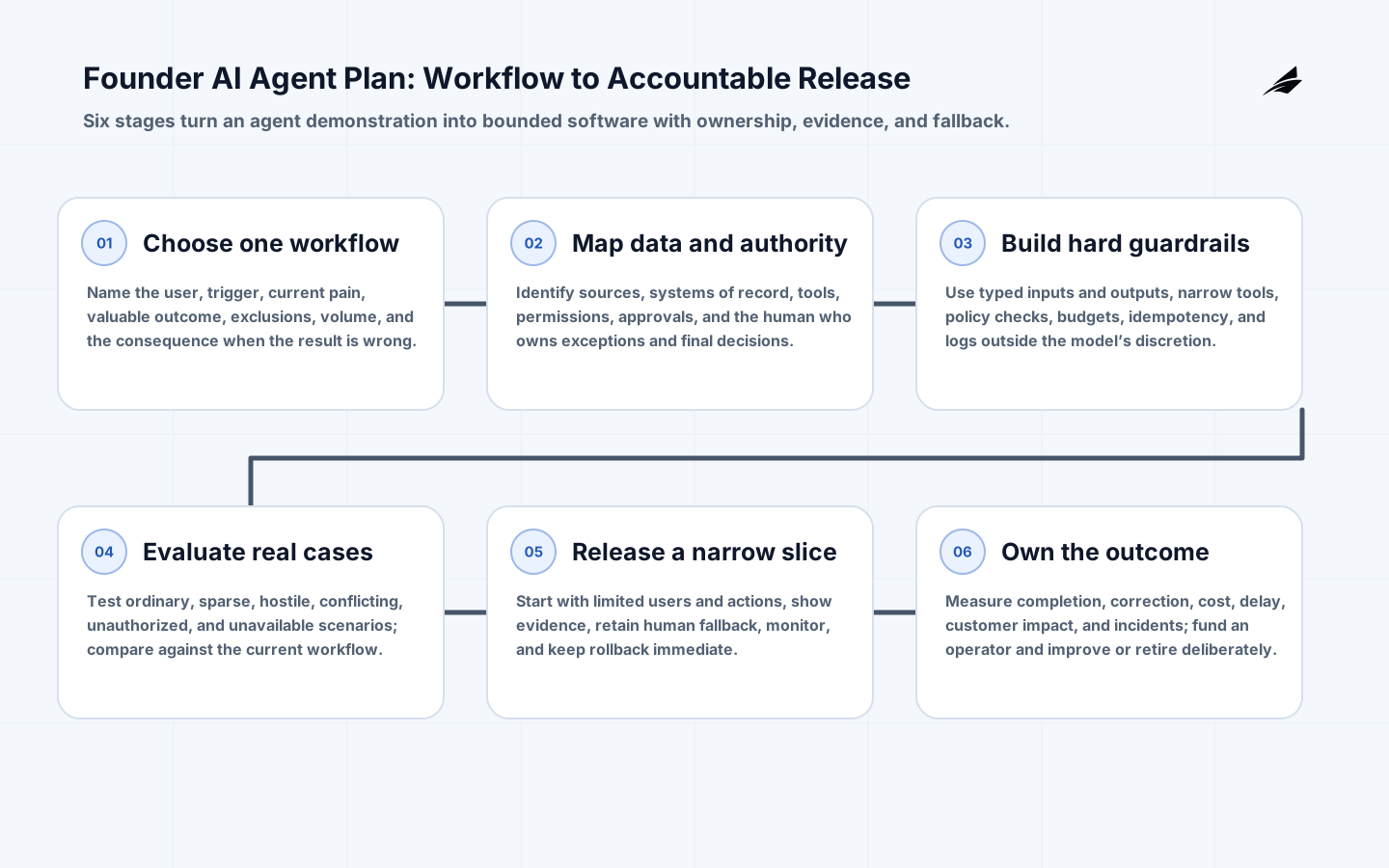
Founders should think about AI agents as software workers with a variable reasoning component, not as autonomous employees who can safely improvise across the company. An agent can interpret a request, retrieve context, choose among tools, and continue through several steps. That flexibility is valuable when the work is difficult to encode as one fixed rule, but it also creates more ways to overreach. The founder's job is to define the outcome, authority, evidence, and fallback before increasing autonomy. The UK NCSC secure AI guidance is a useful companion because it carries security thinking from design through deployment and ongoing operation.
Ask What the Agent Owns
A product idea such as "an agent for customer success" is too broad to build or govern. Rewrite it as a bounded job: gather the last three support interactions, identify the account's open issue, draft a response using approved policy, and create a review task. The job has a trigger, inputs, tools, output, owner, completion test, and stop conditions. Those details are the foundation of an AI agents architecture because they separate useful initiative from unbounded access.
Set an Authority Budget
Before launch, write an authority budget in plain language and enforce it in code. Define what the agent may read, what it may draft, what it may change, how much money or capacity it may consume, and which decisions always require a person. Authority should be granted to a particular tool call under a current identity, not to the model as a general capability. Revisit the budget when the product, data, or customer population changes.
| Capability tier | Good first boundary | Required control |
|---|---|---|
| Observe | Read a customer's approved context, search internal documentation, or inspect a queue assigned to the current team. | Tenant and role checks on every query, field minimization, and an audit record of the sources returned. |
| Prepare | Draft a reply, summarize an account, assemble a handoff, or propose a prioritized list without changing the source system. | Human-visible evidence, typed output, editable draft state, and a clear label that the work is proposed. |
| Act with confirmation | Send a low-risk message, create a task, or update a reversible field after a named reviewer confirms the exact action. | A confirmation step that displays target, parameters, impact, and identity immediately before execution. |
| Act within a rule | Perform a narrowly defined low-impact update when all deterministic preconditions pass. | Allowlist, idempotency key, rate limit, transaction log, and automatic rollback or compensating action. |
| Never delegate | Change permissions, commit legal or financial obligations, delete records, or make a decision affecting a person's rights. | Keep the decision with an authorized human or deterministic control, even when the agent can prepare the supporting material. |
This approach reflects the OWASP guidance on excessive agency: the risk grows when a model can invoke broad tools, make high-impact changes without independent verification, or inherit more privilege than the task needs. A small number of narrow functions is easier to test and easier to explain to customers than one generic tool that accepts arbitrary code or API requests. For a deeper approval boundary, see the human approval design guide.
Design the Agent as a Workflow
- Receive a request with a trace ID, authenticated subject, tenant, purpose, and time budget.
- Retrieve only the records and policy passages allowed for that subject and task; treat retrieved content as evidence, not privileged instructions.
- Plan a small next step and validate the selected tool, arguments, target, and expected side effect before calling it.
- Observe the result, check whether it matches the expected schema and state transition, and stop when the completion condition is met.
- Escalate when evidence conflicts, a required tool is unavailable, the agent exceeds a retry or spend limit, or the action crosses the approval boundary.
- Write a compact trace that supports support, security review, customer explanation, and replay without retaining unnecessary private content.
The agent loop should be surrounded by ordinary software. Use typed tool contracts, explicit state, timeouts, idempotency, authorization middleware, and transaction boundaries. The model may suggest the next step, but the application should decide whether that step exists and whether the current identity may take it. A failed call must produce a visible state such as "waiting for review" or "blocked by policy" rather than another silent attempt. The underlying mechanics are explained in how AI agents work in business workflows.
Scenario: A Founder Launches Support Triage
Consider a small SaaS company with a growing support queue. The first agent does not answer customers directly. It reads the current ticket, searches the approved help center, checks recent product incidents, labels the issue, and drafts a response with links to the supporting passages. It may create an internal escalation task, but only the support lead sends the customer message. The system blocks access to billing records unless the ticket is already linked to an authorized account context.
The founder can evaluate this pilot with a modest set of operational questions: Did the label help the right team pick up the case? Did the draft save review time without increasing correction work? Were citations current and relevant? How often did the agent loop, retrieve unrelated content, or hit a permission boundary? If the answers are positive, the next release might allow a low-risk task creation rule. It should not jump straight to sending messages or changing account state merely because the draft quality looks impressive.
Inspect Trajectories, Not Just Answers
A final answer can look correct after an unsafe path. Review the trajectory: which context was retrieved, which tool was selected, what arguments were supplied, what permissions were checked, how many retries occurred, and whether the system of record changed. Store enough metadata to reconstruct the decision without exposing secrets or retaining full customer content by default. For higher-risk actions, capture the approval event and the exact version of the policy and tool contract that governed it.

Evaluate the Product Promise
Evaluation should reflect the job customers pay you to complete. Build cases from normal requests, incomplete context, contradictory records, stale policy, unauthorized users, malicious instructions, unavailable services, and ambiguous language. Score task completion, factual support, correct refusal, permission adherence, tool-call validity, latency, cost, and human correction. A benchmark that measures only response quality will miss an agent that writes beautifully while selecting the wrong account or repeating an irreversible action.
| Signal | Founder interpretation | Decision it informs |
|---|---|---|
| Accepted outcome rate | How often the owner accepts the result with no material correction for the defined task. | Whether the workflow is solving a real problem well enough to continue the pilot. |
| Escalation quality | Whether the agent stops for the right reasons and gives a reviewer the evidence needed to proceed. | Whether autonomy can increase or the boundary, retrieval, or interface needs work. |
| Unauthorized attempt rate | How often a user, document, or model path tries to cross a permission or tool boundary. | Whether identity and policy controls are working, and whether abuse testing needs expansion. |
| Cost per completed task | Model, retrieval, tool, review, and support cost for an outcome rather than a single request. | Whether the agent improves unit economics after accounting for human oversight and failure handling. |
| Recovery age | How long blocked or failed tasks remain without an owner or customer-safe fallback. | Whether the operating team can support the feature at the promised service level. |
Protect the Trust Boundary
Assume that instructions can arrive through every input channel. A support ticket, retrieved web page, uploaded document, or email may contain text that attempts to redirect the agent. Keep system policy and user content in separate representations, mark untrusted content, restrict tool arguments, and validate output before execution. Do not let the agent decide that it has permission because a source says it is an administrator. Authorization must come from the application and the current identity.
Use the NIST Generative AI Profile to organize governance around testing, provenance, incident response, and human oversight. The RAG research also helps explain why retrieved context can improve knowledge-intensive work without making the generator authoritative. Founders should make those distinctions visible in product behavior: show sources, state uncertainty, and provide a human route when the evidence does not support the requested action.
Scale Autonomy in Deliberate Steps
| Stage | What changes | Gate to advance |
|---|---|---|
| Shadow | The agent produces recommendations while the existing team completes the work as usual. | The owner can compare recommendations with actual outcomes and classify failure modes. |
| Assist | The agent drafts or organizes work in a user-facing surface; a person accepts, edits, or rejects it. | Correction, evidence, and escalation metrics meet the agreed threshold across edge cases. |
| Constrain | The application permits a small set of reversible actions under deterministic conditions. | Authorization, idempotency, rollback, rate limits, and incident ownership are tested in production-like conditions. |
| Expand | Coverage, tools, or volume increases only for workflows with comparable evidence and risk. | The support model, unit economics, regression suite, and customer communication can absorb the new scope. |
Each stage should have a rollback that the team has actually rehearsed. A model provider change, prompt update, new connector, or policy revision can alter behavior even when the feature name stays the same. Keep a known-good configuration, make traffic or capability changes reversible, and give support staff a clear way to disable agent actions while preserving access to the underlying workflow.
Founder Launch Checklist
- Write one job with a trigger, owner, completion test, excluded cases, and fallback.
- Inventory every read, write, connector, secret, identity, and customer-visible side effect.
- Set an authority budget with explicit human-only decisions and spend, time, and retry limits.
- Define typed tool contracts, authorization checks, idempotency, state transitions, and audit fields.
- Evaluate normal, incomplete, conflicting, adversarial, unauthorized, and unavailable cases.
- Review trajectories, correction reasons, recovery age, and cost per completed task before expanding autonomy.
- Keep a tested disable path and a known-good release that support can activate without a code change.
Key takeaways
- Choose an AI-agent workflow because it has a bounded outcome, reviewable evidence, and a clear owner, not because the interface appears autonomous.
- Keep identity, authorization, schemas, budgets, approvals, and side effects in controlled application services outside the model decision.
- Evaluate complete business cases, including tool failures, conflicting records, denied actions, and recovery, before expanding permissions or volume.
- Operate the agent as a changing service with versioned components, visible traces, human escalation, rollback options, and regular outcome review.
Frequently Asked Questions
What is a sensible first agent for a startup?
Choose a repetitive coordination or drafting job with a human review point, approved data sources, and a reversible outcome. Support triage, internal research, and handoff preparation are often easier to observe than an agent that sends messages or changes financial state.
When should a founder increase autonomy?
Increase autonomy when the current boundary has stable outcome, refusal, authorization, cost, and recovery evidence across representative cases. A persuasive demo or a high average score is not enough if the failure tail remains unexplained.
What should an agent trace contain?
Record the request and identity references, retrieved source IDs, tool and argument metadata, policy decisions, retries, approvals, output destination, version identifiers, and final status. Apply retention and redaction rules so observability does not become an ungoverned copy of customer data.
Conclusion: Earn Each Increase in Autonomy
AI agents become a durable product capability when their freedom is earned through evidence. Start with a bounded job, make authority explicit, keep decisions in the right control plane, inspect the path as well as the answer, and rehearse recovery. That discipline lets a founder capture the speed of agentic software without turning an uncertain model into an invisible operator of the business.