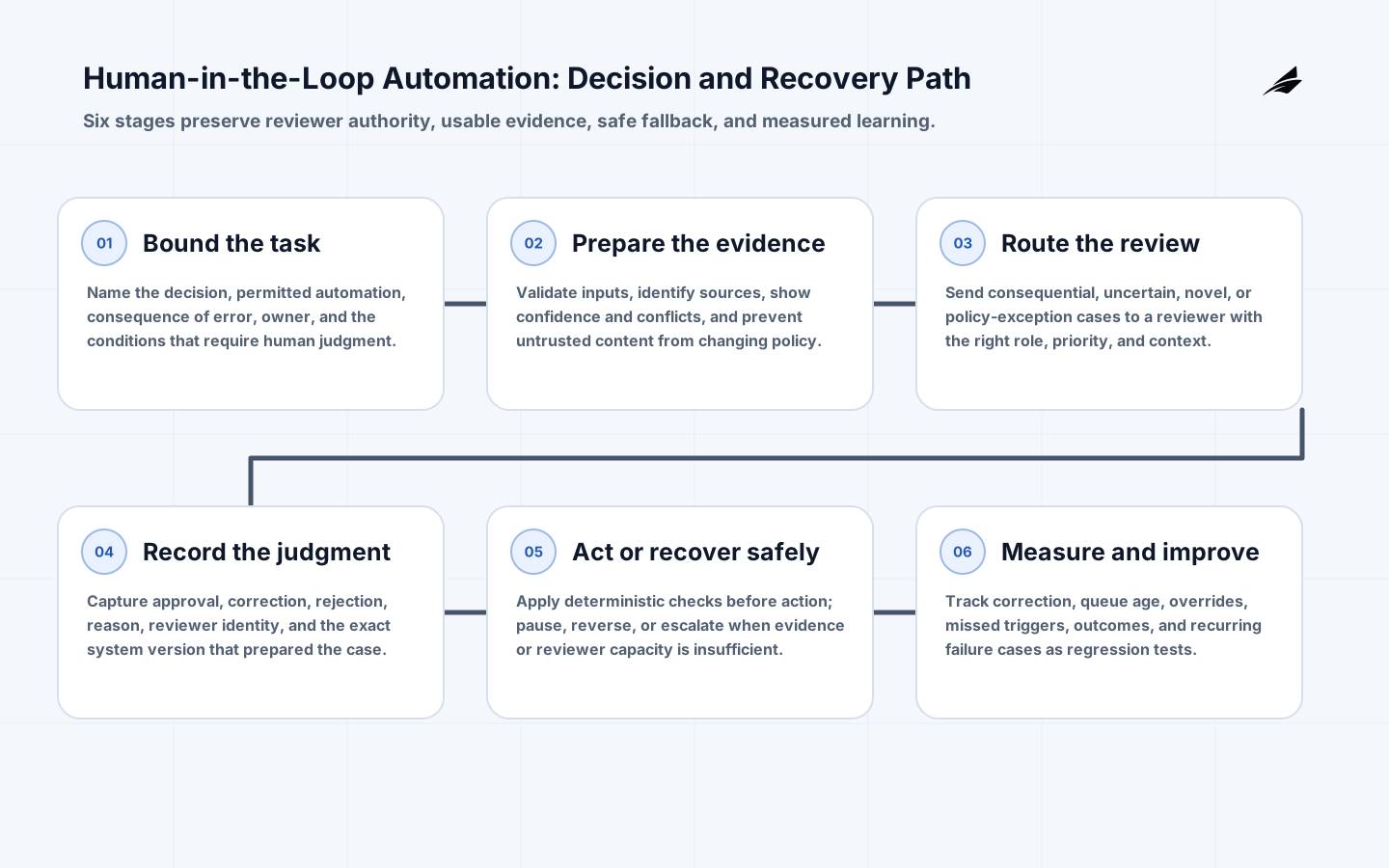
Human-In-The-Loop Automation is easiest to understand as a workflow in which software prepares, recommends, or executes bounded work while a person retains a defined decision, approval, or correction role. For IT managers, the practical question is not whether the technology can produce an impressive demonstration. It is whether it can reduce clerical effort without obscuring accountability for exceptions, consequential decisions, or changes that a person must own. That distinction changes the work: define the decision, identify the evidence and authority behind it, and decide what happens when the system is unsure. This guide explains the operating choices that make human-in-the-loop automation testable, reviewable, and useful in day-to-day work. It also separates capability from accountability, because a capable model or index does not itself establish that an outcome is permitted, current, or correct.
What Human-In-The-Loop Automation Means
A review workflow should be described in terms of the work it changes. In a credible first release, the team can point to a requester, an input, trusted records or tools, a bounded result, and a person or service that owns the final decision. The boundary for human-in-the-loop automation is a repeatable decision with clear evidence and known exception types; it is not simply placing a human at the end of an opaque system and calling the process governed. Writing that sentence early prevents a common failure: teams expanding from one useful task into a broad assistant before they can explain its evidence, permissions, or recovery path. The NIST AI RMF is a useful framing here because it treats governance, context, measurement, and management as connected activities rather than a final sign-off.
Set a Useful Boundary
| Question | Practical decision | Evidence to retain |
|---|---|---|
| Who uses it? | A named role using human-in-the-loop automation for one repeatable task. | Identity, purpose, and access decision. |
| What is in scope? | a repeatable decision with clear evidence and known exception types; it is not simply placing a human at the end of an opaque system and calling the process governed | Source or tool owner, version, and policy. |
| What is returned? | A result that helps users reduce clerical effort without obscuring accountability for exceptions, consequential decisions, or changes that a person must own. | Output, supporting evidence, and timestamp. |
| When does it stop? | Cases involving uncertainty, missing evidence, or a prohibited action. | Reason code, handoff, and disposition. |
A boundary should also name the non-goals. Human-in-the-loop automation is often proposed as a shortcut around an unresolved data problem, policy disagreement, or poorly owned workflow. It cannot settle those questions. Instead, choose a narrow case where the organization can identify a correct or acceptable outcome and has a meaningful fallback. The fallback might be a source link, a review queue, a clarification prompt, or a conventional interface. A useful fallback protects users from confident but unsupported output and gives the team examples for improvement. It is part of the product, not an embarrassment to hide.
Design the System Around Evidence
The working parts of human-in-the-loop automation are intake classification, evidence assembly, confidence or rule signals, reviewer assignment, a decision interface, escalation rules, audit history, and feedback that improves the upstream step. Each part should have an owner and a visible contract. Do not compress these responsibilities into a single prompt or service simply because the user experiences one screen. Source ownership determines what may be used; identity and authorization determine who may see or do what; application code enforces business invariants; and the model or retrieval layer provides bounded assistance. This separation keeps a bad response from becoming a bad state change. It also makes investigation possible: when an outcome is wrong, the team can tell whether the cause was data, retrieval, policy, tool execution, interface design, or model behavior.
| Layer | Decision | Operational check |
|---|---|---|
| Inputs | Accept only the records and requests required for human-in-the-loop automation. | Validate format, provenance, and access before processing. |
| Decision path | separate automation that prepares evidence from automation that commits an action; the second category requires stronger authority, reversibility, and supervision | Record configuration, policy version, and evidence used. |
| Output or action | Present a bounded result and reduce clerical effort without obscuring accountability for exceptions, consequential decisions, or changes that a person must own. | Validate schemas and enforce authority outside the model. |
| Recovery | Address automation can create automation bias, bury urgent cases in a queue, or give reviewers too little context to exercise meaningful judgment. | Route exceptions to an accountable person or service. |
The architecture needs a reliable record of what happened. Capture stable identifiers for the request, source version or tool call, configuration, policy decision, result, and final disposition. Retain only what is necessary for security and investigation, and set retention rules deliberately. A trace does not make a system safe by itself, but it lets engineers reproduce a failure rather than debate a screenshot. The UK National Cyber Security Centre's secure AI development guidance reinforces the need to carry security work from design through operation. For human-in-the-loop automation, that means reviewing dependencies, data handling, access paths, changes, and incident response as one system.
Evaluate Real Work Before Release
Evaluation for human-in-the-loop automation should begin with the work people already do, not a polished demo. Measure the complete decision path: whether the right cases reach the right reviewer, whether context is sufficient, whether reviewers can disagree, and whether corrections change later behavior Build the set with operators, support staff, or subject-matter owners who can explain why an answer, action, or escalation is appropriate. Keep a holdout portion that is not used to tune the implementation. Then test changes against the same decision rules, including cases that look superficially successful but use weak evidence. The relevant technical literature, including Human-Centered AI, can inform design choices, but local evaluation decides whether the system is fit for this particular workflow.
- Collect ordinary examples, edge cases, and cases where human-in-the-loop automation must decline or hand work back.
- Define what counts as a correct result, useful evidence, acceptable latency, and a safe failure before examining scores.
- Test permission boundaries, stale or conflicting inputs, dependency outages, and hostile or malformed content where relevant.
- Have an independent reviewer inspect a sample of outcomes, especially cases the system rates as easy.
- Version the test set, configuration, and policy so a regression can be reproduced instead of guessed.
Operate It as a Service
After release, the hard work becomes ordinary operations. The main risk is that automation can create automation bias, bury urgent cases in a queue, or give reviewers too little context to exercise meaningful judgment. Assign a product owner for the outcome, an engineering owner for the service, and a route for security or policy questions. Establish a change procedure for source material, prompts or configurations, models, tool definitions, and thresholds. Every change should have a reason, test evidence, rollout scope, and rollback option. OWASP guidance is particularly relevant when untrusted content can reach an AI component: instructions inside data, documents, or tool responses should not silently override the application's policy. Keep users informed about limitations in the moment they matter, rather than relying on a generic disclaimer.
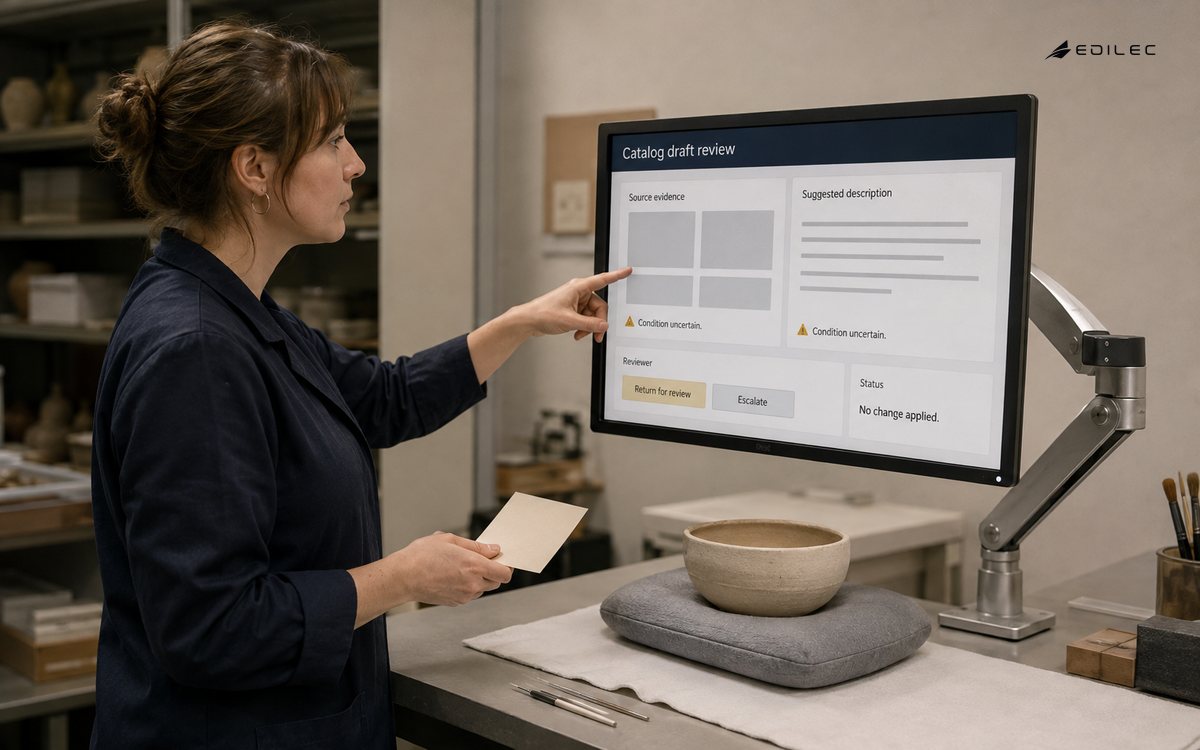
A support process should distinguish a product defect, a source-data defect, a permissions problem, and a judgment call. Those categories lead to different fixes. Give operators a way to inspect the case, suppress a harmful result, correct the source where appropriate, and communicate the resolution back to the affected user. Design the review screen around the decision, not the model output: show source evidence, policy, uncertainty, prior state, permitted actions, and an explicit reason when a reviewer overrides. This operating discipline is what lets a team expand carefully: new tasks inherit a working pattern for evidence, access, review, and recovery instead of starting from an empty page.
Measure Outcomes and Failure Modes
The most useful signals for human-in-the-loop automation are reviewer agreement, override rate, queue age, time to resolution by risk tier, missing-evidence rate, appeal or correction rate, and the share of cases safely automated. Read them together rather than celebrating one attractive number. A lower cost can conceal more manual rework; a high acceptance rate can conceal users who stop checking the system; a low refusal rate can conceal that the system answers questions it should not. Segment metrics by task type, source, user role, or input quality when that changes risk. Pair quantitative dashboards with sampled case review. The aim is not to prove that every output is perfect. It is to discover where the workflow is dependable, where it needs a better guardrail or source, and where it should not be used.
Key Takeaways
- Human-In-The-Loop Automation should solve one named operational decision before it is expanded into a platform promise.
- Evidence, access control, and final authority belong in explicit system components, not in a model instruction alone.
- Evaluate representative work and unsafe cases before release, then preserve the cases that expose real weaknesses.
- Instrument outcomes, exceptions, and recovery so the owner can improve the workflow with facts rather than anecdotes.
- Use a useful abstention or handoff path whenever the evidence, policy, or confidence is insufficient.
Frequently Asked Questions
Is human-in-the-loop automation appropriate for a first AI project? It can be, when the task is narrow, the records or tools are owned, and someone can judge the result. Start with a process where success means more than a plausible-looking response: a verified source was found, a review was completed with enough context, or a bounded action was completed under policy. Avoid using the first release to resolve uncertain data ownership or rules that leadership has not agreed. Those issues need a decision before automation can make them visible at scale.
How much human review does human-in-the-loop automation need? The answer is designed into the case tiers. A routine preparation task may only need sampled quality review, whereas an approval, customer commitment, or irreversible action needs a reviewer with the authority to decide. The reviewer must receive enough evidence to disagree intelligently: source records, the applicable policy, the proposed action, uncertainty, and a clear override control. Measure whether review changes outcomes; a queue that never changes decisions may be wasting attention or hiding a weak escalation rule.
Conclusion
Human-In-The-Loop Automation becomes valuable when it is treated as a dependable part of a real workflow rather than a standalone intelligence claim. Start with a bounded task, make source and authority visible, test normal and uncomfortable cases, and run the result with owners and evidence. That approach may feel slower than a broad launch, but it produces something teams can actually support. Once the first path earns trust through measured outcomes and recoverable failures, expansion becomes a deliberate product decision rather than a leap of faith.