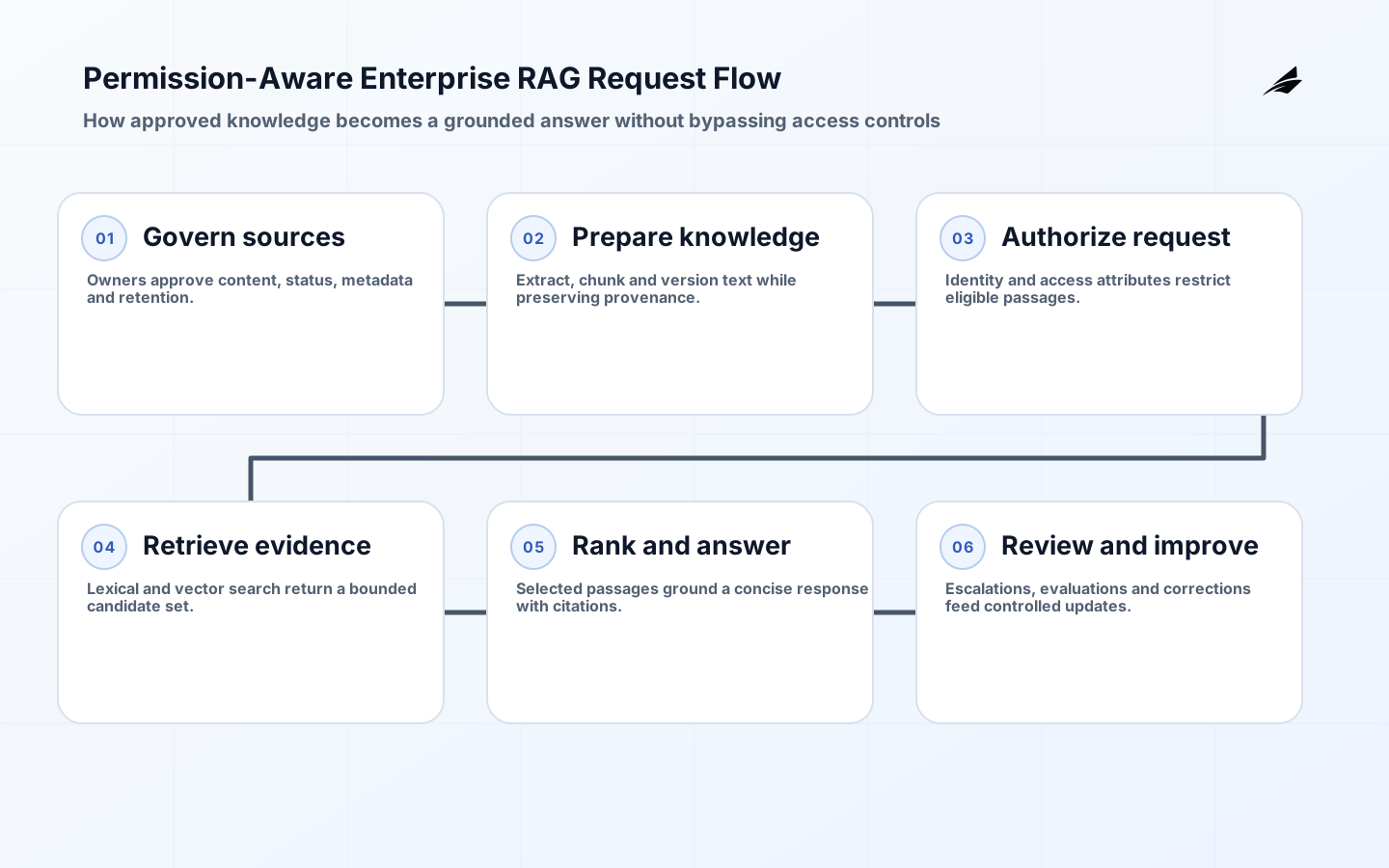
Retrieval-augmented generation, or RAG, can help employees and support teams answer questions from approved policies, product documentation, procedures and case history. Its value is not that a language model suddenly knows the company. The system searches a controlled corpus at request time, supplies selected passages to a model and asks it to answer from that evidence. This makes knowledge easier to update and provides a path to citations, but it does not make every answer correct. A production design must treat content quality, retrieval, authorization, generation and human escalation as separate controls.
What RAG does and where it fits
The original RAG research combined a model's parametric memory with retrieved external passages for knowledge-intensive tasks. In a company setting, the practical pattern is broader: ingest approved sources, divide them into retrievable units, attach metadata and permissions, create lexical and vector representations, retrieve candidates, rank them, assemble a bounded context and generate an answer with evidence references. The answer should preserve uncertainty when the corpus is incomplete or conflicting. RAG is therefore an information system with a generative interface, not merely a prompt attached to a document folder.

| Layer | Primary job | Key control |
|---|---|---|
| Source systems | Hold policies, manuals, release notes, tickets and records | Named owner and authoritative status |
| Ingestion | Extract, normalize, classify and detect changes | Versioning, validation and deletion propagation |
| Index | Store text, embeddings, metadata and access attributes | Tenant and document-level authorization |
| Retrieval | Find and rank evidence for the question | Hybrid search, filters and relevance thresholds |
| Generation | Compose a bounded answer from retrieved context | Grounding instruction, citations and refusal behavior |
| Experience | Present answers and collect corrections | Clear provenance, feedback and escalation |
| Operations | Evaluate, monitor and recover the service | Traceability, test sets, alerts and rollback |
Select use cases by consequence and knowledge readiness
Begin where the source material is reasonably complete, ownership is clear and a wrong answer can be caught before harm. Internal policy discovery, agent-assist summaries and product troubleshooting are usually easier starting points than autonomous customer commitments. A support assistant can propose an answer and cite the applicable troubleshooting guide while an agent remains responsible for sending it. A benefits assistant dealing with eligibility, by contrast, should route ambiguous or individualized cases to a qualified team rather than infer an entitlement from a nearby paragraph.
- Define the user, decision and consequence for each proposed use case.
- List the authoritative sources and the team allowed to approve each source.
- Specify actions the assistant may never take, such as changing an account or promising compensation.
- Write conditions for answering, asking a clarifying question, declining and escalating.
- Choose a measurable baseline: current search success, handling time, transfer rate or answer-review effort.
Prepare the knowledge base before tuning the model
RAG exposes the condition of the underlying knowledge estate. Duplicate procedures, expired policies and contradictory product notes will produce inconsistent answers regardless of model quality. Inventory sources and classify each as authoritative, supplementary or excluded. Record an owner, audience, effective date, review date, sensitivity, product or region and canonical URL. Preserve document versions needed for audit, but make the currently effective version unmistakable. When a source is deleted or access changes, propagate that change to text, vectors, caches and evaluation fixtures.
Chunking should follow meaning, not an arbitrary character count. Keep headings with their content, retain table labels, avoid separating a condition from its exception and include enough path metadata to reconstruct context. Small chunks can retrieve precise phrases but lose surrounding qualifications; large chunks preserve context but consume the model's context window and introduce irrelevant material. Test several strategies with real questions. For support content, a unit such as one troubleshooting step set, policy clause or product feature often gives a useful starting boundary.
| Content problem | Likely answer failure | Remediation |
|---|---|---|
| Duplicate versions | Outdated and current instructions compete | Choose a canonical record and apply effective dates |
| Missing headings | Retrieved passage lacks topic context | Preserve hierarchy in chunk metadata |
| Scanned or complex files | Extraction drops tables or warnings | Validate parsing and retain page references |
| Unowned content | Errors persist without correction | Require an accountable source owner |
| Broad permissions | Restricted facts appear in results | Carry source access attributes into retrieval |
| Slow updates | Answer cites superseded guidance | Use change detection, freshness targets and reindex alerts |
Design retrieval and answering as observable stages
Enterprise questions contain exact identifiers as well as natural-language intent. Lexical search is strong for error codes, names and distinctive phrases; vector search helps when user wording differs from the documents. Hybrid retrieval runs both and combines their candidates, after which filters and a reranker can improve ordering. Apply product, locale, date and permission filters deliberately. Do not assume that increasing the number of retrieved chunks improves answers: excessive context can bury the decisive passage and increase latency and cost.
The generation contract should tell the model which evidence it may use, how to cite it and what to do when evidence is absent or contradictory. Ask for the shortest answer that resolves the question, with steps and caveats only when supported. Each citation should point to a stable source location that the user can open and is authorized to view. Store retrieval candidates, scores, applied filters, selected chunks, model version and final output in a privacy-conscious trace so failures can be diagnosed without retaining unnecessary conversation data.
Example: an agent-assist workflow for a failed device setup
A support agent enters the device model, firmware version, region and the customer's error message. The application validates those fields and searches current manuals, known-issue notices and approved troubleshooting procedures. Exact search finds the error code while vector retrieval finds a differently worded connectivity article. Permission and region filters remove internal engineering notes and instructions for another market. The reranker places the current known-issue notice first. The model proposes three supported checks, cites the notice and manual sections, and states that replacement eligibility cannot be determined from the retrieved material. The agent reviews the answer and opens the warranty workflow separately if needed.
Evaluate the pipeline, not only the final prose
A polished response can conceal failed retrieval, while a correct passage can be turned into an unsupported conclusion. Build a representative evaluation set from real, de-identified questions, including common requests, rare terms, typos, ambiguous wording, restricted documents, outdated guidance and questions with no answer. Label relevant passages and expected answer attributes with domain experts. Measure retrieval separately from answer groundedness, completeness, citation correctness and escalation behavior. Automated graders can accelerate testing, but consequential or nuanced cases still need human review.
| Measure | Question answered | Review slice |
|---|---|---|
| Recall at k | Did retrieval include a relevant passage? | By product, locale and question type |
| Ranking quality | Were useful passages near the top? | Exact identifiers versus natural language |
| Groundedness | Are claims supported by supplied evidence? | High-consequence claims and numeric details |
| Citation correctness | Does each reference support the adjacent claim? | Tables, exceptions and multi-source answers |
| Abstention quality | Does the system decline when evidence is insufficient? | Unanswerable and conflicting-source cases |
| Authorization | Can a user retrieve only permitted content? | Roles, tenants, revoked access and shared links |
| Operational performance | Is the service usable and stable? | Tail latency, failures, indexing lag and cost |
Control the risks unique to knowledge assistants
NIST's Generative AI Profile recommends lifecycle risk management rather than relying on a single technical safeguard. For RAG, important failure modes include sensitive retrieval, poisoned or untrusted content, prompt instructions embedded in documents, overconfident synthesis, stale indexes and feedback loops that promote bad answers. Treat retrieved text as data, not trusted instructions. Separate system instructions from content, restrict tool use, identify source trust levels and require human authorization for actions with business or personal consequences.
| Risk | Preventive control | Detection or recovery |
|---|---|---|
| Unauthorized disclosure | Identity-aware filters and least-privilege indexes | Cross-role tests and access-log review |
| Stale answer | Effective dates and change-driven indexing | Freshness dashboard and source-link validation |
| Content poisoning | Approved connectors, provenance and source review | Anomaly review and index rollback |
| Embedded prompt injection | Treat content as untrusted and constrain tools | Adversarial test suite and trace review |
| Unsupported answer | Evidence-only instruction and relevance threshold | Groundedness sampling and user escalation |
| Overautomation | Keep decisions and side effects outside answer generation | Approval logs and incident review |
| Silent dependency failure | Health checks, timeouts and degraded mode | Alerts and a direct-search fallback |
A staged RAG rollout plan
- Inventory and govern: choose one bounded domain, name source owners, clean canonical documents and classify permissions.
- Build retrieval first: expose ranked passages to evaluators without generation, then tune chunking, metadata, lexical and vector retrieval against labeled questions.
- Add answer generation offline: test citations, unsupported claims, conflicting sources, prompt injection and no-answer behavior.
- Run a limited internal pilot: use agent assist or employee search, require review and capture structured correction reasons.
- Expand with gates: add audiences or sources only when authorization, freshness, relevance and support ownership meet agreed criteria.
- Operate continuously: review failed queries, incidents, content changes, model changes and evaluation results; retain a tested rollback path.
Key takeaways
- Treat RAG as a governed information system, not a prompt attached to a document folder.
- Clean, classify and assign owners to source content before tuning retrieval or generation.
- Enforce user and document permissions before evidence enters model context.
- Evaluate retrieval, groundedness, citations, abstention and operations as separate stages.
- Start with a bounded, reviewable use case and expand only through measured rollout gates.
Frequently asked questions
Does enterprise RAG require a vector database?
Not always. The requirement is reliable retrieval with metadata and authorization, not a particular product category. Some search platforms combine full-text and vector capabilities; a small, exact-term corpus may initially work well with lexical search. Select infrastructure after testing actual queries, update volume, permission needs, scale and operational constraints.
Is RAG a replacement for fine-tuning?
No. RAG supplies current external evidence at request time. Fine-tuning can change model behavior or specialize a task, but it is not the simplest way to keep changing policies or product facts current. They can be combined, though each adds evaluation and governance work.
Will citations guarantee a correct answer?
No. A citation may be irrelevant, outdated or insufficient for the claim. Evaluate whether the cited passage supports the adjacent statement and whether important qualifications were preserved. Users should be able to inspect the source.
How quickly should knowledge updates appear?
Set freshness targets by content risk. A critical safety notice may require event-driven indexing and immediate cache invalidation; a low-risk handbook page may tolerate a scheduled update. Monitor actual ingestion lag and failed deletions instead of relying on the planned schedule.
Conclusion
Useful RAG for company knowledge and support starts with governed information and ends with a measurable operating service. Build authorization into retrieval, preserve source provenance, evaluate each pipeline stage and keep high-consequence decisions under human control. A narrow deployment that reliably cites current approved evidence is a stronger foundation than a broad assistant that answers everything without knowing when to stop.