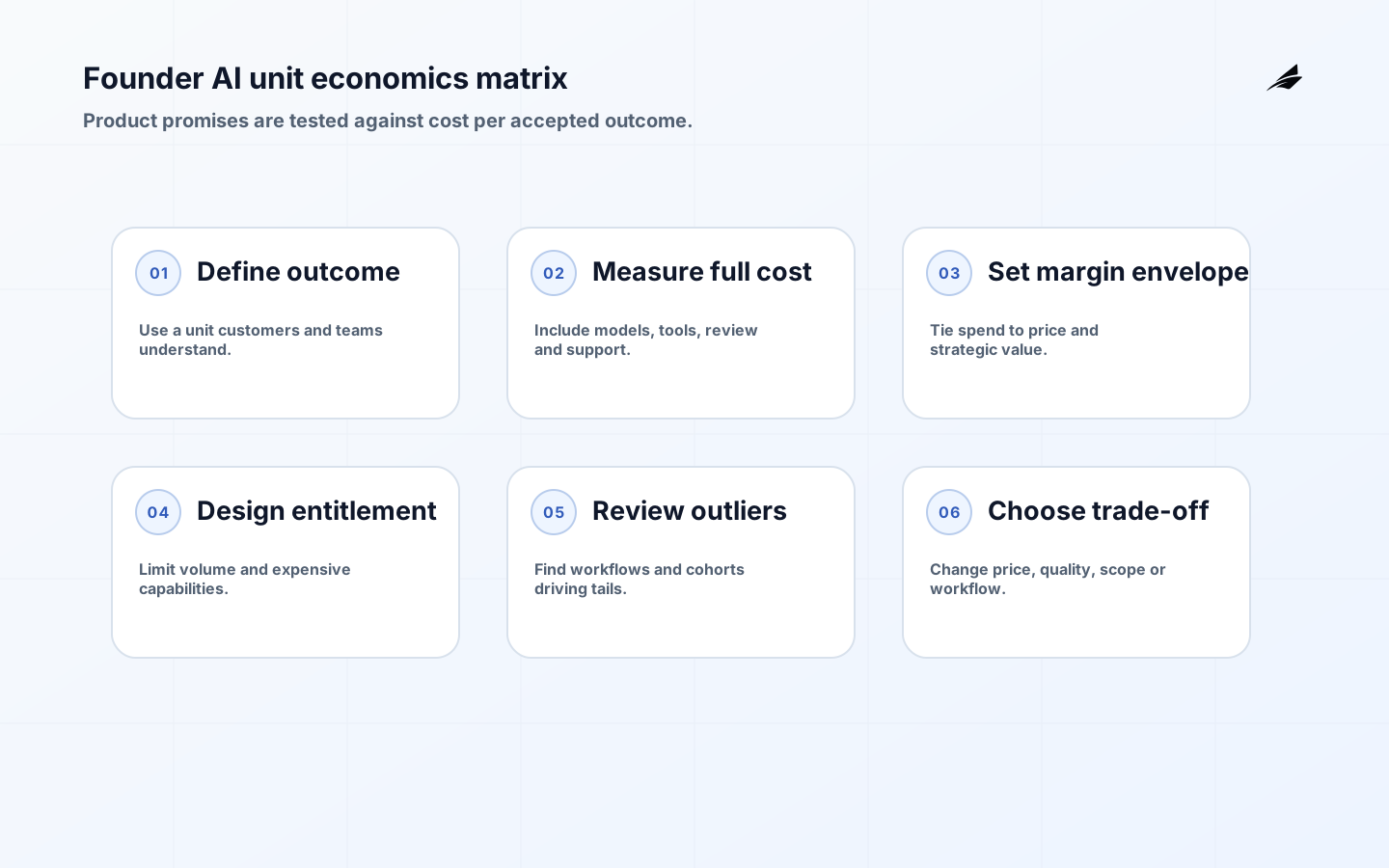
AI cost controls should be treated as an operating capability, not a feature label. The decision for a founder is which customer outcome justifies a unit of model, retrieval, storage, and human-review cost. AI cost controls are product controls. The invoice arrives by provider account, but the useful decision is made by feature, customer tier, workflow, and outcome. A cheap request that creates costly manual rework is not economical, and a more capable request may be justified when it prevents a high-cost error. The NIST Generative AI Profile frames this work as a lifecycle concern: map intended use and impacts, measure performance and risks, manage the response, and govern the responsibilities around it. That is a useful antidote to a demonstration that proves a model can produce an answer but says nothing about authority, evidence, or recovery.
Start With the AI cost controls Decision
Write the job in one sentence, then write the unacceptable outcome beside it. For AI cost controls, the operating question is not whether the technology is impressive; it is whether a named person can complete a bounded task with appropriate evidence and control. Teams often watch a monthly total without a reliable mapping from usage to product activity. That hides retry loops, oversized context, unbounded agent steps, abandoned drafts, and premium models assigned to routine work until a customer or budget owner notices too late. The NIST AI Risk Management Framework supports this discipline by connecting intended context, measurement, governance, and management rather than treating risk as a late security review. How It Managers Should Think About Fine-tuning Decisions is a useful adjacent reference, but it should not replace a local description of the decision owner and failure boundary.
| Decision element | Question to settle | Evidence to keep |
|---|---|---|
| User and outcome | Who uses AI cost controls, and what completed work changes for them? | A task definition, accountable owner, and a measurable acceptance condition. |
| Authority boundary | What may be read, drafted, proposed, submitted, or changed? | A policy rule, identity claim, approval record, and revocation path. |
| Failure response | What happens when evidence is absent, conflicting, stale, or unsafe? | A visible abstention, escalation route, and incident or correction record. |
Build an Evidence Boundary
Create a cost ledger that joins model tokens, embeddings, tool calls, storage, egress, and human review to a workflow and tenant or cost centre. Define the unit that matters: resolved case, approved document, qualified lead, or successful analyst task. This is where seemingly small implementation choices become operational commitments. A source link or event record must remain meaningful after a deployment, an employee role change, or a correction. The UK National Cyber Security Centre guidance emphasizes secure design, development, deployment, and operation as connected activities. Use that lifecycle view to assign an owner to the inputs, the policy, and the response when AI cost controls behaves unexpectedly.
- Name the source systems, people, and decisions that AI cost controls depend on; do not bury them in configuration alone.
- Classify information and actions by consequence, then choose controls that operate at the boundary where the consequence occurs.
- Keep an inspectable record of the input, material context, policy result, and output or side effect for cases that matter.
- Design a correction path that can remove or repair a bad record and tell an operator what work may have been affected.
- Practice the uncertain case. A system that can only handle happy-path inputs has not yet earned autonomy.
Put Controls Where They Can Enforce
Set default model and context budgets, maximum tool steps, concurrency limits, cache rules, and feature-level spending alerts. Make an intentional, logged path for a higher-cost model or longer context. A hard stop is appropriate when a runaway workflow could create material cost. The OWASP guidance for LLM applications is particularly relevant when untrusted content can influence model behaviour or tool use: controls need to survive hostile and malformed inputs, not merely ordinary requests. For AI cost controls, prefer deterministic enforcement for identity, limits, destinations, schemas, and approvals. A model can help interpret context; it should not be the final authority for a rule that a service can verify directly.
| Control layer | What it protects | Practical test |
|---|---|---|
| Identity and access | The requester, source, and action scope. | Change membership or role and confirm the prohibited result remains unavailable. |
| Data and context | Currency, completeness, and permitted use of evidence. | Inject an obsolete, conflicting, or incomplete record and verify the response routes appropriately. |
| Action and recovery | Side effects, spend, external calls, and correction. | Force a validation failure or denied approval and confirm the state is safe and observable. |
Measure the Work, Not Just Uptime
Track cost per completed outcome, success and escalation rate, input versus output tokens, cache hit rate, retries, tool calls per task, and cost distribution by customer tier. Use the FOCUS specification to make cost data easier to compare across providers, then add product identifiers the standard cannot know. Keep a small, versioned evaluation set close to the workflow and add real failures after review. Distinguish service availability from decision quality: a system can have low latency and still provide the wrong evidence or trigger costly rework. Review results with the people who understand the task, then turn recurring failure patterns into a test, a source repair, a product change, or a tighter boundary.
Release in Bounded Steps
Instrument before broad launch. Run representative workload tests, publish expected unit ranges, and decide which degradation is acceptable: shorter context, deferred work, human handoff, or a lower-cost model for low-risk tasks. Define a rollback condition before release, including who can disable the capability and how a human completes the work during recovery. Small launches are valuable when they are instrumented and reviewed; they are not a license to skip permissions, source checks, or error handling. Record the decision to expand with the same care as the initial decision to use AI cost controls.
Operate AI cost controls as a Living Service
Cost review works best when it is tied to product decisions people can actually make. Examine unusually expensive tasks alongside their completion and escalation outcomes, then decide whether to change the prompt, retrieval policy, model tier, caching rule, or customer entitlement. Review both tail consumption and median consumption: a small number of looping requests can dominate spend even when most tasks are efficient. Make pricing and service-level choices visible to product, finance, and engineering so a budget response does not quietly degrade a critical customer workflow. Forecast from workload drivers rather than a single month of invoices, and update assumptions after major feature or provider changes. The point of AI cost controls is not to suppress useful usage; it is to choose where higher cost produces enough customer or risk value to be intentional.
Keep Review Evidence Actionable
Review limits against customer commitments before tightening them. A lower cap may be sensible for exploratory work but unacceptable for a contracted compliance workflow; the service policy should make that difference explicit before a runtime limit discovers it accidentally.
Assign Accountable Owners
Give a product owner responsibility for the unit metric and an engineering owner responsibility for its instrumentation. Finance can challenge assumptions, but it should not be asked to infer a workflow from provider line items. This division makes cost review productive: the team can see which product choice changed consumption and decide whether the customer outcome still justifies it.
Choose an economic envelope before product pricing
Founders should begin AI cost controls with the business unit customers understand: a resolved support case, reviewed document, completed workflow or active account. Model and infrastructure bills matter, but a product becomes governable only when spend is connected to that unit and to revenue or strategic value. Build a simple contribution view that includes model tokens, retrieval, tool calls, storage, retries, observability, human review and support. Segment by plan, feature and customer cohort. Averages alone hide the small group of workflows that can consume most of the margin.

| Founder decision | Metric to review | Action when the envelope breaks |
|---|---|---|
| Price the feature | AI cost per billable outcome and gross margin after service work | Change entitlement, price, workflow or included volume |
| Choose default quality | Incremental success per incremental unit cost | Use the higher-cost path only where outcome value justifies it |
| Offer unlimited use | Tail distribution and abuse-resistant fair-use threshold | Add transparent limits or queued processing |
| Fund optimization | Monthly spend by top workflow and expected savings | Prioritize changes with measurable payback, not cosmetic token cuts |
The FinOps Framework emphasizes collaboration between engineering, finance and business teams; its cost data is useful only when product leaders can act on it. The AWS Cost Optimization Pillar similarly frames cost as a continuing design discipline. Hold a monthly portfolio review that includes gross-margin risk, quality, latency, customer adoption and concentration. Edilec’s guides to model evaluation, tool calling and the engineering implementation of AI cost controls provide the technical counterpart. A founder should approve the economic envelope and customer promise; engineering should decide how to meet it without silently degrading safety or usefulness.
Key Takeaways
- AI cost controls earns trust through a defined job and a named decision owner.
- Evidence, identity, and action boundaries must be explicit before a wider launch.
- Controls are strongest when enforced by deterministic services at the point of consequence.
- Evaluation should include difficult, absent, stale, and adversarial cases, not only successful examples.
- Expansion is a governed operating decision supported by outcomes, not a reward for a polished demo.
Frequently Asked Questions
Lowering the model price is not a complete cost strategy. The durable lever is a bounded workflow whose usage can be tied to a customer outcome and changed deliberately when the outcome does not justify the spend. The practical next step is to select one workflow, write its evidence and authority boundaries, and create a small set of cases a domain reviewer can judge. That produces much more useful learning than a broad rollout with no shared definition of success.
Conclusion
AI cost controls becomes dependable when its operating constraints are visible: what it is for, what information it may use, what it may do, who can intervene, and how the organisation knows it is improving. Start with the consequential decision, preserve the evidence around it, and make uncertainty a safe state rather than something the system hides.