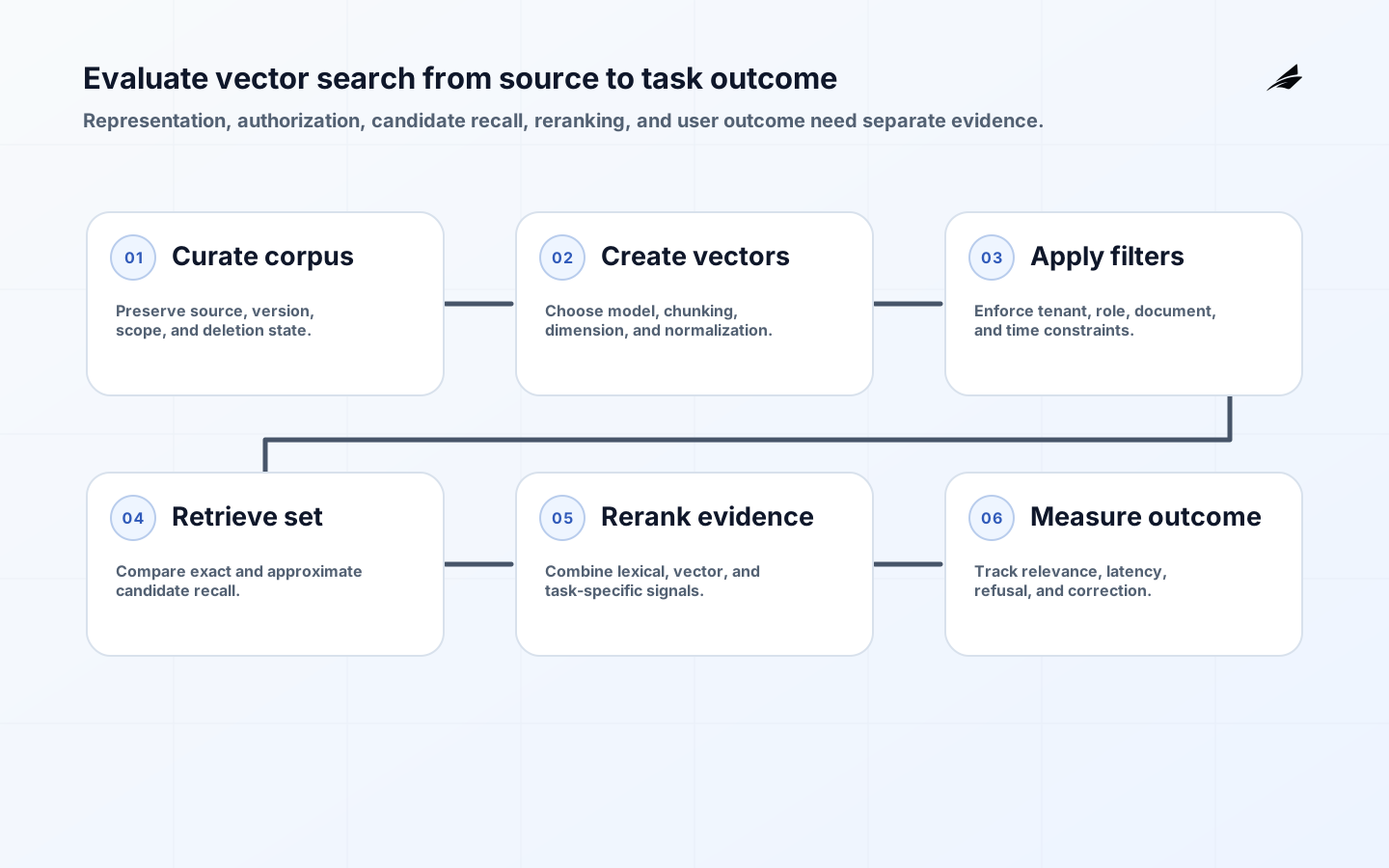
Vector search finds items whose numerical representations are close under a chosen distance function. For AI automation, that can surface semantically related policies, cases, products, or messages even when the query and source use different words. The database is only one part of the result. Representation model, chunking, metadata, access filtering, distance metric, approximate index, reranking, and the task's definition of relevance all affect what reaches the user or model. A good design begins with judged examples and a permission boundary, then measures the speed–recall trade-off against exact search. “Top five nearest vectors” is an implementation result, not evidence that the correct, current, and authorized material was retrieved.
Design the representation around the source and task
Choose the unit to embed with care. A full document can blur several topics; a tiny fragment can lose the exception that changes meaning. Preserve parent document, section, title, date, source type, language, and access attributes so returned items can be interpreted and filtered. Version the embedding model and chunking method; either change may alter results even if the content has not changed. Normalize or pre-process content only when you can explain the consequence, especially for tables, code, identifiers, and multilingual text. Test queries from real users rather than inventing only neat paraphrases. The best representation is the one that supports a meaningful decision with inspectable source context.
| Design choice | Benefit | Trade-off to test |
|---|---|---|
| Smaller passages | More precise local matches. | May lose qualifying context. |
| Larger passages | More context for a reader or generator. | May dilute similarity and raise cost. |
| Metadata filters | Enforce scope and enable exact constraints. | Incomplete metadata can hide valid records. |
| Hybrid lexical search | Handles names, codes, and quoted terms. | Requires combined ranking evaluation. |
Filter by authority and access before ranking
Similarity is not authorization. Apply tenant, role, document state, retention, and policy filters before results are used in an answer or workflow. Keep the filter attributes synchronized with the underlying records and test behavior when a user changes role or a source is withdrawn. Use business rules to exclude obsolete or low-authority material where appropriate. A nearest-neighbor score is a relative signal within a candidate set, not proof that the returned passage is correct. Show the source and relevant date so the user can judge it. Semantic search offers the operational framing for this user-facing decision.
Evaluate relevance with task judgments
Create a query set from real tasks and label which sources are sufficient, helpful, misleading, restricted, or stale. Measure whether useful evidence appears at the depth a user will actually inspect, and segment results by query type, language, source, user role, and importance. Compare vector-only retrieval with lexical and hybrid baselines; exact terms often matter in operations even when semantic matching is valuable. Review confusing near matches, not only outright misses, because they can produce confident but wrong downstream explanations. Test index updates, deletes, permission changes, and model upgrades against the same set. A quality metric without representative query judgment is merely a property of the index, not evidence of user value.

| Operational signal | What it can expose | Action |
|---|---|---|
| Judged relevance at top results | Ranking fit for the task. | Adjust representation, filters, or hybrid strategy. |
| Stale-result rate | Index or source lifecycle delay. | Trace event time and refresh path. |
| Permission denial anomaly | Broken access synchronization. | Audit attributes and role-change tests. |
| Query reformulation | Vocabulary or discovery gap. | Review intent and add governed synonyms or metadata. |
Operate indexes as changing data products
An index needs source ownership, ingestion monitoring, capacity planning, backup or rebuild strategy, access review, and deletion handling. Watch index lag, failed parses, vector count changes, search latency, and query patterns without keeping more sensitive query data than necessary. Plan how to rebuild after changing embeddings or chunking, and whether old and new indexes must run in parallel for comparison. Keep an exit path: source documents and metadata should remain usable if a chosen vector service changes. Retrieval pipelines covers the wider lifecycle; vector search inherits every weakness in the sources it represents.
Introduce vector search with a measurable fallback
Run a side-by-side pilot with the existing search or manual process. Ask users whether the returned sources were sufficient, current, and easy to verify, then investigate the cases where they were not. Define a manual or lexical fallback for sensitive searches and make the handoff visible rather than silently dropping results. Set release thresholds for access tests, representative relevance, latency, and freshness. When vector search feeds RAG systems, keep evidence citations and abstention rules intact; a faster candidate search does not justify a weaker answer policy.
Benchmark exact, approximate, filtered, and hybrid retrieval separately
The Sentence-BERT paper is an important reference for sentence-level representations and similarity search. Current pgvector documentation distinguishes exact search from approximate HNSW and IVFFlat indexes and recommends monitoring approximate recall against exact results. Security must be designed around retrieval: OWASP's current LLM guidance identifies vector and embedding weaknesses alongside prompt injection and sensitive-information risk. The NIST Generative AI Profile supports lifecycle measurement and governance, while W3C PROV provides a model for keeping source and transformation history attributable.
| Benchmark path | What it reveals | Release question |
|---|---|---|
| Exact vector | Representation quality without ANN loss | Are relevant items close under this metric? |
| Approximate vector | Speed-recall effect of index settings | Is lost recall acceptable at target latency? |
| Filtered vector | Interaction between retrieval and metadata scope | Do real roles and tenants receive enough valid results? |
| Hybrid plus rerank | Value of lexical evidence and second-stage scoring | Does the full pipeline improve task success? |
Build a judged query set with relevant items, hard negatives, vocabulary shifts, short and long questions, multilingual cases where applicable, and queries that should return nothing. Run exact vector search as a reference before tuning an approximate index. Measure recall at the candidate depth used by downstream reranking, not only top-one accuracy. Then add metadata filters that match real authorization and business scope; filtering after approximate candidate selection can reduce the number of valid results, so test selective roles and tenants explicitly. Compare lexical, vector, and hybrid retrieval for identifiers, names, error codes, and policy language. Record p50 and tail latency, index size, build time, ingest lag, and recall by query class. Re-run after model, dimension, normalization, index parameter, or corpus changes.
Related implementation guidance
Read Edilec's semantic search guide for task framing, the retrieval pipeline guide for source lifecycle, and the embeddings guide before locking a representation into a production index.
Implementation checks
| Operating check | Concrete practice | Why it matters |
|---|---|---|
| Embedding unit | Choose passages that preserve the qualifiers needed for the task. | Similarity results can be read in meaningful context. |
| Metadata filter | Synchronize role, tenant, date, source status, and retention attributes. | Nearest matches remain within policy scope. |
| Hybrid baseline | Compare semantic retrieval with lexical and metadata search for real queries. | Exact names and identifiers are not lost. |
| Index version | Record embedding model, chunking, normalization, and build time. | Ranking changes are attributable and reversible. |
| Query set | Maintain judged tasks with relevant, misleading, stale, and restricted examples. | Evaluation reflects the work users actually do. |
| Deletion test | Verify withdrawn or changed records disappear on the required schedule. | The index does not retain unofficial truth. |
| Capacity plan | Monitor index lag, latency, rebuild duration, and storage growth. | Scale decisions follow evidence instead of surprise bills. |
| Fallback design | Offer lexical search or human escalation for sensitive misses. | A weak similarity result never becomes the final authority. |
Representation choices should be documented in language a product and operations team can review. Explain what was embedded, what metadata filters apply, what kinds of query benefit from semantic similarity, and where exact or hybrid retrieval remains necessary. This makes it possible to spot a mismatch between the technology and the work. For example, a search for a part number or contract clause may need lexical precision, while a search for a recurring issue may benefit from concept matching. A system that exposes this distinction is easier to tune and easier for users to trust.
When an embedding model is upgraded, treat it like a data migration. Compare old and new results on retained query judgments, measure rebuild time and index size, test deletions and permissions, and decide how users will experience any behavior change. Keep the previous index or a clear rollback plan until the new representation has passed the relevant task slices. This discipline prevents a seemingly technical upgrade from quietly changing what evidence operators see during a consequential workflow.
Vector search quality can drift even without an embedding-model change. New documents, vocabulary shifts, source duplication, and changing query patterns alter the candidate space over time. Schedule evaluation against retained task queries and inspect the results when source collections grow or a new connector is added. Use the findings to adjust metadata, parsing, chunk size, or hybrid ranking before altering the representation blindly. This operating cadence helps the team distinguish a true semantic-retrieval problem from a source-governance or product-discovery problem.
Document those reviews so a later operator can explain whether a result changed because of content, index policy, or representation.
Key takeaways
- Choose embedding units that preserve enough source context for the task.
- Version chunking and embedding choices because both change results.
- Apply authority, retention, and permission filters before using similarity.
- Compare vector, lexical, and hybrid retrieval against real task judgments.
- Operate the index with refresh, deletion, access, and rebuild ownership.
- Keep a verifiable source and a fallback route for sensitive decisions.
Frequently asked questions
Is vector search better than keyword search? It is better for some vocabulary-mismatch tasks, while keyword search is often essential for names, codes, and exact phrases; hybrid evaluation should decide. Does a vector database secure the documents? No. Authorization and metadata synchronization are application responsibilities. How often should embeddings be regenerated? When source content changes according to its refresh policy or when a versioned representation change is evaluated and approved.
Conclusion
Vector search can make conceptually related material easier to find, but it becomes useful in AI automation only when it is governed by source context, access policy, evaluation, and operational ownership. Treat similarity as evidence to inspect, not an answer by itself.