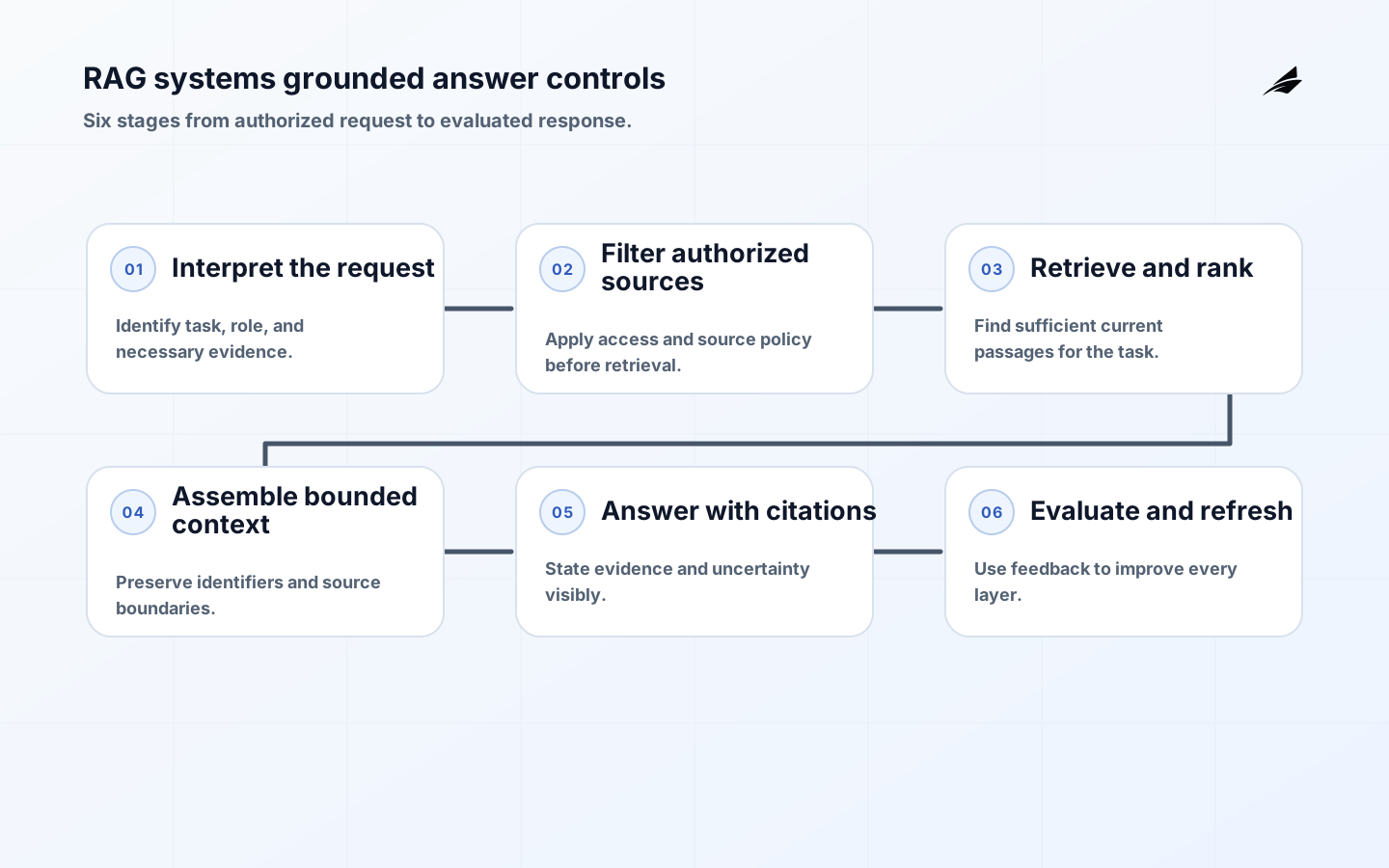
What Changes When RAG Systems Move into Production is useful only when it improves a real operating decision, not when it adds an impressive interface around an uncertain process. For CTOs, the practical question is answering a user request from authorized, current evidence while making the boundary of that evidence visible. Start with the work owner, the permitted inputs, the decision that may follow, and the harm that a wrong result could cause. In this setting, RAG systems are a capability inside a system of records, people, and controls. The NIST AI Risk Management Framework provides a helpful discipline: govern the use case, map context and impacts, measure performance, and manage what the evidence shows. That framing keeps design choices tied to accountable work rather than vendor vocabulary.
Set a decision boundary for RAG systems
Write down the decision before selecting a model, index, or automation platform. The service should support answering a user request from authorized, current evidence while making the boundary of that evidence visible; it should not quietly become a substitute for the accountable owner. Its input contract needs user identity, task intent, approved corpus, access attributes, source currency, retrieval query, context budget, and answer policy. Its durable evidence should be an answer record connecting the user request, applicable permissions, retrieved passages, context assembly, answer version, citations, and evaluation judgement. Be explicit about showing fluent prose that appears grounded even though its citations are stale, insufficient, unrelated, or unavailable to the requester. That failure statement is productive because it tells engineers what to test and tells operators when to stop. A bounded contract also makes it possible to decide where assistance ends: the system may prepare, retrieve, classify, or propose, while policy interpretation, customer commitment, or another material act remains with the authorized role.

| Boundary question | Practical answer | Evidence to retain |
|---|---|---|
| What decision is supported? | answering a user request from authorized, current evidence while making the boundary of that evidence visible | Named workflow, owner, and consequence level. |
| What enters the service? | user identity, task intent, approved corpus, access attributes, source currency, retrieval query, context budget, and answer policy | Input schema, permissions, and data provenance. |
| What must not happen? | showing fluent prose that appears grounded even though its citations are stale, insufficient, unrelated, or unavailable to the requester | Negative tests and escalation rule. |
| What proves a result? | an answer record connecting the user request, applicable permissions, retrieved passages, context assembly, answer version, citations, and evaluation judgement | Traceable outcome and review record. |
Design RAG systems as an evidence-bearing service
The architecture should make the important boundaries visible. For this use case, separate source governance and retrieval evaluation from answer generation; require the service to cite inspectable passages and permit it to decline when evidence is inadequate. Give each step an owner and a version: source or input policy, transformation, model or retrieval configuration, action policy, and evaluation set. Keep the identifiers that allow a reviewer to reconstruct a result later. A system that cannot say which records, rules, or tool calls influenced an outcome is difficult to improve safely. This is also where product teams should distinguish a capability from an authority. An interface can suggest the next move; the surrounding service must determine whether the move is permitted, whether the evidence is sufficient, and what receipt is needed after it occurs.
Put controls where the work actually changes state
Controls are most useful at the moment information is exposed, a tool is invoked, a queue is routed, or a record changes. For RAG systems, filter content before retrieval, preserve source and chunk identifiers, test prompt-injection resistance in retrieved material, limit context to relevant evidence, and log unsupported-answer signals. Do not rely on a conversational instruction as the last line of defense. Rules that protect identities, data scope, credentials, schemas, budgets, and irreversible actions belong in systems that can enforce them independently of generated text. The NIST Generative AI Profile describes risks that span confabulation, information integrity, privacy, and human-AI configuration; the practical response is to make each relevant boundary testable and owned. For threats involving untrusted content or tool use, the OWASP LLM guidance is a useful companion.
| Control point | Failure it addresses | Operational check |
|---|---|---|
| Identity and scope | An authorized-looking request exceeds its purpose. | Test role, tenant, and purpose changes. |
| Evidence or context | Weak or stale material shapes a result. | Sample source lineage and freshness. |
| Action boundary | A suggestion becomes an unapproved side effect. | Validate server-side policy and receipt. |
| Recovery path | A defect persists because nobody can stop it. | Exercise pause, rollback, and escalation. |
Evaluate RAG systems with decisions, not demos
Build a small evaluation set from privacy-reviewed, representative work. Include ordinary cases, difficult terminology, incomplete evidence, changing permissions, stale inputs, and cases that should be declined or escalated. The key measures are citation entailment, passage sufficiency, answer completeness, permission correctness, source freshness, abstention quality, and incident response time. Review by meaningful slices, such as user role, source family, request consequence, language, or modality; a strong average can hide the exact failure that matters to a small operational group. Separate component measures from outcome measures. A fluent response, a short latency, or a high similarity score does not prove that the underlying decision was supported correctly. Record reviewer judgements and turn confirmed misses into versioned regression tests.
Pilot in a workflow that can teach the team
A credible first release is a single question class with a governed corpus, known authority boundaries, and subject-matter reviewers who can judge evidence rather than style. Preserve the existing route while the team observes what changes. Define entry criteria, an accountable on-call or support owner, success and stop conditions, and the recovery route before inviting more users. Ask participants to label outcomes as useful, incomplete, inaccessible, unsafe, or too slow, then inspect the trace behind those labels. retrieval pipeline design offers a related operating pattern worth aligning before adding more scope. Resist rollout metrics that count only activity. The stronger signal is whether the service reduced time to a defensible next step without moving hidden effort or risk elsewhere.
Operate RAG systems as a changing system
Production conditions move: source owners revise records, permissions change, users discover edge cases, model providers update behavior, and demand shifts across workflows. Assign routines for change review, access testing, evaluation refresh, incident handling, and capacity planning. Citation entailment, passage sufficiency, answer completeness, permission correctness, source freshness, abstention quality, and incident response time should appear in an operational review alongside qualitative samples; numbers without traces cannot explain a regression. The Secure Software Development Framework is relevant here because it treats secure practice as a lifecycle responsibility, including responding to vulnerabilities and preserving integrity in released systems. A change to inputs, configuration, tools, or data should trigger proportionate re-evaluation, not an assumption that a prior demonstration still represents today’s service.
Judge RAG citations for entailment and access
A production RAG test should ask whether a cited passage actually supports the answer, not simply whether a citation is present. Reviewers should label passages as sufficient, partial, contradictory, stale, or inaccessible to the requester. Include questions whose correct response is a refusal because the corpus does not contain enough authority. Test prompt injection and instruction-like text embedded in documents separately from normal relevance tests; retrieved material is data, not an instruction channel. When an answer combines several sources, make the source boundaries visible enough that a reader can trace each material claim. This approach helps teams find whether a failure belongs to corpus governance, retrieval, context assembly, answer generation, or the presentation layer.
Implementation checks for RAG systems
- Name the specific decision and accountable owner before expanding RAG systems to adjacent work.
- Version the inputs, configuration, policies, and evidence required to reconstruct a result.
- Test the negative path: showing fluent prose that appears grounded even though its citations are stale, insufficient, unrelated, or unavailable to the requester.
- Make human authority, automated authority, and prohibited actions distinguishable in the workflow.
- Measure citation entailment, passage sufficiency, answer completeness, permission correctness, source freshness, abstention quality, and incident response time on realistic cases and retain examples behind material metrics.
- Exercise pause, escalation, and recovery before a broad production release.
Key takeaways
- RAG systems should be scoped to an accountable decision, not a vague ambition to automate knowledge work.
- The durable output is an answer record connecting the user request, applicable permissions, retrieved passages, context assembly, answer version, citations, and evaluation judgement.
- Server-side access, action, and recovery controls matter more than a prompt-only promise.
- Evaluate difficult cases, abstentions, and user-role differences alongside ordinary success.
- Pilot a reversible workflow, then expand only when evidence supports the next boundary.
Frequently asked questions
Does RAG systems require full automation? No. Assistance can be valuable when it prepares evidence, prioritizes work, or proposes a bounded next step while an authorized person remains responsible for material decisions. What should be measured first? Start with the outcome that the named workflow needs, then inspect evidence quality, access or policy correctness, and the cost or delay of recovering from a miss. When should the service abstain? It should abstain or escalate whenever the required evidence, authority, permission, or confidence boundary is not met. A clear non-result is often safer and more useful than a polished but unsupported answer.
Conclusion
RAG systems becomes dependable through disciplined boundaries: a named decision, accountable owner, inspectable evidence, enforceable controls, and ongoing evaluation. Build those conditions into the workflow first. The technology can then improve a real task without obscuring who owns the result or how the service should recover when the evidence is not good enough.