RAG systems for AI automation join a user request with retrieved evidence before a model produces an answer or proposed action. The retrieval step can improve freshness and provenance, but it does not make an answer true, authorized or safe. A production design must govern which sources enter the index, preserve document and permission lineage, retrieve evidence for the current user and task, evaluate whether claims are supported, and route consequential outcomes through deterministic controls.
Build the surrounding system with Edilec's retrieval pipeline guide, semantic search guide and AI agent architecture guide. These components become one service only when identity, evidence and action authority remain connected.
Design RAG as a system of evidence
The core path includes source registration, ingestion and parsing, metadata and access enforcement, retrieval, ranking, context assembly, generation, citation, and evaluation. Keep source identifiers and passage boundaries throughout so a user can open the material behind a claim. Retrieve only what the current role may access and use the minimum context necessary for the task. A generation component should be instructed to distinguish evidence from uncertainty, but presentation and policy controls must not depend on an instruction alone. When no sufficient source is available, provide a safe alternative such as a direct search result, a request for clarification, or a review route. Retrieval pipelines explains the source lifecycle beneath this path.
| Layer | Responsibility | Evidence of health |
|---|---|---|
| Sources | Authority, currency, and ownership. | Inventory, refresh record, and retirement rule. |
| Retrieval | Find authorized relevant passages. | Judged query results and access tests. |
| Generation | State supported answer and limits. | Citation coverage and sampled grounding review. |
| Workflow | Route action to the right authority. | Approval trace, exception, and recovery record. |
Govern sources as carefully as prompts
A useful RAG corpus is smaller than an organization’s entire content estate. Include records with clear ownership, permitted audience, useful structure, and a defined update path. Preserve titles, dates, version, access attributes, and source links. Keep historical material distinct from current policy so a user can understand why it was retrieved. Deleted or restricted content must be removed or made inaccessible on a defined schedule. Prompt changes cannot repair a stale or contradictory corpus. If an answer changes because a source changed, the trace should show that plainly. The semantic search guide provides the search quality and permission questions that apply before generation begins.
Measure grounding, relevance, and task outcome separately
Build evaluations from real workflow questions with expected evidence, including cases that should abstain. First test whether the retrieval layer finds enough authorized, current context. Then test whether the response faithfully reflects that context, cites it correctly, respects formatting and policy, and helps the user complete the task. Finally, measure outcome: did the response reduce rework, improve decision quality, or shorten a supported process? Segment results by user role, source type, language, complexity, and impact. A single “answer quality” score cannot reveal which part needs improvement. Keep examples where the system gave a good answer for the wrong reason; those are early warnings that grounding is fragile.
| Observed issue | Likely layer | First response |
|---|---|---|
| No relevant citation | Source or retrieval. | Check coverage, query reformulation, and metadata. |
| Citation does not support claim | Context assembly or generation. | Constrain claim format and evaluate grounding. |
| Different users see same restricted fact | Access enforcement. | Repair policy filter before further rollout. |
| Correct answer arrives too slowly | Architecture or workflow. | Measure retrieval, generation, and tool latency separately. |
Protect RAG from untrusted context and overreach
Retrieved documents can contain deceptive instructions or sensitive facts. Keep system policy and tool authority separate from retrieved content, validate all tool inputs, and apply permissions before context assembly. Do not give a response component direct access to broad administrative tools merely because it can cite records. Log policy decisions and source identifiers needed for investigation while minimizing sensitive text retention. Test indirect prompt injection, content withdrawal, role changes, and malformed sources. OWASP describes several LLM-specific risks, but the practical defense is architectural: untrusted content informs a response; it does not redefine the workflow’s authority.
Release RAG with clear limits and feedback
Pilot a narrow set of users and sources, retain a manual fallback, and collect feedback tied to the evidence path: missing source, stale source, irrelevant retrieval, unsupported claim, permission issue, or unclear presentation. Version sources, index, retrieval configuration, model, prompt, and evaluations with each release. Monitor no-answer rate, citation coverage, correction effort, freshness lag, latency, and escalation. Expand source access only after tests prove that the existing policy boundary holds. AI agents should consume RAG output as evidence, not treat it as permission to execute an action.
Implementation checks
| Operating check | Concrete practice | Why it matters |
|---|---|---|
| Corpus boundary | Admit only sources with owner, audience, update path, and access metadata. | Grounding begins with a governed evidence set. |
| Retrieval test | Judge whether sufficient authorized evidence appears at useful depth. | Generation is not blamed for a search failure. |
| Context assembly | Keep passage boundaries and source identifiers beside each context item. | Claims can be traced to inspectable evidence. |
| Answer policy | Require clear citations, bounded claims, and safe abstention behavior. | Fluency cannot substitute for support. |
| Role test | Exercise permissions before and after user, source, or policy changes. | Restricted facts cannot influence a response. |
| Injection defense | Treat retrieved text as untrusted data and validate all tool inputs. | Content cannot override system or workflow authority. |
| Feedback code | Classify reports as source, retrieval, grounding, access, or presentation issues. | Fixes target the appropriate layer. |
| Release trace | Version corpus, index, retrieval, model, prompt, and evaluation together. | Changed behavior can be explained to users and operators. |
A RAG response needs an evidence policy that users can learn. Decide whether every material statement must cite a passage, whether citations need dates, how the interface handles conflicting sources, and what the system says when an answer is inferred rather than stated. Apply the same policy across channels so a user does not receive a more confident answer in a chat surface than in a case-management screen. This consistency is especially important when the response is copied into another record, where a lost citation can turn a tentative summary into an unsupported fact.
Review source gaps as signals about the business process. Repeated unanswered questions may show that a policy is inaccessible, a product team has not documented a change, or a support workflow has no authoritative owner. Do not solve every gap by adding more documents to the index. Sometimes the correct fix is a clearer process, a structured field in the system of record, or a named escalation path. That approach keeps RAG grounded in the organization’s actual operating model instead of becoming a substitute for it.
Grounding reviews should include cases where sources disagree. Rather than forcing a single confident answer, define how the system presents the conflict, names the applicable date or authority, and routes the question when no source can resolve it. This is especially important during policy changes, migrations, and customer exceptions. A transparent conflict response can be more useful than an apparently seamless summary because it tells the user what remains to be decided. It also prevents a ranking preference from quietly becoming a business policy.
Keep a named owner for conflict rules, because source ranking should never quietly become the organization’s final policy decision.
Design a RAG evidence lifecycle
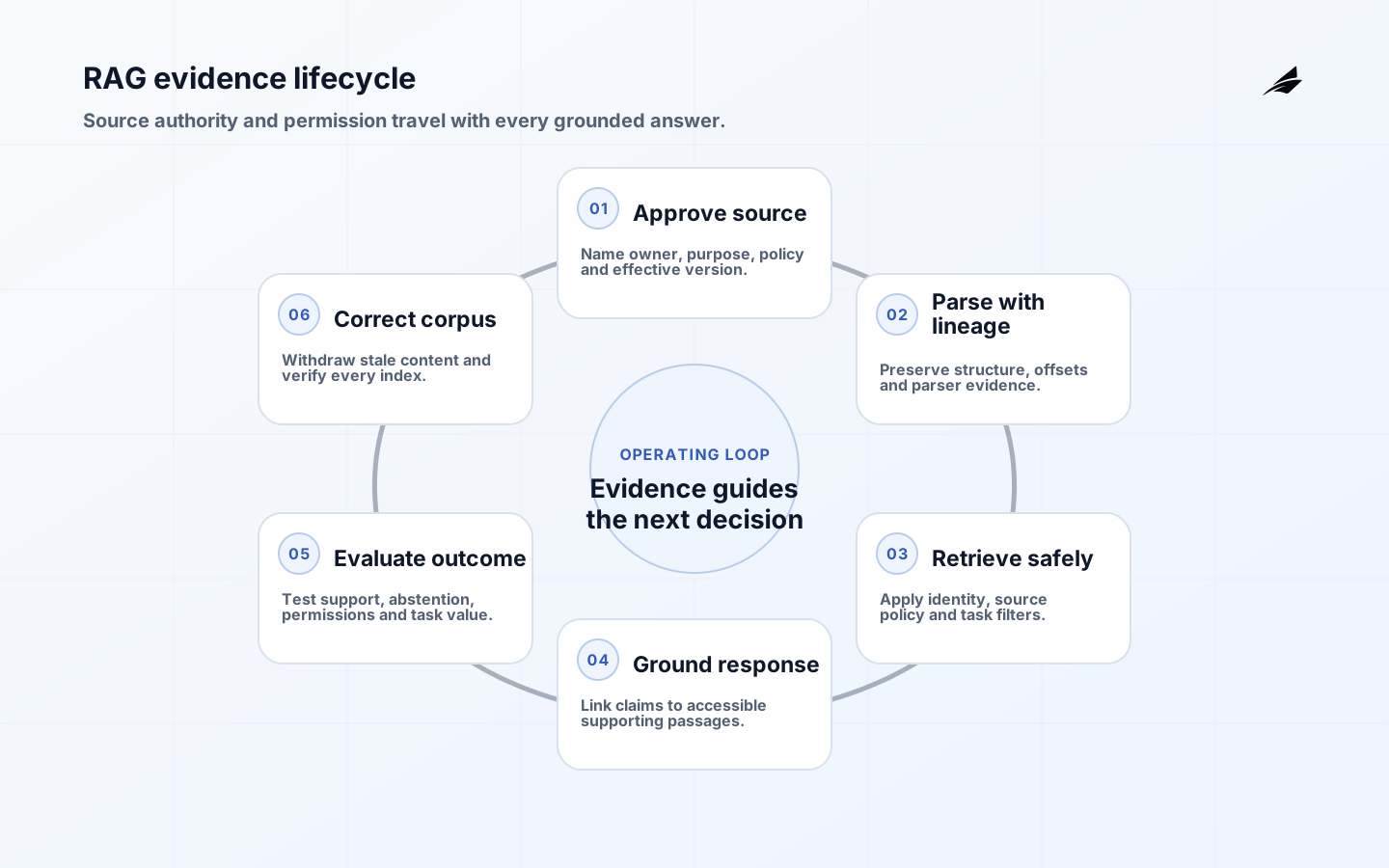
Give every indexed unit a durable record: source identifier, owner, version, effective period, classification, access policy, parser version, chunk boundaries and withdrawal state. Retrieval should evaluate current user and source permissions before content reaches the model. Preserve the selected passages and versions with the run so a reviewer can reproduce what the system saw. Citations must point to usable evidence rather than a home page or a document the user cannot open.

| RAG stage | Primary failure | Evidence to retain |
|---|---|---|
| Source approval | Unowned, stale or prohibited content enters the corpus | Owner, purpose, policy and effective version |
| Parsing and chunking | Tables, headings or relationships lose meaning | Parser version, offsets and structural metadata |
| Retrieval | Relevant evidence is missed or unauthorized text is exposed | Query, filters, ranks and permission result |
| Generation | Claims exceed or contradict retrieved evidence | Prompt, model, passages and claim-support result |
| Action or handoff | A plausible answer triggers excessive authority | Tool proposal, policy decision and human disposition |
| Correction | Removed content remains searchable or cached | Withdrawal event, index verification and affected runs |
The original RAG paper combined parametric and retrieved non-parametric memory for knowledge-intensive tasks, while Dense Passage Retrieval demonstrated learned retrieval for open-domain question answering. Production teams still need context-specific controls. The NIST Generative AI Profile frames risks and actions across the AI lifecycle, and the OWASP guidance for LLM and generative AI covers prompt injection, sensitive disclosure and excessive agency.
Evaluate each stage and the complete task. Measure retrieval recall on answerable cases, precision or noise, permission correctness, citation usability, claim support, appropriate abstention, handoff quality, latency and cost per successful outcome. Include conflicting, stale, multilingual, scanned and malicious documents. Keep a fixed holdout set and a sampled production-review process. A model can produce a well-written answer despite failed retrieval, and a high retrieval score can still support an unsafe action; release gates must inspect both.
Key takeaways
- Build RAG around authorized evidence for one workflow, not a generic answer box.
- Preserve source identity, version, context, and access metadata through the system.
- Evaluate retrieval, grounding, and outcome as separate properties.
- Make citations directly inspectable where a user needs to rely on a claim.
- Treat retrieved content as untrusted data that cannot grant tool authority.
- Version the corpus and configuration so changed answers can be explained.
Frequently asked questions
Does RAG eliminate hallucinations? No. It can provide evidence, but retrieval can fail and generation can still overstate or misread context. Can RAG use one source of truth? Yes, and it is often a strong starting point; add sources only when ownership and evaluation remain clear. When should RAG abstain? When authorized evidence is missing, insufficient, contradictory, or too stale for the stated decision.
Conclusion
RAG systems are reliable when they preserve an honest path from question to authorized evidence to accountable action. Govern the corpus, evaluate the complete chain, and make uncertainty visible wherever the evidence cannot carry the decision.