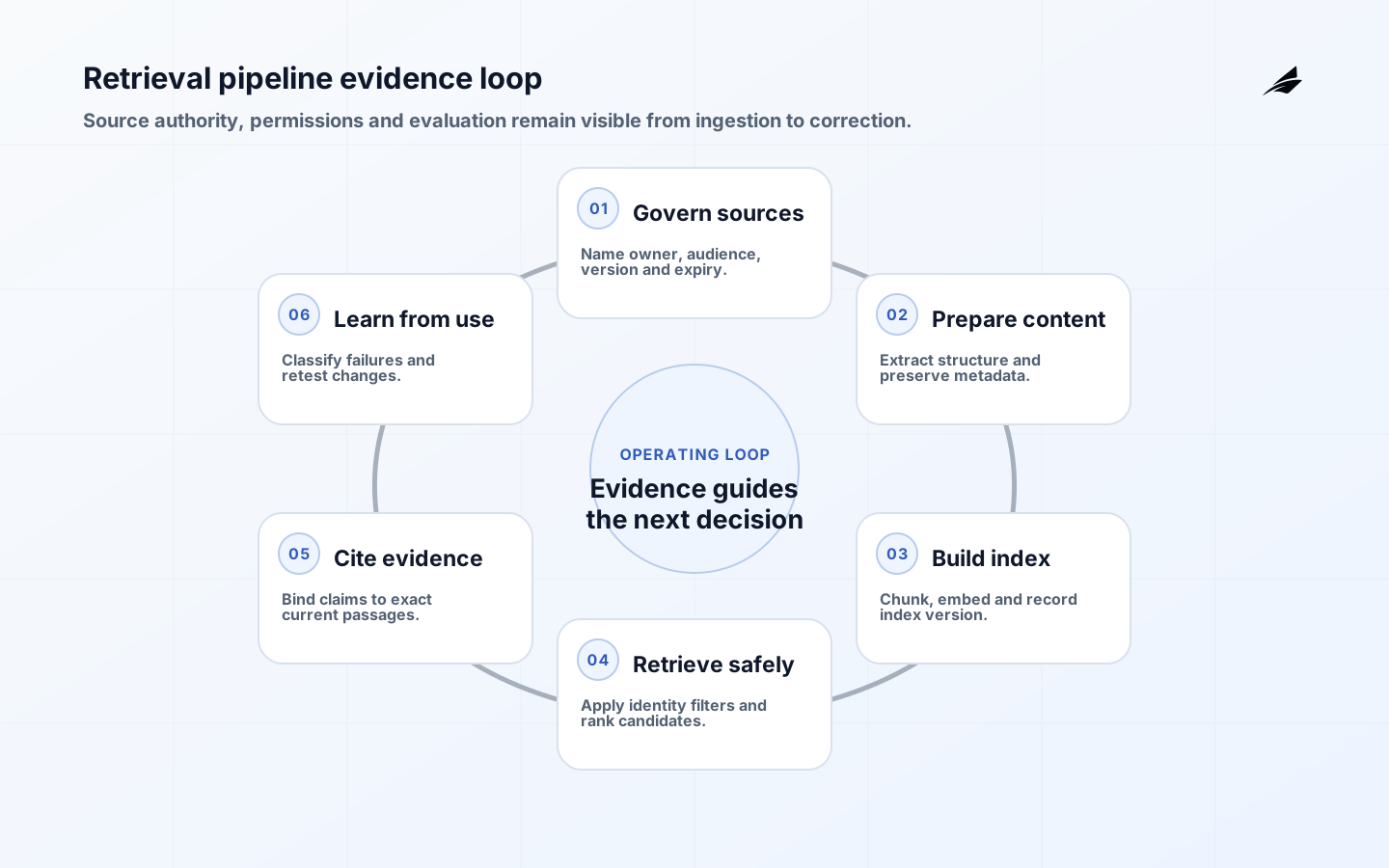
Retrieval pipelines decide which evidence an AI application can see before it generates an answer. For founders, that makes retrieval a product and operations capability rather than a vector-database feature. The pipeline must discover approved sources, preserve ownership and permissions, extract useful content, create searchable units, retrieve candidates, rank them for the actual question and present citations a user can inspect. It also needs a change path when documents expire, access changes or evaluation reveals a blind spot. A weak retrieval layer can make a strong model confidently answer from stale or unauthorized context; a well-run layer makes quality, provenance and cost visible enough to improve.
For connected implementation decisions, see How Operations Leaders Should Think About Semantic Search, RAG Systems for AI Automation, Vector Search for AI Automation, and How CTOs Should Think About Fine-Tuning Decisions. These guides are most useful when their controls are adapted to the same records, owners and consequences rather than applied as independent checklists.
Define retrieval as a measurable service
The original RAG paper combines parametric generation with retrieved non-parametric memory, while Dense Passage Retrieval demonstrates learned dense retrieval for open-domain questions. Production teams still need a local source contract: collection owner, allowed audience, document identity, effective date, deletion behavior, extraction method and refresh objective. The OpenAI retrieval guide illustrates vector stores, semantic search and attribute filters; treat those capabilities as components inside your authorization and evidence design, not as substitutes for it.
Risk follows the whole pipeline. The NIST Generative AI Profile recommends lifecycle governance, measurement and management, and the OWASP GenAI Top 10 identifies prompt injection plus vector and embedding weaknesses that can affect retrieved context. Record source and chunk identifiers, ranking scores, filters and final citations with a privacy-aware trace. OpenTelemetry semantic conventions offer common naming principles, but raw prompts and retrieved passages may contain sensitive content, so telemetry needs deliberate redaction and retention.
Start with a source contract
For each source, name its business owner, intended audience, authority level, update mechanism, retention rule, and access policy. Record whether it is a primary record, a supporting explanation, or historical context. This avoids a common failure in which an old slide deck outranks a current policy because it happened to be easier to parse. Preserve structural context such as document title, section, date, version, and parent record so a retrieved fragment can be interpreted honestly. Do not index material simply because it is available; private notes, expired documents, and unaudited exports create both trust and security debt. The source contract gives the team an explicit way to add, change, suspend, or retire content.
| Pipeline stage | Decision to make | Failure to test |
|---|---|---|
| Ingestion | How changes are detected and attributed. | A revised source remains stale. |
| Parsing | Which structure and metadata are preserved. | A fragment loses its qualification. |
| Indexing | How access and retention metadata travel. | Restricted content becomes retrievable. |
| Serving | How sources and uncertainty are shown. | A fluent answer hides weak evidence. |
Make each transformation inspectable
A practical architecture separates raw source storage from parsed representations, indexable passages, query processing, ranking, and presentation. Keep stable identifiers linking each stage so an operator can trace a result backwards. Chunking, embeddings, and reranking should be versioned because a change can alter what users see without any source content changing. Combine semantic similarity with lexical, metadata, and business-rule filters where the task requires exact terminology, dates, product names, or permission scope. Cache carefully: a fast answer based on a withdrawn policy is a failure. The semantic search guide covers the user-facing retrieval decisions that make this architecture valuable.
Evaluate retrieval before evaluating prose
Create a representative set of questions with known source passages and expected abstentions. Include vocabulary mismatch, long documents, near-duplicates, contradictory records, access differences, and recently updated material. Judge whether the right evidence appears near the top, whether enough surrounding context travels with it, and whether the user can verify the provenance. Only then assess any generated response built on the results. This separation stops a helpful-sounding response from masking an irrelevant or unauthorized retrieval. Track results by source type and user task, because a ranking improvement for general questions can worsen exact policy lookup. Retain the evaluation set as a product asset and update it when sources or workflow change.
| Metric | Question it answers | Caution |
|---|---|---|
| Recall at a reviewed depth | Did the needed evidence appear? | Judge relevance to the decision, not word overlap. |
| Citation correctness | Can a user inspect the support? | A citation can be real yet insufficient. |
| Freshness lag | How long until changes are reflected? | Measure source event time separately from ingestion time. |
| Abstention quality | Did the system avoid unsupported answers? | Do not reward blanket refusal. |
Protect the pipeline from its own inputs
Retrieved text can be untrusted even when it comes from an approved repository. A document may contain instructions intended for a reader but inappropriate for a model or tool. Treat content as data, isolate it from system instructions, constrain tools, and apply access policy before it reaches a generation step. Log retrieval identifiers and policy decisions rather than indiscriminately retaining all content. Review connector permissions, service accounts, and administrative paths as carefully as the visible search interface. OWASP highlights indirect prompt injection and data disclosure as distinct risks; a retrieval pipeline needs controls for both, plus a clear response when a source is compromised or withdrawn.
Fund the operating work, not just the prototype
Budget for connector maintenance, parsing failures, source ownership, access reviews, evaluation, indexing volume, and support, alongside model or vector costs. A low-cost demonstration often relies on a static and unusually clean corpus; live organizations have changed permissions, documents with broken structure, and records that must be removed quickly. Set service objectives for freshness and availability that match the decision consequence. Prefer a smaller corpus with clear ownership over a huge, ungoverned one. Vector search is an enabling component, but it does not remove the cost of knowing what should be searched.
Implementation checks
| Operating check | Concrete practice | Why it matters |
|---|---|---|
| Source onboarding | Register business owner, authority, audience, rights, and retention rule. | The corpus has a defensible boundary. |
| Parser validation | Compare extracted structure with a representative original document. | Tables, headings, and qualifications are not silently lost. |
| Metadata contract | Require stable identifiers, timestamps, access attributes, and source type. | Ranking and policy remain explainable. |
| Connector health | Monitor failures, delays, schema changes, and removed documents. | Stale or partial ingestion is discovered early. |
| Evaluation sample | Maintain task questions with sufficient evidence and expected abstentions. | Changes are tested outside a demonstration corpus. |
| Security test | Test malicious instructions, restricted sources, and connector overreach. | Untrusted content cannot redefine service authority. |
| Support path | Give users a source-correction route and operators a source-disable control. | Bad content can be contained without disabling the whole product. |
| Cost review | Measure maintenance, parsing, indexing, and ownership alongside inference spend. | Founders fund the actual operating capability. |
Founders should agree on the support promise before opening a retrieval service to every employee or customer. Decide who investigates a stale result, who approves a new connector, and how long a source owner has to respond to a correction. Make those expectations visible in the source contract and product support flow. Without them, a useful pilot can become a collection of untracked requests for new material, each carrying unknown rights and maintenance cost. The team can then prioritize sources by demonstrated task value instead of by whoever has the loudest request.
Data quality work should be planned as product work. Broken heading structure, missing dates, duplicated documents, and ambiguous ownership all affect retrieval more directly than a small change in similarity tuning. Build dashboards that show source age, parse failures, unlinked fragments, and collections with no owner. Review those indicators with the people who maintain the records. When the source estate is repaired, the benefits often extend beyond AI: employees can find policy, audit history, and operational guidance more reliably through every channel.
Retrieval reliability also depends on change communication. A source owner who publishes a critical update should know whether it will be indexed immediately, on a scheduled run, or only after manual review. Make that service level explicit and provide an emergency path for documents that must be removed or corrected quickly. Connect the source inventory to the incident process so a team can identify where a disputed statement was used. This creates discipline around freshness without asking every author to understand the retrieval implementation, and it keeps the organization from discovering a stale corpus only after a customer-impacting error.
Diagnose a policy answer that cites the wrong region
Suppose a support assistant answers a leave-policy question for an employee in India using a globally worded section from a United States handbook. The model followed the retrieved context, so prompt tuning will not repair the root problem. The trace should reveal the query, user attributes available for authorization, candidate documents, region metadata, ranking scores and cited chunks. Investigation may show that the ingestion job discarded jurisdiction metadata, a global document received a higher semantic score, or the employee’s region was never applied as a filter.

The correction belongs in the retrieval contract and evaluation set. Restore authoritative region and effective-date attributes, reindex affected documents, require a filter or ranking rule that respects applicability, and add questions where global and local policies conflict. Test not only whether the right document appears in the top results but whether restricted documents remain absent and citations resolve to the exact current passage. Re-run the standing set before release, then monitor abstentions, citation opens, reviewer corrections and no-result queries. That evidence tells a founder whether the system is becoming more useful or merely more fluent.
| Retrieval stage | Failure to test | Evidence to retain |
|---|---|---|
| Source intake | Unapproved, stale or duplicate document | Source owner, version and effective date |
| Extraction | Lost headings, tables or metadata | Parser version and extraction sample |
| Indexing | Wrong chunk boundary or missing entitlement | Chunk ID, attributes and index version |
| Retrieval | Relevant but inapplicable result outranks authority | Query, filters, candidates and scores |
| Answer | Claim lacks exact supporting passage | Citation, passage and reviewer outcome |
Key takeaways
- Register source authority, audience, version, refresh, and retention before indexing.
- Preserve identifiers and context through every transformation.
- Evaluate retrieved evidence separately from generated wording.
- Apply permission and content-safety controls before a result reaches a model or user.
- Measure freshness and abstention quality, not only top-line relevance.
- Budget for source operations and connector ownership after launch.
Frequently asked questions
Is a vector database the retrieval pipeline? No. It is one storage and similarity component; ownership, ingestion, policy, ranking, evaluation, and presentation remain necessary. Can a pipeline use public web content? It can, but source rights, quality, change rate, and citation behavior need explicit treatment. What should happen when no good source is found? The service should say so, offer a permitted alternative, and record the miss for source or query review.
Conclusion
A retrieval pipeline becomes a business capability when its sources are owned, its transformations are traceable, and its answers remain tied to evidence. Start narrow, make changes inspectable, and test the hard cases before inviting broader reliance.