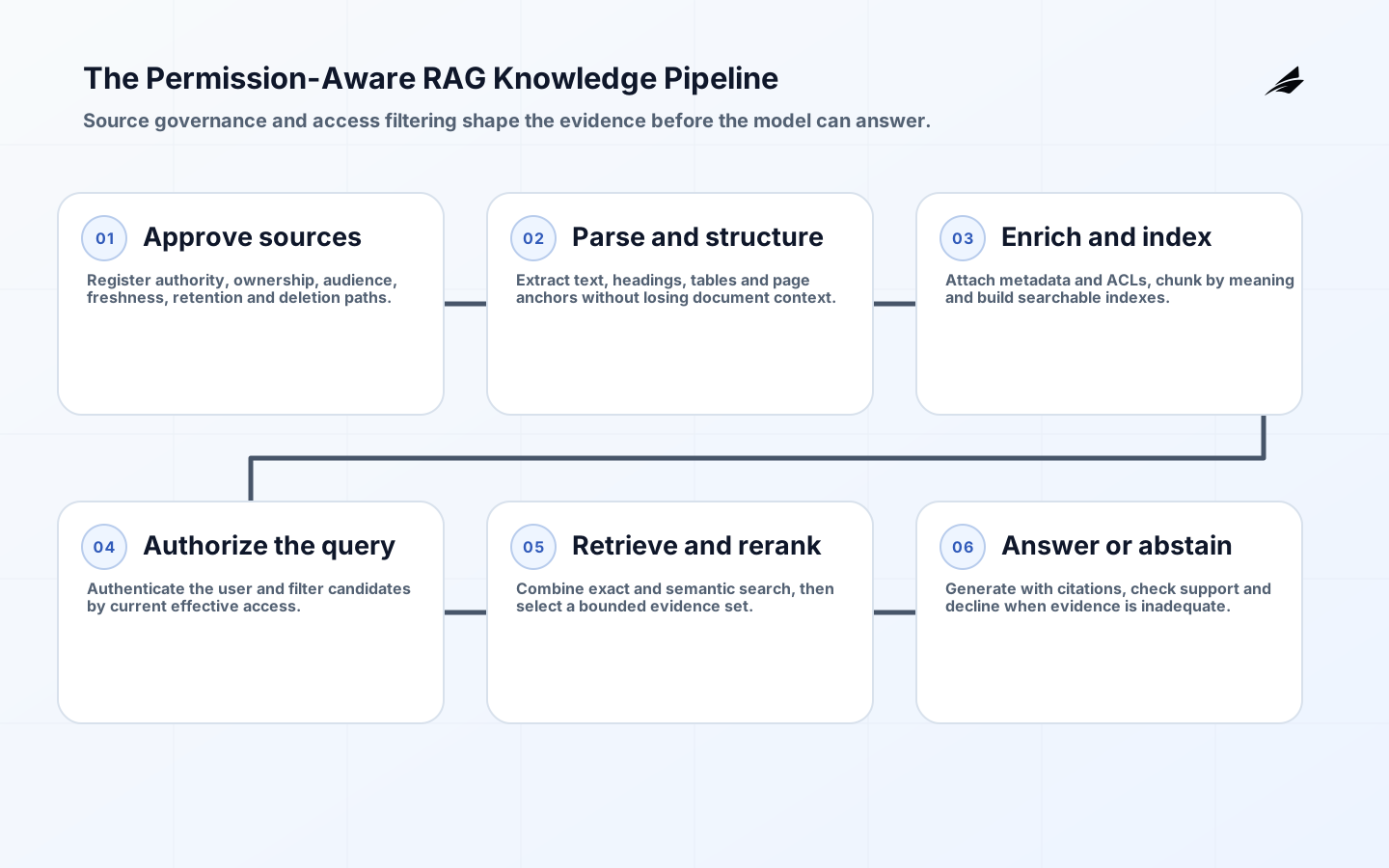
A RAG knowledge base retrieves relevant material from approved sources and places that material in the context of a language model before it generates an answer. Retrieval-augmented generation can make company knowledge easier to use and update without training a model on every document change. It does not make the source content correct, guarantee that retrieval finds the right passage or prevent the model from making unsupported claims. Production implementation therefore depends as much on source governance, permissions and evaluation as on embeddings and prompts.
Start with the knowledge task and its consequence
Buyers searching for RAG implementation usually want internal search, policy Q&A, support assistance, technical documentation help or case research. Define who asks, what sources are authoritative, what answer format is useful and what happens when the answer is wrong. An employee locating a travel policy, an engineer checking a runbook and an agent drafting regulated advice require different access rules, freshness, evidence and human review.
| Candidate | Why RAG may fit | Guardrail |
|---|---|---|
| Internal policy assistant | Answers change when approved policies change and should cite the current document | Filter by employee access and prefer an abstention when no active policy supports the answer |
| Support agent knowledge | Manuals, release notes and resolved cases can ground a draft response | Do not expose another customer's cases; keep sending or account changes under agent control |
| Technical runbook search | Operators need precise steps from versioned operational documents | Show version and owner; require approval before executing remediation |
| Legal or compliance research | Retrieval can locate relevant clauses and evidence | Present source text and metadata for expert review rather than giving autonomous advice |
| Live transactional fact | Often better served by a database or API than document retrieval | Query the system of record and use generation only to explain the result |
The original RAG research combined a generator's parametric memory with retrieved non-parametric memory. In an enterprise product, that broad pattern becomes a pipeline with source connectors, parsing, metadata, indexes, retrieval, ranking, generation, citations and policy checks. RAG for company knowledge and support provides a shorter introduction; this guide focuses on implementation decisions and operating evidence.
Make the knowledge collection governable before indexing
A RAG system can retrieve obsolete, duplicated or unauthorized content very efficiently. Build a source register first. For each repository, record owner, audience, data classification, authoritative status, review date, retention, supported file types, stable identifier and deletion mechanism. Decide whether comments, drafts, archived pages, email attachments and generated text are eligible. Keep document identity and permissions with every chunk so retrieval can enforce them.
| Readiness check | Minimum decision | Failure if omitted |
|---|---|---|
| Authority | Named owner and precedence when sources conflict | The assistant presents an outdated draft as policy |
| Freshness | Change feed or scheduled synchronization with deletion propagation | Revoked or corrected content remains searchable |
| Permissions | Source ACLs mapped to searchable metadata and checked at query time | A user retrieves content they cannot open in the source system |
| Structure | Preserve headings, tables, page references, language and document hierarchy | Chunks lose the qualifiers needed to interpret them |
| Quality | Remove duplicates, extraction failures and unsupported scans or flag them for remediation | Retrieval ranks noisy copies above the authoritative source |
| Lifecycle | Re-index, delete and audit by stable source and chunk identifiers | The team cannot prove or remove what was indexed |
Design separate ingestion and answer pipelines
The ingestion pipeline connects to approved sources, extracts text and structure, cleans content, assigns metadata, divides it into retrievable units, creates embeddings and updates indexes. The answer pipeline authenticates the user, interprets the query, applies source and permission filters, retrieves candidates, reranks them, constructs a bounded context, calls the model and checks the response. Separating these concerns makes freshness, access and failure easier to reason about. Official Microsoft guidance similarly separates ingestion, inference and evaluation in advanced RAG systems.

| Component | Key choice | Test |
|---|---|---|
| Parsing | Extract layout, tables, lists and page anchors for each content family | Compare parsed output with representative source pages |
| Chunking | Use semantic boundaries and retain parent context; tune size by content and query type | Relevant passage is complete enough to answer without unrelated material |
| Indexing | Select lexical, vector or hybrid retrieval and metadata fields | Known-relevant chunks appear in the candidate set |
| Reranking | Rank a small candidate set for the actual question and filters | Relevant evidence moves above plausible but wrong passages |
| Generation | Require citation-compatible output, uncertainty behavior and bounded instructions | Claims are supported by provided context and citations resolve |
| Observability | Log versions, source IDs, retrieved chunk IDs, latency, token use and policy outcomes | A reviewer can reconstruct an answer without storing unnecessary sensitive text |
Do not choose chunk size by a universal rule. A troubleshooting procedure should usually remain a coherent sequence; a policy may need section and subsection context; a table may require its headers repeated. Hybrid retrieval can combine exact terms, useful for codes and product names, with semantic similarity. Metadata filters narrow by product, region, date, content type or audience. Reranking helps when the initial candidate set includes semantically related but non-answering passages. More context is not automatically better because irrelevant passages can distract the model and increase latency and cost.
Example: a support knowledge base across products and customers
A software company wants support agents to search product manuals, release notes, internal troubleshooting guides and resolved tickets. Product documentation is shared; tickets are tenant-restricted. The ingestion pipeline tags each chunk with product, version, language, source owner, effective date and access scope. At query time the application obtains the agent's identity and assigned customer, then filters ticket content to that customer before retrieval. Shared manuals can be searched across the relevant product and version.
The interface shows a draft answer with citations, source version and a clear no-evidence state. It does not send the response or change the account. Agents mark citations as useful, wrong or stale and select a reason when editing the draft. Content-owner alerts are created for stale documents; model quality feedback remains separate from source correction. This distinction matters: changing a prompt cannot repair a wrong manual, and editing a manual should flow through its normal approval process.
Evaluate retrieval and generation separately
Create an evaluation set from real information needs before optimizing the system. Each case should contain the question, user role, eligible sources, expected evidence, answer criteria and whether the system should abstain. Include easy lookups, multi-part questions, ambiguous requests, no-answer cases, conflicting documents, old versions, restricted content and indirect prompt injection inside a document. Split a stable regression set from an exploratory set used during tuning.
- Retrieval coverage: does the candidate set contain the evidence needed to answer?
- Ranking quality: how high does the first useful passage appear, and are irrelevant passages crowding context?
- Groundedness: are material claims supported by the retrieved context rather than model memory?
- Citation correctness: does each citation resolve to a passage that supports the adjacent claim?
- Answer usefulness: is the response complete, direct and appropriate for the user's task and role?
- Abstention quality: does the system decline or ask a clarifying question when evidence is absent or conflicting?
- Security behavior: can unauthorized or malicious content alter instructions, expose data or trigger a tool?
- Operational performance: record latency by stage, failure rate, index freshness and cost per successful answer.
Use automated scoring for repeatability, but review a meaningful sample with domain experts. Model-based graders can assist, yet they also need calibration against human judgments. Set release thresholds by risk category rather than one blended score. A policy assistant might require perfect access-control tests and strong citation correctness even if style quality is merely adequate. Preserve failed cases as regression tests whenever a prompt, model, embedding, parser, index or retrieval setting changes.
Threat-model the knowledge pipeline
RAG introduces a path from stored content into model instructions. OWASP notes that prompt injection can be indirect: a retrieved file may contain text intended to change model behavior. Treat retrieved passages as untrusted data, clearly delimit them, keep system instructions separate and do not give a knowledge assistant unnecessary tools. If tools are required, authorize each action outside the model and require human approval for high-impact changes. RAG improves relevance but does not eliminate prompt injection.
| Risk | Mitigation | Evidence to retain |
|---|---|---|
| Cross-user or cross-tenant leakage | Permission-aware filtering, tenant isolation and negative access tests | Identity, filter policy, retrieved source IDs and denied queries |
| Knowledge poisoning | Approved connectors, source authentication, owner review and anomaly checks | Source lineage, content hash, ingestion actor and version |
| Indirect prompt injection | Untrusted-content boundaries, restricted tools, output validation and adversarial tests | Triggered policy, model/tool request and response action |
| Sensitive data exposure in logs | Minimize captured text, redact fields, encrypt and apply retention and access policy | Logging configuration and access audit |
| Stale or deleted knowledge | Change detection, deletion propagation, freshness service levels and source-open check | Last synchronized time and source status |
| Unsupported confident answer | Citation requirement, claim checks, calibrated abstention and user feedback | Retrieved evidence, response version and reviewer outcome |
Network and service boundaries still matter. Google Cloud's RAG reference architecture separates data processing, retrieval, serving and frontend concerns and uses distinct identities and private connectivity controls. The exact cloud products can differ, but the principle is portable: isolate subsystems, give each service only the access it needs and reduce routes through which source data or prompts can be exfiltrated. NIST's generative AI profile adds lifecycle governance, pre-deployment testing and incident handling to these technical controls.
Estimate implementation and run cost honestly
Implementation cost is driven by source diversity, parsing difficulty, permission complexity, query risk, integration, evaluation depth and user experience. A small collection of clean HTML policies is different from millions of scanned files with inherited permissions and duplicate versions. One-time work includes source inventory, connectors, parsing, index design, interface, security review, test-set creation and rollout. Recurring cost includes synchronization, extraction, embeddings, index storage, retrieval, reranking, model calls, logs, evaluation, support and content-owner time.
- Forecast ingestion by changed documents or pages, not only total repository size.
- Forecast serving by questions, retrieval and reranking calls, average context size and generated output.
- Measure cache benefit only where access and freshness rules permit reuse.
- Include separate development, test and production environments plus backups and observability.
- Track cost per useful, grounded answer and human escalation, not only model tokens.
- Budget for content remediation and evaluation because those are core quality work, not optional polish.
Use a staged rollout with clear gates
- Discovery: choose one audience and task; inventory sources, permissions, baseline search behavior and consequence of error.
- Corpus pilot: ingest a small authoritative collection and prove parsing, deletion, metadata and access filtering.
- Offline evaluation: compare retrieval and generation options against the versioned test set, including security cases.
- Internal preview: release to trained domain users, show citations and collect structured failure reasons.
- Limited production: expose a defined audience or topic, monitor quality, freshness, access denials, latency and cost.
- Expansion: add a source or user group only after its owner, permission mapping, tests and operational support are ready.
- Steady operation: review source health, unresolved feedback, regressions, incidents and model or index changes on a fixed cadence.
Implementation takeaways
- Start with an information task, audience and consequence, not a vector database purchase.
- Govern authority, freshness, permissions and deletion before indexing a broad corpus.
- Preserve structure and metadata; tune chunking and retrieval for actual content families and questions.
- Test retrieval, grounded generation, citations, abstention, access and attacks separately.
- Keep retrieved content untrusted and keep authorization outside the language model.
- Roll out source by source and retain a regression set for every material pipeline change.
- Use Edilec AI automation services to turn the design into a secure pilot, evaluation harness and operating rollout.
Frequently asked questions
Does RAG stop hallucinations? No. RAG can provide relevant evidence, but retrieval can miss, return the wrong passage or supply conflicting text, and the model can still generate an unsupported claim. Require citations, test groundedness and provide an abstention path.
Do we need a vector database? Not always. Exact identifiers, filters and small collections may work with lexical or relational search. Many systems benefit from hybrid retrieval that combines exact-term and semantic signals. Choose from evaluation results, content structure, permissions and operational needs.
How should document permissions be handled? Carry source access metadata into the index and filter retrieval using the authenticated user's current permissions. Test denied cases and propagate permission removal quickly. Do not rely on the model or prompt to conceal retrieved content.
RAG or fine-tuning: which is better for company knowledge? RAG is generally suited to changing, attributable knowledge because content can be updated and cited separately from model parameters. Fine-tuning is useful for behavior, style or specialized task patterns. They can be combined, but fine-tuning does not replace source governance or current retrieval.
What is the best first RAG use case? Choose a bounded, read-only task with authoritative documents, frequent information need, identifiable users and reviewable answers. Avoid beginning with high-stakes autonomous action or a corpus whose ownership and permissions are unknown.
Conclusion
A reliable RAG knowledge base is a governed information service wrapped around a language model. Its quality comes from authoritative sources, permission-aware retrieval, faithful parsing, realistic evaluation and visible uncertainty. Build those foundations with a small audience and corpus, prove that answers are useful and access-safe, then expand deliberately. That path produces a knowledge capability the organization can maintain rather than a convincing demo that decays after launch.