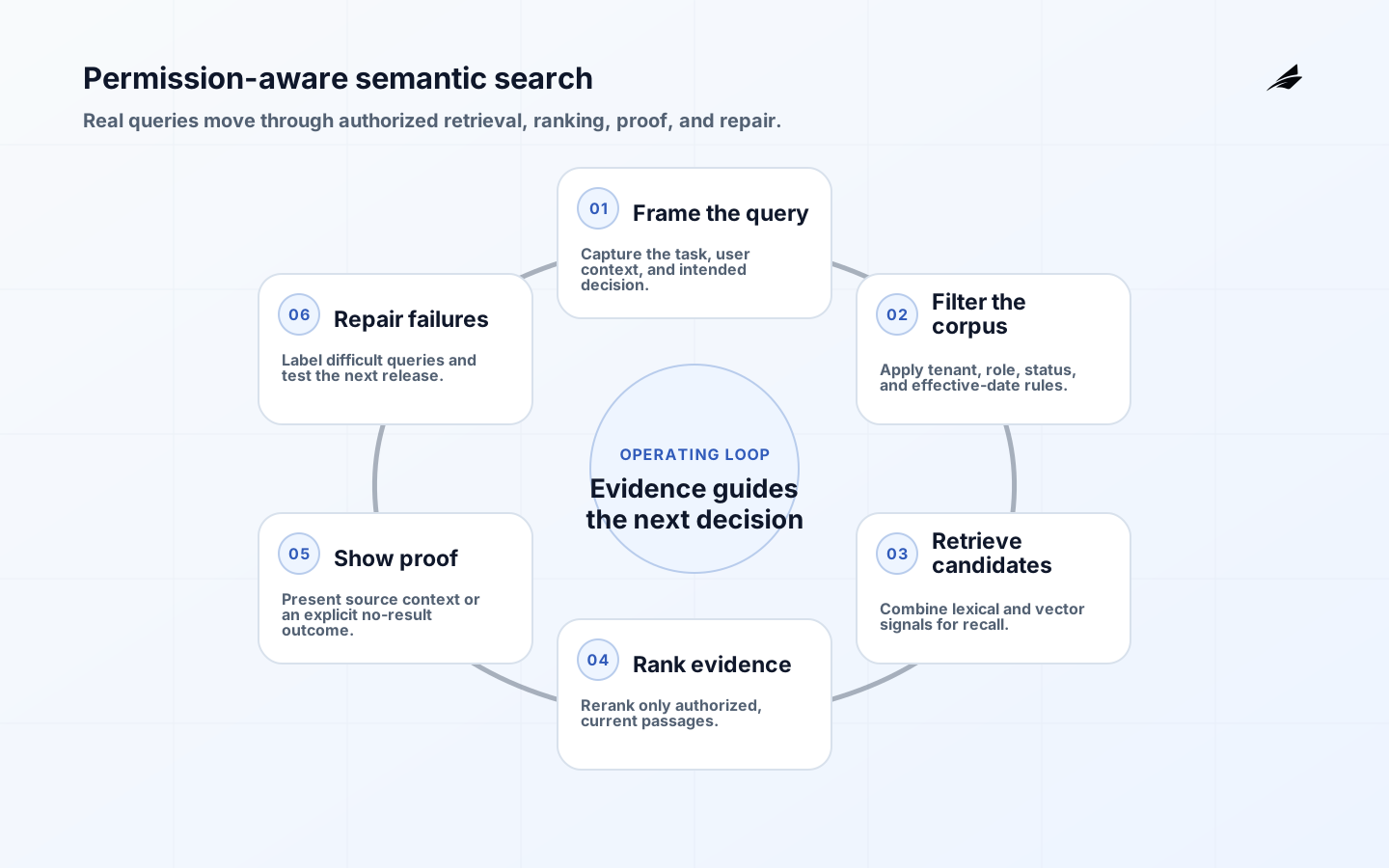
Semantic search helps people find conceptually relevant records even when their query and the source use different words. For an operations leader, its value is not a more impressive search box; it is a shorter, safer path to the current permitted evidence for a real decision. A dependable service combines lexical matching, vector retrieval, filters, and optional reranking according to the corpus and task. It applies identity and document permissions before disclosure, shows enough source context for verification, records difficult queries, and offers a clear “no adequate result” outcome.
Set a decision boundary for semantic search
Choose one workflow where people already spend time reconciling terminology, document versions, or system fragments. Record who asks, what they are trying to decide, the authoritative source for that decision, and what a wrong result could cause. A maintenance technician looking for a shutdown procedure and a support representative looking for a customer policy may use the same retrieval platform but need different source sets, permissions, response formats, and escalation rules. Define the service as assistance, not a new authority: it can retrieve, rank, summarize, and cite; the owner of the underlying record remains responsible for policy and updates. The NIST AI Risk Management Framework is useful because it treats context and measurement as continuous responsibilities, not a launch checklist.

| Question | Design choice | Evidence to retain |
|---|---|---|
| What decision is supported? | Name one repeated work outcome and its accountable role. | Baseline task sample and owner. |
| Which records count? | Register authoritative sources, versions, and refresh owners. | Source inventory and access scope. |
| Who may see results? | Filter before retrieval and verify at display time. | Identity test cases and denial logs. |
| What happens on uncertainty? | Show sources, abstain, or route a human review. | Reason code and reviewed examples. |
Build the retrieval path around evidence
A production semantic search architecture normally separates ingestion, document parsing, metadata and access enforcement, indexing, candidate retrieval, ranking, presentation, and evaluation. Preserve the source identifier, section boundary, effective date, owner, and permission metadata alongside the text. Chunking is not a purely technical tuning exercise: fragments that are too small lose qualifications, while fragments that are too broad obscure the exact passage a reader must inspect. Combine semantic retrieval with lexical or metadata retrieval when exact identifiers, error codes, names, or dates matter. The goal is not one ranking formula for every request; it is a testable retrieval policy for the work being supported. Retrieval pipelines explains the source-to-index operating model in more depth.
Apply permissions before relevance
Permission enforcement must be part of candidate selection, not a final cosmetic check. If restricted content can influence a summary before it is removed from the visible list, the system may still leak sensitive facts. Attach stable access attributes to indexed content, test changes in a user's role, and decide how the system behaves when source metadata is incomplete. For high-impact topics, prefer an abstention over a plausible result from an uncertain access path. Search logs should minimize unnecessary query retention while still allowing the team to diagnose access defects, stale indexes, and unsupported answers. OWASP's guidance on LLM applications is relevant here: prompts, retrieved content, and tool outputs all create distinct security boundaries that need deliberate controls.
| Signal | What it reveals | Useful response |
|---|---|---|
| Source citation coverage | Whether results can be checked. | Require citations for answer-generating paths. |
| Judged relevance by task | Whether ranking helps the intended decision. | Maintain a labeled query set by workflow. |
| Freshness failures | Whether changed records reach the index. | Trace ingestion delay and repair ownership. |
| No-result and reformulation rate | Where vocabulary or scope is failing. | Review queries without expanding access blindly. |
Evaluate with real queries and difficult cases
Build an evaluation set from real, privacy-reviewed questions and include queries with acronyms, conflicting records, outdated procedures, permission differences, and requests that should receive no result. Ask reviewers to judge not merely whether a retrieved passage is topical, but whether it is sufficient for the stated decision, current, authorized, and properly attributed. Measure retrieval quality separately from answer quality so a fluent model response cannot hide a weak evidence set. Review results by source, role, language, and task type. A high average can conceal a critical failure for a small operational group. Feed corrected judgments back into source governance, metadata, query handling, and ranking tests rather than treating every miss as a reason to change models.
Roll out in a bounded workflow
Pilot with a small, representative group and retain the existing route for finding information. Give participants a way to mark an answer as useful, incomplete, inaccessible, or unsafe, then inspect the cited evidence behind those signals. Release criteria should cover access tests, representative relevance, source freshness, latency, support ownership, and the ability to disable the surface without corrupting source records. Do not use click volume as the only adoption measure. A search box can be busy because people cannot find anything, while a smaller number of well-supported decisions may be the more valuable outcome. Link the service to RAG systems for AI automation only after the retrieval foundation is observable.
Implementation checks
| Operating check | Concrete practice | Why it matters |
|---|---|---|
| Query intake | Classify intent, audience, urgency, and named entities before broad retrieval. | A reviewer can see which scope rule and filters applied. |
| Source admission | Require owner, audience, date, and refresh rule for each indexed collection. | New material cannot silently outrank a governed record. |
| Index change | Rebuild or incrementally update with a versioned parser and chunking configuration. | Results can be compared before a ranking change reaches users. |
| Access review | Test additions, removals, and role changes against representative query cases. | A denied user never receives derived facts from a restricted passage. |
| Result display | Present title, date, source, and relevant excerpt near each recommendation. | Operators can check evidence without a second search. |
| Miss triage | Group no-result queries by vocabulary, source gap, and permission outcome. | The team fixes a known cause instead of adding unowned content. |
| Freshness incident | Pause affected answer paths when an authoritative source is withdrawn or disputed. | Users receive a safe notice and an accountable escalation route. |
| Monthly review | Compare accepted results, edits, abstentions, and source changes by workflow. | Investment follows observed decision quality rather than search volume. |
Before choosing an embedding model or a search vendor, run a source walkthrough with the people who own the records. Ask which document settles a disputed question, how a change is announced, which terms users employ that the source does not, and when an answer must be withheld. Convert the answers into a short retrieval charter and a set of test queries. This exposes whether the expected benefit comes from better search, from cleaning a poorly owned repository, or from simplifying a workflow. It also avoids a familiar trap: using semantic matching to compensate for absent records and then presenting the result as operational knowledge.
During steady operation, review a small sample of accepted and rejected searches with both users and source owners. Compare the displayed passage to the original document, inspect the access decision, and ask whether the result actually enabled the next step. Track the time between a source change and its reflected search result, but do not reduce freshness to a single average; a delayed safety procedure matters differently from a delayed newsletter. Give source owners a simple way to signal urgent withdrawal or correction, and test that the search surface responds as designed.
Evaluate an incident-procedure scenario
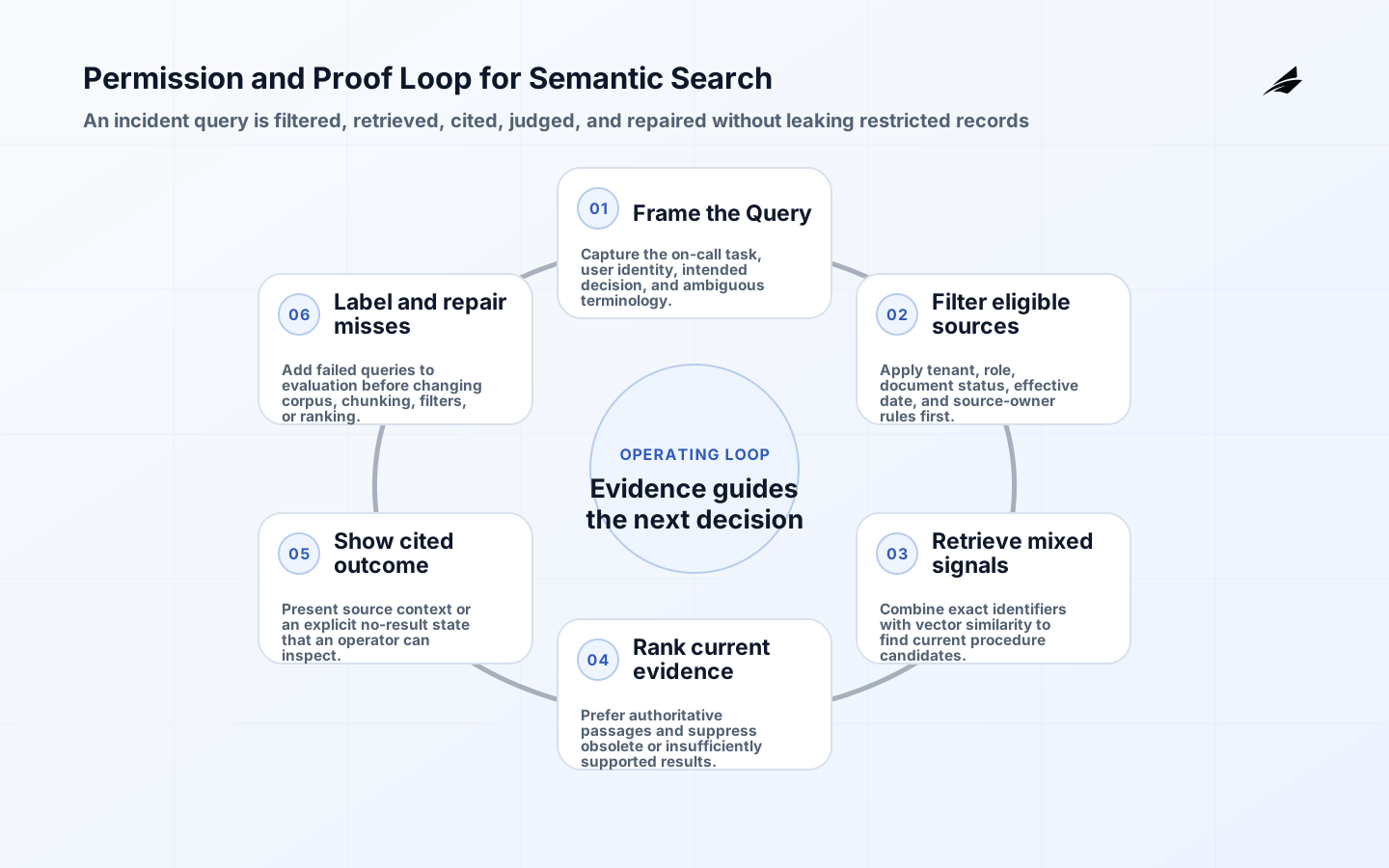
An on-call manager searches “customer uploads stuck after key rotation,” while the current runbook says “object-ingestion failures following credential rollover.” Exact keyword search may miss the relationship; vector retrieval may find conceptually similar but obsolete documents. A hybrid pipeline retrieves keyword and vector candidates, filters by tenant, role, document status, and effective date, then reranks the authorized set. Azure AI Search semantic ranking documentation explains that semantic ranking reranks an initial result set rather than searching the whole corpus. Azure vector relevance guidance also distinguishes exhaustive and approximate nearest-neighbor retrieval and recommends hybrid queries when relevant.
Test with judged operational queries, not invented product demos. Include exact terms, paraphrases, acronyms, misspellings, stale procedures, denied documents, “no answer” cases, and queries with two plausible intents. Measure precision at k, recall at k, and mean reciprocal rank, then review failures by corpus, chunking, filter, candidate retrieval, and reranker. Microsoft’s RAG retrieval guidance describes these metrics. Use the retrieval pipelines engineering notes, embeddings guide for IT managers, and plain-language semantic search guide to connect search behavior to operations. Govern the service under NIST AI RMF when machine-learned ranking materially shapes decisions.
| Test query class | Expected behavior | Failure owner |
|---|---|---|
| Known exact identifier | Return the authoritative record first | Indexing and lexical retrieval owner |
| Operational paraphrase | Find the current procedure despite vocabulary difference | Embedding and hybrid ranking owner |
| Acronym with two meanings | Use context or ask the user to disambiguate | Product and taxonomy owner |
| Restricted document | Exclude it before snippets or ranking output | Identity and authorization owner |
| Superseded procedure | Prefer effective version and label history | Content steward |
| No supporting record | Say no adequate result and offer a repair route | Service owner |
| New recurring failed query | Add a judged case before changing ranking | Evaluation owner |
Key takeaways
- Scope semantic search to a named decision and an accountable owner.
- Keep source identity, dates, structure, and permissions with every indexed passage.
- Use hybrid retrieval when exact identifiers and meaning both matter.
- Evaluate access, evidence quality, and freshness alongside relevance.
- Treat abstention and escalation as useful service outcomes.
- Improve source governance and metadata before assuming a ranking model is the problem.
Frequently asked questions
Is semantic search the same as a chatbot? No. Semantic search retrieves relevant material; a chatbot may use it to compose an answer, but retrieval quality and citations still need independent evaluation. Should every document be indexed? No. Include only content with an owner, a permitted audience, and a defined refresh or retirement rule. How often should ranking be reviewed? Review after material source, policy, user-role, or workflow changes, and on a regular cadence using retained task examples.
Conclusion
Semantic search earns a place in operations when it turns an authorized question into evidence a person can inspect and use. Bound the decision, protect access before relevance, preserve source context, and evaluate the difficult cases. Those habits make the system more useful than a clever demo and more durable than a one-time index build.