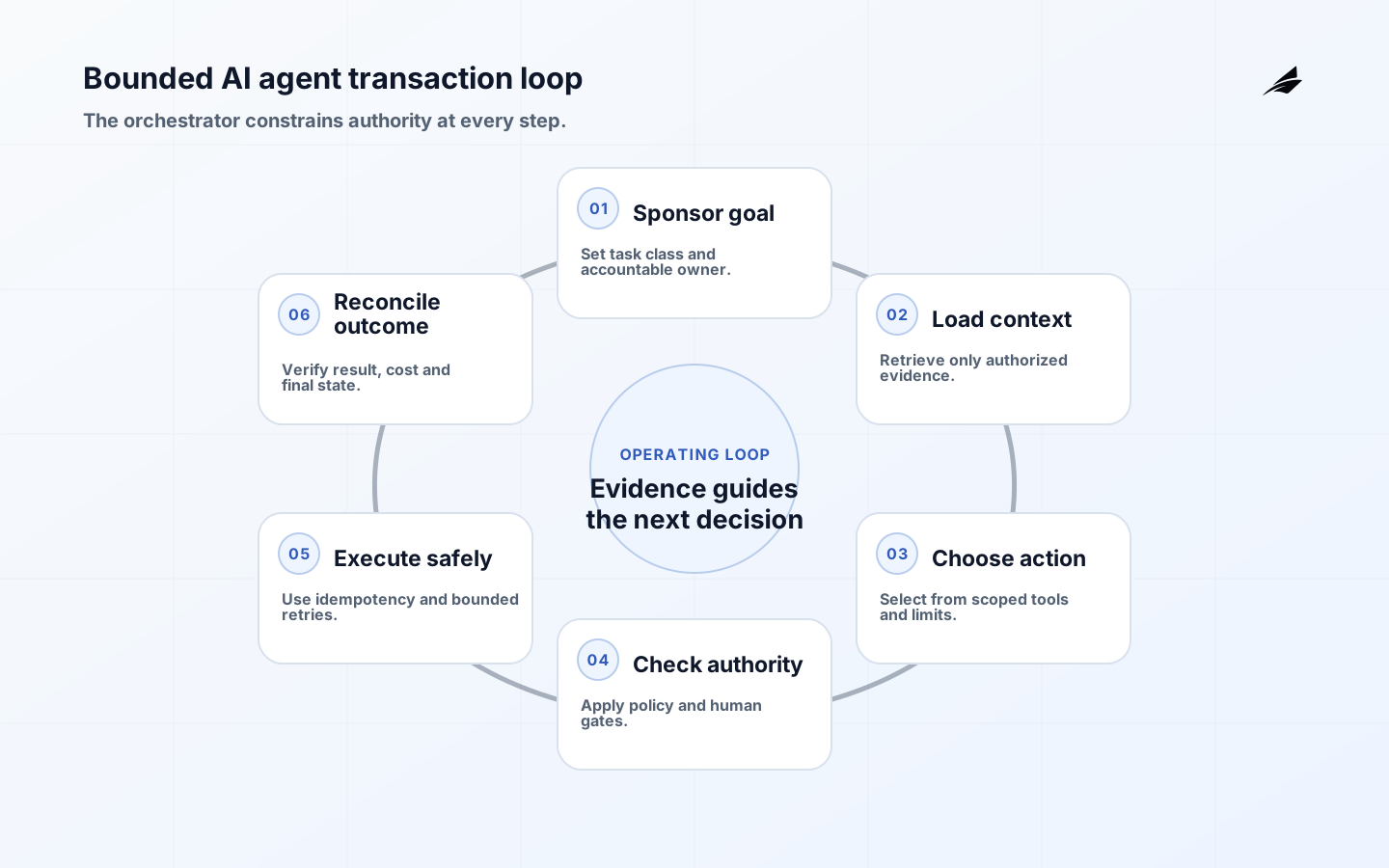
AI agents are systems that use a model to select or sequence steps, often calling tools or services to pursue a task. The useful question is not whether an agent seems autonomous; it is whether a bounded workflow becomes more reliable, faster, or easier to operate. An agent that can search, draft, create a ticket, or update a record introduces state changes and permissions that a chat interface may not. Start with one reversible task and describe the contract in plain language: triggering event, allowed inputs, approved tools, maximum steps, required evidence, approval points, owner, and recovery path. That contract turns a broad concept into a system engineers and operators can test.
Bound the agent to a work contract
Decide whether the agent may recommend, prepare, execute, or only route work. Keep material writes behind explicit authorization until repeated evidence justifies a narrower automatic path. Tool definitions should be small and typed: describe what each tool does, validate arguments, enforce identity and scope server-side, and return structured receipts. Do not rely on the model to remember a policy that the tool can enforce. Limit the tools available in each workflow and use separate identities for separate duties. A capable agent with broad credentials is a broad failure surface. The task contract should include the conditions under which the agent must stop, ask for clarification, or hand a case to a person.
| Agent capability | Necessary boundary | Evidence |
|---|---|---|
| Read records | Role and purpose-limited retrieval. | Source identifiers and access decision. |
| Propose a plan | Maximum steps and cited assumptions. | Plan trace and user edits. |
| Call a tool | Schema validation and least privilege. | Arguments, result, and receipt. |
| Write a system record | Explicit approval or deterministic policy. | Approver, before/after state, rollback path. |
Design orchestration for stoppable execution
Use a workflow engine or durable state model when the task crosses time, services, or approvals. Record the current step, inputs, tool receipts, retry state, and expiry rather than relying on a conversational transcript to reconstruct work. Set budgets for turns, time, tool calls, and monetary impact. Make retries idempotent and distinguish a temporary transport error from an action whose outcome is unknown. For asynchronous work, show the user an understandable status and a way to cancel or escalate. The agent should never have to guess whether a previous action completed. These details are ordinary distributed-systems discipline, and they matter more as an agent acts across more than one service.
Ground plans and actions in inspectable evidence
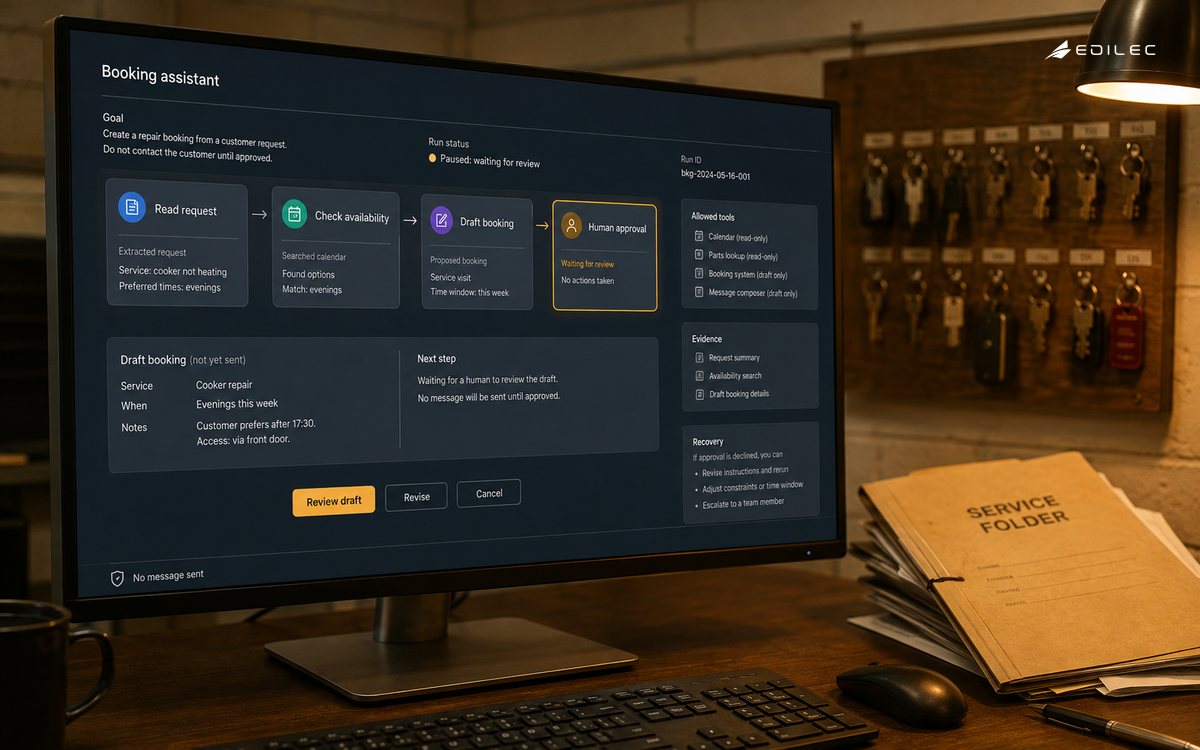
An agent should state the records, policy, or user instruction that supports a proposed action, then preserve that connection in the case trace. Separate untrusted retrieved text from authority to act; a document can inform a plan but cannot grant a new permission. Require confirmation for actions that leave the system, change money, affect customer access, or create a material commitment. When a task cannot be completed safely, return the reason and the next accountable route instead of inventing an alternative. AI guardrails are therefore part of the agent architecture, not a later moderation layer.
| Failure mode | Design response | Test case |
|---|---|---|
| Prompt injection in a retrieved record | Isolate content and enforce tool policy outside model text. | Document asks agent to override a rule. |
| Repeated tool loop | Set step and retry limits. | Dependency returns ambiguous error. |
| Partial external action | Use receipts and reconciliation. | Timeout after a write request. |
| Stale plan | Revalidate changing inputs before execution. | Record changes while approval is pending. |
Evaluate complete trajectories, not single replies
Evaluate the full path: task selection, retrieved evidence, planned steps, tool arguments, authorization, final state, and user experience. Include success cases, missing data, denied access, malicious content, tool outage, duplicate request, and a user who changes their mind mid-task. Score completion quality, invalid actions prevented, escalation quality, cost, latency, and recoverability. Replay retained cases after changing a tool schema, model, prompt, policy, or source. Keep an evaluation set that represents the workflow rather than only elegant prompts. AI cost controls should be measured alongside quality because an unbounded agent can consume resources without finishing useful work.
Operate agents with owners and recovery drills
Assign owners for the workflow outcome, tool permissions, source data, evaluation set, incident response, and user support. Monitor stop reasons, failed tool calls, approval delays, correction patterns, and unexpected step depth. Maintain a kill switch that stops new actions, a reconciliation procedure for in-flight cases, and a communication route for affected users. Exercise those procedures before broad rollout. Make configuration and policy changes reviewable, because small changes in a tool description or model behavior can produce a new trajectory. An agent is ready to expand when its normal and abnormal behavior are both understandable to the people responsible for operating it.
Implementation checks
| Operating check | Concrete practice | Why it matters |
|---|---|---|
| Task contract | Name trigger, allowed inputs, tools, maximum steps, owner, and stop states. | The agent has a bounded, testable job. |
| Tool catalog | Use small typed tools with server-side authorization and receipts. | The model cannot manufacture a new privilege. |
| State durability | Persist current step, input version, result, and retry status. | Operators can recover work after restart or timeout. |
| Action gate | Require confirmation or deterministic policy before material writes. | Authority is visible outside conversational text. |
| Trajectory test | Exercise happy paths, outages, injection, duplicate requests, and changed input. | Evaluation covers the complete workflow. |
| Budget control | Cap turns, time, tool calls, and spend by task class. | An ambiguous loop stops safely. |
| Observability | Monitor stop reasons, tool failures, approval delay, and correction patterns. | Owners can see behavior that a single success metric hides. |
| Recovery drill | Practice kill switch, reconciliation, and user communication for in-flight work. | The service can be contained without losing accountability. |
Start agent deployment with a simulation or shadow mode whenever practical. Let the workflow produce a proposed plan and tool calls without committing state, then compare the trace with what qualified operators actually did. This reveals missing inputs, unsafe assumptions, and unnecessary steps before the agent has authority to create downstream work. A shadow mode should still use realistic identities and permissions; an agent that succeeds only with broad test credentials has not demonstrated a production-ready path. Record the differences as cases for design, tool, and policy review.
As the agent expands, resist measuring progress by the number of tools or the apparent breadth of autonomy. Measure the proportion of tasks completed with correct evidence, the number of interventions avoided without new harm, and the ease with which an operator can explain or reverse an outcome. A smaller agent that reliably closes one valuable loop is often a better foundation than a general agent that starts many tasks and leaves people to recover them. Expansion should follow observed control strength, not an architectural ambition.
Tool permissions should have an expiration and review story. Temporary access for a pilot, a new integration, or a special support case can become permanent simply because nobody sees it again. Record why a tool was granted, which agent workflow uses it, the least scope required, and the owner who must renew or remove it. Review those records alongside actual tool usage. A permission that is unused is still an exposure; a permission used in unexpected ways is a signal that the task contract or interface is too broad.
Treat every agent run as a bounded transaction
An AI agent becomes operationally meaningful when it can observe state, choose a permitted action, invoke a tool and use the result to continue. That loop also creates risk: an ambiguous goal can expand into several consequential actions, external content can redirect the plan, and a valid tool can be misused. Treat each run as a bounded transaction with a sponsor, task class, input scope, tool allowlist, maximum steps, time and cost budget, approval policy and terminal status. The orchestration layer should enforce those limits independently of model instructions and preserve enough evidence to reconstruct what happened.
| Authority class | Permitted behavior | Required gate |
|---|---|---|
| Observe | Read approved context and produce a cited summary | Source permissions and output review |
| Propose | Prepare a draft action or change set | Deterministic validation and accountable reviewer |
| Execute reversible | Perform a bounded action with an idempotency key | Policy check, limits and verified rollback |
| Execute consequential | Affect money, identity, external communication or production state | Explicit human approval and post-action reconciliation |
The NIST AI Risk Management Framework helps organize governance, mapping, measurement and management, while OWASP’s Securing Agentic Applications Guide addresses practical threats around tools, identity, memory and orchestration. Evaluate the complete workflow rather than a model answer: authority adherence, correct tool choice, task success, unsupported claims, recovery, latency and resource use. Edilec’s guides to AI guardrails, agent memory and tool-calling cost and scale cover nearby design choices. Begin with observe or propose authority; expand only when representative tests and production traces show that failures remain bounded and understandable.
Key takeaways
- Define one reversible work contract before adding tools or autonomy.
- Enforce identity, scope, and validation in tools rather than model instructions.
- Use durable state, receipts, budgets, and idempotency for multi-step work.
- Keep material writes behind authorization and preserve before/after evidence.
- Evaluate full trajectories, including outages, malicious content, and changed inputs.
- Practice stopping and reconciling the workflow before scaling it.
Frequently asked questions
Is an agent just a chatbot with tools? Sometimes, but a tool-using system needs workflow state, authorization, and recovery design that a simple conversational surface may not. Can an agent approve its own actions? It can apply deterministic policy, but material authority should be defined outside the model and proportionate to consequence. How many tools should an agent have? Start with the smallest set needed for one outcome; each additional tool expands the test and security surface.
Conclusion
AI agents become practical when their freedom is deliberately limited by a work contract, tool controls, evidence, and recovery. Build one observable path first, then expand authority only when the operating evidence supports it.