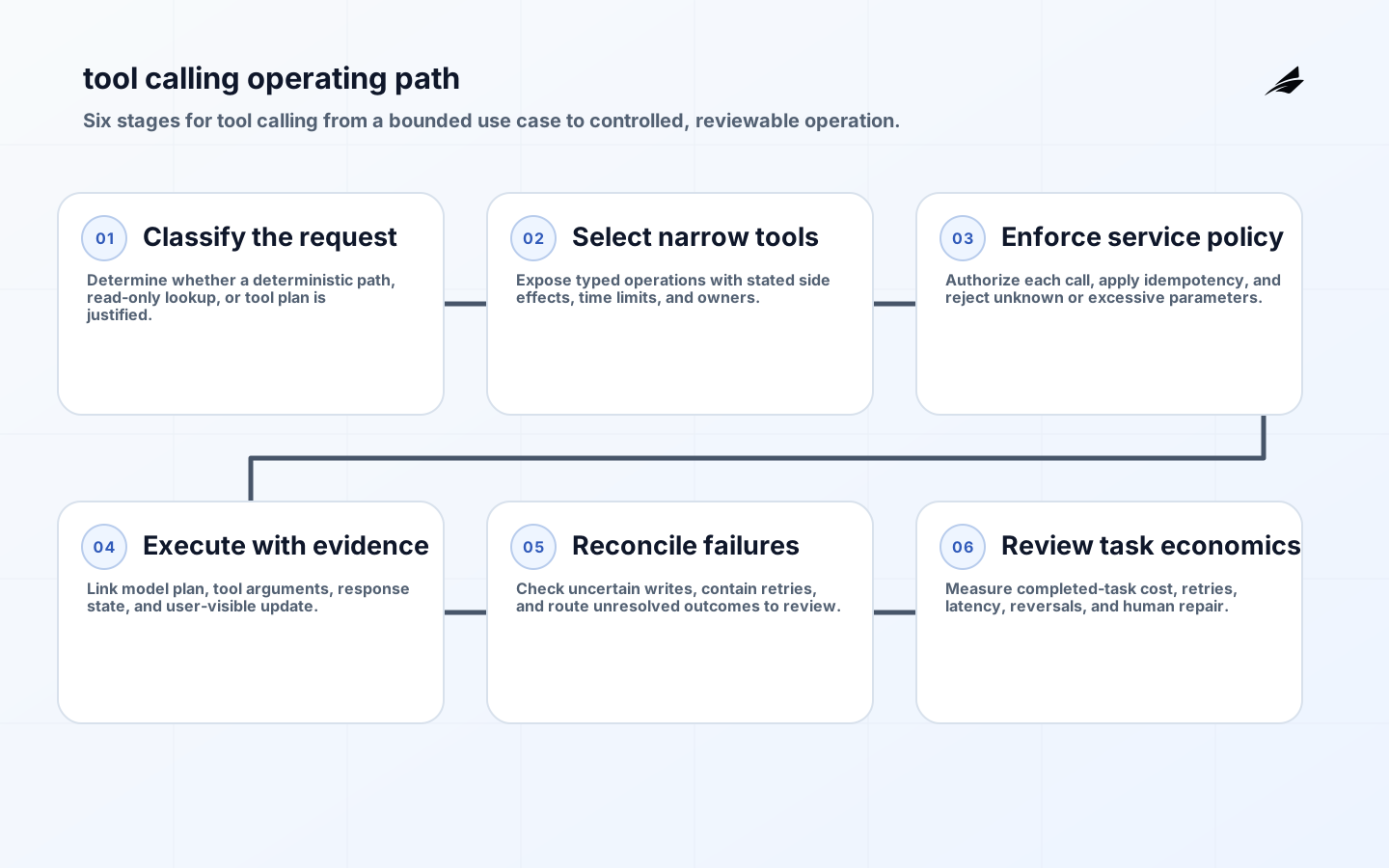
Tool calling lets a model request a typed operation from software: look up an order, create a draft, query a schedule, or submit a review item. The model should be treated as a planner and formatter, not as the authority that performs the operation. Cost and scaling decisions begin with the workflow, because the expensive path is rarely just model tokens. It can include repeated retrieval, unnecessary tools, slow dependencies, retries, human repair, and audit storage. The NIST Generative AI Profile offers a useful lens: measure the sociotechnical system and its impacts, rather than treating a model call as the whole product.
Map The Unit Of Work
Choose one request that has a clear start, a bounded set of permitted tools, and an observable result. “Help operations” is not a unit of work; “prepare a shipping exception summary and create a review task when inventory status is disputed” is. Identify the tools the model may request, their expected response time, data classification, side effects, and owner. Then separate read-only discovery from write actions. The plain-language tool calling guide explains the core pattern; this guide focuses on what changes once many requests, integrations, and users arrive.
| Cost driver | What commonly causes it | Control to add |
|---|---|---|
| Token volume | Large tool schemas, whole documents, and repeated conversation history are sent on every turn. | Provide only task-relevant fields, summarize durable state, and cache safe deterministic lookups. |
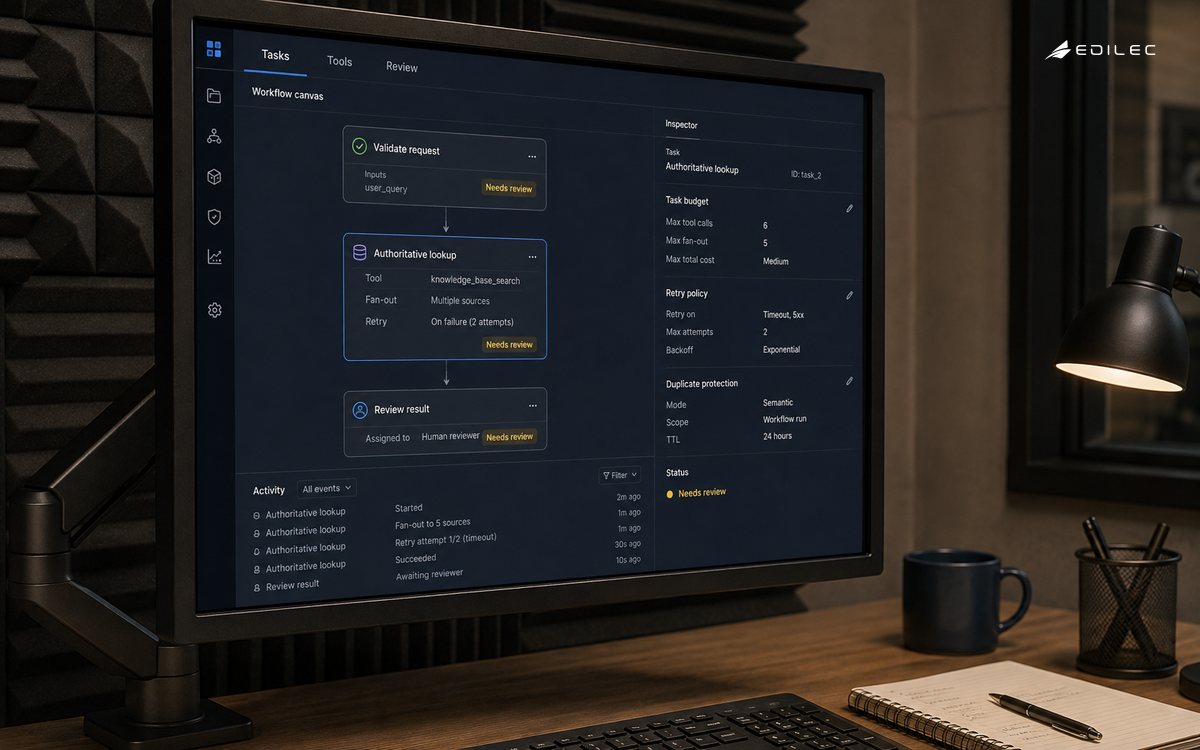
| Tool fan-out | The model calls several overlapping services to answer a question that one authoritative query could resolve. | Define a tool-selection policy, expose a consolidated read model where appropriate, and cap parallel calls. |
| Retries and timeouts | Slow dependencies lead to repeated model planning and duplicate downstream requests. | Use time budgets, idempotency keys, visible queue states, and a graceful partial-result path. |
| Human repair | Ambiguous actions and weak validation create review work after the fact. | Require structured arguments, show the proposed change, and route uncertain cases before execution. |
Design For Bounded Execution
A useful tool contract describes what it does, the exact parameter schema, the actor identity it needs, the effect it may create, and the evidence it returns. Keep each tool narrow enough that authorization remains understandable. A create_refund tool should not be a generic database mutation; it should enforce order eligibility, amount limits, approval requirements, and idempotency on the server. OWASP's LLM guidance is relevant because indirect instructions can try to steer agents toward unsafe actions. The receiving service must reject requests that do not satisfy policy, even when the model's explanation sounds reasonable.
- Classify requests before planning so simple deterministic work does not incur an agent loop.
- Give tools explicit input and output schemas; reject unknown fields and enforce server-side limits.
- Attach an idempotency key to any operation that could be duplicated by a retry or delayed response.
- Set a per-task budget for model calls, tools, elapsed time, and external side effects.
- Return machine-readable status codes such as completed, needs-review, unavailable, or denied.
- Persist a correlation identifier across the model request, each tool call, user-visible update, and audit event.
Scale The Control Plane
Scaling is mostly a control-plane problem: routing, concurrency, rate limits, credentials, configuration, and observability must grow without turning every agent into a privileged integration hub. Use service identities that are scoped to the action, not a shared administrative credential. Isolate tenants and workload queues so a burst from one client does not consume capacity needed by another. Apply backpressure when dependencies are saturated, and make queued or failed state visible to the user. The UK secure AI development guidance reinforces the need to protect the surrounding deployment and operational environment, not only the model interface.
Measure Economics And Reliability
Track cost per completed task, not cost per model request. Pair it with completion rate, invalid-call rate, p95 task duration, retry count, dependency errors, human-review rate, and reversals. Segment these measures by workflow and release version; an average can conceal one expensive or unsafe path. Review traces for calls that exhausted budget, selected unnecessary tools, or generated arguments the server rejected. The OpenAI Agents guide is a helpful implementation reference for multi-step systems, while the business case still comes from whether the completed task is cheaper, faster, and more dependable than the previous process.
| Scenario | Expected system behaviour | Evidence to retain |
|---|---|---|
| A dependency times out after accepting a write | Do not immediately repeat the side effect; query by idempotency key or route the outcome to review. | Request identifier, tool response state, reconciliation result, and user notification. |
| The model proposes a prohibited action | The server denies it and the application explains the next permitted route without exposing policy internals. | Actor, policy decision, requested parameters, and denial reason code. |
| Daily volume spikes | Prioritise bounded work, apply queue limits, and defer non-urgent enrichment rather than failing unpredictably. | Queue age, rejection count, service saturation, and recovery time. |
| A tool schema changes | Run compatibility tests and block incompatible agents until the contract is updated. | Schema version, affected workflow list, regression results, and rollback decision. |
Release In Stages
Start in read-only or draft mode where possible. Compare proposed calls with actions made by experienced staff, then introduce a small reversible write capability with named reviewers. Make ownership explicit for the agent configuration, every tool, incident response, and cost review. Once the system is stable, expand one tool or workflow at a time, preserving the evaluation cases that exposed prior defects. This staged approach creates evidence about both technical performance and the work people actually delegate to the system.
Governance And Change Control
Governance for tool calling should describe each tool contract and service budget in the same practical terms used to run the service: who can change it, what evidence is required, how a change is reviewed, and how the previous state can be restored. Treat a downstream API changes behaviour or a volume surge arrives as a production event rather than routine maintenance. The owner should assess whether the change alters the permitted decision, data scope, safety controls, user explanation, or support obligation. Record the outcome in a change log that links to test results and the responsible approver. That modest discipline avoids a common failure mode in which a technically small update changes behaviour but nobody can later explain why.
Build A Review Pack
Keep a compact review pack for tool calling, made from expensive traces, uncertain writes, and manual reversals. For every example, retain the expected result, the evidence a reviewer should inspect, the unacceptable result, and the recovery action. Refresh the pack when operations expose a new failure class, but preserve a stable core so releases can be compared over time. Invite the people who own source records, resolve exceptions, and answer customer questions to review samples with engineering. Their observations often reveal that a failure is caused by an outdated record, confusing state, or incomplete policy rather than a model defect. A useful review ends with an owner and a measurable follow-up, not a vague request to improve quality.
Turn Feedback Into Improvement
Do not expand tool calling simply because early users like the experience. First classify feedback by severity, frequency, affected user group, and reversibility. Fix issues that expose protected data, create unsupported decisions, or trap people in an unclear state before pursuing broader coverage or lower costs. Then decide whether the repair belongs in source stewardship, interface design, policy logic, model configuration, evaluation data, or team training. This framing keeps the improvement loop honest: the model is one component of a service with people and systems around it. Publish the decision and its expected signal, then verify after release that the change reduced the observed problem without moving it into an invisible manual process.
- Name the accountable owner for each tool contract and service budget and the person who approves material changes.
- Define which change events must trigger testing, access review, communications, or rollback preparation.
- Keep a representative case pack with expected evidence and a documented reason for each outcome.
- Review correction and override data with operations, security, and the people who own the underlying records.
- Prioritize failures by user impact and reversibility before optimizing speed, appearance, or model cost.
- Close each recurring issue with a specific test, control, owner, and a date to check the effect.
Key Takeaways
- Keep tool authority narrow, typed, and enforced by the service that owns the action.
- Measure completed outcomes, retries, and repair work alongside model spend.
- Use idempotency and reconciliation for writes; a retry must not silently duplicate work.
- Protect capacity with queues, rate limits, tenant isolation, and time budgets.
- Roll out from read-only evidence to limited reversible actions before broader automation.
Frequently Asked Questions
What is the first thing to build for tool calling? Start with a narrow, high-frequency task with a known owner, accessible evidence, and a safe fallback. How much human review is required? Match review to impact, uncertainty, reversibility, and legal obligations; low-risk drafts differ from irreversible record changes. What should be logged? Keep the minimum information needed to reconstruct inputs, policy and validation decisions, versioned configuration, and outcome, with retention and access controls. When should a team expand tool calling? Only after the evaluation set, live exception data, and user feedback show the existing boundary is stable enough to support more work.
Conclusion: Scale The Guardrails With The Work
Tool calling becomes valuable when it turns a bounded request into a correct, observable operation. Design the contracts and recovery path first, then optimize tokens and throughput with real traces. That order keeps a growing agent system from becoming an opaque collection of privileged integrations.