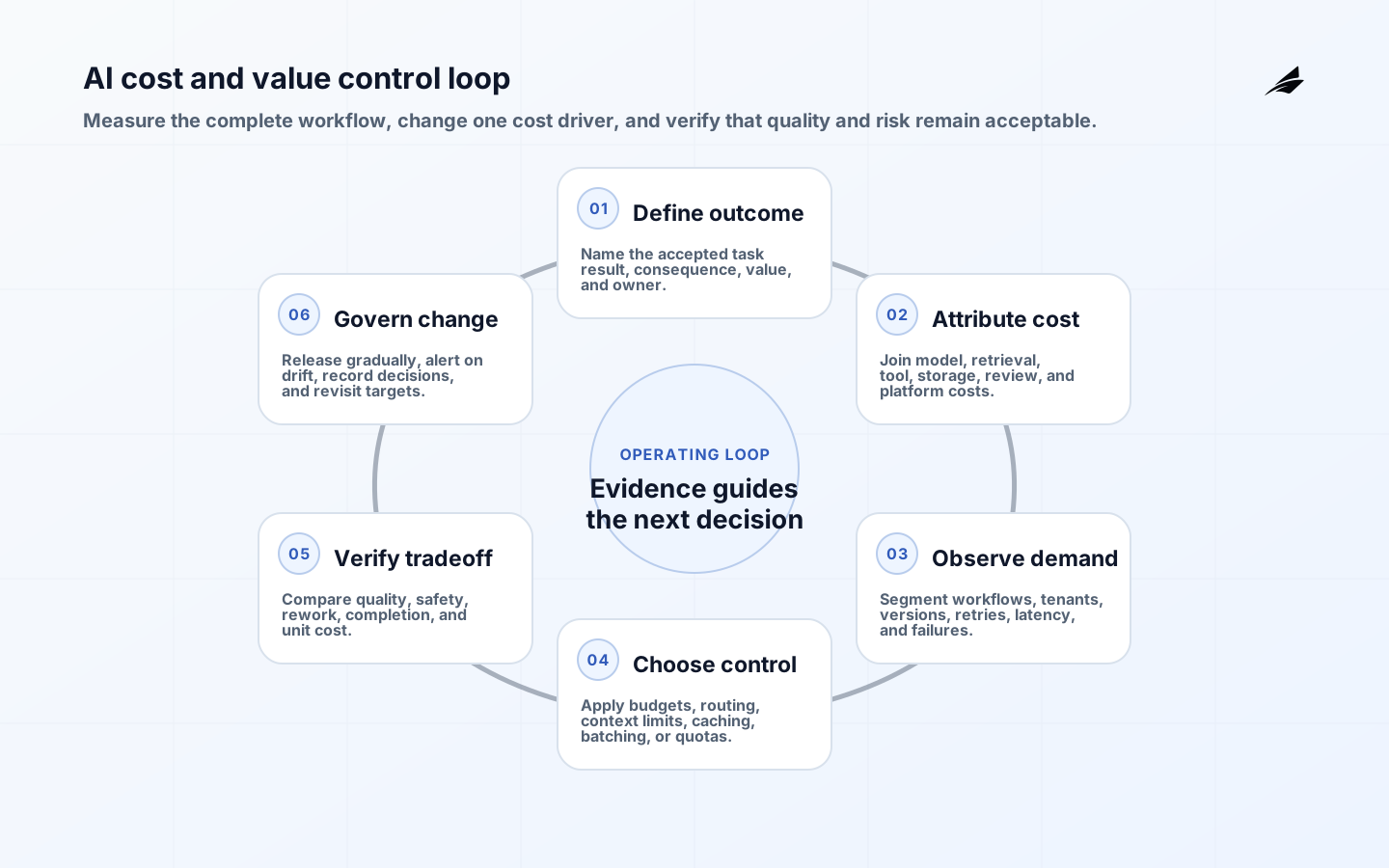
AI cost controls should protect the economics of a useful outcome, not merely reduce token volume. A completed support resolution, reviewed document, accepted classification, or developer task may involve retrieval, model calls, tools, retries, safety checks, human review, storage, and observability. Engineering teams need a unit that connects those costs to quality and value. Otherwise a cheaper configuration can appear successful while producing more rework, escalation, latency, or harmful errors.
Measure cost per accepted outcome, not tokens alone
The FinOps Foundation defines unit economics as connecting technology spend with the value it creates. Its current guidance notes that generative AI programs often begin with cost per token and mature toward cost per assist, agent action, or case deflected. The FinOps for AI category also highlights granular, unpredictable spend that crosses providers, SaaS, data centers, and model vendors. Build an allocation model that records product, tenant, workflow, model, prompt or policy version, retrieval use, tool use, retry reason, latency, outcome, and review disposition without storing sensitive prompt content unnecessarily.
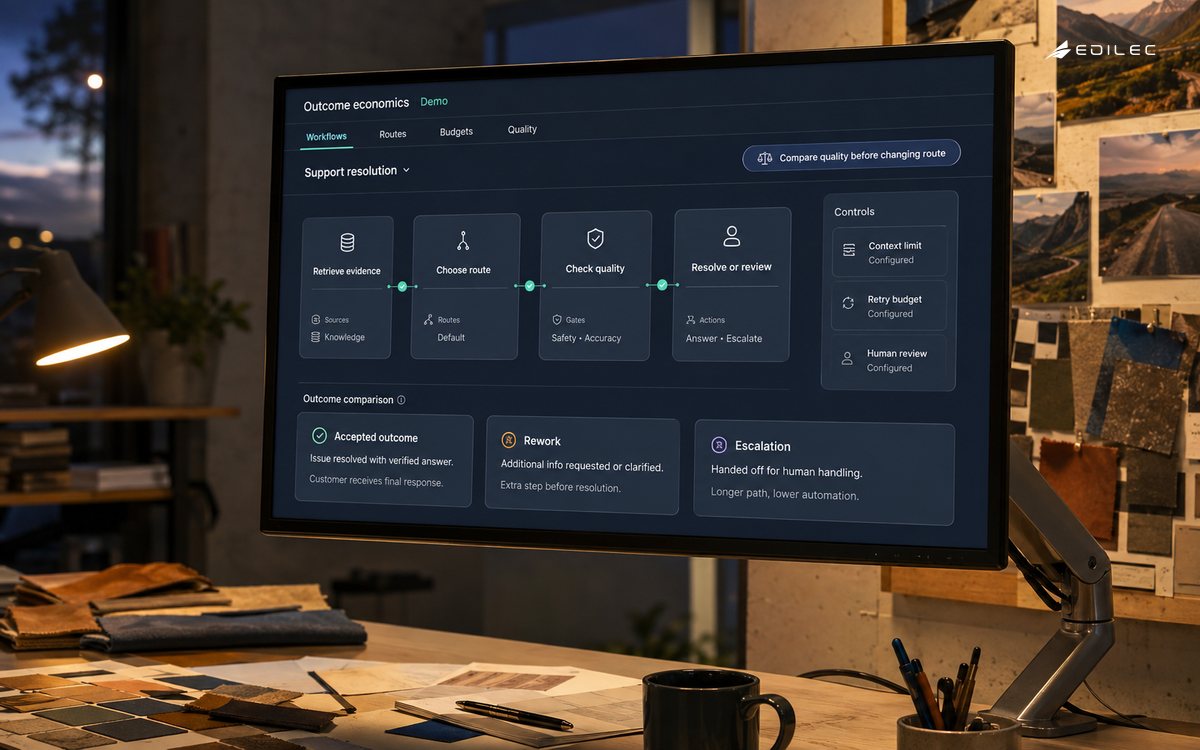
Use controls in layers. Prevent accidental demand with authentication, quotas, concurrency limits, timeouts, maximum tool steps, and bounded context. Improve efficiency with caching where correctness permits, smaller representations, retrieval filters, batch work, and model routing validated against the task. Stop runaway behavior with circuit breakers and spend-rate alerts. The NIST AI RMF connects measurement to ongoing risk management, and the NIST Generative AI Profile emphasizes evaluation across the lifecycle. Every cost optimization should therefore run through the same quality, safety, and rollback checks as any other product change.
| Control | Cost effect | Quality safeguard |
|---|---|---|
| Context budget | Limits repeated history, retrieved passages, and oversized attachments. | Evaluate whether required evidence remains available. |
| Model routing | Uses lower-cost capability for bounded tasks and escalates harder cases. | Route by measured task class, confidence, and consequence. |
| Cache or reuse | Avoids equivalent computation and repeated retrieval. | Key by policy and source version; never serve stale or unauthorized output. |
| Workflow limit | Bounds retries, tool calls, time, concurrency, and total spend. | Return an explicit partial or escalated state rather than silent truncation. |
Measure the full cost of a valuable outcome
Choose a unit such as a resolved support case, approved document, completed analysis, or correctly routed incident. Record the baseline time, quality, and cost before introducing new controls. Attribute direct provider charges and the surrounding system costs by workflow, model route, tenant, and feature where reasonable. Separate predictable workload from experiments, abuse, retries, and failed jobs; otherwise a useful service can appear uneconomic because it is carrying unrelated demand. Cost data should be timely enough for operational decisions but paired with quality signals, because reducing context, retrieval, or review can lower spend while increasing expensive rework downstream.
| Cost component | Question to ask | Control example |
|---|---|---|
| Inference | Which task and route consumed it? | Per-workflow budgets and model routing. |
| Retrieval and storage | Does the corpus improve the outcome? | Retention, index scope, and caching review. |
| Tools and retries | What side effects or failures repeat? | Idempotency, timeout, and retry limits. |
| Human review | Which corrections are recurring? | Fix upstream source, rule, or interface defects. |
Instrument demand before restricting it
Capture a trace that links a user or service request to model route, prompt and context size, retrieval count, tool calls, retries, latency, and final outcome. Avoid retaining sensitive content when identifiers and summaries will support cost analysis. Tag experiments and internal tests so they do not distort production unit economics. Classify requests into meaningful shapes: simple extraction, grounded question answering, complex multi-step work, and malformed or abusive traffic. This reveals where routing or product design can help. A broad “average cost per request” conceals the long tail that may deserve a different model, a smaller context, a queue, or a refusal.
Use controls that preserve the task outcome
Start with product and workflow controls before aggressive model reduction. Limit unbounded input sizes, require structured fields where possible, prevent duplicate submissions, and cache stable results with clear invalidation rules. Route simple, low-consequence work to an appropriate cheaper path only after evaluating it against the defined quality bar. Set timeouts, maximum tool turns, retry budgets, concurrency limits, and per-tenant quotas with a visible response when a limit is reached. Design graceful degradation: a system might offer retrieved documents without a generated synthesis, defer a long job, or request clarification rather than silently returning a weaker answer. AI agents need especially clear turn and tool budgets because autonomy can multiply cost quickly.
| Change | Likely saving | Quality check |
|---|---|---|
| Shorter approved context | Lower input cost and latency. | Check evidence coverage and unsupported claims. |
| Task-based model routing | Lower cost on simple work. | Compare route errors by impact level. |
| Semantic cache | Avoid repeat computation. | Verify freshness and user-specific permissions. |
| Tool-call cap | Bound runaway execution. | Confirm complex valid cases have an escalation path. |
Put budgets in an accountable operating loop
Budgets are useful when someone can interpret and act on them. Establish normal ranges, alert thresholds, and an owner for workflow, platform, and vendor anomalies. Review cost alongside completion rate, correction effort, latency, safety incidents, and user abandonment. A sudden increase may indicate a product change, a source explosion, a retry defect, or an attack; the response should follow evidence rather than automatically degrading service. Use forecast scenarios based on observed demand and capacity limits, not only a single growth assumption. FinOps practices are valuable here because cost ownership is shared among engineering, finance, and product rather than isolated in a billing report.
Test savings as product changes
Treat a cost control as a release with hypotheses, evaluation cases, observability, and rollback. Compare before and after results across normal and difficult task slices. Watch for displaced cost: a shorter model call might produce more reviewer edits, support contacts, or repeat searches. Review abuse controls for fairness and ensure legitimate high-volume users have an accountable route. The fine-tuning decisions guide is relevant when a customization proposal claims savings; compare its full training, evaluation, and operational cost with simpler measures.
Implementation checks
| Operating check | Concrete practice | Why it matters |
|---|---|---|
| Outcome ledger | Join each workflow outcome to inference, retrieval, tool, and review cost. | Spend is interpreted against delivered value. |
| Demand classes | Separate ordinary, complex, experimental, malformed, and abusive requests. | One outlier class does not distort a useful route. |
| Context budget | Set a maximum context size with a measured fallback strategy. | Savings do not silently remove required evidence. |
| Tool budget | Limit turns, retries, and concurrency with idempotent recovery. | Failures cannot create unbounded expense. |
| Route evaluation | Compare model routes by quality, latency, and correction effort. | Cheaper choices remain proportionate to consequence. |
| Cache policy | Specify eligibility, invalidation, tenant scope, and permission checks. | Repeated work is reduced without serving stale data. |
| Budget ownership | Assign response roles for workflow, platform, and vendor anomalies. | Alerts lead to diagnosis rather than indiscriminate throttling. |
| Savings review | Measure displaced support, rework, and review time after every change. | Cost reduction is verified as a product improvement. |
Cost reviews are most useful when they are attached to product choices. A long context window may be justified for an investigation but wasteful for a simple classification; a review step may cost money but prevent a much larger correction later. Make those trade-offs explicit in the workflow definition and identify who can authorize an expensive route. This allows engineers to optimize the ordinary path without making exceptional work impossible. It also gives finance an explanation of cost variation that is grounded in service demand rather than a mysterious change in provider invoices.
Build alerts around unusual combinations rather than a single spend number: high retry rate with low completion, higher context size after a source release, more tool turns after a policy change, or a steep rise in a single tenant’s failed requests. Each combination suggests a different investigation. Attach a runbook that says what evidence to inspect and who owns the next decision. When a limit is applied, record the user-facing impact and the recovery route. A budget control that silently abandons a critical task creates a cost problem somewhere else.
Cost attribution should be precise enough to change behavior without becoming a second product to maintain. Start with a few workflow tags and a reliable way to distinguish normal traffic from failed or experimental traffic. Validate the tags against sampled traces and billing data before acting on them. When teams see an attributable cost, give them a decision they can actually make: remove duplicate work, choose a route, set a retention rule, or escalate a valuable exception. This keeps cost controls connected to engineering work instead of producing reports that nobody can safely interpret.
Review the control after an incident and record whether the limit protected the outcome or merely deferred the cost to another team. Update the workflow runbook when that answer changes.
Key takeaways
- Measure cost per verified outcome, not only per model call.
- Trace model, retrieval, tool, retry, and human-review costs to workflow demand.
- Classify request shapes before choosing quotas or cheaper routes.
- Guard against runaway execution with limits and visible degradation behavior.
- Evaluate every saving against quality, safety, latency, and downstream rework.
- Give product, engineering, and finance shared ownership of budget decisions.
Frequently asked questions
Is a cheaper model always the first answer? No. Input design, caching, duplicate prevention, retrieval scope, and workflow routing often reduce cost without changing model capability. Should users see limits? They should receive an understandable state and an alternative route rather than an unexplained failure. How do we detect cost abuse? Compare request shape, identity, retries, tool depth, and outcome against expected patterns, then investigate without assuming all unusual use is malicious.
Conclusion
Effective AI cost controls make valuable work predictable without silently damaging it. Measure the full path, segment demand, make expensive routes intentional, and test savings against the outcome users and operators actually need.