AI guardrails for product teams are designed boundaries that keep an AI-enabled workflow within its intended purpose, authority and recovery capacity. They include ordinary product decisions such as who may use the feature, which data it may access, what the model may propose, which actions software may execute, when a person must decide, and what happens when confidence is inadequate. A blocked-word list or model safety setting can contribute, but neither governs the complete user journey.
Product leaders should start from people and consequences rather than the model. The NIST AI Risk Management Framework organizes risk work through Govern, Map, Measure and Manage. Its structure is useful because guardrails depend on context and continuing evidence, not a one-time test. Pair this article with Edilec's guides to human-in-the-loop automation, AI agents and retrieval-augmented generation when the product retrieves company knowledge or acts through tools.
Define intended use and credible harm
Write a narrow use statement: which user, in which workflow, uses the system for which decision or task, with what level of authority. Then list foreseeable misuse and failure. A support drafting assistant can produce inaccurate policy statements, expose another customer's records, overstate certainty or encourage an agent to send an unreviewed promise. The harm is not simply “bad output”; it may be financial loss, discrimination, privacy breach, unsafe action, loss of appeal or operational delay. Include people affected by outputs even if they never interact with the interface.
Define where AI is optional, assistive or decisive. A system may summarize evidence but not determine eligibility; recommend a refund but not issue it above a threshold; classify routine requests but route ambiguous cases. State prohibited uses in product and access controls, not only policy text. If the same general model serves several workflows, keep separate system prompts, data scopes, evaluation sets and authority. Broad reuse can silently expand risk beyond the evidence gathered for the original feature.
| Product decision | Guardrail question | Evidence |
|---|---|---|
| Audience | Who may invoke the capability? | Role and eligibility test |
| Purpose | Which task and outcome are allowed? | Use statement and prohibited cases |
| Data | Which records may enter context? | Permission-filter and tenant-boundary tests |
| Output | What form, claims and uncertainty are acceptable? | Representative evaluation results |
| Action | What may software execute? | Tool policy, limits and approval log |
| Recovery | How can a person correct or appeal? | Fallback exercise and support route |
Layer guardrails across the system
No single guardrail is reliable enough for every failure. Prevent unsupported use through feature access and workflow scope. Minimize input through permission-aware retrieval and data classification. Shape behavior with clear instructions and structured outputs. Validate critical fields in deterministic code. Constrain tools with allowlists, parameter schemas, value limits, idempotency and authorization at execution time. Require human approval for consequential or ambiguous actions. Observe outcomes and provide a kill switch or safe degraded mode.
Treat model refusals as one layer, not the enforcement boundary. Models can misunderstand instructions, and adversarial or accidental content can alter behavior. The OWASP Top 10 for LLM applications describes risks including prompt injection, sensitive information disclosure, improper output handling and excessive agency. A product guardrail should assume that model output is untrusted data. Escaping output, validating commands and authorizing the final action belong in conventional software outside the model's discretion.
Design context and data boundaries
Specify which sources may enter the context window, under whose permissions, for which purpose and for how long. Retrieval should enforce tenant and record access before results reach the model. Remove irrelevant personal or secret data, and distinguish user-supplied content from trusted instructions and system records. External pages, documents and tool results may contain hostile instructions; label and delimit them as data. Do not let the model choose a broader data scope than the authenticated user is allowed to query.
Product interfaces should explain source and freshness where they matter. Cite retrieved records for factual answers, make missing evidence visible and let users inspect the context used. A citation does not prove that the claim follows from the source, so evaluation should test faithfulness as well as source presence. Define retention for prompts, outputs, feedback and traces. Operational logging must not become an uncontrolled copy of sensitive conversations. Use redaction and access controls, and preserve only the detail needed for support and evaluation.
- Filter retrieval by the user's effective permissions before semantic ranking.
- Separate trusted system instructions from untrusted retrieved or user content.
- Validate structured outputs against schemas and business rules.
- Require source references for claims that depend on company records.
- Redact sensitive fields before telemetry and evaluation storage.
- Provide a clear path to report, correct and remove harmful content.
Bound tools and actions outside the model
An agent that can search, send, change or purchase needs a capability model. Give each tool a narrow business function and let the application authorize every call using current user and resource context. Limit amounts, recipients, record populations and rate. Use preview and confirmation for irreversible or external effects. Separate planning from execution so a model can propose an action without automatically obtaining authority. Never place a high-privilege credential in the model context or rely on a prompt to prevent misuse.
Design retries and partial failure. A timed-out action may have succeeded, so retries need idempotency and result lookup. A multi-step workflow may need compensation or human recovery. Record the proposed action, validated parameters, policy decision, executor, external result and final state. Human approval should show the evidence and consequence, not a vague “approve AI” button. The reviewer must be able to change or reject the proposal and know whether the action has already occurred.
| Action class | Default control | Escalate when |
|---|---|---|
| Read approved knowledge | Permission filter and source display | Source is missing, stale or conflicting |
| Draft internal text | User review before adoption | Content affects policy or a person's rights |
| Send external message | Preview, recipient restriction and confirmation | Promise, legal claim or sensitive data is involved |
| Change a record | Schema, authorization and audit event | High-value or cross-tenant object is affected |
| Trigger payment or deletion | Deterministic limit and independent approval | Threshold, anomaly or irreversible effect occurs |
| Run privileged administration | Prohibit or route to controlled operator workflow | Always |
Evaluate the complete user journey
Build an evaluation set from real task categories, edge cases, denied requests, ambiguous inputs and affected user groups. Score the final workflow outcome, not only model similarity. Useful dimensions include task success, groundedness, harmful omission, privacy, authorization, refusal quality, human correction effort, latency and cost. Include multi-turn and tool-use cases where state can drift. Compare with the non-AI baseline so the team knows whether the feature reduces work or merely changes where errors appear.
Set release thresholds by consequence. A brainstorming aid can tolerate more variation than a system drafting medical, financial or employment decisions. Review failure clusters rather than relying on one average. The NIST AI RMF Playbook supplies suggested actions across governance, context mapping, measurement and management. Product teams should adapt those actions to the workflow and record why a threshold, reviewer or fallback is proportionate.
Design user control, fallback and appeal
Users need to know when AI is involved and what responsibility remains with them. Show uncertainty and source limitations in the moment of use, not in distant terms. Make it easy to edit a draft, choose a non-AI route, escalate a case and report a harmful result. Avoid interfaces that pressure reviewers to accept through default selection, buried evidence or high-volume queues. Measure whether reviewers meaningfully correct outputs; nominal approval with no time or context is not effective oversight.
Fallback should preserve the underlying service. If the model, retrieval system or safety service is unavailable, decide whether the feature pauses, becomes manual, returns approved search results or offers a smaller deterministic path. Protect user work during transition. Communicate degradation and expected resolution. Test disabling the capability without redeploying the entire product, and ensure queued actions cannot execute after a kill switch unless deliberately resumed.
Operate a product guardrail loop
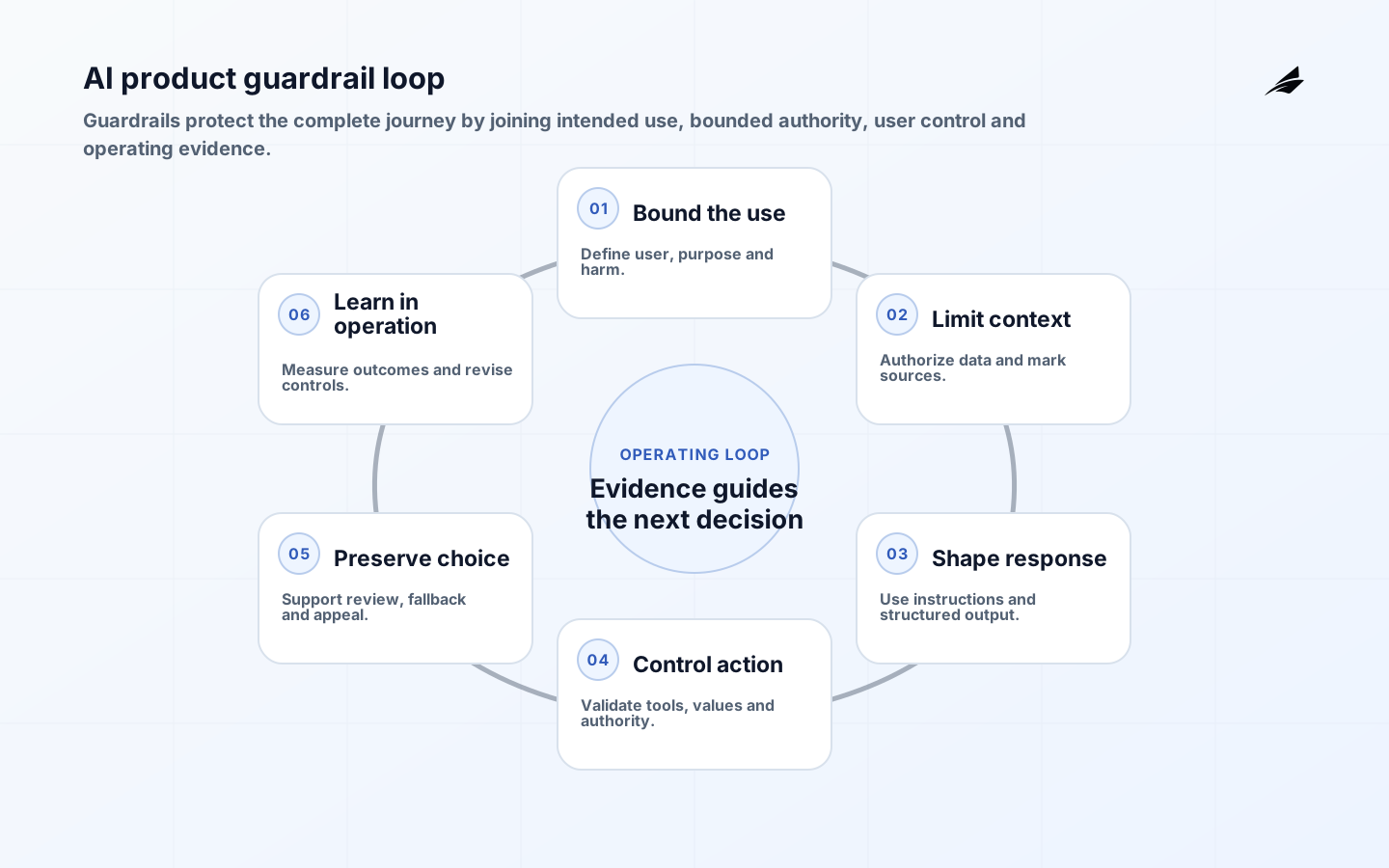
The diagram follows one AI-enabled interaction from intended use and context through generation, deterministic checks, bounded action, user control and operating review. Evidence from corrections, denials, incidents and outcome metrics feeds the next release. This loop matters because models, data, prompts, tools and users change. A guardrail that passed a launch test can degrade after a model update or workflow expansion, so every material component needs versioning and reevaluation triggers.
Monitor outcomes and change safely
Version model, prompt, retrieval configuration, tools, policy and evaluation set. Release through a limited cohort and compare guardrail outcomes with the prior version. Monitor harmful or unsupported responses, permission denials, tool failures, human overrides, complaints, latency and cost alongside business value. Investigate changes by user group and task category. The NIST Generative AI Profile highlights risks such as confabulation, data privacy, information integrity and human-AI configuration; a balanced scorecard prevents quality improvements from concealing a safety regression.
Key takeaways
- Start guardrails from intended use, affected people and credible harm.
- Layer access, context, model, output, action, human and recovery controls.
- Treat model output and retrieved content as untrusted until validated.
- Evaluate the complete workflow against representative and adverse cases.
- Give users meaningful review, fallback, correction and appeal paths.
- Version every material component and monitor safety with product value.
Frequently asked questions
Is content moderation an AI guardrail?
Yes, for defined content risks, but it is one layer. It does not enforce record permissions, tool authority, transaction limits, source accuracy or user appeal by itself.
When is human review necessary?
Use it when context, rights, high consequence or uncertainty requires accountable judgment. The reviewer needs evidence, authority, time and a usable alternative; otherwise the approval step is decorative.
Who owns AI guardrails?
Product owns the intended workflow and user outcome. Engineering, security, privacy, risk, operations and domain owners implement and review specific boundaries. One accountable product or service owner coordinates the whole system.
Conclusion
AI guardrails become credible when they are part of product architecture rather than a filter attached to model output. Define the allowed job, control context and authority, evaluate realistic journeys, preserve meaningful human choice, and prepare a fallback. Then observe the service as models and use change. That approach supports useful AI without asking users or operators to absorb risks the product could have prevented.