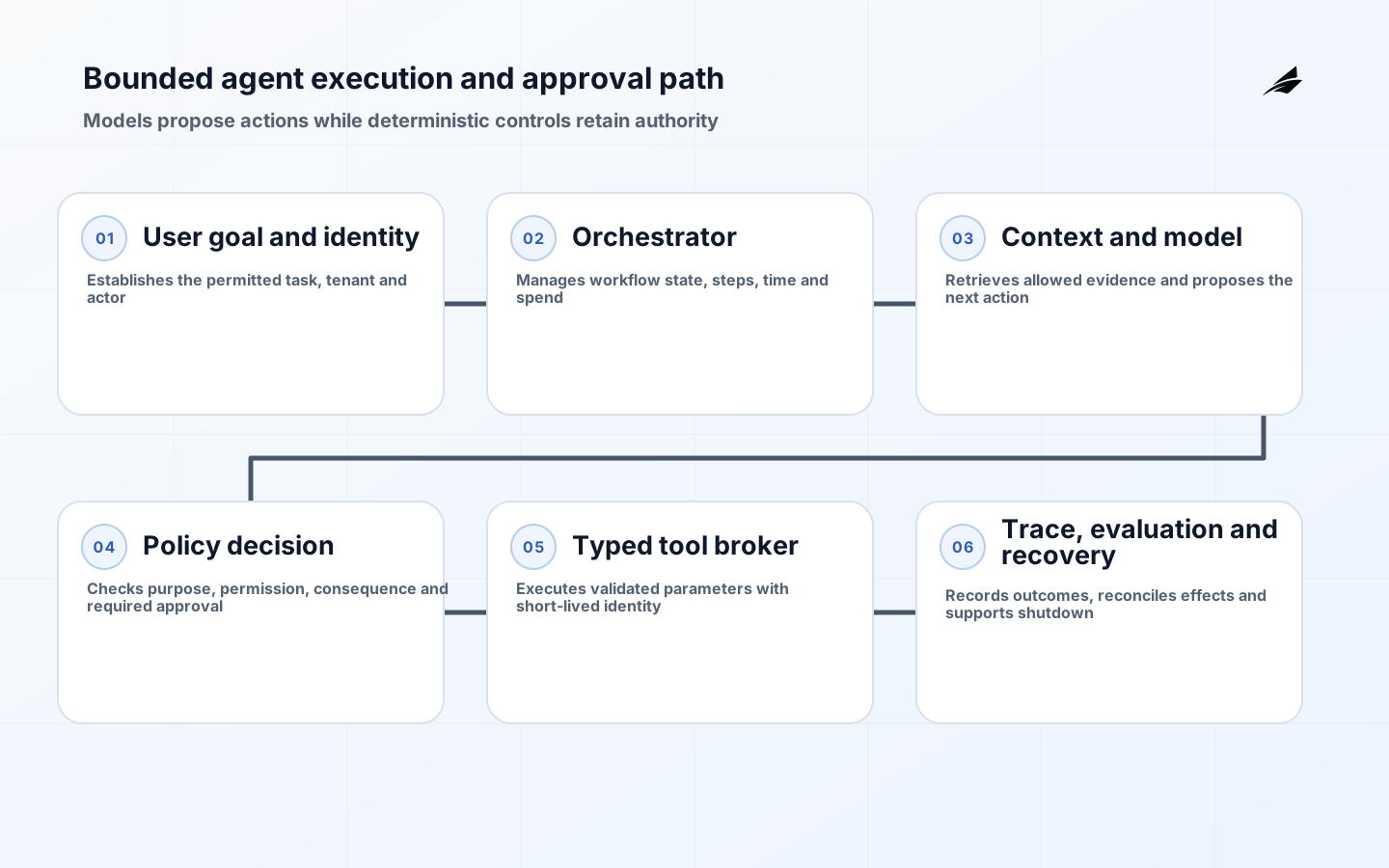
An agentic development platform provides reusable infrastructure for AI systems that select actions, call tools, inspect results and continue toward a goal. It may include model access, prompt and workflow versioning, tool registration, identity, memory, policy, evaluation, tracing, deployment and incident controls. The platform does not make an agent autonomous in a trustworthy sense. Reliability comes from a bounded workflow, controlled authority, observable execution and accountable people who decide where automation is appropriate.
Start with a task whose inputs, allowed actions, success conditions and escalation path can be described. Drafting a support response from approved records is easier to bound than letting an agent issue refunds, alter accounts and contact customers. Autonomy is not a maturity ladder that every use case should climb. The appropriate level depends on consequence, reversibility, uncertainty, time sensitivity and detection. A deterministic workflow with one model-assisted step may be safer and more valuable than an open-ended planner.
Key takeaways
- Select a bounded workflow before selecting a framework or model.
- Give every agent and tool call a real workload identity with least privilege and short-lived credentials.
- Treat retrieved content, tool output and messages as untrusted data that can influence the model.
- Evaluate the complete trajectory, including tool choice and side effects, not only the final answer.
- Require approval or deterministic policy for consequential, irreversible and high-uncertainty actions.
- Version prompts, models, tools, policies and datasets so production behavior can be reconstructed.
Scope autonomy by consequence and reversibility
Map the workflow as states: intake, context gathering, planning, tool selection, proposed action, validation, approval, execution and closure. For each state, define permissible data, tools, timeout, retry, budget and stop condition. Identify effects outside the platform, such as a sent message, changed record, created credential or financial transaction. Those effects need idempotency, confirmation and reconciliation. An agent should not infer authority from a natural-language request when enterprise policy can resolve it explicitly.
Use an autonomy matrix. Low-consequence, reversible actions may run automatically within limits. Medium-consequence actions can require deterministic validation or sampled review. High-consequence or irreversible actions should require a competent human or a separately authorized service to approve the exact proposed effect. Human review is meaningful only when the reviewer sees source evidence, proposed parameters, policy warnings and alternatives, and has enough time and authority to reject. A button added after the decision is effectively made is not oversight.
| Action class | Example | Control before execution | Recovery |
|---|---|---|---|
| Read | Search approved knowledge | Permission-aware retrieval and data filtering | Remove leaked context and investigate |
| Draft | Prepare an internal response | Source display and content policy | Discard or edit draft |
| Low-risk write | Add a tagged note | Schema validation, scope and idempotency | Delete or supersede note |
| External communication | Send customer message | Approval of recipient and final content | Correction and incident path |
| Sensitive change | Modify access or payment state | Independent authorization and step-up approval | Compensation and reconciliation |
| Irreversible action | Delete regulated record | Prohibit or require formal controlled workflow | Restore only if protected copy exists |
Separate orchestration, policy and tool execution
A practical architecture has an interaction layer, orchestrator, policy decision point, context service, model gateway, tool broker, state store, evaluation service and telemetry pipeline. The orchestrator manages workflow state and budgets. The policy layer checks whether an action is allowed for this identity, tenant, data and environment. The tool broker validates typed parameters and executes with a scoped identity. Models propose; deterministic components enforce authority and invariants. This separation makes controls testable and limits framework-specific coupling.

Keep short-lived execution state distinct from durable memory. Persist only information with a defined purpose, provenance, access rule, retention and correction path. Conversation summaries can contain model errors and should not silently become authoritative facts. Tool results need source and timestamp. Encrypt sensitive state and segregate tenants. Define maximum steps, tokens, wall time, tool calls and spend per run. Terminate loops that repeat actions, fail to make progress or encounter an unapproved state.
Secure tools as privileged interfaces
Register each tool with owner, purpose, input and output schema, data classification, allowed environments, side effects, authentication method, limits and incident contact. Avoid a generic shell, database or HTTP tool when a narrow business operation can be exposed. Resolve resource identity server-side and authorize the specific object and function. Use short-lived credentials bound to the workload and user delegation where required. Never place durable secrets in prompts, traces or model-visible configuration.
Prompt injection can arrive through user text, documents, web content, emails or tool output. Retrieval and filtering do not eliminate it. Label untrusted content, minimize it, keep instructions separate where the platform permits, restrict tools independently, and require approval for sensitive effects. Validate tool output before feeding it onward. Apply egress controls and destination allowlists to tools that fetch resources. OWASP agentic guidance and MITRE ATLAS are useful threat references, but teams need a use-case-specific threat model.
| Risk | Preventive control | Detection and response |
|---|---|---|
| Behavior hijacking | Bound instructions, untrusted-content handling and limited tools | Trajectory alerts and adversarial evaluations |
| Tool misuse | Typed narrow tools and policy checks | Denied-call and unusual-parameter monitoring |
| Privilege abuse | Scoped workload identity and delegation | Access review and credential revocation |
| Memory poisoning | Provenance, write policy and correction | Memory diff and suspicious-source review |
| Runaway loop | Step, time, token and spend budgets | Loop detector and forced termination |
| Repudiation | Immutable action record and correlation | Reconstruct run and reconcile side effects |
Evaluate decisions, trajectories and outcomes
Build an evaluation set from representative and difficult cases before production. Include missing data, conflicting instructions, denied permissions, malicious documents, tool timeouts, duplicate events and requests outside scope. Score task completion, factual support, policy compliance, tool selection, argument correctness, unnecessary actions, escalation quality, latency and cost. For consequential actions, false-positive and false-negative consequences may differ, so aggregate accuracy is insufficient. Review performance by user, language and risk-relevant segment where lawful and appropriate.
Test components and end-to-end runs. Unit tests cover tool schemas and policy. Simulations use fakes to check workflow and side effects. Model evaluations replay a versioned dataset under fixed configuration. Adversarial tests explore prompt injection, authority confusion and data leakage. Shadow mode compares proposals with real work without executing. In production, sample traces under privacy controls and monitor changes in tool distribution, denial, escalation, abandonment and corrections. A model update, prompt edit or tool schema change can all require re-evaluation.
Create governance that can stop or narrow the system
Apply NIST AI RMF functions iteratively: govern roles and risk tolerance; map context, users and impacts; measure performance and risk; manage through prioritization and response. Maintain an agent registry containing owner, purpose, users, model, tools, data, autonomy class, evaluation record, deployment and review date. Define prohibited uses and an exception process. Risk acceptance belongs to a named authority, not the developer who happens to own the prompt.
Provide kill switches at workflow, tool, tenant and deployment levels. Incident response should preserve prompts, configuration, tool calls, approvals and side effects while respecting data controls. Revoke credentials, stop new runs and reconcile incomplete actions. Communicate with affected operational and security owners. Post-incident work should update datasets, policies, runbooks and architecture. Do not rely solely on adding a sentence to the system prompt after a control failure.
Model cost and roll out through gates
Cost includes model input and output, retrieval, tool infrastructure, evaluation, observability, security review, human approval, support and incident handling. Long trajectories multiply consumption and latency. Model cost per completed acceptable task, not per token or run, and include retries and rejected outputs. Compare with deterministic automation and workflow redesign. A cheaper model can be more expensive if it increases review and correction; a strong model cannot repair an unnecessary process.
Use frame, prototype, evaluate, shadow, limited pilot and controlled expansion gates. The prototype proves interfaces, not readiness. Evaluation must meet predefined thresholds. Shadow mode exposes context and workflow gaps. A pilot limits users, tools, data and time with staffed support. Expansion follows stable quality, security and operational evidence. Define rollback as disabling execution, preserving state and reconciling side effects, not merely switching models. Revisit scope when the system repeatedly needs broad exceptions.
Frequently asked questions
What makes an AI system agentic?
The useful distinction is that it can select and sequence actions or tools based on intermediate results rather than produce one response. The label covers a wide range of autonomy. Architecture and controls should describe actual capabilities and effects instead of relying on the word agent.
Does human approval make an agent safe?
Not by itself. Reviewers need clear evidence, usable controls, time and authority, while deterministic systems still enforce access and transaction rules. Review fatigue, misleading summaries and irreversible pre-approval actions can make nominal oversight ineffective.
Should an enterprise build or buy the platform?
Assess needed workflow control, identity integration, data boundaries, evaluation, portability, operations and skills. Managed services can reduce undifferentiated work, but the enterprise still owns use-case design, configuration, approvals and outcomes. Preserve exportable traces, prompts, datasets and tool contracts and plan exit.
Operational acceptance must include trained support ownership and a rehearsed failure response. The exercise should include an interrupted tool call, ambiguous side effect, expired credential and escalation so responders prove they can establish state without asking the model to reconstruct authority.
Conclusion
An agentic platform is valuable when it makes bounded AI-assisted workflows easier to build, test and govern. Begin with a task and consequence model, separate model proposals from policy and execution, and expose narrow tools with real identities. Evaluate trajectories against difficult cases, observe production effects and retain the ability to stop, reconcile and learn. This discipline allows teams to use adaptive planning where it helps while keeping authority, evidence and accountability in systems and people that can reliably carry them.