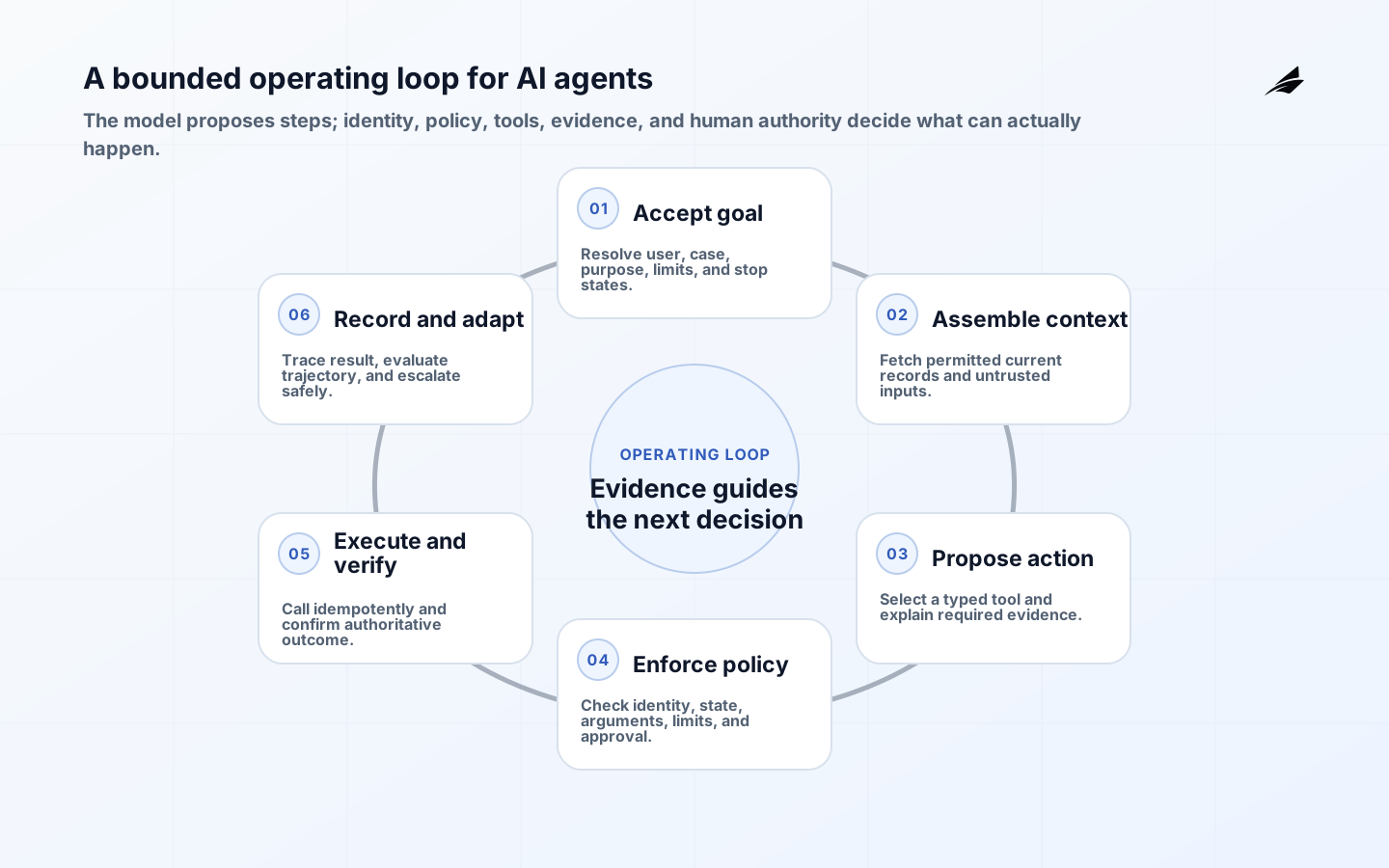
AI agents for automation combine a model with state, tools, and a loop that selects the next action. That architecture can coordinate multi-step work, but it can also repeat expensive calls, trust hostile context, misuse valid tools, or report success before the underlying business state is complete. Production design therefore begins with a bounded job and an authority model. Define the terminal states, allowed tools, identity, data scope, step and spend limits, approval transitions, and recovery owner before optimizing prompts. The model may interpret context and propose a path; deterministic services should still enforce permissions, schemas, destinations, transaction rules, and consequential approvals. Autonomy is not a single setting. It is a series of explicitly granted capabilities that should be earned with evidence.
Start with the agent's bounded job
Write the job in one sentence, then write the unacceptable outcome beside it. For AI agents, the operating question is not whether the technology is impressive; it is whether a named person can complete a bounded task with appropriate evidence and control. An agent with broad tools and vague success criteria can chase irrelevant context, repeat expensive steps, call the wrong system, or make a plausible but unauthorized change. More autonomy magnifies the cost of unclear identity and missing stop conditions. The NIST AI Risk Management Framework supports this discipline by connecting intended context, measurement, governance, and management rather than treating risk as a late security review. How CTOs Should Think About Multimodal AI is a useful adjacent reference, but it should not replace a local description of the decision owner and failure boundary.
| Decision element | Question to settle | Evidence to keep |
|---|---|---|
| User and outcome | Who uses AI agents, and what completed work changes for them? | A task definition, accountable owner, and a measurable acceptance condition. |
| Authority boundary | What may be read, drafted, proposed, submitted, or changed? | A policy rule, identity claim, approval record, and revocation path. |
| Failure response | What happens when evidence is absent, conflicting, stale, or unsafe? | A visible abstention, escalation route, and incident or correction record. |
Build an evidence boundary
Define the goal, allowed inputs, allowed tools, data scope, maximum steps, time budget, expected terminal states, and handoff owner. Treat every tool as an API product with typed inputs, policy enforcement, idempotency where possible, and a meaningful error response. This is where seemingly small implementation choices become operational commitments. A source link or event record must remain meaningful after a deployment, an employee role change, or a correction. The UK National Cyber Security Centre guidance emphasizes secure design, development, deployment, and operation as connected activities. Use that lifecycle view to assign an owner to the inputs, the policy, and the response when an AI agent behaves unexpectedly.
- Name the source systems, people, and decisions that AI agents depends on; do not bury them in configuration alone.
- Classify information and actions by consequence, then choose controls that operate at the boundary where the consequence occurs.
- Keep an inspectable record of the input, material context, policy result, and output or side effect for cases that matter.
- Design a correction path that can remove or repair a bad record and tell an operator what work may have been affected.
- Practice the uncertain case. A system that can only handle happy-path inputs has not yet earned autonomy.
Put controls where they can enforce
Bind tools to the end user or service identity, not to a shared superuser credential. Require approvals for material transitions, validate arguments outside the model, restrict network destinations, and store a trace that links intent, evidence, tool call, result, and final state. The OWASP guidance for LLM applications is particularly relevant when untrusted content can influence model behaviour or tool use: controls need to survive hostile and malformed inputs, not merely ordinary requests. For AI agents, prefer deterministic enforcement for identity, limits, destinations, schemas, and approvals. A model can help interpret context; it should not be the final authority for a rule that a service can verify directly.

| Control layer | What it protects | Practical test |
|---|---|---|
| Identity and access | The requester, source, and action scope. | Change membership or role and confirm the prohibited result remains unavailable. |
| Data and context | Currency, completeness, and permitted use of evidence. | Inject an obsolete, conflicting, or incomplete record and verify the response routes appropriately. |
| Action and recovery | Side effects, spend, external calls, and correction. | Force a validation failure or denied approval and confirm the state is safe and observable. |
Measure the work, not just uptime
Evaluate complete trajectories, not only final prose. Track task completion, unsafe or invalid tool attempts, loop length, duplicate calls, recovered failures, approval latency, and the rate at which operators must correct an asserted completion. Keep a small, versioned evaluation set close to the workflow and add real failures after review. Distinguish service availability from decision quality: a system can have low latency and still provide the wrong evidence or trigger costly rework. Review results with the people who understand the task, then turn recurring failure patterns into a test, a source repair, a product change, or a tighter boundary.
Release in bounded steps
Use a read-only or draft-producing agent first. For a deployment assistant, let it inspect a change request and prepare a plan before it can open a pull request; attach execution only after the plan and tools are reliably observable. Define a rollback condition before release, including who can disable the capability and how a human completes the work during recovery. Small launches are valuable when they are instrumented and reviewed; they are not a license to skip permissions, source checks, or error handling. Record the decision to expand with the same care as the initial decision to use AI agents.
Operate AI agents as a living service
Agent operations should include a runbook for the people who own failures. It should say how to pause a workflow, revoke a tool credential, inspect the trace, repair a partially completed task, and contact the owner of an affected external system. Review long or repeated runs as product signals, not just cost anomalies: they often reveal a missing terminal state, ambiguous tool response, or a task that needs a human decision earlier. Maintain scenario tests for retries, duplicate delivery, unavailable tools, changed permissions, and contradictory retrieved context. When an agent is expanded to a new capability, repeat the action inventory rather than assuming the old controls transfer. The agent may be one interface to a user, but operationally it is a chain of systems whose boundaries deserve the same care as any other production workflow.
Evaluate trajectories, side effects, and recovery—not only final answers
The ReAct paper demonstrated interleaving reasoning and action, but a production agent also needs conventional service controls. The NIST Generative AI Profile frames governance and measurement across the lifecycle. The OWASP Top 10 for Agentic Applications 2026 covers goal hijacking, tool misuse, identity and privilege abuse, memory poisoning, and cascading failures. OWASP's LLM guidance adds prompt injection and excessive agency, while the NCSC secure-design guidance recommends threat modeling, least privilege, secure defaults, and restrictions on AI-triggered actions.
| Agent boundary | Deterministic control | Trajectory assertion |
|---|---|---|
| Identity | Bind calls to user or narrowly scoped service identity | A role change immediately removes prohibited tools |
| Tool use | Typed schema, destination allowlist, idempotency | Malformed or repeated calls cannot create side effects |
| Authority | Policy check and explicit approval for material transitions | Denied approval leaves a safe, visible state |
| Resources | Step, time, token, and spend limits | A loop stops, records context, and reaches an owner |
A trajectory test records the initial state, material context, each model decision, policy result, tool call, tool response, state transition, terminal claim, and actual business outcome. Build cases for success, ambiguous goals, stale records, conflicting instructions, denied permissions, injected content, partial tool failure, timeout, duplicate delivery, unavailable approval, and cancellation. Assert invariants at every step: no cross-tenant read, no unauthorized write, no duplicated billable action, no continuation after a denied gate, and no success claim before authoritative confirmation. Measure completion, invalid tool attempts, unnecessary steps, repeated calls, cost, latency, escalation quality, and successful compensation. Replay real incidents after removing sensitive data. A model upgrade should not bypass the same regression and canary discipline expected for other behavior-changing dependencies.
Related implementation guidance
The AI workflow approvals guide helps place human authority at material transitions. The agent memory guide covers retained context, and AI agents in production extends the architecture into on-call, change, and recovery practices.
Keep review evidence actionable
Treat partial completion as a first-class outcome. The run record should say which actions succeeded, which did not, and whether retrying is safe; otherwise a human inherits a confusing state while the system reports a cheerful but misleading completion message.
Assign accountable owners
Define ownership at the tool boundary. Each external capability needs a service owner who can specify valid actions, rate limits, error semantics, and recovery. The agent owner then composes those capabilities under a bounded goal. This avoids a common production gap in which an agent team is accountable for the interface but no one owns the downstream effect of an automated call.
Key takeaways
- AI agents earns trust through a defined job and a named decision owner.
- Evidence, identity, and action boundaries must be explicit before a wider launch.
- Controls are strongest when enforced by deterministic services at the point of consequence.
- Evaluation should include difficult, absent, stale, and adversarial cases, not only successful examples.
- Expansion is a governed operating decision supported by outcomes, not a reward for a polished demo.
Frequently asked questions
An agent is not defined by a brand or a single framework. It is an operational pattern: a model participates in a controlled loop with state and tools. Its reliability comes from the boundaries of that loop. The practical next step is to select one workflow, write its evidence and authority boundaries, and create a small set of cases a domain reviewer can judge. That produces much more useful learning than a broad rollout with no shared definition of success.
Conclusion
An AI agent becomes dependable when its operating constraints are visible: what it is for, what information it may use, what it may do, who can intervene, and how the organization knows it is improving. Start with the consequential decision, preserve the evidence around it, and make uncertainty a safe state rather than something the system hides.