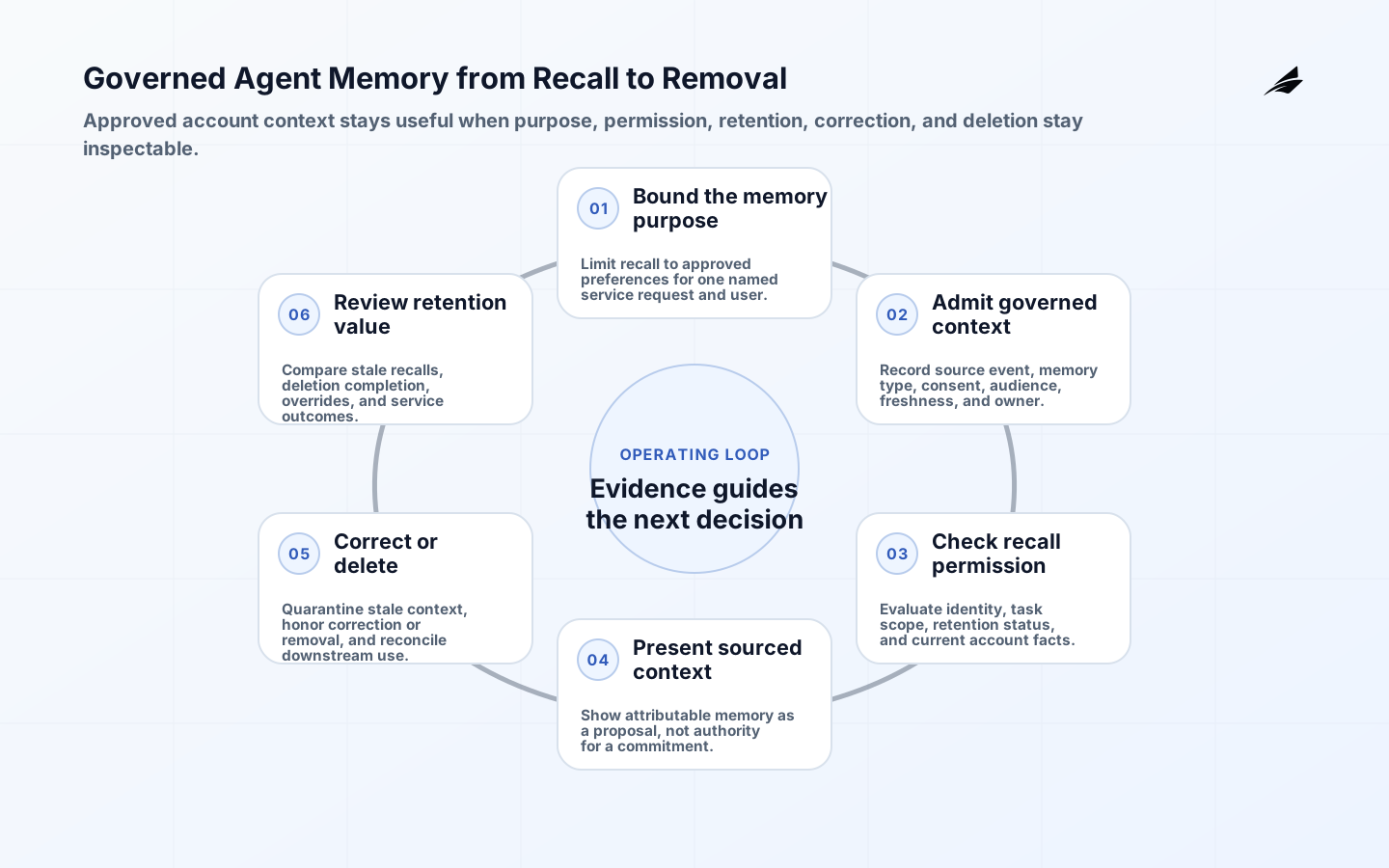
Agent memory is valuable only when it makes a customer-success assistant that recalls approved account preferences for a named service request more dependable for IT managers. In AI automation, the useful unit is not a model feature; it is a work loop with a named user, permitted evidence, a decision boundary, and a recovery route. This guide connects agent memory, memory retention, context management, and deletion workflow to the practical questions an operator has to answer before deployment. Start with one decision where the current manual route is understood. A fluent output or a fast demonstration is not evidence that the resulting action is correct, authorized, current, or reversible.
Set the operating boundary for agent memory
Write a one-page boundary statement for a customer-success assistant that recalls approved account preferences for a named service request. It should name the person using the result, the decision supported, the authoritative record, inputs that may be used, actions the system may propose, and actions it may never complete alone. For this case, the system of record is the current account record and privacy register; it remains the place a user can verify the outcome. This framing forces a productive distinction between assistance and authority. The capability may prepare or rank work, but it should not create a new channel for bypassing policy, access checks, or ordinary accountability. AI governance for growing companies offers a useful companion for assigning those responsibilities before a pilot expands.

| Boundary question | Decision for this workflow | Evidence to keep |
|---|---|---|
| Purpose | Support one named task; exclude autonomous commitments. | Current workflow map and accountable owner. |
| Inputs | Use only a source event, memory type, permission, retention rule, and correction request. | Source version, access decision, and data owner. |
| Output | Return a proposal with source references or a pending state. | Example outputs, reviewer disposition, and rationale. |
| Recovery | Use this fallback: quarantine or delete the memory, use the current account record, and investigate the retention decision. | Pause decision, affected scope, and reconciliation record. |
Design the agent memory work loop before the interface
Map the sequence from request to completed work. A person requests help; the system collects permitted evidence; it creates a structured proposal; independent checks decide whether the proposal is allowed; then a person or a governed service takes the action. Make uncertainty a valid result. When the evidence is missing, contradictory, stale, or outside the allowed scope, the correct outcome is a visible pending state rather than a confident guess. This is especially important for stale or overbroad context quietly changing the answer or exposing information. The NIST Generative AI Profile is helpful here because it frames risk management across the lifecycle rather than as a last-minute model review.
- Use the current account record and privacy register as the reference point when a user needs to check a agent memory result.
- Capture the version of every prompt, model, policy rule, and source that could change the work loop.
- Validate structured fields before an integration consumes them; do not rely on prose interpretation.
- Make an escalation queue part of the normal design, with enough context for the next owner to decide quickly.
- Test the manual route periodically so it remains a real fallback rather than a forgotten promise.
Test agent memory against real work, not a showcase set
Agent-memory evaluation should include corrected preferences, expired consent, conflicting account details, deletion requests, and a new user who must not inherit another person's context. For every test, record whether recalling memory was permitted and whether the answer could have been produced from the current record alone. Measure stale recalls separately from helpful recalls. Reviewers should be able to identify the event that created a memory and the rule that kept it. This exposes retention errors before an apparently personalized assistant becomes a source of quiet misinformation.
| Test slice | What to inspect | Release response |
|---|---|---|
| Routine work | Completeness, evidence match, and user effort. | Release only when results are consistently actionable. |
| Hard cases | Ambiguity, missing data, and conflicting sources. | Require a pending state or an assigned reviewer. |
| Abuse cases | Attempts to change instructions or reach restricted data. | Block the path, retain a minimal security record, and investigate. |
| Changed conditions | New role, source, version, or integration. | Re-evaluate the affected route before normal use resumes. |
Put agent memory controls at decision points
A policy document does not substitute for a control in the path of an action. Attach authorization, validation, and approval checks to the moment they matter. The privacy and data steward should own the workflow boundary, while source owners remain accountable for the records they maintain and security owners can challenge access design. Enforce permissions outside the model, pass only validated arguments to tools, and show reviewers the underlying evidence rather than a confidence score alone. OWASP's Top 10 for Large Language Model Applications is a good reminder that prompt injection, insecure output handling, and excessive agency are system-design problems, not merely wording problems.
Operate agent memory with signals that change a decision
Monitor the whole outcome, not only model latency or token use. The central signal for this workflow is stale-memory and deletion-completion rate. Pair it with volume, source freshness, reviewer overrides, security events, and the time a case spends waiting for help. Segment results by task type, source, role, and version so an average cannot hide a concentrated failure. Set each threshold with an owner and a response: investigate, restrict the feature, correct the source, or pause the route. NIST's AI Risk Management Framework organizes this discipline around governing, mapping, measuring, and managing risk; it is a useful operating cadence, not a promise that a single control removes risk.
- Review stale-memory and deletion-completion rate with a fixed sample of completed and escalated cases.
- Preserve enough trace data to reconstruct the request, evidence, decision, and final outcome without creating an unrestricted copy of sensitive content.
- Treat a cluster of reviewer edits as a product signal, not simply individual user preference.
- Re-test after any material change to a source event, memory type, permission, retention rule, and correction request, the model, a policy rule, or a connected service.
- Report both benefits and exceptions to the owner who can change scope or funding.
Recover from a agent memory failure without losing the lesson
Practice the fallback while the workflow is quiet. A front-line user needs a clear way to flag a questionable outcome; the privacy and data steward needs authority to pause the affected route; and downstream records need reconciliation against the current account record and privacy register. Preserve the evidence that explains the incident, then classify the cause before changing anything. It may be an outdated source, an authorization mismatch, a brittle instruction, a poor test case, or a changed business rule. The UK National Cyber Security Centre's secure AI development guidance supports treating security and resilience as recurring engineering work, including during deployment and maintenance.
Make memory changes inspectable
Treat a memory policy change like a data-governance change. Before adding a new memory type or extending retention, identify the purpose, source, access audience, correction route, deletion behavior, and how users will know that context is in use. Test migrations with accounts that have conflicting or withdrawn preferences. A person should be able to correct the current record without guessing which hidden summary influenced a response. Periodically sample active memories against their source events; this finds records that are technically retained but no longer meaningful for the service being delivered.
Agent memory takeaways
- Begin with a customer-success assistant that recalls approved account preferences for a named service request, not a broad agent memory platform claim.
- Keep the current account record and privacy register visible as the source a reviewer can inspect.
- Use memory retention and context management to improve a bounded work loop, then measure the resulting outcome.
- Make stale or overbroad context quietly changing the answer or exposing information a test case and an escalation condition.
- Assign the privacy and data steward authority to restrict scope or stop the route when evidence changes.
Frequently asked questions about agent memory
Should agent memory make the final decision? Usually not at first. Let it prepare, retrieve, classify, or propose within the boundary, then use an independent rule or accountable person for consequential action. How much evaluation is enough? Enough to represent the work you intend to automate, including the cases where the right response is to stop. Add cases when users correct the system or the operating context changes. What should be logged? Retain the minimum information needed to reproduce an outcome: versions, authorized inputs, evidence references, validations, reviewer decision, and final result. When is expansion justified? Only after the existing route shows stable value, a documented control owner accepts the wider boundary, and the new data or action has been evaluated on its own terms.
Conclusion: make agent memory answer to the work
The practical question is not whether agent memory is impressive in isolation. It is whether it helps a customer-success assistant that recalls approved account preferences for a named service request while preserving authority, evidence, and recovery. Start small, test the awkward cases, measure a result that matters to users, and keep the current account record and privacy register available when automation needs to yield. That combination gives an AI automation program a chance to improve work without making its failures harder to see.