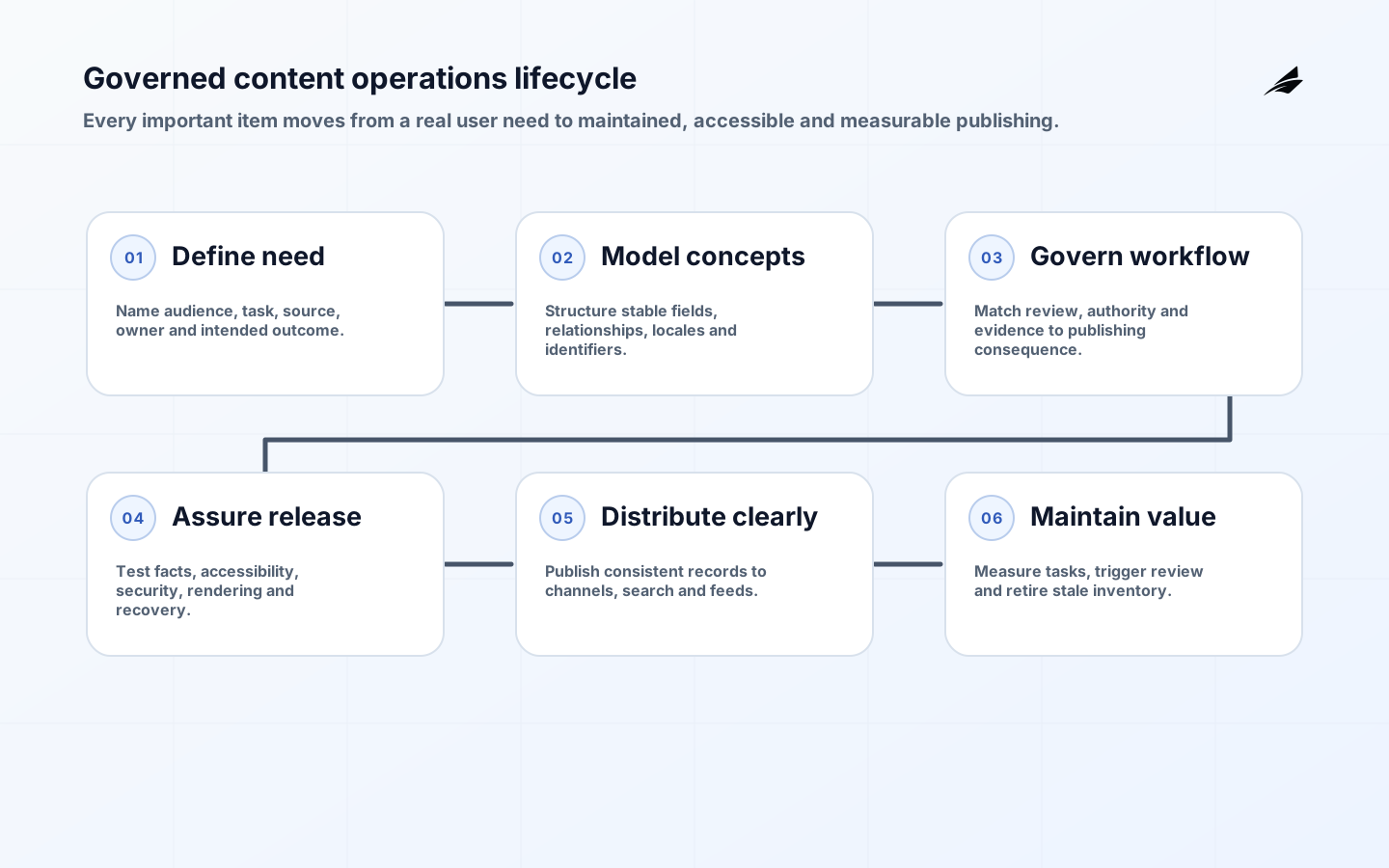
A content operations system is the people, rules, information model and technology used to plan, create, approve, publish, distribute, measure and retire content. It is not synonymous with a content management system. The CMS stores and delivers assets; the operating system clarifies why an item exists, who may change it, which evidence supports it and when it must be reviewed. This practical guide turns that broader definition into an implementable publishing model.
Use the content operations implementation checklist during delivery and the content operations FAQ for procurement questions. Teams managing discovery can connect the model to schema and sitemap optimization. The goal is one traceable lifecycle, even when several tools and channels are involved.
Define the content operations system around user outcomes
Inventory the user needs and business obligations the content serves: completing a task, comparing an offer, understanding a policy, finding support or meeting a disclosure requirement. Record the current path, search language, abandonment, support contacts, production delay and consequence of stale information. Content without a named audience, owner or next action should not automatically enter the migration backlog. It may be redundant inventory that deserves consolidation or retirement.
Create a service map from trigger to outcome. Show where users discover information, what questions they bring, which content and data answer them, what transaction follows and how feedback returns. The Government Digital Service's content design guidance starts from user need and emphasizes maintaining content after publication. Apply that principle beyond web pages to emails, help text, product messages, documents and syndicated records.
| Content class | Primary owner | Required evidence | Typical review trigger |
|---|---|---|---|
| Product or service | Product manager | Current capability, terms and user research | Release or offer change |
| Policy or compliance | Policy or legal owner | Approved rule and jurisdiction | Law, policy or interpretation change |
| Support | Service operations | Resolved cases and product behavior | Incident or contact trend |
| Editorial insight | Editorial lead | Sources, author and review record | Material source change |
| Structured reference | Domain steward | Field definition and authoritative system | Schema or source-system change |
Design a reusable content model
Model stable concepts rather than page layouts. A service description may contain a title, concise summary, eligibility, steps, evidence, contact, owner, effective date and related services. Channels can render those fields differently without maintaining divergent copies. Keep prose blocks for material that genuinely needs narrative freedom. Excessive fragmentation makes authoring painful; a single rich-text field prevents reliable reuse, validation and targeted updates. Prototype the model with real edge cases before migrating at scale.
Define identifiers, field purpose, allowed values, relationships, locale behavior and fallback. Distinguish translation from localization: translated words may still contain the wrong legal rule, price, date format or support path. Store source language and translation status, prevent silent fallback for regulated statements, and connect every variant to a common conceptual record. Version breaking schema changes and test consumers before removing fields. Content APIs are production interfaces and deserve the compatibility discipline used for software contracts.
Build workflow and governance that match risk
Use the lightest workflow that controls the actual consequence. A spelling correction may need one publisher; a safety instruction may need subject, legal and accessibility review. Define statuses, entry criteria, approver authority, separation of duties, service times, escalation and emergency publication. A workflow is not effective merely because the tool displays colored stages. Test whether reviewers receive the evidence and rendered context needed to make a decision, and whether rejected work returns with actionable feedback.
Maintain a responsibility record for each content domain: accountable owner, authoring team, subject reviewers, publisher, localization contact and incident contact. Time-bound delegated rights and remove departed users promptly. Preserve approvals and material versions, but avoid collecting personal activity indefinitely without purpose. Editorial governance should make high-risk changes reviewable while allowing routine, low-risk updates to move quickly. Measure queue age by risk class to expose bottlenecks rather than pressuring every item into one turnaround target.
Make accessibility and content quality release criteria
Quality checks should cover factual support, task completion, plain language, links, dates, structured fields, localization, rendering and accessibility. W3C's WCAG 2.2 Recommendation includes requirements for text alternatives, keyboard access, understandable interfaces and robust markup. Automated scans catch only part of that surface. Test representative templates and journeys with keyboard and assistive technology, include disabled participants in research, and assign defects to owners with release or remediation decisions.
Create source and claim practices proportionate to risk. Record the authoritative reference and checked date for claims that affect money, eligibility, safety or rights. Use descriptive link text, meaningful headings and labels that make sense out of context. Preview every supported viewport and channel. For downloadable documents, verify the accessible artifact rather than assuming the source template guarantees it. Emergency content needs preapproved patterns, short expiry and a follow-up review after the immediate incident.
Choose and secure the publishing platform
Evaluate authoring usability, modeling, workflow, APIs, localization, search, preview, versioning, audit, access control, deployment, portability and total operating cost. Run a scenario-based trial: create a structured service, translate it, change one shared fact, preview channels, revoke an author, restore a prior version and export the records. Include editors, developers, accessibility specialists and operators. A feature matrix cannot reveal whether routine publishing requires fragile workarounds or privileged vendor intervention.
Treat extensions, themes, pipelines and integrations as software. Inventory dependencies, protect build provenance, scan components, review code, separate environments and rehearse rollback. The NIST Secure Software Development Framework supplies outcome-oriented secure development practices that can be tailored to this publishing surface. Apply least privilege to authors and machine accounts; isolate secrets; log administrative changes; and prepare for compromised credentials, malicious uploads, API abuse and unavailable delivery infrastructure.
| Platform acceptance test | Pass evidence | Failure to avoid |
|---|---|---|
| Model evolution | Compatible change reaches all consumers | Channel breaks after field rename |
| Permission boundary | Author cannot publish or export beyond role | Broad editor becomes administrator |
| Preview integrity | Reviewer sees locale, device and personalization state | Approval against misleading draft |
| Recovery | Known version, assets and configuration restored | Database returns without usable media |
| Portability | Structured records and assets export with relationships | Proprietary archive without semantics |
| Peak delivery | Cached and origin paths meet service objective | Campaign traffic overwhelms preview or API |
Publish for discovery without manufacturing search-first copy
Use the language people use when describing a real need, then answer it clearly. Google's people-first content guidance asks whether material provides substantial value and leaves the reader able to achieve a goal. Its Search Essentials describe baseline technical and spam policies. Neither supports mass-producing near-duplicate pages. Consolidate overlapping intent, maintain accurate titles and descriptions, and ensure important information exists in indexable text.
Generate canonical URLs, metadata, structured data and sitemaps from governed fields where practical, with validation before release. Structured data must describe visible page content and follow the vocabulary and search-feature rules in use. Redirect retired URLs to the closest genuine replacement, or return a clear removal status when none exists. Monitor crawl and rendering errors, but interpret search metrics alongside task completion, qualified demand and support outcomes. Traffic gained through a misleading promise is a content defect.
Migrate content as a controlled redesign
Classify every item as retain, revise, merge, archive or delete. Map retained content to the new model, normalize identifiers and relationships, and preserve required records separately from public publishing. Automate mechanical conversion but route ambiguous fields and broken assets for human resolution. Compare counts by type and locale, sample rendered meaning, validate redirects and freeze or reconcile edits made during cutover. Do not copy obsolete navigation and duplicated prose simply because migration tooling can move it.
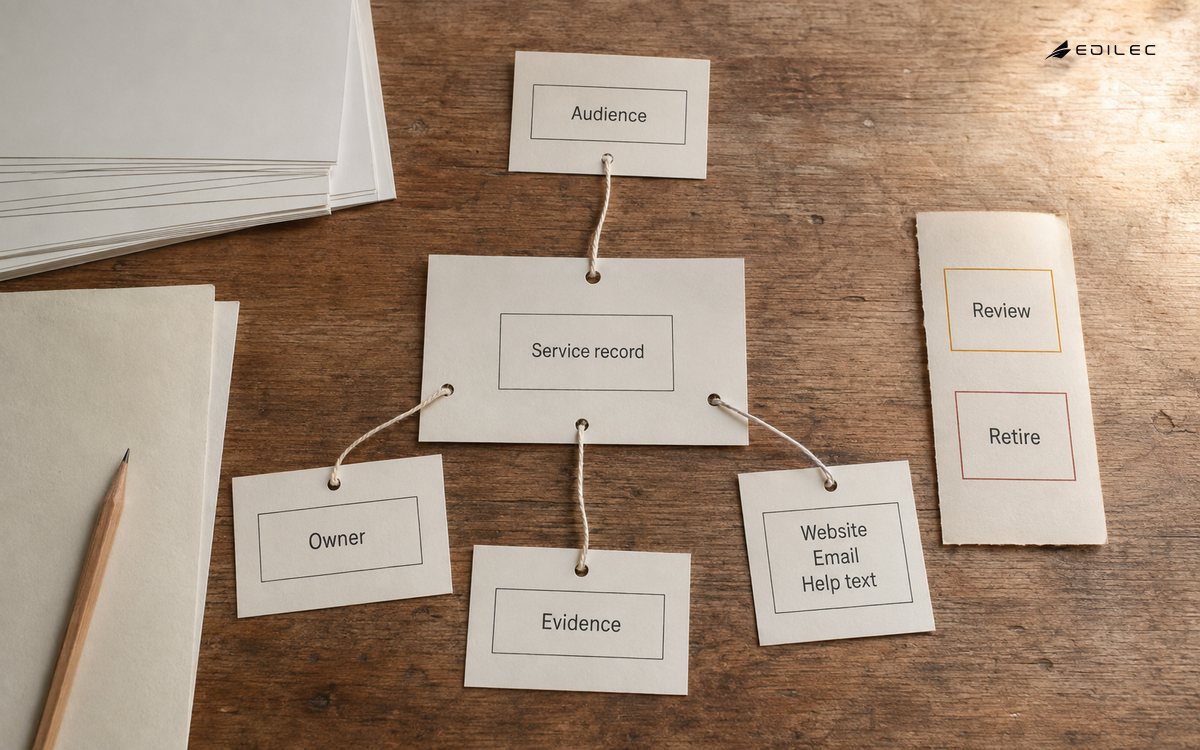
Release by domain or journey. Keep a rollback point, observe errors and user behavior, and staff a short correction window with clear authority. Verify search indexing, forms, analytics consent, accessibility and channel feeds after release. Retire old admin access, APIs, webhooks, storage and licenses only after retention and rollback obligations are satisfied. Record unresolved exceptions with owners and due dates so temporary dual-running does not become an invisible permanent architecture.
Operate content through evidence and scheduled retirement
Measure task success, comprehension, search refinement, support deflection with quality safeguards, freshness, accessibility defects, correction time, workflow age and cost per maintained outcome. Segment by content type and audience. Page views alone reward duplication and sensational discovery; publication volume rewards inventory growth. Review whether users reached the intended next step and whether policy or product owners trust the representation. Pair quantitative signals with usability sessions, support cases and editorial review.
Give each durable item an owner, review trigger and maximum review interval. Trigger review on source, product, law, price, schema, search or support changes. An expired review date should change visible status and enter a queue; it should not silently republish the same content with a new date. Retirement removes discovery and delivery paths, updates links and sitemaps, preserves required records and measures whether users encounter a gap. A smaller accurate library is easier to search and govern.
Key takeaways
- Design content operations around user tasks and accountable source owners.
- Model reusable concepts while preserving an efficient authoring experience.
- Match workflow depth to consequence and give reviewers rendered context.
- Make accessibility, security, portability and recovery platform acceptance criteria.
- Measure maintained outcomes and retire stale inventory deliberately.
Frequently asked questions
Is a CMS a content operations system?
It is one component. The operating system also includes strategy, ownership, evidence, modeling, workflow, distribution, measurement and retirement. Buying a CMS without those decisions usually digitizes existing bottlenecks.
Is a headless CMS always better?
No. It can improve reuse and channel flexibility, but it adds front-end, preview and integration responsibilities. Choose it when those capabilities justify the operating complexity and authors can still understand what they are publishing.
Conclusion
A strong content operations system makes every important item traceable from user need and source evidence through structured creation, proportionate approval, accessible delivery and measured maintenance. Technology should encode that lifecycle without trapping content or slowing safe routine work. The result is a publishing service whose accuracy and usefulness can be demonstrated, not merely a larger repository.