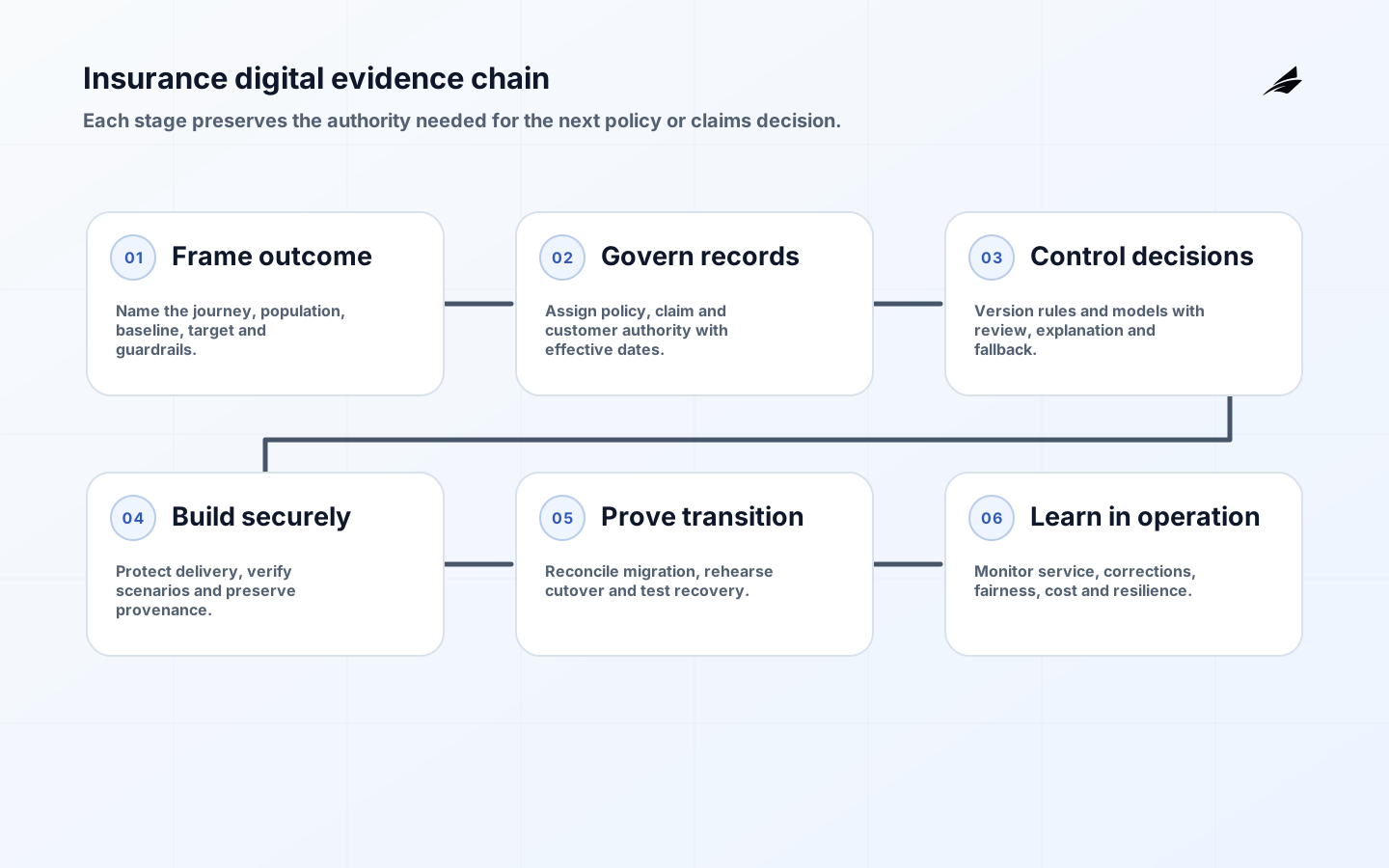
Digital engineering for insurance is the disciplined redesign of products, decisions, data and software across the policy lifecycle. It is broader than replacing a core system or adding a mobile app. A useful program connects quotation, underwriting, policy administration, billing, claims, servicing and regulatory evidence while preserving the meaning and ownership of each record. The objective is not digitization for its own sake; it is faster, more consistent service with controls that remain defensible when a customer, auditor or regulator asks how a decision was made.
This guide complements the insurance implementation checklist, the insurance delivery FAQ and the broader Digital Transformation Services Implementation Checklist. Business leaders can use it to frame an investable outcome, establish data and decision authority, and demand operating evidence before scale.
Start with an insurance outcome, not a technology label
Choose a bounded customer or operational outcome: reduce time from complete claim submission to coverage decision, increase straight-through policy changes without raising correction rates, or shorten commercial quote turnaround for defined risk classes. Name the population, starting baseline, target, guardrails and accountable executive. “Modernize underwriting” is too broad because it hides several decisions, handoffs and products. A measurable outcome exposes whether the constraint is missing data, fragmented rules, queue design, integration latency, manual rework or a policy that technology cannot fix.
Map the current journey using real cases, including cancellations, reinstatements, referrals, supplements, disputes and catastrophe surges. Capture where staff interpret documents, override a recommendation, request evidence or wait for another party. For example, a personal-lines claim may appear suitable for automation until a repair estimate conflicts with policy endorsements. That exception needs an explicit state, a qualified owner and a traceable route back to the policy version in force on the loss date.
| Lifecycle area | Engineering focus | Acceptance evidence |
|---|---|---|
| Quote and underwriting | Risk inputs, rules, referral thresholds and explanation | Representative cases reproduce approved eligibility and pricing decisions |
| Policy administration | Versioned coverage, endorsements, billing and effective dates | Events reconcile to the authoritative policy record |
| Claims | Intake, coverage, triage, reserves, payments and recovery | Exception paths preserve authority and decision history |
| Service | Identity, consent, omnichannel context and fulfillment | Customer request reaches completion without duplicate entry |
Model the policy lifecycle and record authority
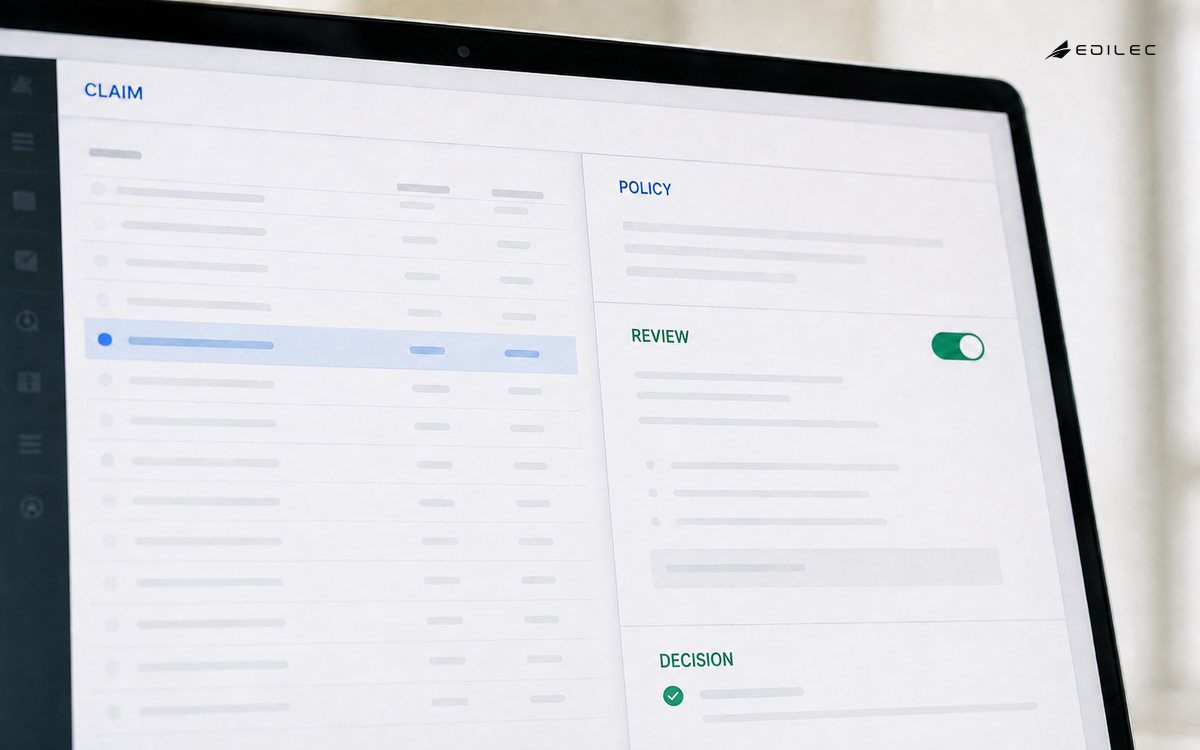
Insurance platforms fail quietly when the same term means different things across channels. Define stable identifiers for party, risk, submission, quote, policy, coverage, claim, exposure and payment. Record which system may create or correct each entity and how effective-dated changes propagate. A data lake is not automatically authoritative. Analytical copies should retain source identifiers, event time, processing time, transformation lineage and quality status so a report or model output can be traced to the operational facts available at that moment.
Treat external data as a governed dependency. Property, telematics, credit-based, geospatial, medical or fraud data may have licensing, permissible-use, freshness and correction constraints. Store the provider, retrieval time, version and match confidence alongside the value. Design for disputes: a customer or adjuster needs a route to challenge incorrect data, and corrected information must reach downstream decisions. The NIST Privacy Framework provides a useful structure for connecting data processing to privacy risk rather than treating notices as the entire privacy program.
Govern AI-supported insurance decisions
Inventory every model and rule that influences eligibility, pricing, underwriting referral, claim triage, fraud review, settlement or customer communication. Include vendor services and models embedded in platforms. For each use, document purpose, owner, affected population, input provenance, human authority, prohibited uses, performance thresholds and monitoring. The NAIC AI model bulletin emphasizes governance and risk management around decisions that affect consumers; adoption and enforceability still depend on jurisdiction, so legal owners must map applicable state requirements rather than assume the bulletin itself is law everywhere.
Evaluation must resemble production. Test accuracy and error cost across relevant product, geography and customer segments; inspect false positives and false negatives separately. Compare the model with the current decision process and a simpler baseline. The NIST AI RMF organizes work around Govern, Map, Measure and Manage, which helps teams connect technical testing to impact and accountability. Keep a safe fallback when inputs are missing, confidence is low, drift exceeds tolerance or a customer requests review.
Compose architecture around change and evidence
Separate product configuration, decision services, workflow, documents, customer experience and analytical consumption where their change rates differ. This does not require microservices everywhere. It requires explicit contracts and ownership. A policy transaction should be idempotent, effective-dated and observable; an event should identify its schema version and business meaning. Prefer a small number of well-governed integration patterns over direct point-to-point connections that bypass validation and make incidents impossible to reconstruct.
Define quality scenarios before selecting products: peak quote volume, catastrophe claim intake, policy issuance latency, recovery point, recovery time, document retention, accessibility and staff fallback. Include identity boundaries for customers, agents, adjusters, employees and service accounts. The NAIC Insurance Data Security Model Law resources are a useful regulatory reference, but applicability varies by state. Architecture decisions should therefore map to the insurer’s legal inventory, risk assessment and information-security program, not to a generic compliance claim.
Build security and quality into delivery
Protect source repositories, build identities, package registries and deployment environments. Require review for changes to pricing, eligibility, claims authority and customer notices, even when those changes are low-code configuration. The NIST Secure Software Development Framework groups practices into preparing the organization, protecting software, producing well-secured software and responding to vulnerabilities. Translate those practices into repository controls, dependency policy, threat models, test evidence, artifact provenance and a vulnerability response agreement.
Layer tests around insurance behavior. Unit tests prove a rule; contract tests prove system boundaries; scenario tests prove effective dates, rounding, documents and exception routing; reconciliation proves financial and policy records agree. Use de-identified or synthetic fixtures that preserve difficult distributions and relationships. A clean happy-path test suite is dangerous when production contains backdated endorsements, duplicate parties, partial payments and reopened claims. Track escaped defects by business impact and root cause, then add a permanent control or test.
Migrate records without losing meaning
Profile source data before promising a conversion rate. Quantify missing keys, conflicting dates, orphaned transactions, invalid code values and documents without reliable association. Decide which history will be migrated, archived with searchable access, or reconstructed on demand. Every mapping needs a business owner and treatment for unmappable values. Reconcile counts and financial totals by product and period, but also sample complete policy and claim histories to detect semantic errors that aggregate totals conceal.
Rehearse cutover with production-scale extracts and timed dependencies. Define freeze windows, in-flight transaction handling, rollback conditions, communications and authority. A rollback must address data created after cutover, not merely redeploy the old application. For phased migration, specify which platform owns each customer and transaction at every stage. Frontline staff need concise exception procedures and a staffed command channel; their observations during pilot operation are production evidence, not informal feedback to postpone.
| Measure | Definition | Decision supported |
|---|---|---|
| Straight-through completion | Eligible cases completed without manual touch, with exclusions disclosed | Whether automation handles the intended population |
| Decision correction rate | Material decisions reversed because data, rule or model was wrong | Whether speed is compromising accuracy |
| Cycle time by path | Elapsed time for automated, referred and exception journeys | Where queues and handoffs remain |
| Record reconciliation | Authoritative entities and financial totals matching after transfer | Whether migration or integration is trustworthy |
| Service recovery proof | Critical scenarios restored within approved objectives | Whether resilience works beyond documentation |
Operate the capability as an insurance service
Assign a service owner who can balance customer, underwriting, claims, actuarial, compliance and technology priorities. Operational dashboards should pair outcome with guardrail: faster claim decisions beside correction and complaint rates; higher automation beside referral quality and segment performance. Review vendor changes, model drift, data-quality exceptions, privileged access, unresolved defects and recovery tests on a defined cadence. Product owners should have authority to pause automation when evidence falls outside tolerance.
Commercial agreements need portability and incident cooperation. Specify access to configuration, decision history, logs, model documentation, data exports and transition support. Identify subcontractors and concentration dependencies. Price the whole lifecycle: licenses, integration, data acquisition, environments, assurance, migration, support, change and exit. A low implementation quote can create high operating cost if every product change requires specialist vendor work or if evidence is available only through paid professional services.
Key takeaways
Before approving scale, ask a team outside the project to trace one quotation, one endorsement and one disputed claim from customer input through rules, records and final communication. That short exercise often exposes missing lineage or unclear authority more effectively than a polished steering report.
- Anchor investment to one measurable policy or claims outcome with explicit guardrails.
- Preserve record authority, effective dates and lineage across operational and analytical systems.
- Govern every AI-supported consumer decision with representative tests, review authority and fallback.
- Treat migration, security, resilience and vendor exit as product requirements from the start.
- Measure completed insurance work and decision quality, not feature output alone.
Digital engineering for insurance FAQ
Does digital engineering require replacing the core platform?
No. A team may first improve workflow, expose governed services, repair data contracts or replace one product component. Replace the core when its constraints materially block the target outcomes and the organization can fund migration and operational change. Encapsulation is useful only when the old behavior and data remain supportable.
Should insurers automate every low-risk decision?
No. Automation should depend on reliable inputs, bounded authority, economic value and monitored consequences. Some apparently simple decisions carry fairness, legal or customer-impact concerns. Start with a defined population, compare outcomes, preserve human escalation and expand only when evidence supports the additional authority.
Conclusion
Digital engineering for insurance succeeds when faster journeys remain explainable, correct and recoverable. Build around insurance semantics, accountable decisions and representative operating evidence. That approach turns software change into a durable capability: one that can evolve products and service without losing the trust embedded in policy records and claims decisions.