How CTOs Should Think About Connected Operations
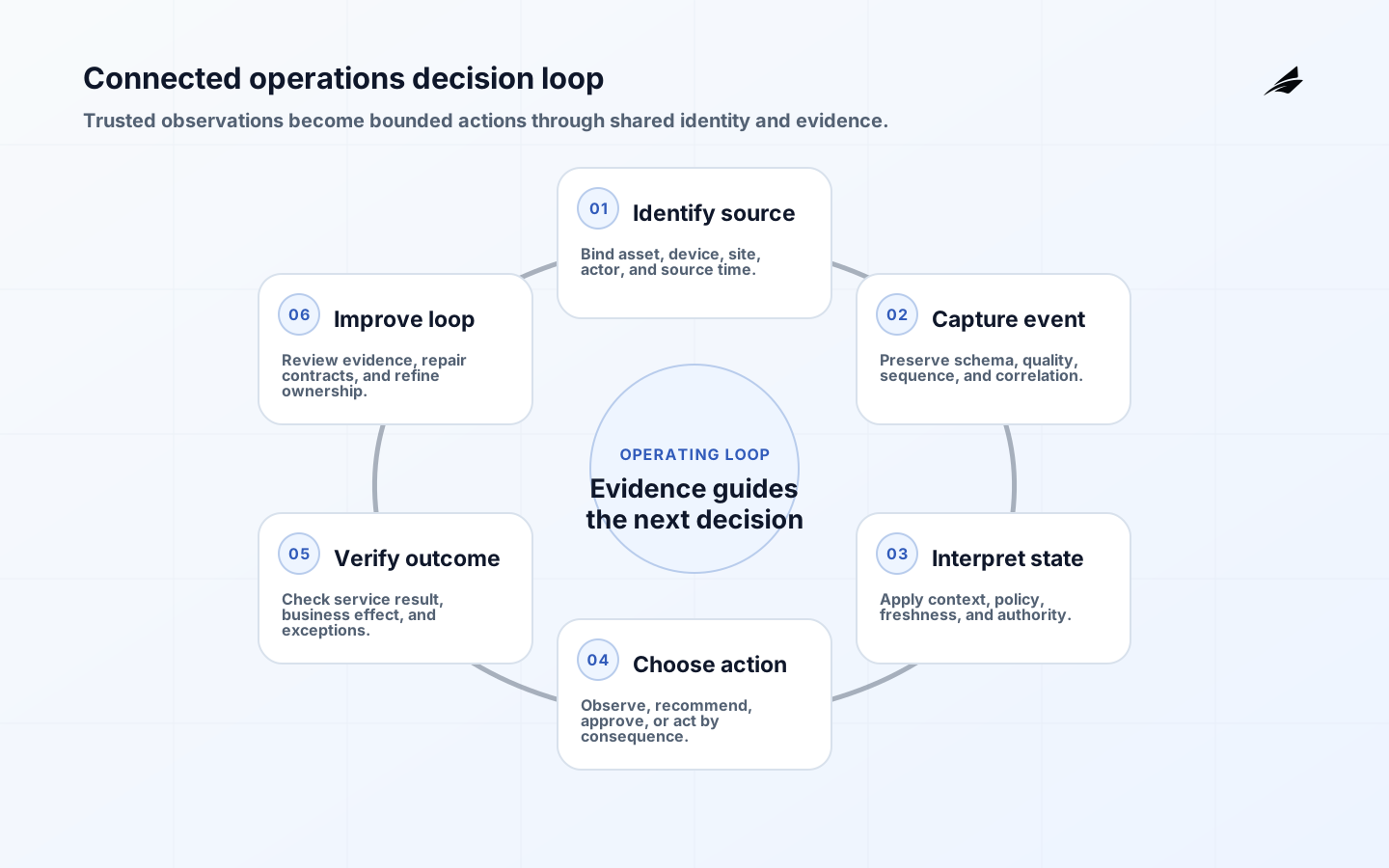
Connected operations describes a dependable loop between physical or digital activity, operational decisions, and the people accountable for outcomes. A CTO should not judge the program by the number of devices online or the amount of data in a stream. The strategic question is whether the organization can turn a trustworthy observation into an authorized action, explain that action later, and recover when a device, network, service, or person is unavailable. The architecture must respect the pace and safety of the operation while giving product and technology teams a common view of state.
Choose the decision the system must support
Choose a workflow whose outcome is visible to an accountable team: reduce an avoidable truck roll, keep a production line within a safe condition, reconcile a delivery, or detect a service degradation before a customer reports it. Define the decision, not merely the data feed. What may a system decide automatically? What requires a person? What evidence makes the decision valid? A temperature value without device identity, calibration context, and time semantics may be interesting but not operationally useful.
NIST SP 800-213 is a good reminder that an IoT device is part of a wider system and should be assessed through organizational risk management. Use that view in architecture reviews. Name the operating owner, process boundary, data steward, safety constraint, and fallback. A connected-operations roadmap that cannot name who responds to an exception is an integration plan, not an operating model.
| Layer | Decision | Minimum evidence |
|---|---|---|
| Physical or source | What happened and which asset reported it? | Stable identity, source time, quality state |
| Transport | Can the observation arrive without silent loss or duplication? | Delivery policy, sequence, retry, lag |
| Interpretation | What does the observation mean in this context? | Schema, unit, calibration, version |
| Action | Who or what may change the world? | Policy, authorization, approval, outcome |
| Learning | What should improve after the event? | Trace, exception reason, owner, review |
Keep asset, device, event, and actor identities distinct
Connected systems fail at the seams between teams. Operations says asset; engineering says device; finance says customer account; field service says work order. Establish identifiers and relationships that survive those boundaries. Record the asset, site, tenant, device, sensor, event, work order, and human actor separately when they have different lifecycles. Avoid using a mutable display name as the key. A stable identity lets the organization reconcile late messages, device replacements, and ownership changes without rewriting history.
Give every consequential event clear time semantics. Source time answers when the observation occurred; ingest time answers when the platform saw it; processing time answers when it acted. Add an explicit quality state for unknown, estimated, stale, corrected, or unavailable. OpenTelemetry's logs data model is helpful for common context and correlation, but the business meaning still belongs in the domain contract.
Match transport semantics to the workflow
A durable event stream is useful when multiple consumers need the same history, when consumers may be offline, or when replay is part of recovery. It is not automatically the right answer for every device interaction. A synchronous command may be clearer for a request that needs an immediate authorization result. A batch export may be safer for large historical analysis. Choose based on durability, ordering, latency, ownership, replay, privacy, and failure handling rather than architecture fashion.
Apache Kafka documentation makes the mechanics of topics, partitions, consumer groups, and offsets explicit. Translate those mechanics into operating decisions: what ordering matters, who owns retention, when a consumer is considered caught up, and how a replay is prevented from repeating an external side effect. If a consumer calls a vendor API, use an idempotency key and a durable outcome record. A replayable stream without side-effect discipline is a recovery hazard.
| Need | Prefer | Watch for |
|---|---|---|
| Immediate command | Authenticated request with explicit result | Timeouts, retries, partial completion |
| Shared history | Durable event stream with consumer progress | Unbounded retention, replay side effects |
| High-volume telemetry | Buffered ingestion and windowed processing | Backpressure, sampling, stale decisions |
| Cross-system correction | Versioned event or reconciliation job | Silent mutation of past facts |
| Human exception | Queue with ownership and due time | Unowned backlog and duplicate work |
Put human authority at the control boundary
Connected operations crosses IT and operational technology, so availability is not the only concern. A control that is secure but causes an unsafe stop is not a successful control. Separate observe, recommend, and act permissions. Limit commands by device, site, operating mode, time, and consequence. Require a person or local interlock for actions that can affect safety or irreversible state. NIST's OT security guidance supports preserving performance, reliability, and safety while applying cybersecurity controls.
Design degraded modes intentionally. A gateway may buffer data, a service may stop sending commands, or a person may use a local procedure. Show the operator whether the system is live, delayed, estimated, or unavailable. Do not let a stale value look current because a dashboard refreshed. The most trusted connected-operations interface is often the one that makes uncertainty visible and tells the operator what to do next.
Prove one connected workflow end to end
Build one path from source to decision to outcome before connecting every asset. A useful slice includes the real identity path, one representative device or event source, the production-like transport, a durable state record, one operator view, and the manual fallback. Test offline behavior, duplicated messages, clock skew, schema change, missing permissions, and a late correction. The slice should let an operator answer what happened, what the system did, and what remains to be done.
Use gates that make risk visible: source acceptance, event contract, authorization review, failure rehearsal, limited production, and operating review. Keep the exact software, schema, policy, and configuration versions with each release. If the team cannot reproduce a result from retained evidence, it is not ready to expand. Edilec's event streaming guide and connected operations practical guide provide adjacent implementation patterns, while IoT telemetry explained helps clarify measurement semantics.
Measure freshness, action, and recovery
Track more than online devices and message throughput. Measure known-state coverage, event freshness, late and duplicate rates, decision latency, command success, human overrides, exception age, recovery time, and the business outcome selected at the start. Segment by site, device family, workflow, and failure reason. A high throughput number with rising stale decisions is a warning, not a win. Keep a sample of successful cases so quiet errors do not disappear into a green dashboard.
Give each metric an owner and an action threshold. Operations may own queue age, reliability may own delivery lag, security may own unauthorized command attempts, and product may own workflow completion. A metric without a response is decoration. Review the exception distribution monthly and use it to change the data contract, device support plan, or workflow boundary.
Record the architecture decisions that cannot drift
The CTO should settle a few durable questions early: which facts are authoritative, where policy is evaluated, who owns device identity, how much history is retained, what requires approval, and what happens when the platform is unavailable. Also decide whether the organization is building a reusable capability or a bounded product feature. Reuse is valuable only when the semantics, ownership, and security boundary are genuinely shared. A generic event platform can spread ambiguity faster than it spreads efficiency.
Keep the architecture honest by naming the source of truth for each important fact. A device may be authoritative for its own measurement, a work-order system for assignment, and a local interlock for safety. Do not force one platform to pretend it owns facts it only caches. When sources disagree, show the conflict and route it to an owner instead of silently choosing the newest value.
Make cross-team contracts small and testable. The source team should publish identity, units, quality, and timing; the platform team should preserve delivery and correlation; the workflow team should define interpretation and action; the operating team should define safe response. This division lets a team change one component without changing the meaning of every event. It also makes an incident easier to localize.
Plan for organizational change as carefully as technical change. A site can change owner, a device can be replaced, a service can be renamed, and a workflow can move to another team. Keep stable IDs, effective dates, and ownership history so old events remain understandable. If a dashboard shows only the latest name, a responder may misread a past event and take the wrong action.
Use a decision record for every automatic action with meaningful consequence. Include the observation, policy version, authority, evidence, requested action, result, and exception route. This record should be readable by an operator and machine-queryable for analysis. It gives the CTO a way to review whether connected operations are actually reducing delay and risk rather than simply increasing data movement.
Create a shared glossary for asset, device, site, event, state, command, incident, and outcome. Put the definitions beside the schemas and dashboards, not only in a planning document. When a product team says event and an operations team says event but they mean different lifecycle facts, the system may appear integrated while decisions remain inconsistent. A small glossary is a practical form of architecture governance.
Review the loop with people who do the work. Ask whether the observation arrives in time, whether the operator can tell current from stale, whether the action is safe in degraded mode, and whether recovery is possible without platform specialists. Their answers should change the boundary, data contract, or runbook. Connected operations earns scale through repeated evidence, not through a larger topology diagram.
When the platform cannot answer confidently, abstention is a valid operating result. Record why the system stopped, what evidence is missing, and which person or process owns the next check. This is better than filling a gap with an inferred value that looks authoritative. Over time, the distribution of abstentions shows where better instrumentation, device support, or workflow design would create the most value.
Key takeaways
- Start with an accountable operating outcome, not a device count.
- Give assets, events, actors, and commands stable identities and explicit time semantics.
- Select synchronous, streaming, or batch patterns by failure and replay needs.
- Separate observation, recommendation, and action authority.
- Build a vertical slice that includes real identity, durable state, and a manual fallback.
- Measure known-state coverage and business completion alongside platform health.
Frequently asked questions
Do we need a single connected-operations platform?
Not necessarily. Start with shared identity, event semantics, authorization, and observability. A platform earns its place when several workflows need the same controls and operating evidence. Buying or building a central platform before those contracts are clear usually creates a larger place for inconsistent meanings to hide.
When should an event stream be used?
Use one when multiple consumers need durable history, consumers may be offline, or replay is a deliberate recovery and analysis capability. For an immediate command or a simple request-response interaction, a direct authenticated service call may be easier to reason about. The decision should document ordering, retention, replay, and side-effect behavior.
Conclusion
A CTO makes connected operations valuable by joining physical context, digital state, authority, and learning into one accountable loop. The architecture should make uncertainty visible, preserve history, constrain actions, and recover gracefully. That is the foundation for scaling from one useful workflow to a connected operating capability the business can trust.