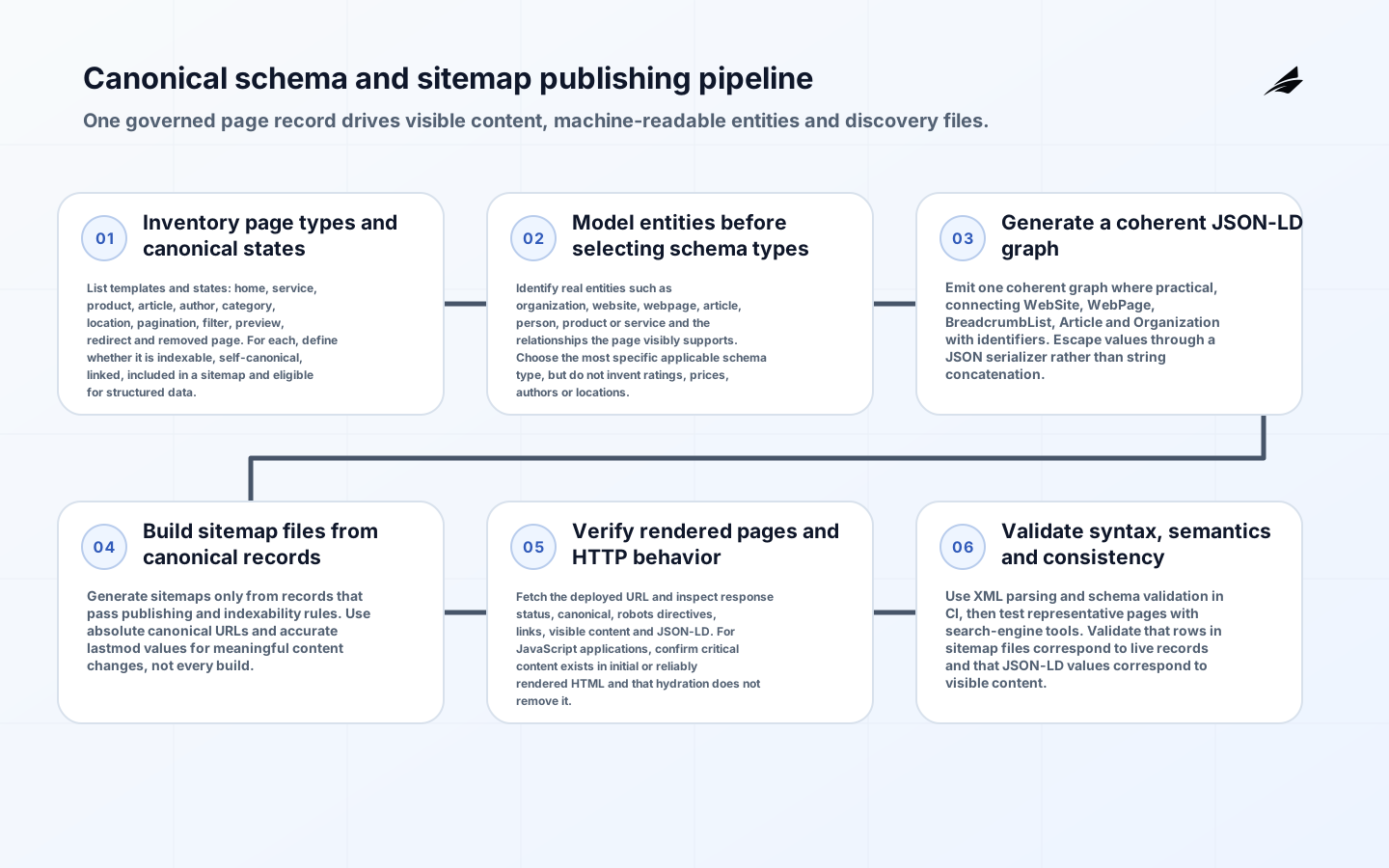
Schema and sitemap optimization improves how a publishing system describes its pages and exposes canonical URLs for discovery. Structured data represents entities and page facts; an XML sitemap lists URLs a site wants crawlers to consider. Neither makes thin content valuable, forces indexing or substitutes for internal links. The reliable approach is to generate visible content, canonical metadata, JSON-LD and sitemap entries from the same governed record so they cannot quietly contradict one another.
This guide is written for product, content and engineering teams that operate more than a handful of pages. It covers indexable scope, canonical identity, schema selection, JSON-LD graphs, sitemap generation, validation and monitoring. Google's structured-data policies require markup to represent visible, truthful content, while the sitemap protocol sets concrete file and URL limits. Optimization means reducing ambiguity and defects, not inserting hidden terms or marking every paragraph as a special entity.
Use the schema and sitemap implementation checklist for release gates, the schema and sitemap FAQ for troubleshooting, and the technical SEO audit guide for a broader crawl and rendering review.
Inventory page types and canonical states
List templates and states: home, service, product, article, author, category, location, pagination, filter, preview, redirect and removed page. For each, define whether it is indexable, self-canonical, linked, included in a sitemap and eligible for structured data. Do not infer indexability from route existence. A published record may still be too incomplete or duplicative to expose.
Normalize host, protocol, trailing slash, case and parameters. Canonical URLs in HTML, internal links, schema identifiers and sitemaps should use the same normalized form. Redirect alternates directly. Avoid canonicalizing pages with materially different content. If a language or regional variant is intended, coordinate canonical and hreflang rather than making every variant point to one market.
| State | Canonical behavior | Sitemap behavior |
|---|---|---|
| Primary public page | Self-referencing canonical | Include when valid and indexable |
| Equivalent alternate | Redirect or canonical to primary | Exclude |
| Draft or preview | No public indexing | Exclude |
| Removed page | Relevant redirect or 410 | Remove promptly |
Model entities before selecting schema types
Identify real entities such as organization, website, webpage, article, person, product or service and the relationships the page visibly supports. Choose the most specific applicable schema type, but do not invent ratings, prices, authors or locations. Use stable @id values so references across page graphs point to the same organization, author and webpage. Schema.org defines vocabulary; search-engine documentation defines feature eligibility.
Map each property to an authoritative content field and owner. The headline comes from the visible title, dates from publishing records, images from licensed media metadata, and authors from profile records. If a required field is unavailable, fix the content model or omit the markup. Avoid hand-written JSON-LD copied between pages because stale values and mismatched URLs are difficult to detect at scale.
Generate a coherent JSON-LD graph
Emit one coherent graph where practical, connecting WebSite, WebPage, BreadcrumbList, Article and Organization with identifiers. Escape values through a JSON serializer rather than string concatenation. Keep canonical URL, language, headline, description, author, dates and image consistent with the rendered page. Multiple valid script blocks can work, but duplicate entities with conflicting values create avoidable ambiguity.

Do not use markup as invisible advertising. FAQ properties should reflect questions and answers readers can see, and product properties should describe the represented product. Google may choose not to display a rich result even when markup is valid. Treat structured data as maintained publication output. Test a sample of each template and create regression tests for required identifiers, URLs and dates.
| Entity | Source record | Consistency check |
|---|---|---|
| WebPage | Canonical page record | @id equals canonical URL fragment policy |
| Article | Title, dates, author and image | Values match visible article |
| BreadcrumbList | Navigation hierarchy | Items resolve and order is stable |
| Organization | Site-wide organization record | Same @id reused across pages |
Build sitemap files from canonical records
Generate sitemaps only from records that pass publishing and indexability rules. Use absolute canonical URLs and accurate lastmod values for meaningful content changes, not every build. Split files before protocol limits and create a sitemap index. Keep each file on an allowed host and path. Compression can reduce transfer size, but the uncompressed limits still apply.
Exclude redirects, errors, noindex pages, canonical alternates and parameter noise. A sitemap should be a clean assertion, not a database dump. Segment by page type or update cadence when that helps diagnosis, but avoid hundreds of tiny files. Google states that priority and changefreq are ignored, so do not fabricate them. Internal links remain essential because crawlers and readers need a navigable site.
| Field | Rule | Frequent defect |
|---|---|---|
| loc | Absolute normalized canonical URL | Mixed host or trailing-slash policy |
| lastmod | Meaningful content modification date | Set to deployment time on every build |
| file membership | Indexable 200-status canonical only | Redirects and noindex URLs included |
| sitemap index | References valid child files | Stale files remain after migration |
Verify rendered pages and HTTP behavior
Fetch the deployed URL and inspect response status, canonical, robots directives, links, visible content and JSON-LD. For JavaScript applications, confirm critical content exists in initial or reliably rendered HTML and that hydration does not remove it. A sitemap can help discovery but cannot repair an empty application shell, endless loading state or soft 404.
Test alternate URL forms, deleted pages and redirect chains. Confirm robots.txt permits pages and required media or script resources. Ensure structured-data URLs resolve without authentication. Compare browser DOM with raw response where rendering matters. Automate checks in deployment, then manually inspect representative pages because syntactic validation cannot detect misleading entity meaning.
Validate syntax, semantics and consistency
Use XML parsing and schema validation in CI, then test representative pages with search-engine tools. Validate that rows in sitemap files correspond to live records and that JSON-LD values correspond to visible content. Check duplicate @id values used for different entities, invalid dates, missing image dimensions, broken author URLs and breadcrumbs that do not match navigation.
Maintain contract tests per template. A test can assert that an Article page has a canonical, WebPage and Article identifiers, visible author, publish date and indexability agreement. Separate errors that break parsing from warnings about optional enhancements. Do not chase optional fields that the business cannot maintain accurately. Accuracy is more valuable than maximum property count.
Monitor discovery and indexing evidence
Submit the sitemap index through supported search-console tools and reference it in robots.txt where appropriate. Monitor fetch status, discovered URL counts, indexing exclusions, canonical choices and structured-data enhancement reports. Compare by page type and release cohort. A decline may come from content quality, demand, canonical consolidation, redirects or rendering; the sitemap itself is only one signal.
Reconcile the published content inventory, sitemap URLs and crawl observations regularly. Alert on sudden count changes, child-file failures and invalid markup after template releases. Remove retired URLs rather than leaving them indefinitely. When search engines choose another canonical, compare visible content, links, redirects and metadata before forcing a tag change. Their choice can expose real duplication in the site model.
Operate schema and sitemaps as publishing code
Assign owners for content fields, template generation, sitemap jobs and incident response. Version schema output and test migrations before changing @id policy or entity relationships. Keep build logs that show excluded records and reasons. Large libraries need deterministic chunking so URL movement between child files does not cause unnecessary churn and so failures can be isolated.
Document recovery: regenerate files from authoritative records, purge caches, verify checksums and resubmit only when needed. Do not edit generated XML manually. Review page types after product changes because a new filter or archive can create unexpected URL populations. A healthy system makes each public URL explainable from a record and rule rather than from accumulated exceptions.
Key takeaways
- Structured data describes entities; sitemaps list canonical discovery targets.
- Generate visible content, canonicals, JSON-LD and sitemap entries from shared records.
- Include only valid, indexable 200-status canonical URLs in XML sitemaps.
- Validate meaning and consistency, not only JSON or XML syntax.
- Use indexing reports as evidence while recognizing that neither schema nor sitemaps guarantee inclusion.
Frequently asked questions
Does schema markup improve rankings?
It can help systems understand a page and enable eligible search features, but it is not a ranking guarantee. Accuracy and visible page value remain essential.
Should every URL appear in a sitemap?
No. Include canonical, indexable, successful pages the site wants discovered. Exclude redirects, errors, drafts, noindex pages and duplicate alternates.
How should lastmod be set?
Use the date of a meaningful content change. Do not update every URL merely because the site was rebuilt or the sitemap was regenerated.
Can a site use multiple sitemap files?
Yes. Split by protocol limits and optionally by page type or update cadence, then list child files in a sitemap index.
Conclusion
Schema and sitemap optimization is a consistency discipline. Canonical content records should produce truthful visible pages, machine-readable entities and clean discovery files. When generation, validation and monitoring are part of publishing operations, teams can diagnose indexing problems without resorting to hidden content, inflated URL counts or contradictory metadata. It also gives maintainers a repeatable way to trace every machine-readable assertion back to a visible field, accountable owner and current canonical page.