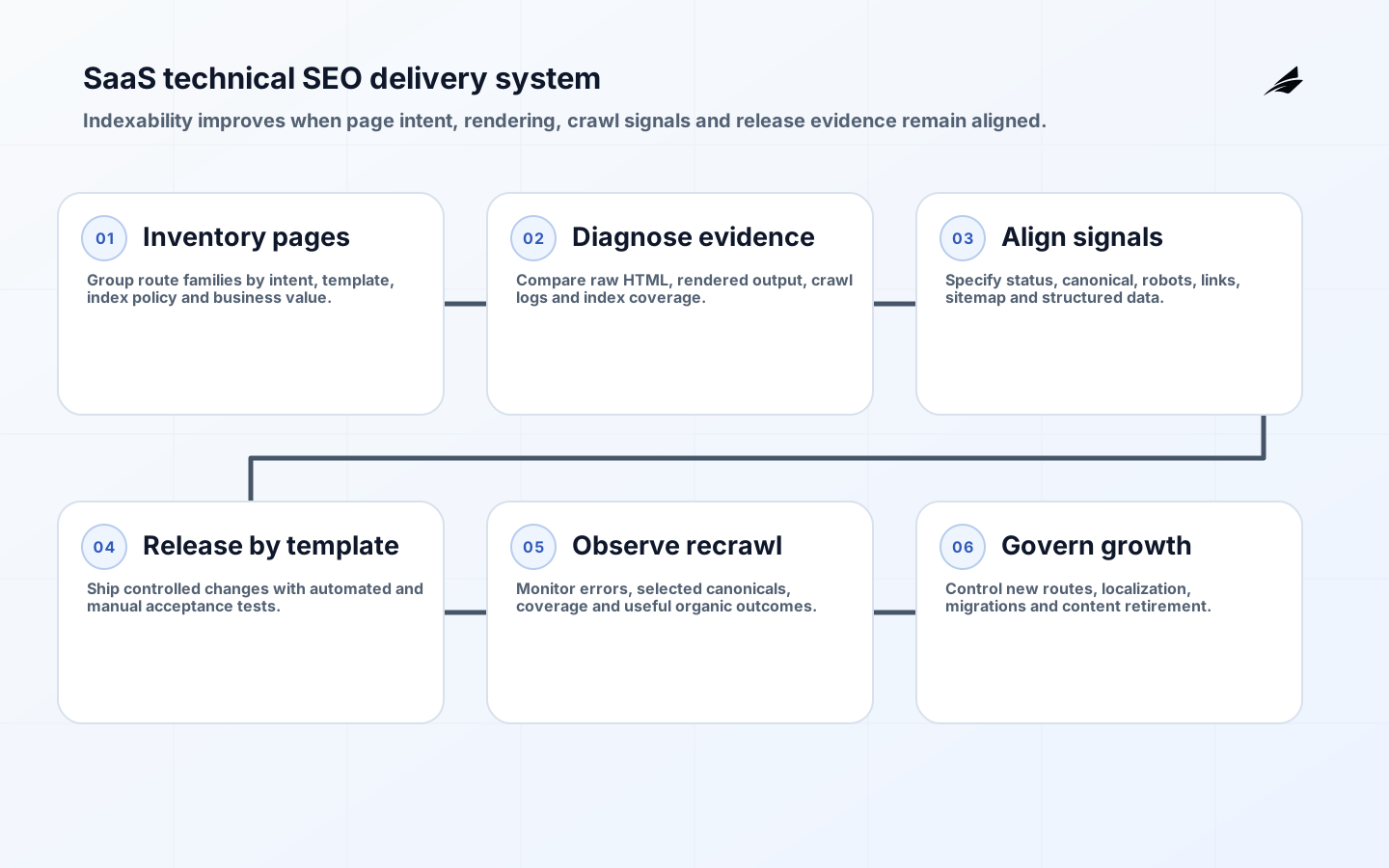
Technical SEO services for SaaS companies align site architecture, rendering, discovery and metadata so search engines can retrieve the same useful product and educational content that people receive. The work is engineering, information architecture and measurement rather than a hidden collection of keywords. A sound engagement identifies which page types answer distinct user needs, removes crawler traps and duplicate signals, and makes releases observable. Ranking remains a competitive outcome no provider can guarantee.
This plan supports teams scoping a technical review, implementation or migration. It connects to the SaaS technical SEO checklist and technical SEO engineering FAQ. Google’s documentation is explicit that crawling does not guarantee indexing; content still needs a clear purpose, accessible delivery and enough value to be selected. The engagement should therefore connect technical findings to page quality and product strategy.
Baseline indexability by page type
Inventory templates and route families rather than sampling only a few URLs. Separate marketing pages, services, product documentation, integrations, comparison pages, help content, blog articles, author pages, localization and application routes. For each type, record intended index status, canonical policy, rendering method, internal-link source, sitemap inclusion, structured data and ownership. Compare submitted, crawled and indexed groups using Search Console and server logs where available, then inspect representative URLs manually.
Define the problem with evidence. A discovered-not-indexed group may reflect low internal prominence, large publication volume, duplication, weak response performance or simply evaluation delay. A crawled-not-indexed group requires inspection of content, canonical signals, duplication and rendered output. Do not respond by placing the same keyword paragraph on thousands of pages. Consolidate overlapping routes, strengthen genuinely distinct pages and stop generating combinations that do not serve a real search task.
| Page type question | Evidence | Typical decision |
|---|---|---|
| Should it be indexed? | Distinct intent and useful primary content | Index, merge or exclude |
| Can it be discovered? | HTML links, sitemap and crawl logs | Improve hierarchy or remove orphan |
| Is the signal consistent? | Status, canonical, robots and redirects | Resolve contradictions |
| Can content be rendered? | Raw and rendered HTML comparison | Server-render critical content |
| Does it earn maintenance? | Traffic, conversion and support value | Improve, consolidate or retire |
Make critical SaaS content available in HTML
Google can render JavaScript, but rendering adds a processing phase and scripts can fail. Return meaningful titles, headings, primary copy and crawlable links in the initial HTML through static generation, server rendering or reliable hybrid rendering where practical. Use ordinary anchor elements with resolvable href values. Ensure an error or API timeout does not return a visually polished 200 response with no article content. Test raw response, rendered DOM, resources, console errors and status code.
Keep canonical and robots decisions stable between initial and rendered HTML. Avoid changing a canonical to a different URL after rendering or temporarily emitting noindex while content loads. Unique title and description metadata should be route data, not inferred from a generic client shell. Lazy-load supplementary media without hiding primary content behind interaction. Validate mobile behavior, because responsive rendering defects can remove navigation or text from the version crawlers and users receive.
Control crawl space without hiding valuable routes
Use robots.txt to manage crawling, not as the primary method for removing indexed URLs. Return appropriate status codes, use noindex where a page may be crawled but should not appear, and remove internal links and sitemap entries when content is retired. Faceted navigation, sorting, calendars, internal search, tracking parameters and infinite spaces require explicit rules. Generate clean, stable URLs from a constrained vocabulary and avoid session or user-specific state in public addresses.
Partition XML sitemaps by meaningful page type or publication group so coverage can be diagnosed. Include canonical, indexable URLs with accurate modification dates, not every route the application can produce. A sitemap aids discovery but does not replace internal links. Build contextual links from product and guide pages using meaningful anchor text, and preserve navigational hierarchy. Large sites should monitor response time, errors and duplicate crawl; smaller sites usually gain more from content and architecture quality than elaborate crawl-budget tactics.
Make canonicalization and redirects deterministic
Choose one canonical URL for each distinct document and make signals agree: self-referential canonical, internal links, sitemap, hreflang and redirects. Canonical tags are hints, not commands, and Google may select another version when content and linking contradict them. Do not canonicalize genuinely different localized or product pages to a generic hub. Normalize protocol, host, path case, trailing slash and parameters at the routing layer.
For a migration, create a one-to-one redirect map from old URLs to the closest equivalent new content. Avoid chains, loops and mass redirects to the home page. Preserve valuable content, metadata and internal relationships while changing one major variable at a time where possible. Crawl the map before launch, monitor old and new server logs, keep redirects long enough for users and systems, and maintain ownership of retired domains. A rollback plan must consider new URLs already discovered after launch.
Use structured data as a truthful machine-readable layer
Add schema types that accurately represent visible content and follow search-engine feature requirements. BlogPosting can identify articles, Organization can identify the publisher, BreadcrumbList can express hierarchy and Product applies only when the page genuinely describes an offering with supported properties. Structured data does not make thin content authoritative. Generate it from the same source as visible page data to avoid mismatched names, dates, images or canonical URLs, then validate output and monitor enhancement reports.
Expose indexable images through stable URLs, descriptive filenames, accurate alt text and surrounding context. Do not place every image behind scripts or authentication. Include licensing or attribution when required and use image sitemap extensions only when they add discovery value. Performance matters, but aggressive cropping and fixed heights should not make diagrams unreadable. Serve appropriate dimensions and formats while preserving a crawlable original asset URL.
Design localization and product-led pages for distinct intent
Use separate stable URLs for localized content, self-canonicalize equivalent language-region pages and connect genuine alternatives with reciprocal hreflang annotations. Avoid automatic location redirects that prevent users or crawlers from choosing another version. Translate the complete useful page, including navigation and metadata, rather than changing a city name inside repeated copy. Local or integration pages should contain specific delivery, constraints, examples and relationships that justify their existence.
Programmatic publishing needs quality gates. Require a defined intent, unique evidence, source ownership, internal links, complete metadata and a review or expiry process. Generate only combinations backed by real products, integrations or service coverage. Track page-type performance and prune routes that cannot be improved. Publishing thousands of near-identical pages can consume crawling and editorial attention while weakening the site’s overall clarity.
| Cost driver | Why it matters | Planning artifact |
|---|---|---|
| Route volume | Determines crawl and audit scale | Template inventory |
| Rendering stack | Changes implementation and QA | Raw/rendered test matrix |
| Migration | Adds redirect and monitoring risk | Verified URL map |
| Localization | Adds content and hreflang governance | Locale ownership matrix |
| Engineering access | Controls whether fixes ship | Prioritized delivery backlog |
Run technical SEO as a release program
- Inventory page types, intended index status and current evidence.
- Prioritize blockers by affected valuable URLs and implementation risk.
- Specify acceptance tests for HTML, status, metadata, links and schema.
- Release fixes by template with before-and-after crawl evidence.
- Monitor logs, coverage, performance and conversion through a stable window.
- Assign ongoing ownership for routes, migrations and publishing quality gates.

Key takeaways
- Audit route families and rendered output, not only a handful of URLs.
- Make status, canonical, robots, links and sitemap signals agree.
- Publish pages only when they answer a distinct useful intent.
- Treat migrations and JavaScript rendering as testable engineering releases.
- Measure index coverage with content value and business outcomes together.
Frequently asked questions
How quickly do technical fixes affect indexing?
Timing varies by crawl demand, site health, page importance and the nature of the change. Confirm the deployed response immediately, submit important sitemap updates and monitor recrawl. Do not treat a short observation period as proof that a technically correct fix failed.
Is a crawler report enough for an audit?
No. A crawler reveals links and responses from its configuration, but the review should also inspect rendered content, Search Console, server logs, templates, analytics and publishing workflows. Findings need implementation context and a testable business priority.
Can a service guarantee first-page rankings?
No credible provider can control search-engine selection or competitors. A service can guarantee defined audits, implementations, tests and reporting. Organic performance depends on technical accessibility, relevance, originality, reputation, user value and continued competition.
Acceptance should be template-specific: sample URLs alone can miss route-generation defects. Add automated assertions for status, canonical, index directives, titles, primary headings, structured data and internal links, then retain manual review for rendered meaning and quality.
Give technical findings a durable owner and an expiry condition. A temporary noindex rule, migration redirect, experiment parameter or rendering fallback can become harmful after its original purpose ends. Keep a decision register tied to templates and release history, and schedule reviews for exceptions. This makes future redesigns safer because teams can distinguish deliberate search behavior from residue that nobody remembers creating.
Monitor the response received by crawlers as well as browser analytics. Edge rules, bot protection, geography and caching can serve a status or document that application tests never see. Sample major crawler user agents in logs and investigate unexplained changes without creating crawler-only content.
Conclusion
Technical SEO for a SaaS company is a durable delivery capability. Make valuable content available in reliable HTML, constrain crawl space, align canonical signals and publish truthful metadata. Then govern routes and migrations like product releases. This replaces one-time audit theater with an observable system that helps users and search engines understand the site as it changes.