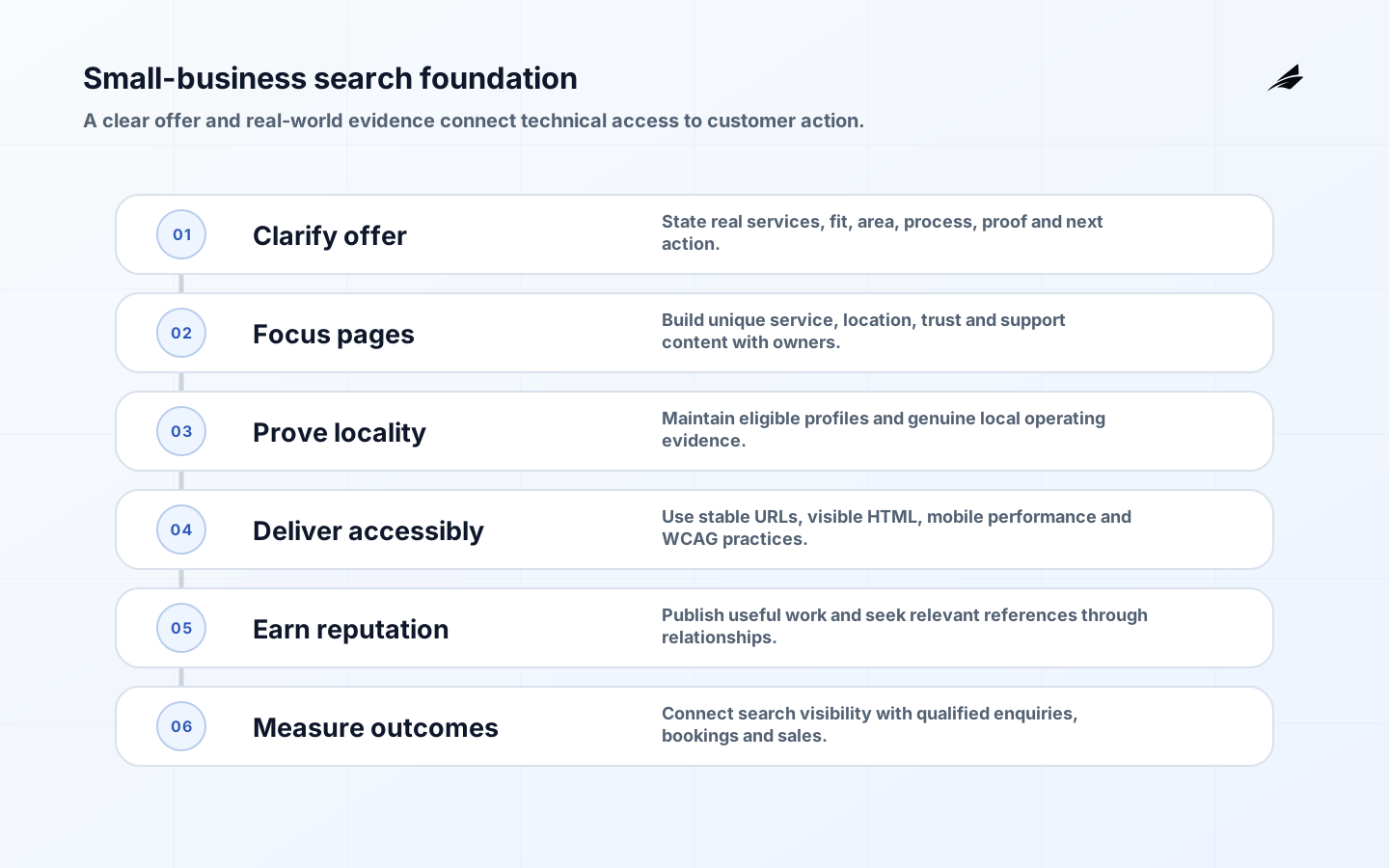
SEO-ready website development for a small business means building a site that clearly explains the offer, serves the real customer journey and can be crawled, rendered and maintained. It is not a package of hidden phrases or thousands of thin location pages. The strongest foundation is usually modest: accurate business information, useful service pages, credible proof, stable technology and a clear path to contact, book or buy.
This FAQ addresses decisions owners face before commissioning a website. It separates launch essentials from ongoing marketing and explains what evidence to request from a developer. Google states that no method guarantees inclusion or first position, so the objective is a useful technically sound site that can improve through reputation, content and customer experience.
What makes a small-business website search-ready?
The site needs one preferred version of each useful page, descriptive URLs, unique titles and headings, visible main content, crawlable links, correct status codes, mobile use and reasonable performance. It should explain services, service area, process, proof and the next action. Acceptance evidence should identify the responsible owner, the source record, the expected result and the decision required when the result is missing.
A launch audit should verify HTML, canonicals, robots rules, sitemap, links, accessibility and truthful structured data. It should also remove overlapping pages. Technical correctness cannot rescue ten generic pages that differ only by city name. Test the normal path, boundary conditions and a realistic failure path; a successful demonstration alone does not prove the small-business website is ready.
| Page | Useful content | Weak substitute |
|---|---|---|
| Service | Scope, fit, process, constraints and proof | A repeated short paragraph |
| Location | Real service evidence, logistics and contact | A city inserted into a template |
| About | People, qualifications and verifiable history | Unverifiable superlatives |
| Guide | Firsthand answer, examples and limitations | A rewritten summary of other sites |
| Contact | Accessible form, alternatives and expectations | A form without privacy or response details |
Which pages does a small business need?
Most service businesses need a homepage, focused service pages, an about or trust page, contact details, privacy information and resources answering real buying questions. Shops may need categories, products, delivery, returns and support. Real staffed locations can justify distinct pages. Keep the definition and its effective date with the implementation so later teams can explain why historical and current behavior differ.
Create a matrix with purpose, audience, question, proof, action and owner. Combine subjects that would produce substantially the same answer. Publish case studies or guides when the business has firsthand experience and can maintain accuracy. Make exceptions visible in the same operating workflow instead of routing them to private spreadsheets or undocumented support messages.
How should local search visibility be handled?
Create or claim the correct business profile and follow rules for name, categories, address, service area and eligibility. Google's guidelines require accurate real-world representation and discourage additions to the business name. Keep hours, phone, website and location current. Use progressive exposure and explicit stop conditions so the team can learn from production without placing the entire estate at risk.

Describe local work with real projects, logistics, regulations or customer needs. Earn mentions through suppliers, associations, community activity and customers. Do not create false offices, multiple ineligible profiles or copied city pages. Measure the business completion time and error consequence, not only component uptime or the number of tasks closed.
How much content is enough?
Publish enough to answer important customer questions and distinguish the business. A professional service may need detailed scope and examples; an emergency repair page may prioritize coverage and response. Use headings, tables and photographs when they improve understanding. Preserve identifiers, timestamps and version information across handoffs so reconciliation can distinguish delay, duplication and correction.
Maintain content after launch. Update changed services, people, prices, policies, standards and images. Consolidate obsolete pages. Original data, calculators, checklists and documented experience can earn references because they solve a problem; volume alone does not. Document the recovery sequence and exercise it with representative state before relying on it during a live incident.
Does the website platform matter?
Any platform can work if it produces accessible pages, stable URLs, editable metadata, responsive layouts, crawlable links and controlled redirects. Evaluate update security, backups, ownership, export, performance and support. The business should own its domain and accounts. Apply least privilege to people and services, and record material administrative actions with enough context for later review.
Test what production returns, not only an editor preview. Important content should work without interaction. Optimize images and limit third-party scripts that slow pages or collect unnecessary data. Establish updates, uptime checks and tested restoration. Review this control when scope, integrations, users or obligations change; a launch-time decision should not become a permanent assumption.
What should budget and timeline include?
A credible proposal separates discovery, content, design, development, migration, analytics, redirects, training and post-launch support. Cost depends on page complexity, integrations, photography, commerce, locations and content readiness. Ask who supplies copy, evidence and approvals. Separate a commercial promise from the operational mechanism and evidence that will make the promise dependable.
Plan time for decisions, not just coding. Use acceptance stages for page inventory, representative templates, complete content, technical QA and launch. Do not choose a date before domain, content and redirect dependencies are known. Give users a clear degraded state and next action instead of allowing partial data or failed automation to appear complete.
| Deliverable | Evidence | Warning |
|---|---|---|
| Page plan | Approved URL inventory and owners | Page-count promise without rationale |
| Technical build | Crawl and responsive QA | Only screenshots or plugin scores |
| Content and media | Ownership, sources and approval | Copied text or unlicensed images |
| Migration | Tested content-equivalent redirects | All old URLs sent to homepage |
| Measurement | Business actions, consent and account access | Ranking guarantee without decision metrics |
Do backlinks matter, and how should they be earned?
Links help people and systems discover pages, but relevance and legitimacy matter. Build assets worth citing: original data, expert explanations, tools, community resources or clear case studies. Ask real partners and publications to reference material when it helps their audience. Automate repeatable verification where it shortens feedback, while retaining accountable human judgment for consequential ambiguity.
Avoid paid schemes, reciprocal networks, spun posts and comments inserted only for a URL. Judge referrals by relevance and real use, not only third-party scores. A few references from genuine organizations can be more valuable than thousands of unknown domains. Version configuration with code and deployment records so a defect can be reproduced, contained and corrected without guesswork.
How should results be measured?
Track enquiries, bookings, qualified calls, sales or other actions with appropriate privacy controls. Segment important services and locations. Use search reports for queries, pages and indexing patterns while recognizing processing delays and tool limitations. Define a small set of leading and lagging measures, then remove metrics that have no owner or operating response.
Review technical health, visibility and conversion together. More impressions without relevant action may signal mismatch; more traffic with a broken form is an operations failure. Compare meaningful periods and annotate site, offer, season and market changes. Keep platform reports in context and retain ownership of the customer journey, because a dashboard cannot explain every market or operational change.
What should be included in website handover?
Handover should make the business independent enough to keep information accurate and obtain help from another qualified provider. Request a register of domain, DNS, hosting, content system, analytics, search tools, forms, email delivery, third-party scripts and media licenses. Accounts should use business-controlled identities with recovery methods and least-privilege roles. Avoid a single provider mailbox as the only administrator for a core business asset.
- Business-owned domain, DNS, hosting, repository and content-system access.
- Page inventory, redirect map, analytics events and search-tool verification.
- Media source, license, filename, alt text and reusable original files.
- Backup, restoration, update, security and incident-response instructions.
- Training for normal content edits plus a clearly priced support path.
Test the handover rather than accepting a folder of documents. Have the owner update business hours, publish a small correction, restore a safe backup or invite a replacement administrator. Verify forms and email after credential changes. Close obsolete provider accounts and record who now owns renewals. A clean transfer protects continuity and makes future redesign or marketing work easier to procure.
Key takeaways
- Build focused pages around real services, evidence and decisions.
- Keep business information accurate and follow profile eligibility rules.
- Choose maintainable technology with accessible rendering and ownership.
- Earn references through useful work and genuine relationships.
- Measure qualified outcomes beside visibility and technical health.
Frequently asked questions
Can a developer guarantee number-one ranking?
No. Search engines control ranking and indexing, and results vary by query, location, competition and time. A professional can implement sound foundations, improve content and measure outcomes. Guarantees of a specific organic position are a warning sign.
Does every small business need a blog?
No. Publish resources when the business has useful questions, experience or updates to share. Strong service, product, location and support pages come first. An abandoned stream of generic articles can dilute quality; a smaller maintained library may work better.
Can the owner manage the site after launch?
They should be able to update normal content, hours, people and offers safely. Handover should include accounts, backups, training and documented limits. Complex integrations and security may need specialist support, but ordinary accuracy should not depend on a developer queue.
Conclusion
An SEO-ready small-business website is an owned, maintainable asset. It explains the offer with credible evidence, follows local and technical rules, respects users and turns appropriate visitors into measurable conversations or purchases. It does not depend on hidden text, duplicated city pages or purchased links.
Begin with the service and page inventory, then verify ownership and production access before sign-off. Launch a complete focused foundation, observe how customers find and use it, and improve from real questions, search data and business outcomes.