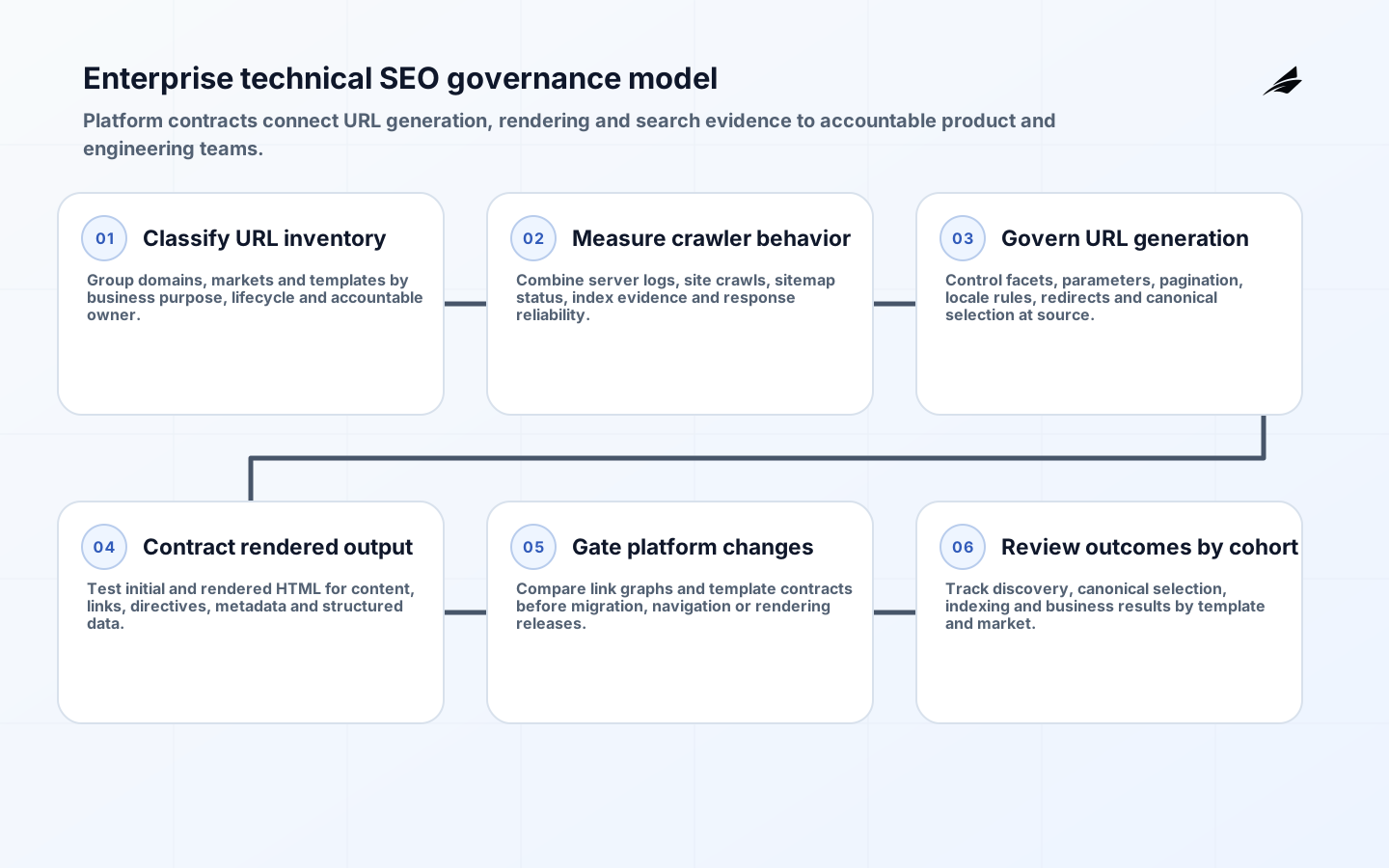
Technical SEO services for enterprise teams keep a large, changing website discoverable and understandable across many templates, markets, products, teams, and release pipelines. The hard problem is rarely finding isolated errors. It is changing the systems that continuously generate duplicate URLs, weak internal links, inconsistent canonicals, render failures, stale sitemaps, and indexable low-value pages.
A professional engagement combines search expertise, web architecture, data analysis, platform engineering, product governance, and change management. This guide explains how to scope that work and connect it to web engineering, cloud operations, and SEO and growth.
1. Scope the website as a system of templates and URL rules
Inventory domains, subdomains, markets, languages, applications, rendering modes, content systems, commerce platforms, feeds, and URL-producing features. Group URLs by template and business purpose rather than attempting to inspect millions individually. Connect each group to traffic, conversions, index status, crawl activity, content ownership, and release owner.
| System area | Questions | Owner | Evidence |
|---|---|---|---|
| URL generation | Which routes, filters, parameters and case rules create URLs? | Platform engineering | Route rules and sampled URL inventory |
| Rendering | What content and links exist in initial and rendered HTML? | Frontend engineering | HTML comparison and rendering tests |
| Canonicalization | How is the preferred URL selected across variants? | Platform and SEO | Canonical, redirect, sitemap and internal-link alignment |
| Navigation | How do users and crawlers reach deep inventory? | Product and information architecture | Link graph, depth and orphan analysis |
| Publishing | How do status, metadata, structured data and sitemaps change? | CMS or commerce owner | Template specification and release tests |
| Internationalization | How are locale, market and language versions related? | International product team | Canonical and hreflang validation |
Create a priority URL taxonomy: strategic pages, active inventory, historical content, utilities, parameters, internal search, account pages, and retired records. This becomes the basis for crawling, indexing, monitoring, and remediation. Raw URL count without business classification produces noisy recommendations.
2. Manage crawl capacity and demand with evidence
Large sites need server-log analysis because a crawler simulation does not show what search bots actually requested. Analyze status codes, response time, template, host, bot identity, parameters, and repeated requests. Compare bot activity with inventory changes and index coverage. Google's current crawl budget guidance describes crawl capacity and demand; many sites only need sound sitemaps and coverage monitoring, while very large or rapidly changing estates benefit from deeper management.
Improve crawl efficiency by removing internal links to redirects and errors, controlling infinite URL spaces, consolidating duplicates, improving server reliability, and publishing accurate sitemaps. Do not block URLs blindly. A robots.txt rule can prevent content inspection while leaving external signals and duplicate relationships unresolved.
| Signal | Interpretation | Action candidate | Caution |
|---|---|---|---|
| High requests to parameters | Navigation or external links create crawlable variants | Change link generation and parameter behavior | Confirm variants have no distinct value |
| Low crawl of priority inventory | Weak discovery, low demand or server constraints | Improve hubs, sitemaps, freshness and response reliability | Crawling does not guarantee indexing |
| Repeated redirects | Old links, feeds or rules remain active | Update producers and shorten redirects | Preserve needed migration redirects |
| Bot errors during peaks | Capacity or dependency instability | Cache, scale and isolate fragile services | Verify bot identity and real-user impact |
| Stale sitemap URLs | Publishing lifecycle is incomplete | Generate from canonical active records | Use meaningful lastmod values |
3. Govern URL structure, faceted navigation and canonicals
Facets, sorting, tracking, pagination, session state, and localization can create vast URL combinations. Decide which combinations satisfy durable search demand and which exist only for interaction. Generate crawlable links for valuable combinations; control or avoid links to empty, near-duplicate, or infinite spaces. Google's URL structure guidance warns that additive filters can create an exploding number of URLs.
Canonical signals must agree across redirects, rel=canonical, internal links, sitemaps, structured data, and international annotations. Google's canonical documentation notes that signals can stack. Build canonical selection into the template contract and test variants continuously. Do not point every unavailable product or thin locale to a category page; use truthful status and replacement behavior.
4. Make JavaScript rendering and internal links dependable
Map which pages are server-rendered, statically generated, client-rendered, or hydrated. Test initial HTML, rendered DOM, status, metadata, content, structured data, and links. Google processes JavaScript through crawling, rendering, and indexing, and its JavaScript SEO guide still recommends server-side or pre-rendering as useful for speed and crawler compatibility.
Treat rendered search behavior as a release contract. A component refactor can remove href attributes, delay primary content, duplicate canonical tags, or return a success shell for missing pages. Add automated tests to representative templates and verify production with URL inspection and logs. Avoid fragment-based content routes for indexable pages.
5. Operate sitemaps, feeds and structured data as products
Segment sitemaps by template, market, or lifecycle so teams can compare submitted and indexed inventory. Include canonical, index-eligible URLs only. Google's sitemap documentation sets limits of 50 MB uncompressed or 50,000 URLs per sitemap and recommends a sitemap index for larger sets. A sitemap is a hint and should not replace internal discovery.
Generate structured data from authoritative fields, not a disconnected SEO text box. Version schemas, monitor validity by template, and validate that marked-up values remain visible and accurate. For commerce, coordinate website markup, product feeds, availability, identifiers, and canonical URLs so systems do not publish contradictory facts.
6. Put technical SEO into release governance
Define a technical SEO contract for every template: status behavior, canonical, robots directives, title and heading source, primary content, internal links, pagination, structured data, sitemap eligibility, performance budget, analytics, and accessibility. Make it part of component documentation and automated tests. SEO specialists should review architecture changes early, not discover their effects after launch.

| Change | Pre-release control | Production validation | Rollback trigger |
|---|---|---|---|
| Platform migration | URL map, response simulation, parity crawl and log baseline | Redirects, canonicals, sitemaps, rendering and key journeys | Material loss of content, links or valid responses |
| Template redesign | Rendered contract tests and structured-data validation | Sampled live rendering and performance | Missing primary content or systematic metadata fault |
| Navigation change | Link graph comparison and priority-depth test | Crawl and bot discovery by template | Priority inventory becomes orphaned or materially deeper |
| International expansion | Locale URL, canonical and hreflang matrix | Cross-market validation and index monitoring | Wrong-market canonicalization or unresolved loops |
| Facet launch | Allowlist, empty-state behavior and crawl simulation | Log volume and index pattern | Unbounded URL generation or server pressure |
7. Measure indexable inventory and business outcomes
Create metrics by template and market: valid indexable URLs, discovered inventory, crawled responses, canonical selection, indexed pages, rendering errors, orphan rate, sitemap freshness, search visits, conversions, and server health. Sampling is necessary at enterprise scale, but retain drill-down to individual examples. Compare releases and cohorts rather than relying on one aggregate coverage chart.
Use controlled experiments where traffic and product constraints permit. Technical changes often interact with content, seasonality, inventory, and ranking systems; avoid claiming causality from a simple before-and-after chart. Record the hypothesis, affected templates, release date, guardrails, and competing changes.
8. Estimate team, cost and delivery by system complexity
Enterprise cost depends on domains, templates, URL volume, markets, rendering, platform count, log access, data engineering, release cadence, migration plans, and implementation ownership. The engagement may require a technical SEO lead, analyst, frontend and platform engineers, data support, content-system owners, and program management. Tool fees are only one line.
A practical plan begins with inventory and two or three high-impact systems, establishes monitoring and template contracts, then expands. Separate audit, implementation, validation, and continuous governance. A large report without engineering capacity is not a delivery plan.
Key takeaways
- Manage templates and URL-producing systems, not isolated page errors.
- Combine crawler, index, analytics and server-log evidence.
- Control infinite spaces at the source and align canonical signals.
- Test rendered HTML and crawlable links in the release pipeline.
- Segment sitemaps and monitoring by meaningful inventory groups.
- Give product and engineering teams explicit contracts and owners.
Frequently asked questions
Does every enterprise site have a crawl-budget problem?
No. Diagnose with logs, coverage, inventory freshness, and server behavior. Duplicate spaces and weak discovery can matter, but many sites gain more from fixing quality, internal links, canonical consistency, and reliability than from trying to force crawl volume.
Should technical SEO be centralized?
A central team can set standards, data, and governance, while platform and market teams implement them. The effective model is federated: central expertise with accountable owners in the systems that create URLs and templates.
How long does enterprise technical SEO take?
A diagnostic can identify priorities in weeks, but system changes, migrations, international alignment, and index response often take quarters. Treat technical SEO as a continuing product capability with staged outcomes rather than a finite audit.
Operating cadence matters as much as the initial program. Review high-severity incidents immediately, template health weekly, inventory and sitemap coverage monthly, and strategic architecture quarterly. Maintain a known-change calendar across CMS, commerce, frontend, infrastructure, and international releases. Give teams a supported exception process so urgent business needs are recorded and retired rather than becoming permanent undocumented behavior.
Supplier evaluation should use the organization's own systems and data. Ask a prospective partner to explain sampling, log normalization, canonical diagnosis, JavaScript testing, experiment design, and how recommendations enter engineering backlogs. Require reproducible queries and exports. The enterprise should retain its historical evidence and monitoring definitions when the engagement ends.
Content lifecycle rules should be implemented alongside technical controls. Define when products, jobs, locations, articles, and campaigns remain live, redirect, archive, or return not found. Preserve pages that retain genuine value, but do not keep unlimited expired inventory merely to preserve URL count. Lifecycle events should update navigation, canonical status, sitemaps, structured data, feeds, and analytics consistently.
Conclusion
Enterprise technical SEO works when search requirements become properties of the platform. Clear URL rules, reliable rendering, aligned canonical signals, accurate sitemaps, controlled releases, and shared evidence let large organizations improve discovery without relying on recurring emergency audits.