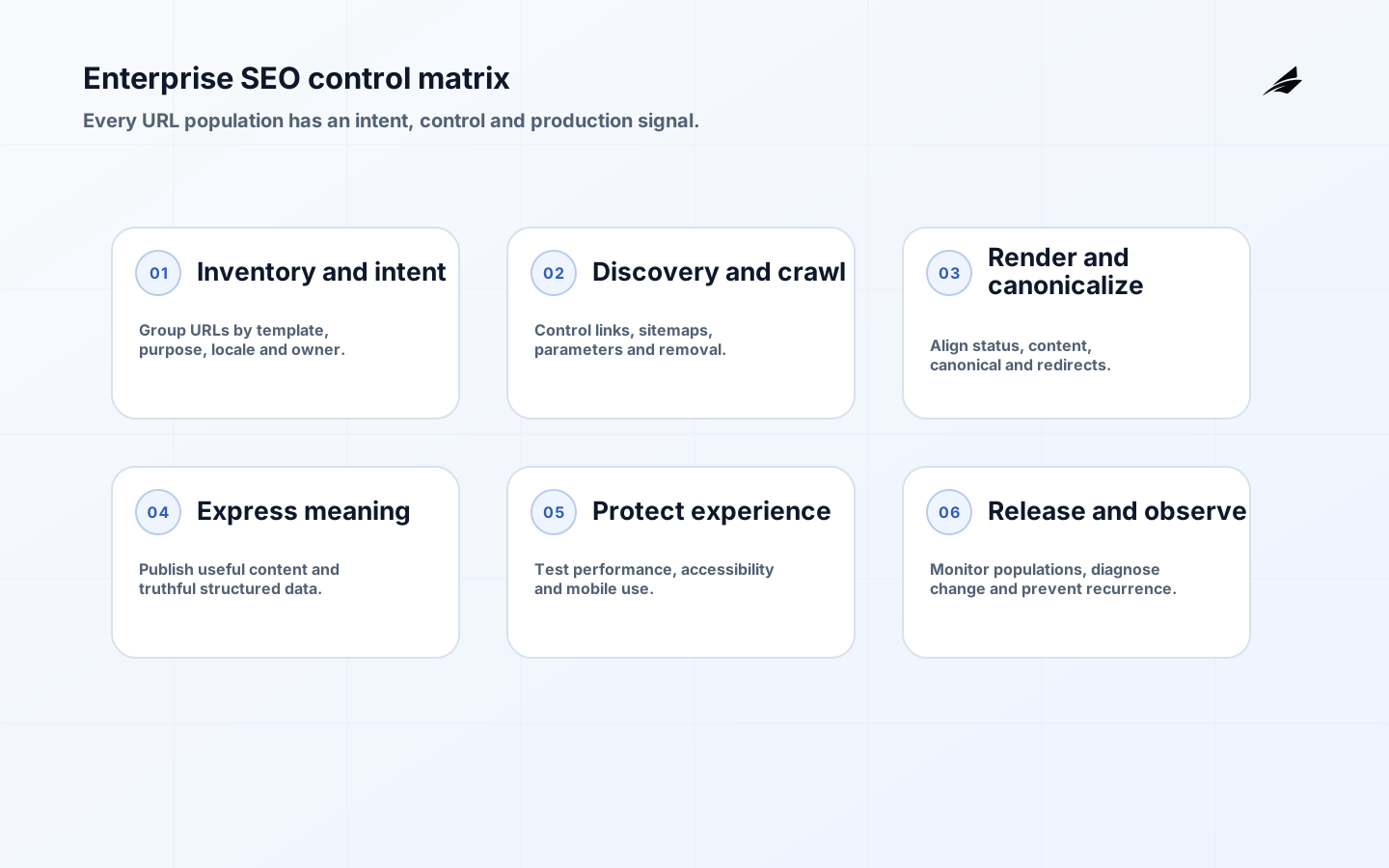
Enterprise technical SEO services coordinate platform, content, product, localization, analytics and release teams so useful public pages can be discovered, rendered, understood and measured. The work is not a list of meta-tag edits. Large sites create technical search risk through templates, routing, facets, JavaScript, international variants, product feeds and migrations. This checklist focuses on implementation controls that prevent defects from multiplying across a large URL inventory.
Use it with Edilec's enterprise technical SEO scope guide, enterprise technical SEO FAQ and general technical SEO checklist. Those pages help connect this engineering work to commercial scope and governance.
1. Map templates, URL populations and search intent
Inventory hosts, protocols, locales, applications, templates, feeds, sitemaps, parameters, legacy routes and owners. Group URLs by generation rule and intended search purpose rather than sampling only high-traffic pages. For each population, define whether it should be crawlable, indexable, canonical, redirected, noindexed, authenticated or retired. Confirm that public pages provide a useful response for the intended audience; technical eligibility cannot compensate for duplicated or empty template content.
Google's current crawling and indexing overview separates URL structure, sitemaps, crawler management, robots controls, canonicalization, mobile rendering, JavaScript and metadata. Use that taxonomy to build an owned control register. Include non-HTML resources and HTTP headers. Test from outside the corporate network with a crawler identity appropriate to the task, because internal previews can hide CDN, consent, authentication and regional behavior.
| URL population | Index intent | Primary control | Release test |
|---|---|---|---|
| Canonical product or article | Index | 200 response, self-canonical and links | Rendered content and canonical agree |
| Filtered or sorted view | Usually consolidate | Facet policy, links and canonical | No unbounded URL expansion |
| Removed content | Remove or replace | 404, 410 or relevant redirect | No soft-404 response |
| Private workflow | Exclude | Authentication and no public links | Anonymous access denied |
| Locale variant | Index when useful | Unique content, canonical and hreflang | Reciprocal locale mapping |
2. Control discovery and crawl demand
Ensure important pages are reachable through ordinary HTML links from stable navigation or contextual hubs. Maintain sitemaps containing canonical, index-intended URLs with accurate last-modified values where available. Keep redirects short and purposeful. Use robots.txt to block crawling only when content need not be fetched; it is not a reliable instruction to remove a URL from results. Use noindex or an appropriate status when removal is the objective and the crawler can access the directive.
Prioritize crawl budget only for genuinely large or rapidly changing sites. Google's crawl-budget guide says the concern is mainly relevant to million-page sites, sites with more than roughly 10,000 rapidly changing URLs, or inventories with many discovered but unindexed pages. It describes crawl capacity and demand, and recommends controlling duplicate inventory, soft 404s, redirects, sitemaps and server health. Do not sell crawl-budget work to a small stable site without evidence.
3. Verify rendering, status and canonical signals
Compare raw HTTP response, browser DOM and crawler-rendered output for every major template. The JavaScript SEO guidance describes crawling, rendering and indexing as distinct phases and recommends server-side or pre-rendering for speed and broad bot support. Put essential content and crawlable links in dependable HTML. Return meaningful status codes at the server edge; a client-rendered not-found message with a 200 response can create a soft 404.

Canonical signals should agree across redirect, HTML or HTTP canonical, sitemap, internal link and alternate-language mapping. Generate absolute normalized URLs from one tested function. Do not canonicalize genuinely different products, locales or paginated content merely to reduce counts. For migrations, preserve a one-to-one old-to-new map where equivalent content exists, return 404 or 410 for removed pages without replacements, update internal links and monitor both inventories.
| Control | Automated check | Sample review | Production signal |
|---|---|---|---|
| Status | Expected response by route class | Edge and application behavior | 4xx, 5xx and soft-404 trend |
| Canonical | Valid absolute target and no chain | Page equivalence | Selected versus declared canonical |
| Rendering | Critical text and links present | Consent and locale variants | Rendered indexing issues |
| Sitemap | Canonical 200 URLs only | Freshness and coverage | Submitted and indexed populations |
| Redirect | Single relevant destination | User journey continuity | Chain, loop and error rate |
4. Preserve page meaning and structured data
Give each template a descriptive title, visible primary heading, useful main content, stable internal links and metadata derived from authoritative fields. Prevent placeholder values and duplicated defaults. Structured data should represent visible page content and use the most specific supported type. Google's general structured-data guidelines require relevance, completeness and visible truthful content, and state that valid markup does not guarantee a rich result.
Validate syntax in CI and compare rendered properties with source records. Sample live pages after release because tag managers, personalization and stale caches can change output. Assign schema ownership to the team that owns the underlying product, event, organization or article data. Monitor rich-result and merchant diagnostics where relevant, but do not fabricate reviews, availability, price or organization relationships to obtain enhanced presentation.
5. Improve user performance without chasing a single score
Measure real-user performance by template, device, geography and connection, then use laboratory traces to diagnose. The current Web Vitals documentation lists Largest Contentful Paint, Cumulative Layout Shift and Interaction to Next Paint as stable Core Web Vitals. Treat them as user-experience signals, not isolated ranking switches. Optimize images, fonts, server response, JavaScript execution, caching and third-party scripts while preserving content and transaction behavior.
Test keyboard access, zoom, semantic structure and assistive technology during the same template work. Search crawlers and disabled users are not equivalent, but clear document structure, meaningful links and reliable server behavior benefit both. Avoid loading essential content only after gestures or consent choices unrelated to its purpose. Establish performance budgets and accessibility checks in component and release pipelines so regressions are stopped near their source.
6. Release in cohorts and monitor business impact
Test templates and route classes in CI, staging and a production cohort. Validate status, robots, canonical, rendered content, links, structured data, performance and analytics. For a migration, preserve pre-change exports and annotate release dates. Define rollback and stop conditions such as unexpected noindex, canonical divergence, server errors, loss of rendered content or a sharp decline in discovered target URLs. Coordinate CDN, application, content and feed releases.
Monitor crawling, indexing, impressions, clicks, conversions and server health by page population. Google's guide to debugging search traffic drops distinguishes technical issues, security, spam, algorithmic changes, seasonality and migrations. Compare query, page, country, device and search type before attributing a decline. Search outcomes are probabilistic; technical work creates eligibility and clarity, not guaranteed ranking.
Run a monthly review with platform, content, analytics and product owners. Prioritize defects by affected valuable URLs and user consequence rather than raw issue count. Track recurrence to the template or generation rule that caused it. Retire stale sitemaps, parameters, redirects and monitoring exceptions. Require every recommendation to name a changed behavior, owner, validation method and outcome signal.
Govern technical SEO services as an engineering capability
Define responsibility across SEO specialists, platform engineering, product, content, localization, analytics, legal and release management. SEO specialists should frame requirements and interpret search evidence; engineering owners implement durable controls in routing, templates and delivery systems. Give urgent indexation defects an incident path, while ordinary improvements enter a prioritized backlog. This avoids a separate queue of recommendations that never reaches the teams controlling site behavior.
Provider acceptance should include reproducible crawls, query definitions, sampled URLs, assumptions and prioritization logic. Require findings at both example and population level. A consultant who identifies a broken canonical should also estimate the generation rule and affected set, propose validation and state potential side effects. Store dashboards and extracts in customer-controlled accounts where possible, with retention and privacy rules for query and log data.
Measure service quality through lead time to diagnose, percentage of recommendations implemented, recurrence, affected valuable URLs, migration defects and business outcomes. Do not reward issue volume; automated crawlers can create thousands of low-value observations. Review recommendations that were rejected or reversed to improve shared design standards. Over time, the best technical SEO program shifts effort from recurring audits into tested components and release guardrails.
Maintain an enterprise search change calendar covering platform releases, domain or URL moves, redesigns, product-feed changes, international launches and major content retirement. Give SEO owners early design access and require a launch risk assessment for high-impact changes. After launch, compare expected and observed discovery, indexing and traffic by affected population. This creates durable organizational memory and prevents several teams from changing the same signals independently across teams and release systems.
Key takeaways
- Manage enterprise SEO by URL population and template ownership.
- Use crawl-budget work only when inventory and crawl evidence justify it.
- Align status, rendering, canonical, sitemaps and internal links.
- Keep structured data truthful, visible and tied to source records.
- Measure performance and accessibility by real user cohort.
- Release gradually and diagnose search changes before assigning cause.
Enterprise technical SEO services FAQ
Can Google index JavaScript websites?
Google can render JavaScript, but rendering is a separate phase and implementation errors can hide content or links. Reliable server-rendered HTML remains useful for users, crawlers and non-Google consumers.
Does a canonical tag prevent crawling?
No. A canonical is a signal for selecting a representative URL, not a crawl block. Control duplicate discovery, links and parameters, and use robots rules only for their intended purpose.
Can technical SEO services guarantee rankings?
No. They can improve discovery, rendering, interpretation and user experience, but search systems and competition change. Contracts should use implementation and outcome measures without guaranteeing a position.
Conclusion
Enterprise technical SEO services are a release and governance discipline. Give every URL population an intent, encode controls in templates, verify rendered production behavior and measure user and search outcomes by cohort. That approach scales farther than recurring audits that rediscover the same defect.