Technical SEO services improve whether search engines can discover, render, understand, consolidate and monitor the pages a business intends people to find. The work sits across content systems, frontend code, infrastructure, analytics and release management. It is not a one-time score or a promise of rankings. A sound engagement identifies technical barriers, assigns fixes to the teams that own them and verifies search behavior after release.
This guide complements the enterprise technical SEO scope guide, technical SEO implementation checklist and enterprise technical SEO FAQ. Use it to shape a statement of work around evidence, affected templates and controlled delivery rather than an open-ended list of recommendations.
Define the technical SEO services scope
Start with the site’s business model and inventory. Record domains, subdomains, protocols, locales, content types, templates, rendering modes, CMSs, edge rules, feeds and recent migrations. Identify which page classes should be searchable and which should not. A marketplace with faceted navigation, a publication with archives and a software site with localized documentation have different crawl and canonicalization risks even if their page counts are similar.
The Google crawling and indexing documentation separates URL discovery, crawler management, robots controls, canonicalization, mobile behavior, JavaScript and metadata. Use these as investigation areas, not a generic checklist. Sample representative URLs per template and state: indexable, redirected, duplicate, expired, filtered, authenticated and erroring. Map each finding to an owner and release path.
| Workstream | Evidence to inspect | Typical deliverable |
|---|---|---|
| Discovery and crawl | Internal links, sitemaps, robots rules, logs and orphan samples | Crawl-path map and prioritized discovery defects |
| Index control | Status, canonical, robots directives, duplication and parameter behavior | Indexability rules by page class |
| Rendering | Raw HTML, rendered DOM, blocked resources and hydration failures | Template-specific rendering acceptance tests |
| Search appearance | Titles, descriptions, structured data and eligibility reports | Metadata and markup rules with validation |
| Performance | Field and lab measures, resource waterfalls and template ownership | Prioritized performance backlog tied to user journeys |
| Migration | URL mapping, redirects, links, sitemaps and pre/post baselines | Release runbook, monitoring and rollback criteria |
Build a baseline that can survive comparison
Create a dated baseline before changing the site. Capture index status and search performance by page type, not only domain totals. Export sitemap membership, canonical targets, status codes, structured-data validity and representative rendered output. Analyze server logs where available to see crawler requests, response codes and waste patterns. Search console data is sampled and delayed; combine it with deterministic site checks and logs rather than treating one interface as complete truth.
Define outcomes with bounds: reduce unintended indexable filter combinations, make all approved product pages reachable through internal links, remove redirect chains from navigation, or ensure critical content exists in rendered HTML. Rankings and traffic are influenced by demand, competition, content and search systems, so they should not be contractual guarantees. Measure whether the technical change occurred and monitor search outcomes as evidence, with other variables documented.
Control crawling, indexing and canonicalization

Robots controls and indexing controls solve different problems. RFC 9309 standardizes the Robots Exclusion Protocol for crawler access. A disallow rule can prevent crawling, but it is not a reliable request to remove a URL from an index. Page-level robots directives or access controls address indexing, and a crawler must be able to fetch a page to read its meta directive. Test combinations in staging and production because a global wildcard can hide an entire site.
Canonicalization consolidates duplicate or very similar URLs; it is not a substitute for information architecture. Google documents redirects and rel="canonical" as strong signals and sitemap inclusion as weaker in its canonical URL guidance. Align signals: the preferred URL should return success, be internally linked, appear in the sitemap and avoid canonicalizing back through a redirect. Do not point genuinely different regional or filtered pages to a generic URL merely to suppress complexity.
Generate sitemaps from authoritative publishing state, not a blind database dump. The sitemap guidance says a single sitemap is limited to 50 MB uncompressed or 50,000 URLs. Segment by stable page class or locale so monitoring can isolate problems. Include absolute canonical URLs intended for search, use accurate modification dates, and remove redirected, noindex or erroring entries.
Validate rendering and internal discovery
For JavaScript applications, inspect the initial response and rendered output. Critical text, links, metadata and structured data should appear reliably without user interaction. Test failed API calls, slow responses, consent states and unsupported clients. A crawler seeing an empty application shell is a release defect even when a developer’s warm browser renders correctly. Prefer server rendering or static generation where it reduces dependency risk, but verify the result rather than assuming a framework mode is sufficient.
Internal links communicate both discovery paths and site structure. Ensure important pages are reachable through crawlable anchors from relevant hubs, with descriptive text and stable URLs. Pagination must expose later items without requiring only an infinite-scroll gesture. Breadcrumbs, category links and related content should reflect genuine relationships. Repair orphan pages through useful navigation rather than placing thousands of unrelated links in a footer.
Treat structured data and performance as product quality
Structured data must describe visible, truthful page content and follow eligibility rules. Google’s structured data policies make clear that correct markup does not guarantee a rich result. Generate markup from the same authoritative fields shown to users, validate required and recommended properties, and monitor template changes. Avoid marking up hidden reviews, invented ratings or an organization type that does not match the page.
Performance work should begin with users and templates. The Web Vitals guidance identifies Largest Contentful Paint, Interaction to Next Paint and Cumulative Layout Shift as Core Web Vitals. Use field data when available because laboratory tests cannot reproduce every device and network. Segment by template and device, identify the actual LCP element or interaction path, and assign fixes to image, font, JavaScript, API or layout owners. Do not trade accessibility or essential function for a synthetic score.
| Risk | Release control | Post-release signal |
|---|---|---|
| Accidental deindexing | Diff robots directives, headers and canonical rules on representative URLs | Unexpected excluded pages and indexed-template totals |
| Redirect loss in migration | Validate one-to-one mapping, chains, loops and internal-link updates | Old URL responses, crawl errors and landing-page search changes |
| Client rendering failure | Test raw and rendered HTML under failed or delayed dependencies | Rendered content samples and crawler response logs |
| Invalid markup at scale | Schema validation in template tests with real fixtures | Enhancement reports and sampled production validation |
| Performance regression | Template budgets and field-informed acceptance criteria | Core Web Vitals distributions by page type |
Estimate technical SEO cost from the delivery surface
Cost depends less on URL count than on variation and organizational reach. Key drivers include number of templates and rendering paths, legacy platforms, locales, parameter combinations, log access, migration complexity, testing environments and the number of teams required to release fixes. A small site split across several vendors can cost more to change than a large site on a coherent platform.
Separate discovery, implementation support and ongoing assurance. A fixed audit can price a known inventory and sample plan. Remediation should be estimated after findings are mapped to code and ownership. A migration benefits from time-boxed readiness gates and launch monitoring. Retainers should name recurring activities such as release review, log analysis and issue verification; “ongoing optimization” without cadence or outputs is not a useful commercial unit.
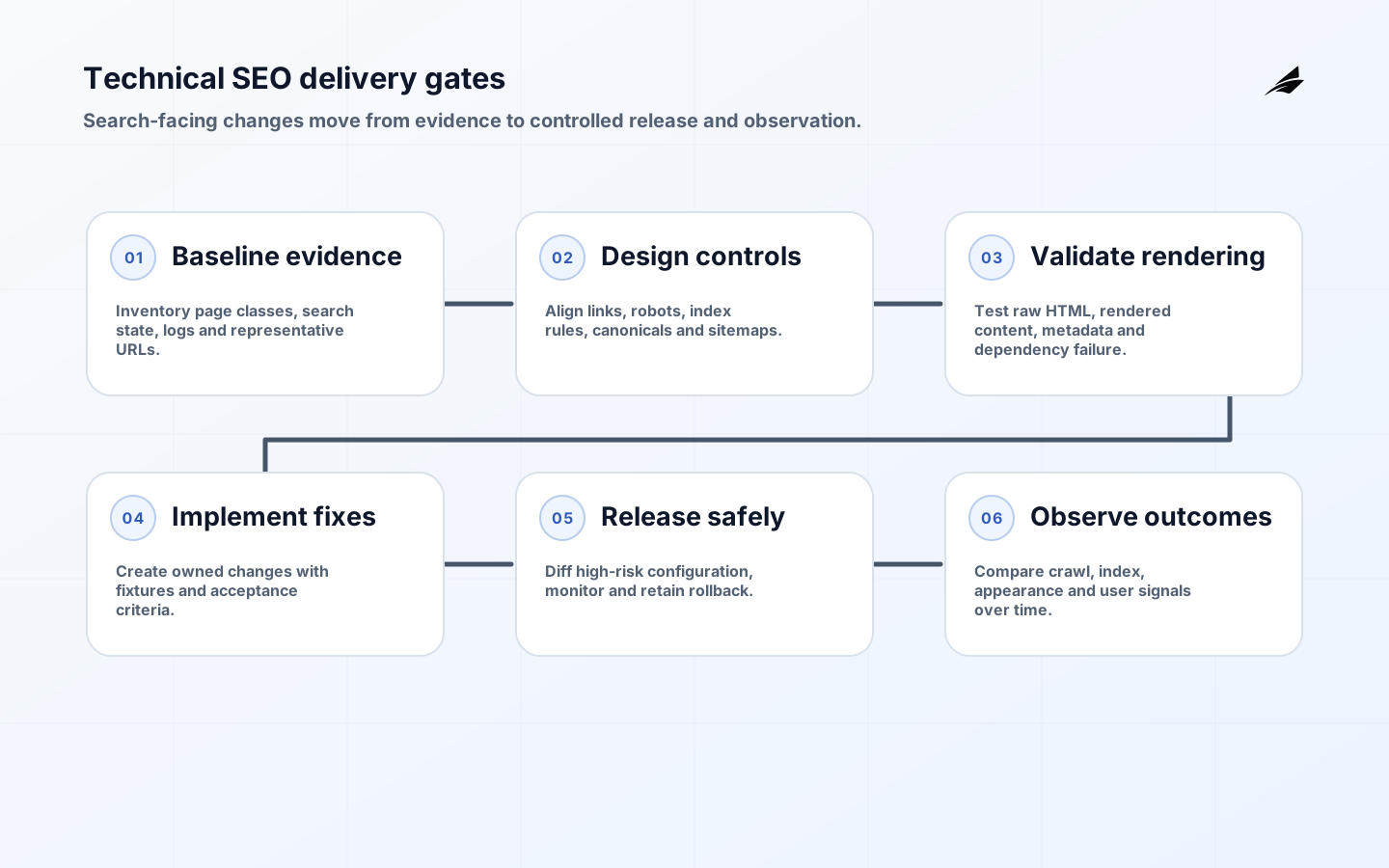
Run the technical SEO delivery plan
- Frame intended searchable page classes, business priorities, constraints and accountable owners.
- Baseline deterministic technical state plus search and crawler observations by template.
- Prioritize defects by affected value, scale, confidence, dependency and reversibility.
- Turn recommendations into acceptance criteria, fixtures and automated checks where practical.
- Release behind controlled gates, with configuration review and rollback for high-impact changes.
- Observe crawler, index and user signals through expected delays, then verify or revise the hypothesis.
A useful backlog item is specific: “Filtered category URLs with sort parameters are internally linked and self-canonicalizing; update the filter component to link to the base category, return the agreed index directive and remove those URLs from the sitemap.” It names the behavior, surface and expected state. “Fix duplicate content” does not give an engineering team enough information to test or release safely.
Protect gains with release checks at the template and configuration layers. Crawl representative fixtures in continuous integration, diff robots and canonical output, validate structured data, and fail deployment only for agreed high-impact conditions. Schedule broader production sampling because edge rules, CMS settings and real content can differ from test. Record exceptions with an owner and expiry so a temporary launch workaround does not become permanent search behavior.
Key takeaways
- Scope technical SEO services by page class, rendering path and business intent.
- Use aligned crawl, index, canonical and sitemap controls; each has a distinct job.
- Translate findings into owned engineering changes with testable acceptance criteria.
- Price the variation, dependencies and release surface, not just the number of URLs.
- Monitor deterministic implementation evidence and search outcomes without promising rankings.
Frequently asked questions
Is a technical SEO audit enough?
Only when the goal is diagnosis. Value usually requires engineering, content-system or infrastructure changes plus verification. An audit should therefore include evidence, priority, affected templates, owner guidance and acceptance criteria, not hundreds of unranked observations.
How long do technical changes take to affect search?
Implementation can be verified immediately, but crawling, reprocessing and reporting take variable time. Site scale, crawl demand, change type and search-system behavior all matter. Agree an observation window and leading indicators instead of declaring failure or success after a fixed number of days.
Can technical SEO services guarantee rankings?
No responsible provider can guarantee organic ranking. It can guarantee defined analysis, implementation support, tests, release controls and reporting. Technical quality removes barriers; relevance, competition, demand and search systems still influence outcomes.
Conclusion
Technical SEO is disciplined web engineering for intended search visibility. Establish the desired page inventory, align discovery and index signals, make rendered content dependable and control high-risk releases. When evidence and ownership are built into delivery, teams can improve search access without turning every traffic movement into guesswork.