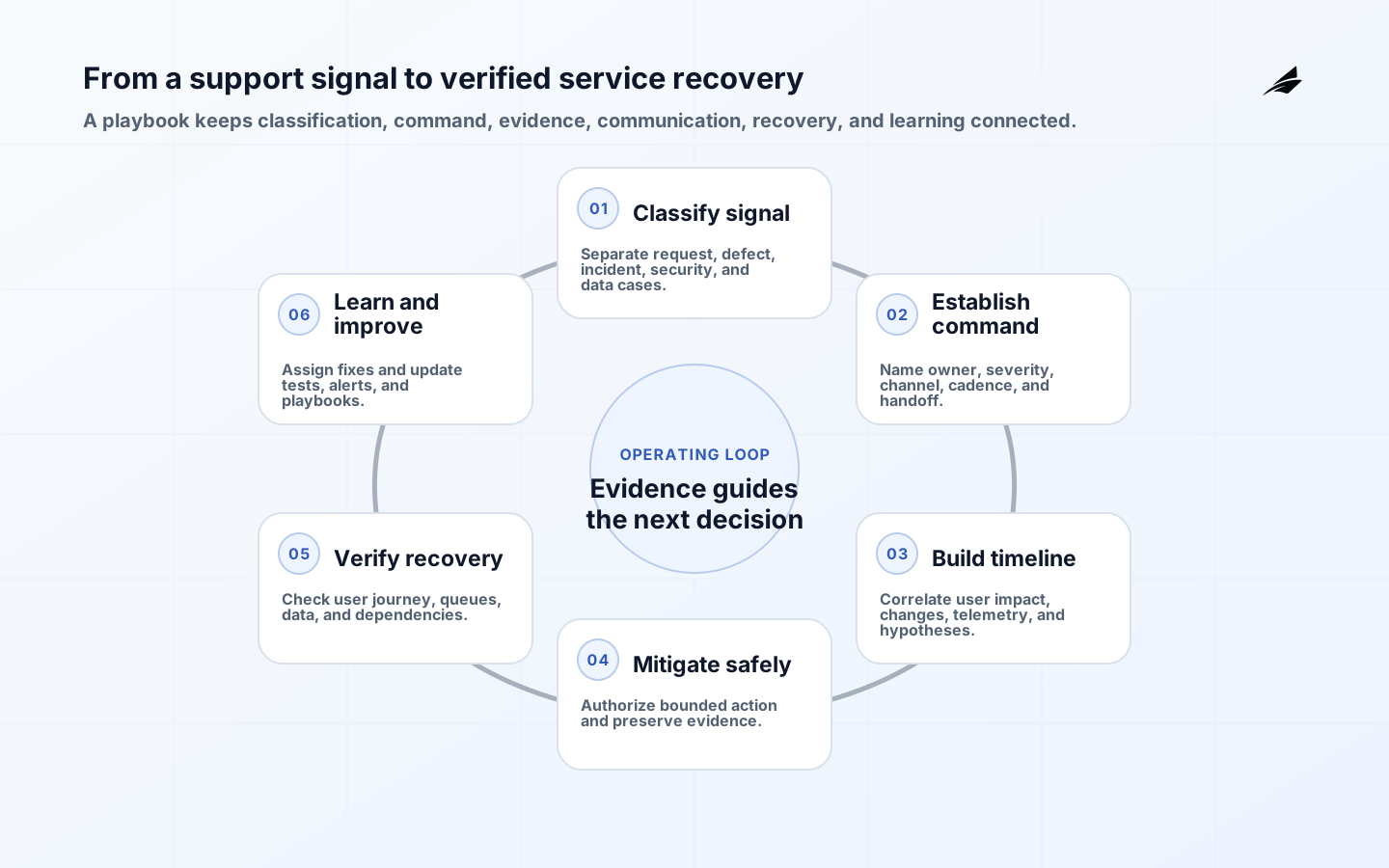
Software support playbooks give responders a reliable starting point when information is incomplete and time matters. They should not prescribe every diagnostic command. They should identify how a report becomes a case, what severity means, who leads, which evidence must be preserved, how customer impact is assessed, when engineering or security joins, how recovery is authorized, and how updates reach affected people. A useful playbook also distinguishes an ordinary request, a product defect, a reliability incident, a security event, and a data-correction case because each requires different authority and records. Reporting and governance improve when those classifications, timestamps, decisions, and outcomes are captured during the work rather than reconstructed from chat after the event.
Key takeaways
- Classify reports by customer consequence and handling route.
- Capture evidence that lets engineering reproduce and correlate.
- Write playbooks around decisions, permissions, and escalation.
- Rehearse major failure conditions with support and engineering.
- Use reporting to identify and reduce recurrent operational burden.
Software support response
Define a small set of support states and severity criteria that reflect customer and business consequence. Separate a question, defect, incident, service request, and suspected security event; each has different handling and evidence needs. Severity should consider affected task, scope, duration, workaround, data or financial consequence, and regulatory impact, not only technical symptoms. Require an initial record with customer-safe description, timestamp, environment, identifiers, observed result, expected result, and owner. This structure makes reports useful to engineering while avoiding the temptation to collect unnecessary sensitive content.
| Planning element | Decision to make | Accountable role |
|---|---|---|
| Report type | Classify question, request, defect, incident, or security concern. | Support lead |
| Severity | Assess task impact, scope, duration, and workaround. | Incident owner |
| Evidence | Capture identifiers, time, observed result, and environment. | Case owner |
| Next action | State permitted recovery or escalation route. | Service owner |
Design the support operating boundary
Build playbooks around decision points. For a common failure, state what to check, what evidence to capture, which change is permitted, when to escalate, and how to communicate status. Link runbooks to dashboards and traces rather than pasting brittle screenshots. OpenTelemetry provides a useful common model for correlating traces, metrics, and logs across a service path. Where a playbook instructs a manual retry or correction, define idempotency and audit requirements so support does not create duplicate work. Make customer communication part of the procedure, with a plain status and a promised next update time.
Build controls and evidence
Governance belongs in the support path without making it unusable. Limit access to customer and production data by task, record exports and material corrections, and give break-glass actions a reason, expiry, and review. The NIST Cybersecurity Framework is a practical frame for identifying, protecting, detecting, responding, and recovering; adapt its thinking to the responsibilities your support organization actually has. A major incident needs a named incident lead and communications owner, while routine cases need a clear handoff target. In both cases, preserve the timeline of decisions and evidence.
| Condition | Control or test | Owner |
|---|---|---|
| Customer reports duplicate action | Check idempotency evidence before any retry. | Support engineer |
| Dependency is unavailable | Use service status, trace, and communication procedure. | Incident lead |
| Sensitive data is involved | Restrict access and follow security escalation route. | Security duty officer |
| Playbook is outdated | Version correction and notify affected responders. | Support operations |
Roll out with real work
Pilot playbooks on the highest-volume and highest-consequence support scenarios. Observe whether a new agent can classify the report, find the service owner, use the evidence links, and explain the next step without private help. Run tabletop exercises for unavailable dependencies, duplicate transactions, an authentication failure, and a suspected data exposure. Update the playbook from the gaps uncovered. Publish changes with short training and version history; an old procedure that remains easy to find is worse than no procedure because it gives false confidence.
Measure and improve
Use reporting to improve service, not to rank people by ticket volume. Track time to acknowledge, time to restore, escalation accuracy, reopen rate, aged cases, repeat incident signatures, playbook usage, and customer-update timeliness. Slice these by service and failure class, then review a sample of narratives beside the dashboard. Numbers can show where a queue is growing; the case history explains whether the cause is a product defect, unclear policy, missing capability, or a weak handoff. Assign improvement actions and review whether they reduced the recurring burden.
Build a case taxonomy that improves routing
A stable taxonomy lets reporting reveal patterns without forcing every customer report into an artificial category. Define a manageable set of issue types, contributing conditions, affected service areas, and resolution codes with examples. Train agents on ambiguous cases and allow a correction route when a later investigation changes classification. Keep taxonomy changes versioned; otherwise trends may reflect a renamed label rather than a real improvement. The purpose is not exhaustive categorization. It is to route work, prioritize recurring harm, and make governance review based on comparable evidence.
Connect support to change management
Support should know which releases, configuration changes, and supplier events could affect customer reports. Include release identifiers and change windows in incident views, and give change owners a route to receive early support signals. Conversely, a planned change should consider the playbook, staffing, customer communication, and rollback evidence needed if it degrades service. This connection shortens diagnosis and prevents support from treating a known rollout effect as an isolated mystery. It also gives engineering a grounded view of actual customer impact.
Review incident learning without blame
A useful review reconstructs conditions, decisions, signals, and recovery actions rather than searching for a single person who made a mistake. Ask what made the issue hard to detect, why the first response was reasonable at the time, and which system or process change would reduce recurrence. Track actions to completion and check their effect in later reporting. Share lessons in a format that helps future responders, including changes to playbooks, alerts, ownership, or product design. The goal is stronger service recovery, not a more elaborate incident archive.
Design the case record for handoff, audit, and learning
NIST SP 800-61 Rev. 3 integrates incident response with cybersecurity risk management and recovery. Google's incident management guidance describes clear command, an acknowledged handoff, and a live state document; its postmortem guidance focuses learning on contributing conditions instead of individual blame. Monitoring Distributed Systems distinguishes useful symptoms from internal causes. The OpenTelemetry logs specification explains trace and resource correlation, which can turn scattered records into an attributable request path.
| Case field | Operational purpose | Governance use |
|---|---|---|
| Impact and scope | Directs severity and immediate response | Explains why escalation was proportionate |
| Decision log | Preserves choices under uncertainty | Supports review without hindsight reconstruction |
| Recovery checks | Proves the complete workflow returned | Distinguishes mitigation from verified restoration |
| Follow-up owner | Turns learning into change | Measures overdue risk reduction work |
Use one durable case identifier across support, incident coordination, engineering work, customer communication, and post-incident actions. Keep the reported symptom, affected tenant or workflow, first-known time, current impact, severity rationale, commander, decision log, mitigations, recovery checks, and next update visible. Separate observed facts from hypotheses. Record when a mitigation changes data or behavior and who authorized it. At handoff, require explicit acknowledgment and transfer the current objective, unresolved risks, and time-sensitive actions. Close the case only after user-visible service and downstream processing are verified; a green endpoint can coexist with stuck jobs or unreconciled records. Follow-up actions should have owners and due dates, and recurring patterns should change monitoring, design, documentation, or staffing rather than merely increasing ticket labels.
Related implementation guidance
The support playbook planning guide covers service boundaries before launch. The internal reporting tools checklist helps design trustworthy operational measures, while the quality assurance checklist turns observed incidents into maintained release evidence.
Set an operating cadence
Support governance should include a clear boundary between service restoration and customer remediation. Restoring a failed component may not resolve duplicate charges, missed deadlines, or incorrect customer messages created during the incident. Playbooks should state when a case needs a compensating action, who may authorize it, what evidence must be retained, and how the affected customer is notified. Track remediation separately from technical recovery in reporting. That distinction helps leaders understand the full consequence of an outage and prevents a resolved infrastructure alert from closing customer work prematurely.
Practical acceptance example
Practical example: several customers report that scheduled exports did not arrive after a supplier outage. The support agent classifies the issue, attaches the job identifier and time range, checks the playbook’s status view, and opens an incident because the affected task has no safe self-service workaround. The incident lead coordinates a replay using idempotent job records and sends customers an agreed update. Acceptance evidence includes a complete incident timeline, no duplicate exports after replay, linked customer cases, and a trend report that shows whether the supplier failure pattern recurs. The decision criterion is whether recovery restores the customer outcome, not merely whether the supplier dashboard turns green.
Final acceptance check
Finally, audit a small sample of closed cases against customer communications and remediation records. A case should not be marked resolved merely because engineering restored a dependency. Acceptance means the customer received the promised outcome, any compensation was authorized, and the final classification supports accurate future reporting.
Implementation checklist
- Classify reports by customer consequence and handling route.
- Capture evidence that lets engineering reproduce and correlate.
- Write playbooks around decisions, permissions, and escalation.
- Rehearse major failure conditions with support and engineering.
- Use reporting to identify and reduce recurrent operational burden.
Frequently asked questions
How detailed should a support playbook be? It should be detailed enough for a trained person to make the next safe decision, capture useful evidence, and know when to stop and escalate. Keep simple triage short, but document high-consequence recovery actions precisely. Test it with people who were not involved in writing it.
Should every support issue become an engineering ticket? No. Classify issues so routine questions, access requests, known workarounds, defects, and incidents follow appropriate paths. Create engineering work when evidence points to a product or platform change, and preserve the link back to affected support cases so priority remains grounded in customer impact.
Conclusion
A support playbook is an operational agreement between customers, support, engineering, and governance. Make it evidence-led, permission-aware, and regularly rehearsed so reporting leads to restored service and durable improvement.