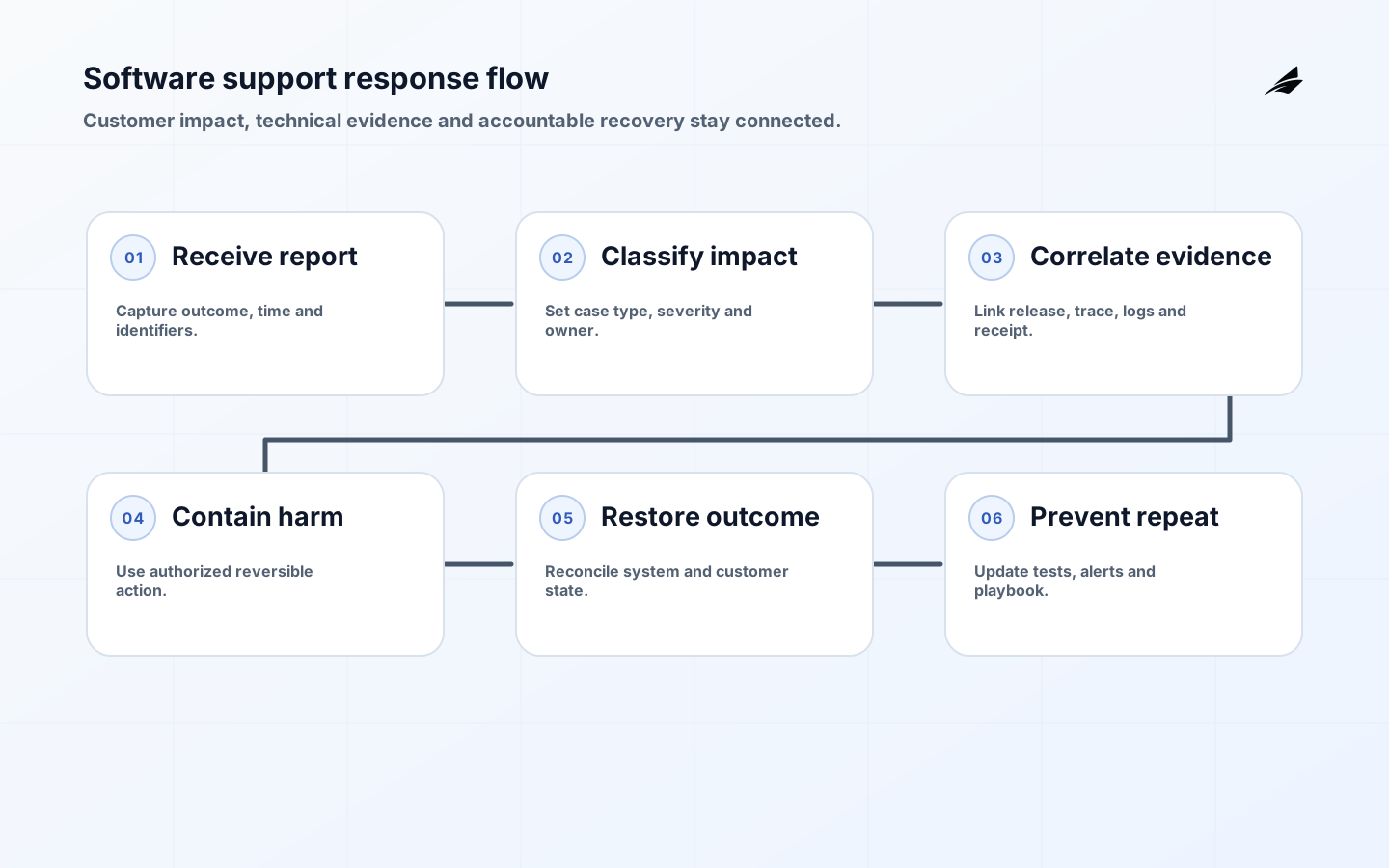
Software support playbooks give responders a tested path from an uncertain customer symptom to classification, evidence collection, containment, restoration and follow-up. They are not scripts that remove judgment or long documents copied from a policy library. A useful playbook tells a trained person what to inspect, which actions are safe, when to stop, who takes command and how to communicate the next update. It also connects support records to engineering telemetry and business impact so the same failure does not have to be rediscovered in every ticket. Planning these playbooks before launch exposes missing ownership, observability and recovery work while there is still time to fix it.
For connected implementation decisions, see software modernization roadmaps, multi-role business applications, developer handoff documentation, and custom software discovery checklist for multi-team delivery. These guides are most useful when their controls are adapted to the same records, owners and consequences rather than applied as independent checklists.
Connect the playbook to incident operations
NIST SP 800-61 Rev. 3 integrates incident response with broader cybersecurity risk management instead of treating preparation, detection, response and recovery as an isolated emergency function. Translate that principle into a small support taxonomy: question, service request, defect, operational incident and suspected security incident. Define customer consequence and escalation thresholds for each. Google SRE’s incident management guidance separates command, operational work, communication and planning roles; adopting those responsibilities prevents everyone from changing the system while no one maintains shared state.
Evidence should connect a customer report to system behavior without turning logs into a data dump. OpenTelemetry signals distinguish traces, metrics and logs, which can be correlated around a request or operation. Use stable case, tenant, release and transaction identifiers where lawful, and follow the OWASP Logging Cheat Sheet to record security-relevant events while excluding secrets and excessive personal data. The NIST SSDF helps feed recurring support findings back into requirements, verification and release practices.
Respond to a duplicated customer transaction
A customer reports two invoices after clicking submit once. The frontline playbook first protects the customer: classify financial consequence, capture the visible invoice IDs and request time, and prevent an improvised retry or deletion. The responder uses the correlation identifier to find the original command, gateway attempts and downstream receipts. If the duplicate is confirmed, a named incident lead coordinates containment while an authorized business owner decides the correction. Support communicates what is known, what the customer should avoid doing and when the next update will arrive.
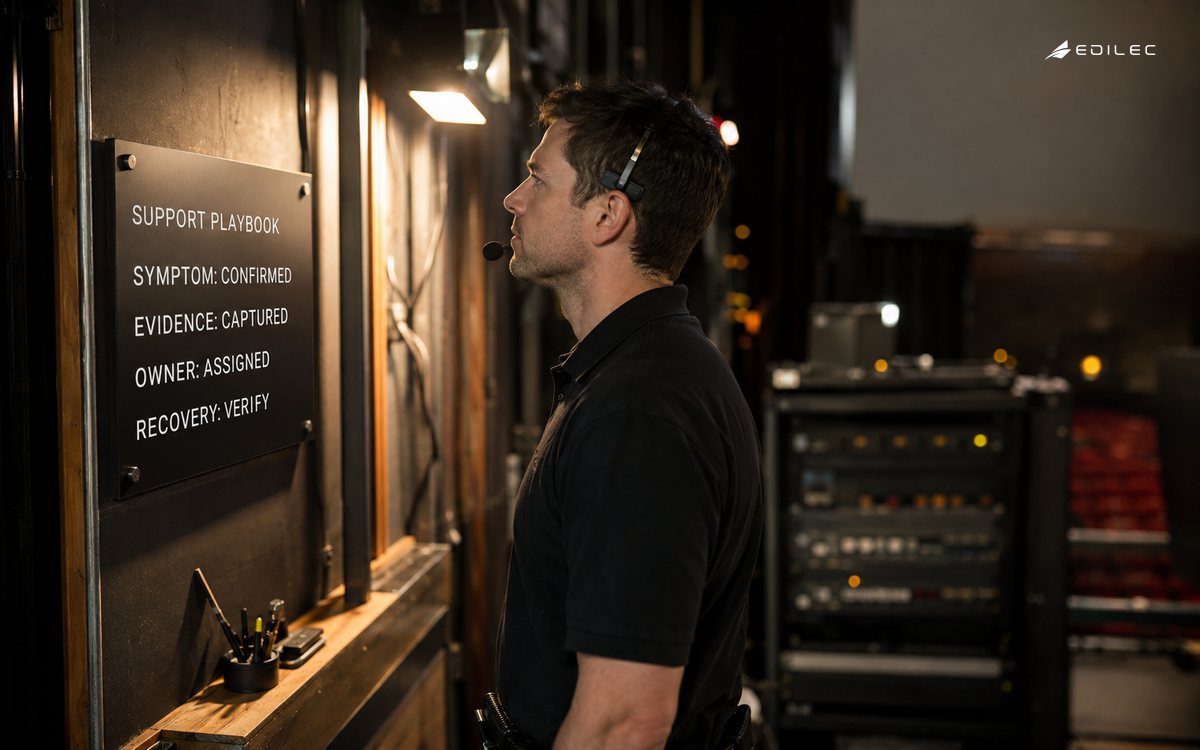
Recovery is not complete when an error graph returns to normal. The team must reconcile the customer account, reverse or void the incorrect transaction through an approved path, verify that notifications and reports agree, and link affected cases to the incident. The playbook then records whether idempotency failed, the response was lost, or a retry policy created a second effect. A follow-up action may change command keys, user feedback, alerts or test coverage. That sequence turns one complaint into evidence for both customer remediation and engineering prevention.
| Response stage | Responder question | Required evidence |
|---|---|---|
| Classify | What customer outcome is affected and how widely? | Case type, consequence, scope and owner |
| Correlate | Which request, release and dependency path is involved? | Case ID, trace, logs and transaction receipt |
| Contain | Which reversible action reduces harm now? | Authorized change and before-state |
| Communicate | What is known and when is the next update? | Timestamped customer and stakeholder notice |
| Recover | Is the customer outcome and system state corrected? | Reconciliation, confirmation and follow-up action |
Key takeaways
- Frame software support playbooks around a measurable outcome and one bounded end-to-end journey.
- Name production telemetry, the customer record, and the incident commander for the active response before designing copied data, automation, or interface polish.
- Model explicit states: reported, triaged, contained, investigating, restored, monitoring, and closed with follow-up.
- Enforce protected actions at the service boundary and preserve a recovery path.
- Release with representative technical decision makers and improve using observed exceptions, not opinions alone.
Define the software support playbooks boundary
Write the outcome in plain language and make its boundary testable. For this work, that means give support staff a reliable path from a customer symptom to containment, evidence collection, recovery, and follow-up. Treat each support incident as a working unit with a trigger, stable identifier, accountable owner, completion condition, and an understood error consequence. A boundary also names what is outside the first release. That protects the team when adjacent requests arrive from other parts of the organization. Review the boundary with support agents, on-call engineers, service owners, and incident managers. Ask what evidence they need, which action they may take, and what happens when information is incomplete. The answer should be specific enough that a release reviewer can identify valid completion without interpreting a broad business aspiration.
| Question | Decision to document | Evidence to collect |
|---|---|---|
| Outcome | give support staff a reliable path from a customer symptom to containment, evidence collection, recovery, and follow-up | Baseline timing, rework, and named business owner |
| Working unit | A support incident with stable identity and lifecycle | Recent normal and difficult cases |
| Authority | production telemetry, the customer record, and the incident commander for the active response | System owner, permitted editors, and policy reference |
| Completion | Durable result, visible confirmation, and recovery condition | Result record, receipt, and reconciliation rule |
| First release | One complete decision loop and its exceptions | Deferred work with owner and review date |
Model state, data, and authority
A state model prevents software support playbooks from degrading into a collection of disconnected pages. Use states that explain what happened, what may occur next, who can act, and what is blocking progress: reported, triaged, contained, investigating, restored, monitoring, and closed with follow-up. Avoid a generic pending status that hides whether the support incident awaits data, a decision, a dependency, or manual repair. For material fields, record the authoritative source, effective time, update expectation, and permitted editors. A display copy can be useful, but it is not automatically allowed to correct the source. Retain the identifier that connects the initiating request, action, downstream call, and recovery activity. This gives operations and engineering a shared route to investigate disagreements without relying on inbox archaeology.
Design controls and recovery
Control design should fit the consequence of the action. In this case, distinguish customer communication, reversible mitigation, privileged action, and permanent correction. Apply permission at the command or API boundary using the current actor, object, relationship, and requested action. Hiding a menu can improve clarity, but it cannot secure a direct request. The OWASP Application Security Verification Standard gives practical checks for authorization, validation, logging, and session handling. Plan a legible response when an action is denied, a dependency times out, or records disagree. A visible exception owned by a real person is safer than a silent retry or undocumented workaround. Significant changes should retain prior state, actor, time, reason, and correlation identifier while avoiding unnecessary personal data in diagnostic records.
| Condition | Expected behavior | Operational evidence |
|---|---|---|
| Information missing | Hold work in a recoverable state and state what is needed. | Validation result and next owner |
| Unauthorized request | Deny at the service boundary without exposing unrelated records. | Actor, action, object scope, review event |
| Dependency failure | Use bounded retry or compensation and expose recovery. | Correlation identifier, attempt history, exception owner |
| Replay or duplicate | Prevent repeated effect and return known outcome. | Request identity, prior result, idempotency decision |
| Manual override | Require authority, reason, and follow-up where appropriate. | Before-and-after state and policy basis |
Build a thin operational slice
Prove the full path before broadening the surface. Create playbooks for likely customer-impacting failures, connected to alert routes and clear escalation stops. Include identity, retrieval of trusted context, allowed transition, usable outcome message, audit event, observable failure, and supportable recovery. Make integration behavior explicit: contract, expected time, duplicate behavior, and the owner who investigates a rejection or delay. The Secure Software Development Framework connects these requirements to secure design, implementation, verification, and release evidence. A thin slice is not a mock-up; it is a production-shaped capability whose behavior remains understandable in ordinary and inconvenient conditions.
Verify quality with real conditions
Run a tabletop and controlled rehearsal to confirm that data, access, and next actions actually exist. Include keyboard users, assistive technology users, unreliable networks, and non-default data conditions in the review. Define acceptance evidence before implementation: expected outcome, protected boundary, error condition, data condition, and named observer. Pair workflow checks with contract and integration checks, then explore places where a responder may misread status or take an irreversible action. Quality is not a release-day ceremony; it is credible assurance for the risks that would make support unsafe or untrustworthy.
Operate and improve after release
Publish each playbook beside its alert route and update it after every material incident. Instrument intent and outcome, not merely page loads. A correlation identifier across browser, service, and dependency activity connects a reported issue to its actual path; OpenTelemetry signals provide common concepts for traces, metrics, and logs. Review cycle time, failed transitions, queue age, corrections, and recovery time alongside customer impact. Retire old reports, credentials, and manual steps only after the replacement has earned trust in real work.
Define release evidence
For software support playbooks, release readiness includes the human conditions around the document. Confirm that the alert identifies a reachable owner, responders have the minimum diagnostic access, and customer-facing teams know what they can say before a root cause is known. Use severity language that is based on impact and urgency, not on the technical novelty of the fault. A responder needs an explicit point where normal troubleshooting stops and incident coordination begins. After restoration, capture the difference between the documented path and the path people actually took: perhaps a dashboard was missing a correlation identifier, a permission was too broad, or an escalation group was unavailable. Convert that observation into a concrete change with an owner and due date. The playbook becomes stronger when it reflects real response behavior, including uncertainty and partial information, instead of presenting an idealized incident that never happens in production. Track whether responders reach the correct owner and whether customer updates meet the agreed cadence; both measures reveal a weak playbook earlier than a postmortem. Review the playbook quarterly even without an incident, because alert routing, access grants, and dependencies often change quietly while the document stays still.
Frequently asked questions
What belongs in the first software support playbooks release?
Include condition, impact check, safe actions, evidence, escalation, communication, and closure criteria.
How should the team decide what to automate?
Prioritize customer-impacting failures, high-frequency requests, and actions requiring elevated access.
Conclusion
A software support playbook succeeds when it makes consequential work legible, controlled, and easier to improve. Start with the customer outcome, establish data and decision authority, rehearse one complete response with recovery, and judge the result by what responders can safely achieve. That sequence creates a capability that remains useful when information is missing, dependencies fail, or the original project team is no longer available.