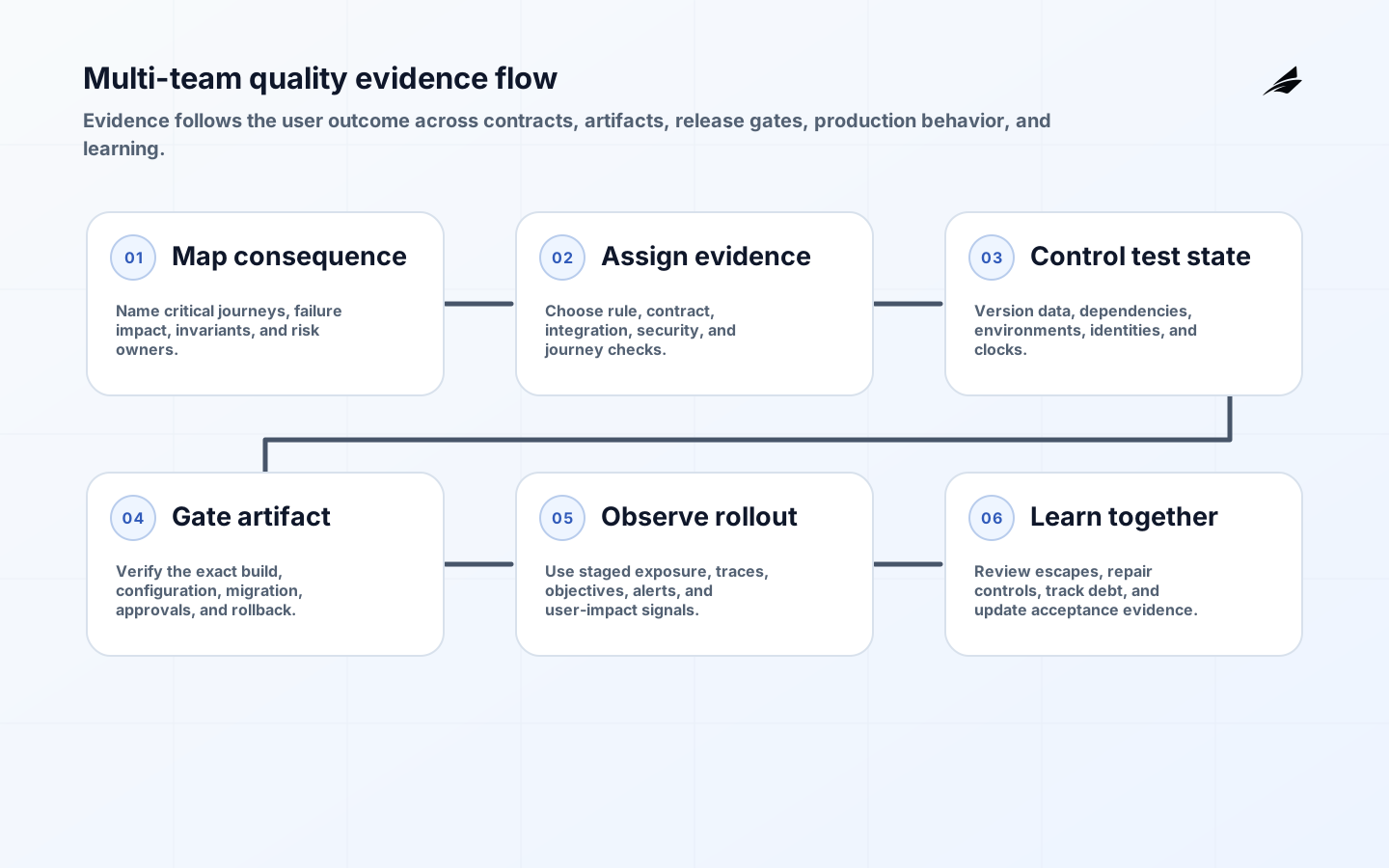
Quality assurance for custom systems is the production of credible evidence that a change is fit for its intended work. In multi-team delivery, quality cannot be delegated to a final test phase because one user outcome may cross a web client, API, identity provider, data pipeline, integration, and support queue owned by different groups. The program needs a shared risk model, versioned interface contracts, representative test data, reproducible environments, release gates, production signals, rollback ownership, and a learning loop that converts escaped failures into better controls.
Define shared quality evidence across team boundaries
Begin with consequences, not a target percentage of automated tests. Map the highest-impact journeys and ask what could produce financial error, privacy exposure, irreversible change, inaccessible service, or silent loss of work. Assign evidence at the boundary where a failure can be detected: unit and property tests for rules, contract tests for interfaces, integration tests for dependencies, journey tests for user outcomes, security verification for misuse, and operational tests for recovery. NIST SSDF organizes secure development practices across preparation, software protection, production, and vulnerability response; the same lifecycle perspective prevents quality work from ending at deployment.
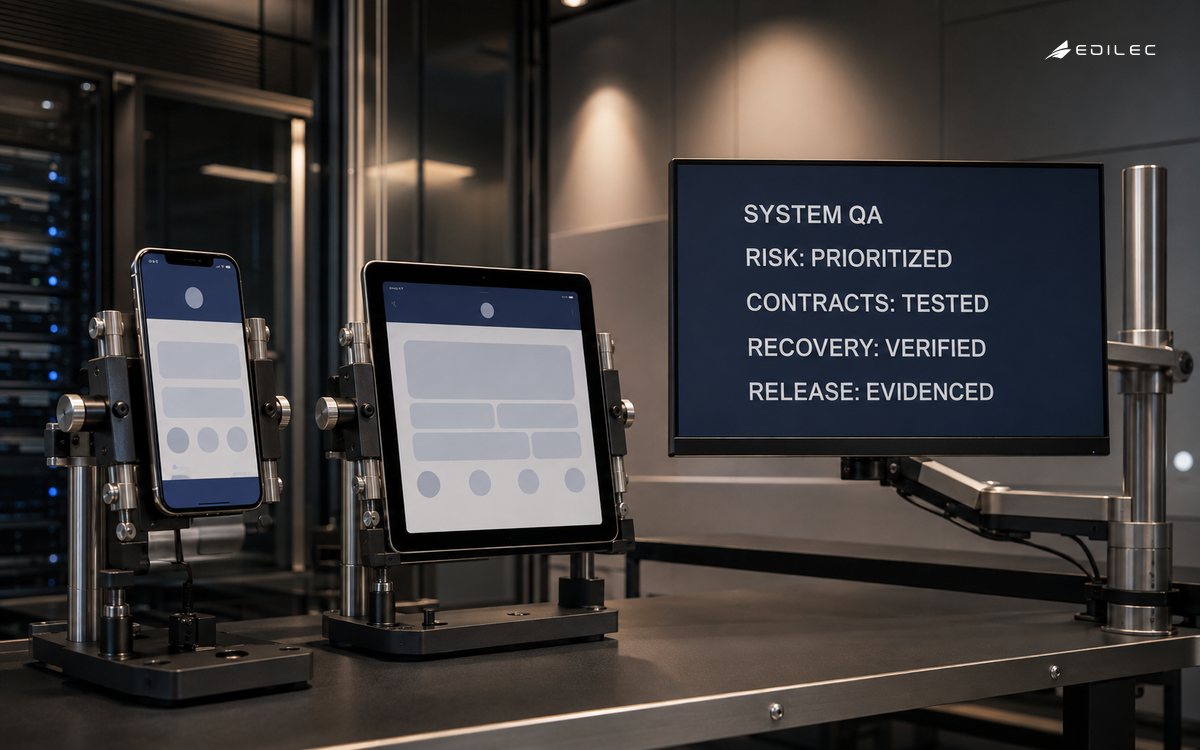
Release evidence must correspond to the actual artifact and configuration being deployed. Google’s release engineering guidance describes reproducible builds, policy gates, audit trails, system-level tests, and staged rollout. Its testing for reliability chapter emphasizes quantifying confidence and testing according to risk. OWASP ASVS can supply application-security acceptance criteria, while OpenTelemetry supports correlated production evidence. Teams should rehearse a failed dependency, incompatible contract, migration rollback, corrupted message, alert handoff, and client-visible correction before calling the release ready.
| Quality boundary | Primary evidence | Named owner |
|---|---|---|
| Business rule | Examples, edge cases, invariant tests, and accepted calculation results. | Domain and implementing team |
| Service contract | Schema compatibility, consumer expectations, timeouts, retries, and error semantics. | Producer and consuming teams |
| Release artifact | Reproducible build, dependency record, test report, approval, and rollback reference. | Release owner |
| Production journey | Correlated traces, service objectives, synthetic checks, incidents, and user impact. | Service and operations owners |
Key takeaways
- Start with customer and operational consequences, not test case counts.
- Write acceptance criteria for outcomes, authorization, and recovery.
- Use layered tests that protect logic, contracts, integrations, and key journeys.
- Record release evidence and accepted risk in an inspectable form.
- Feed production observations back into specific verification changes.
Multi-team quality assurance
Write acceptance criteria around observable outcomes and difficult conditions. A statement such as the page works is not testable enough. Instead specify who can perform which action, what state change is expected, what evidence is recorded, what happens on duplicate input, and how a downstream failure is handled. Bring product, support, security, and engineering into this conversation early; each sees a different failure mode. Maintain a lightweight risk register that links material scenarios to tests, monitoring, and an accountable owner. This is more useful than counting test cases without knowing what they protect.
| Planning element | Decision to make | Accountable role |
|---|---|---|
| Risk scenario | Describe failure consequence and affected journey. | Product and engineering |
| Acceptance evidence | Define result, state change, and recovery expectation. | Feature owner |
| Verification layer | Choose unit, contract, integration, or journey test. | Technical lead |
| Production signal | Name alert or review that validates assumptions. | Service owner |
Design the quality assurance for custom systems operating boundary
Build a layered test strategy that respects system boundaries. Unit tests should protect logic with fast feedback; contract tests should protect agreed interfaces; integration tests should verify real adapters where risk warrants it; and end-to-end tests should cover a small number of high-consequence journeys. Do not make the end-to-end suite the only proof of quality, because it is slow and poor at isolating faults. Test data needs its own design: representative but nonproduction records, stable reset behaviour, and explicit coverage for authorization, time, and unusual states. Keep environment differences visible rather than pretending every stage is identical.
Build controls and evidence
The NIST SSDF frames secure development as an ongoing set of practices, which aligns well with delivery teams that need evidence for design, verification, release, and response. Make quality gates proportionate to risk and avoid a binary pass label that hides known limitations. A release record should state what changed, which scenarios were exercised, which checks failed or were waived, who accepted the risk, and how production behaviour will be watched. Protect test systems and fixtures as carefully as their sensitivity requires; copied production data can turn a helpful test into a privacy or security incident.
| Condition | Control or test | Owner |
|---|---|---|
| Contract changes unexpectedly | Run provider and consumer contract checks. | Owning teams |
| Test is flaky | Classify, fix, or quarantine with a dated owner. | Quality lead |
| Release exception is accepted | Record scope, rationale, expiry, and monitor. | Release authority |
| Production differs from test | Compare environment, data, traffic, and dependency behaviour. | Incident lead |
Roll out with real work
Coordinate release verification across team boundaries with one shared transaction or scenario. Rehearse a successful path, a denied action, a delayed dependency, and a recoverable partial failure. Agree who is on point when the evidence disagrees: a contract may be valid while the business sequence is still wrong. Use progressive delivery for changes with uncertain production effects, and set observable rollback triggers before release. Quality does not end when the change is deployed; early production signals validate whether test assumptions represented real load, data, and customer behaviour.
Measure and improve
Track measures that lead to better decisions, such as escaped defect rate by scenario, change failure rate, time to detect, time to restore, coverage of named risks, flaky-test rate, and unowned release exceptions. Avoid treating code coverage as a quality score; it shows execution, not whether the consequential behaviour was challenged. Review production incidents with a learning posture: ask which evidence was missing, misleading, or ignored, then improve a specific test, monitor, contract, or operating procedure.
Make quality visible in planning and review
Quality work is easier to defer when it is described only as testing. Make it visible in planning as risk reduction with an owner, acceptance evidence, and a deadline tied to the change. During review, ask what would cause the chosen customer journey to fail, how that failure would be observed, and whether the evidence is independent enough to be trusted. This often reveals missing operational checks, not merely missing automated tests. A team that can articulate its remaining uncertainty can make a better release decision than one that reports a green pipeline with unknown coverage.
Coordinate test data and environment ownership
Multi-team testing breaks down when data and environments are shared but nobody owns their reset, configuration, or availability. Publish a service catalogue for test dependencies, including supported scenarios, change windows, fixtures, and contact routes. Use synthetic or safely transformed data, and make time-sensitive behaviours reproducible through controllable clocks where possible. When a test failure appears, distinguish product defect, environment fault, and test defect promptly; otherwise teams lose confidence and start ignoring signals. Reliability of the verification system is itself a quality requirement.
Manage quality debt deliberately
Every waived check, untested migration, flaky scenario, and incomplete observability hook is a form of quality debt. Record it with scope, rationale, owner, expiry, and the condition that will retire it. Do not combine unrelated exceptions into one generic risk acceptance. Review the debt alongside incident and release evidence so it competes fairly with new feature work. Some debt will be rational; the danger is invisible debt that accumulates until a normal change becomes unpredictable. A small, current register makes repayment possible.
Set an operating cadence
Quality planning should also make ownership of testability explicit. A feature is hard to verify when its inputs cannot be controlled, its outputs cannot be observed, or its dependency failures cannot be simulated. Engineers should raise those constraints during design and propose seams such as injected clocks, test endpoints with appropriate protection, deterministic fixtures, or traceable event records. Product owners can then decide whether the risk is acceptable rather than discovering it immediately before release. This is not testing for testing’s sake; it is designing a system whose important claims can be checked repeatedly as teams and dependencies evolve.
Practical acceptance example
Practical example: two teams change an order API and the billing service in the same release. A contract test proves the new field is accepted, but an end-to-end rehearsal reveals that a retry can create a second charge when billing receives a timeout. The release is held until the command carries an idempotency key and the support playbook can locate the original request. Acceptance evidence is a contract scenario, an integration test for retry, an audit record linking both attempts, and a monitored production signal for duplicate charge prevention. The decision criterion is not whether the API returns success; it is whether the customer outcome remains correct under plausible failure.
Implementation checklist
- Start with customer and operational consequences, not test case counts.
- Write acceptance criteria for outcomes, authorization, and recovery.
- Use layered tests that protect logic, contracts, integrations, and key journeys.
- Record release evidence and accepted risk in an inspectable form.
- Feed production observations back into specific verification changes.
Frequently asked questions
Who owns quality assurance in a product team? Everyone who shapes or operates the outcome owns part of it, while specialist QA practitioners may lead test strategy, exploratory work, and quality coaching. The key is explicit responsibility: a team should know who owns acceptance, automation, environment readiness, release risk, and production observation.
How many end-to-end tests are enough? Cover the few journeys where a failure has the highest consequence or where component tests cannot reveal the integration behaviour. Keep the suite intentional and reliable. Add lower-level tests for variations so the system can give fast, localized feedback during everyday development.
Conclusion
Quality assurance becomes a delivery advantage when teams connect each important risk to evidence before release and feedback after it. Make the evidence legible across boundaries, then use incidents and exceptions to strengthen the next change.