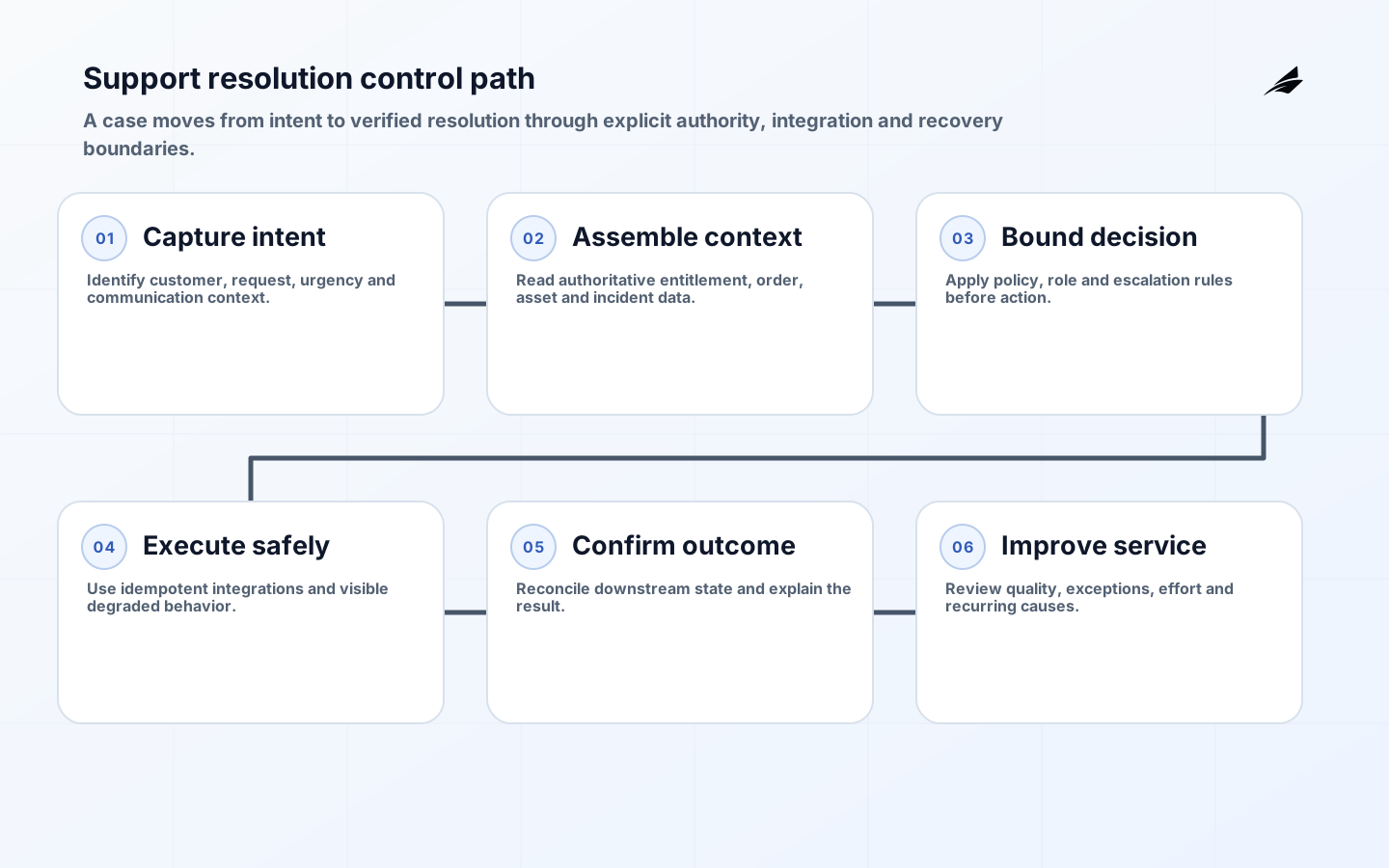
Custom Software for Support Teams: Scope, Cost, Risks and Delivery Plan requires more than selecting tools or assembling a feature list. The implementation must connect a defined business outcome to data, authority, failure behavior and permanent ownership. This guide explains the decisions a buyer, product leader and delivery team should settle before committing the full build. It uses current primary standards where they define a useful control, while keeping the architecture proportional to the actual workflow and consequence.
The practical goal is an operable service: people can complete the intended work, understand state and exceptions, and recover when a dependency or decision fails. Scope therefore includes discovery, design, integration, security, delivery, rollout and support. The sections below can be used for proposal review, architecture workshops and acceptance planning. Related reading includes Support Tooling for SaaS: Context, Control and Faster Resolution, AI Workflow Automation for Support Teams: Scope, Cost, Risks and Delivery, Application Managed Services: Scope, Service Levels, Risks and Transition Plan.
Scope the support outcome before the interface
Start with the work that should improve: faster correct resolution, fewer transfers, lower repeat contact, safer refunds, or better escalation. Map one representative request from intake through identity checks, diagnosis, action, customer communication and closure. Record where an agent changes systems, waits for data or repeats a decision. The first release should remove one costly constraint without replacing every support platform. Preserve the system of record and integrate around it unless the evidence shows that its data model or workflow fundamentally blocks the target outcome.
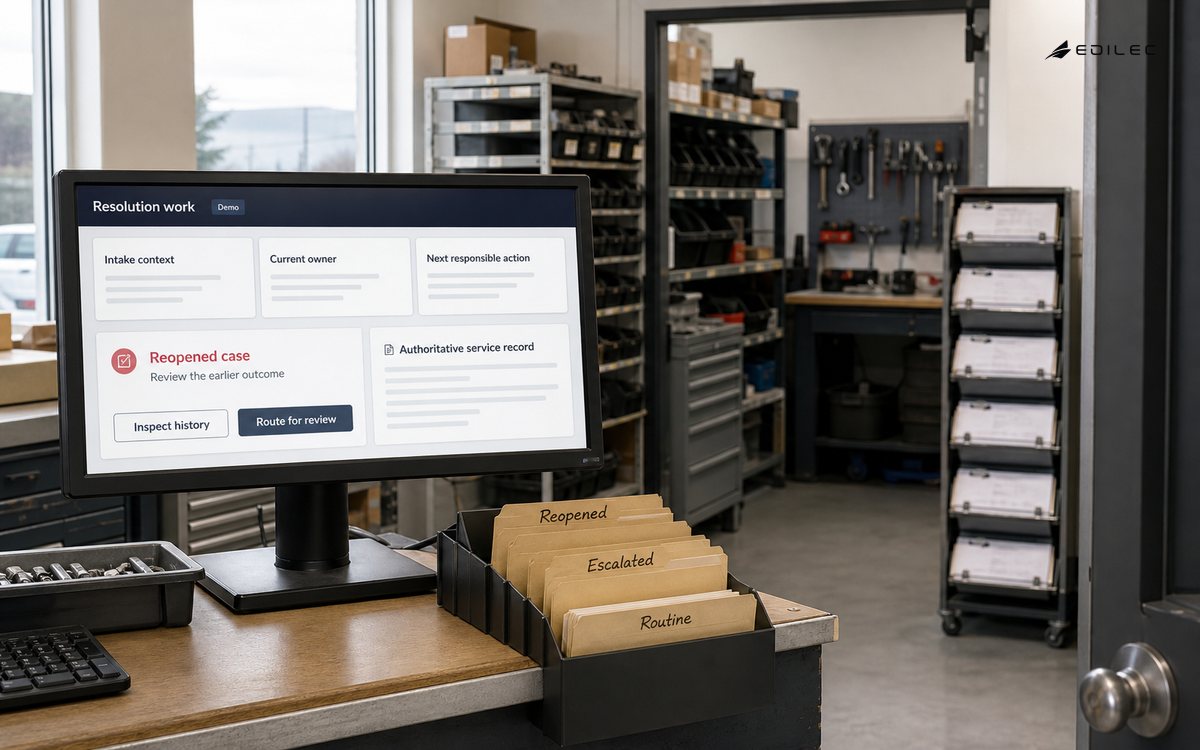
Create a baseline from several weeks of cases before designing the target. Sample simple, escalated, reopened and high-risk work; measure elapsed time separately from active handling. Interview frontline agents and the teams receiving escalations. Convert findings into acceptance scenarios with actual policy limits and representative customer histories. This prevents a demonstration from proving only the clean path that experienced agents already handle quickly.
Model cases, customers and service obligations explicitly
A useful support domain model separates customer, account, entitlement, conversation, case, incident, order, asset and action. A case can contain several conversations; an incident can affect many cases; an entitlement can control response targets without changing priority. Store timestamps with their meaning, not as one generic updated field. Make queues, ownership, status transitions and reopen rules explicit. This prevents reports from treating an automated acknowledgement as a response or a reassignment as progress. The model should also preserve the source and confidence of imported customer context.
Define state transitions with preconditions and resulting events. For example, closing a case may require a customer-facing explanation, completed downstream action and a reason code, while reopening should restore ownership and service-clock treatment predictably. Keep configurable taxonomy under governance because changing a reason or queue can alter automation and reporting. Use migration mappings rather than silently merging historical categories.
| Area | Decision | Evidence |
|---|---|---|
| Scope area | Decide before build | Acceptance evidence |
| Workflow | Eligible case types, states and authority | Representative cases complete without hidden handoffs |
| Data | System of record, freshness and retention | Fields reconcile to their authoritative source |
| Integrations | Timeout, retry and fallback behavior | Failure tests preserve case access and ownership |
| Security | Roles, elevation and audit events | Unauthorized actions fail and privileged actions are attributable |
Design integrations for degraded operation
Support software commonly depends on CRM, identity, billing, order, product telemetry and communication services. Define the read and write authority of each connection, stable identifiers, freshness expectations, timeout behavior and reconciliation. Do not let a failed enrichment call make the case inaccessible. Cache only data whose staleness is acceptable, show age to agents, and queue writes with idempotency keys where retries are safe. Every integration needs an owner, contract test, observable failure mode and manual fallback. OpenTelemetry traces can connect a support action to downstream requests without exposing sensitive conversation content.
Maintain a dependency register with authentication method, data owner, support window, rate limit, sandbox fidelity and planned retirement. Decide whether the support application calls dependencies synchronously, consumes events or uses replicated read models. Each choice has a different consistency promise. Contract tests should run against provider changes, while synthetic production checks verify credentials and network paths before agents discover failure during a customer conversation.
Protect customer context and consequential actions
Support tools concentrate personal data and powerful actions, so access cannot be based only on employment in the support department. Use least-privilege roles, scoped elevation and purpose-linked access for refunds, credential resets, exports and account changes. Mask data that is unnecessary for the current task. Record who viewed and changed sensitive fields, but keep secrets and full message bodies out of general logs. Use the OWASP ASVS as a verifiable application-security baseline and the NIST SSDF to make secure development evidence part of delivery rather than a final penetration-test gate.
Add threat scenarios for account takeover through support, malicious attachments, prompt or message content, insider browsing and bulk export. Require step-up verification before changing credentials or payment details. Scan uploads, constrain rendering and isolate untrusted content. Retention should distinguish the case record from transient diagnostic data. Review audit access itself, since a searchable support log can become a second sensitive-data store.
Estimate cost from workflow and integration uncertainty
The largest cost drivers are rarely the number of screens. They are unresolved process variants, legacy interfaces, data cleanup, permissions, migration, reporting and the operational support required after launch. Estimate discovery, implementation, assurance, rollout and ongoing ownership separately. For each uncertain dependency, fund a short proof before committing the full plan. Prefer a range tied to assumptions over a precise figure that hides risk. The business case should compare build cost with avoidable handling time, error cost, delayed revenue, compliance exposure and the cost of retaining the current fragmented workflow.
Use staged commercial gates: discovery acceptance, risky-integration proof, workflow pilot and production expansion. At each gate, compare remaining uncertainty with expected value. Include internal subject-matter time and change management in the budget; agents, policy owners and system custodians are delivery capacity. Track recurring costs per active agent, case and integration so architecture decisions can be revisited as volume and vendor pricing change.
| Area | Question | Control |
|---|---|---|
| Cost driver | Early question | Control |
| Process variation | How many real paths differ from the documented path? | Sample cases and classify exceptions |
| Legacy APIs | Can writes be retried and reconciled safely? | Prototype the riskiest integration |
| Migration | Which history must remain actionable? | Migrate only justified records and retain access |
| Operations | Who owns incidents and releases? | Budget runbooks, telemetry and support rotation |
Release by queue, action and risk
Pilot with a bounded queue whose cases are representative but recoverable. Run historical cases through the new rules, test concurrency and rehearse failed integrations. During rollout, compare old and new outcomes rather than forcing immediate migration of every queue. Use feature controls for high-risk actions and keep a documented rollback path for workflow, data and permissions. Train supervisors on exception handling before training every agent on the happy path. A release is accepted only when permanent owners can diagnose the service, reconcile downstream state and restore work after a failure.
Prepare a conversion plan for open cases, drafts, attachments, service clocks and subscriptions. Decide which history remains in the legacy system and provide linked read access where migration adds little value. During coexistence, establish one owner for each case and prevent notifications from both platforms. Rehearse rollback with newly created records so the team knows how work is reconciled, not merely how traffic is redirected.
Measure resolution quality, not activity volume
Avoid declaring success because agents clicked less or automation closed more tickets. Track time to correct resolution, transfer rate, reopen rate, first-contact resolution, customer effort, policy exceptions and downstream corrections. Segment measures by request type and channel so easier work does not mask deterioration in complex cases. Pair business outcomes with DORA delivery measures and service indicators such as queue age, integration errors and failed notifications. Review qualitative samples because an apparently fast closure can still contain an incomplete explanation or unsafe action.
Define guardrails before launch: no rise in unauthorized actions, missed priority cases, unresolved integration failures or inaccessible customer communication. Review metrics weekly with case samples and agent feedback. Improvement work should address source causes such as missing product telemetry or ambiguous policy, not merely tune routing. Retire automations that shift effort into hidden correction queues even when headline handling time improves.
Key takeaways
- Scope one measurable support constraint before replacing a platform.
- Treat integrations and permissions as product behavior, not plumbing.
- Design degraded operation and reconciliation before rollout.
- Measure correct resolution and customer effort alongside delivery speed.
Frequently asked questions
Should a support team buy or build?
Buy when a standard product fits the case model and differentiating workflows are limited. Build or extend when integrations, permissions, service logic or customer experience create material advantage that configuration cannot deliver safely.
Should AI be in the first release?
Only if it solves a bounded task with measurable quality and a safe fallback. Search, summarization and suggested classification are usually easier to control than autonomous refunds, account changes or closure decisions.
How long should discovery take?
Enough time to observe representative work, inspect systems and prove risky interfaces. For a bounded workflow this can be a few focused weeks; a multi-region replacement with migration and regulated data needs a larger discovery and staged commitment.
Conclusion
Custom software for support teams succeeds when it makes the service easier to resolve, explain and operate. A credible plan names the target outcome, preserves authoritative data, bounds powerful actions, anticipates integration failure and releases into a measured queue. That discipline produces a maintainable support capability rather than another interface layered over unresolved process problems. Review the service quarterly against case evidence so workflow growth remains intentional and obsolete automation is removed.