Multi-tenant SaaS architecture matters to product and engineering teams launching a shared B2B product. In practical terms, it is an application model in which one deployed service serves multiple customer organisations, while the product deliberately identifies every request, record, and permission with the right tenant context. That definition is more useful than a product label because it points to decisions a team can test: what the boundary is, what information is trusted, which failure conditions are acceptable, and who responds when the normal path breaks. The related concerns of shared application architecture, a SaaS data model, and tenant-aware access control should be designed as part of the operating model, not appended after an initial launch.
What multi-tenant SaaS meaning means
Multi-tenant SaaS should be explained in the language of responsibilities and observable behaviour. A tenant is usually a customer organisation, but the business must define it precisely. A parent company, subsidiary, reseller, or workspace can each require a different boundary; treating them as interchangeable causes entitlement and reporting errors. A useful definition therefore includes the information that crosses the boundary, the actors allowed to change it, the evidence retained, and the conditions in which the system refuses to proceed. That gives practitioners a way to challenge vague requirements before they become fragile implementation assumptions.
Architecture decisions to make first
The architecture is not a diagram of components alone. It is the set of contracts that lets product and engineering teams launching a shared B2B product operate the capability repeatedly. Make the following decisions explicit before choosing a platform feature or writing an integration. Each one affects the likely failure mode, the test plan, and the people who will need evidence later.
| Decision | What to define |
|---|---|
| Tenant identity | Decide how a request obtains an immutable tenant context and reject ambiguous context. |
| Isolation model | Choose row-level, schema-level, database-level, or service-level separation for the sensitivity and scale involved. |
| Administrative scope | Separate platform support duties from customer administration and record elevated actions. |
| Lifecycle rules | Define tenant creation, migration, retention, suspension, and deletion before the first customer is onboarded. |
Implementation path
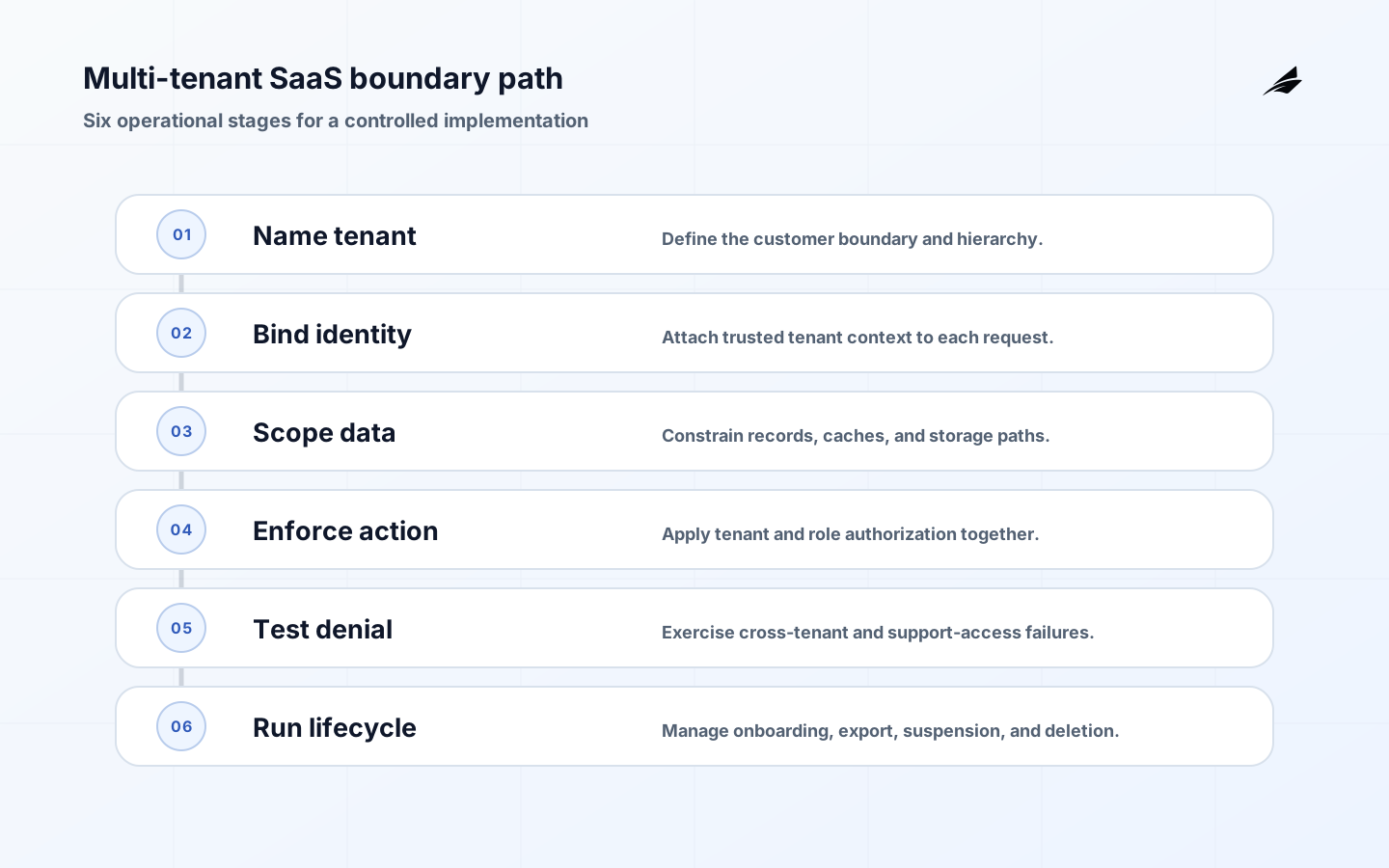
- Model the tenant hierarchy and the user-to-tenant membership rules.
- Put tenant context into authenticated requests, background jobs, caches, exports, and event messages.
- Make every repository query and storage key tenant-scoped by construction.
- Test cross-tenant denial, not just happy-path access, with representative accounts.
- Provide an operator route for support that is time-bounded, approved, and auditable.
- Rehearse export, deletion, and recovery for one tenant without affecting another.
Build a thin, inspectable path first. It should include the unpleasant cases as well as the demonstration case: a missing identifier, a delayed message, an expired credential, a rejected record, or an unavailable dependency. Give that path named inputs and outputs, a clear retry or escalation rule, and a way to prove what happened. This is where shared application architecture becomes operational rather than aspirational.
Risks and controls
The dangerous failure is not merely a missing filter in a page. Tenant context can disappear in an asynchronous worker, an analytics export, an object-store path, a cache key, or a support tool. Establish one authoritative tenant identifier, carry it through every contract, and make a missing identifier fail closed. Role checks decide what a user may do; tenant checks decide which organisation’s data is in scope. Both are needed.
| Operating signal | What it shows |
|---|---|
| Cross-tenant authorization test pass rate | Evidence that negative tests deny access across all interfaces. |
| Onboarding lead time | Time from approved tenant to a usable, correctly configured workspace. |
| Support elevation duration | How long any staff access is active and whether its reason was recorded. |
| Tenant lifecycle completion | Success of export, deletion, suspension, and restoration drills. |
Review and measurement
Measurement should tell the team whether multi-tenant SaaS meaning is still meeting its contract, not merely whether infrastructure is running. Review the signals in the table with the owner who can change the workflow. Look at trends, samples of failures, and the gap between detected and resolved issues. When a metric changes, follow the evidence back to the contract, implementation version, and real user or device behaviour before declaring a fix.
- Set a service objective for the consequence that matters, not only a technical average.
- Sample successful and failed cases to verify that SaaS data model is understandable.
- Make a named owner responsible for triaging exceptions and publishing the resolution.
- Review access, configuration, and retention choices whenever the process or fleet changes.
- Use controlled tests to rehearse recovery before an incident requires improvisation.
Operational scenario
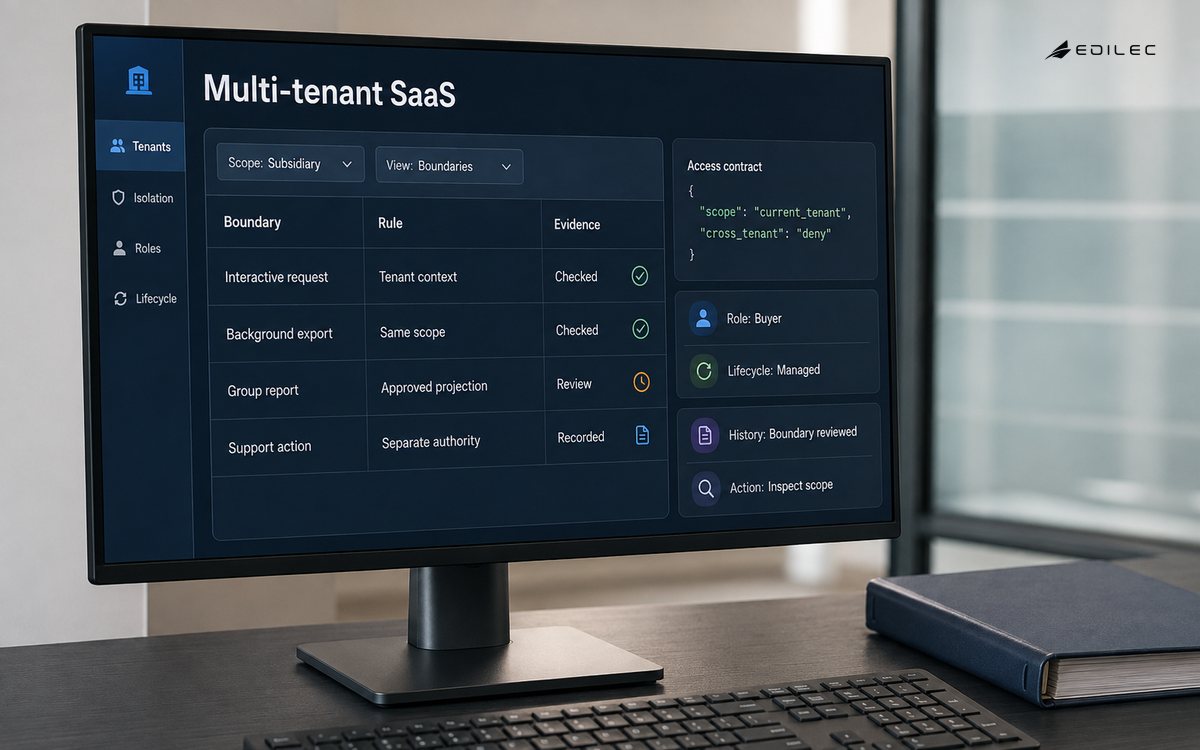
Consider a procurement platform used by a holding company and its subsidiaries. A buyer may be a member of a subsidiary but a group finance user needs selected consolidated reports. That is not a reason to remove tenancy from the data model. It is a reason to state a parent-child hierarchy, a narrowly defined reporting projection, and the approval required to cross the normal boundary. A background export must carry the same scope as an interactive screen. The relevant planning context is the earlier custom software versus SaaS decision guide, because a configuration limit that creates manual cross-tenant work can be a material product decision.
Evidence and testing
For every tenant-sensitive feature, capture an acceptance example with two organisations, at least two roles, and one support operator. The expected result should specify the data that can be read, changed, exported, and searched, as well as the evidence that records a denied request. Add these cases to automated testing and repeat them after query, cache, job, or reporting changes. A production metric cannot prove isolation by itself; controlled negative tests, code review of scoping boundaries, and sampled support access records together provide stronger assurance.
Design review questions
At design review, ask whether the tenant identifier is immutable for the request lifecycle, whether any shared resource is deliberately shared, and how a customer can leave. Examine scheduled jobs, imports, feature flags, full-text indexes, file paths, analytics, and backup restoration, because these routes commonly bypass an otherwise careful application layer. The team should be able to show the governing rule in one sentence: no organisation can receive another organisation’s data or authority unless an explicit, reviewed relationship authorises it.
Practical operations
A team operating a shared SaaS product should make tenant boundary tests part of every change that touches data movement. The review set includes migrations, imports, scheduled reporting, search indexing, feature previews, backups, and customer-support tools. For each route, identify the tenant context, the policy enforcement point, and the evidence emitted when access is denied. Treat cross-organisation reporting as a separately authorised projection, not an accidental result of a broad query. This practice exposes the hard cases before a new integration or customer escalation pushes engineers toward a one-off exception that weakens the platform.
Limits and tradeoffs
Isolation has a cost. Separate databases can simplify certain assurance and recovery goals but increase migration, observability, and fleet-management work. Shared storage can reduce operating cost but demands stricter tenant scoping and test coverage. There is no universally superior model. The defensible choice is the one whose boundaries the team can explain, automate, observe, and change without handling one customer’s data as an incidental side effect of work for another.
- Name the accountable owner before adding another integration or policy.
- Keep a representative failure test beside the normal acceptance test.
- Record the version of the contract, configuration, or rule in use.
- Use evidence from real operations to improve the next release.
- Make temporary exceptions visible, approved, and time-bounded.
- Review the boundary whenever the business process or fleet changes.
Adoption and change management
Customer onboarding, support escalation, and organisation restructuring are the moments when hidden tenancy assumptions become visible. Prepare for them with a small change record that names the proposed change, contract or policy version, expected operational effect, affected owners, test evidence, rollout window, and reversal decision. Give users and support teams a plain-language explanation of the behaviour that will change, especially where a new denial, warning, or data-quality status can be mistaken for a defect. Monitor the first production cases closely and compare them with the pre-change baseline. When an exception appears, decide whether it is a valid new requirement, a training issue, a data defect, or a control that must remain firm. This practice keeps multi-tenant SaaS meaning connected to the people who operate it. It also prevents a series of urgent local fixes from becoming an undocumented alternate system. Retire obsolete rules and integrations deliberately, preserve the evidence needed for a later review, and update runbooks so the next team member inherits a working explanation rather than a collection of historical assumptions.
Key takeaways
- Multi-tenant SaaS is a contract between technical components, people, and operations.
- Define boundaries and ownership before optimising a tool or interface.
- Treat SaaS data model as a first-class output, with evidence for failure and recovery.
- Make exceptional conditions testable and visible to an accountable owner.
- Revisit the contract as customers, devices, data, or regulations change.
Frequently asked questions
Does multi-tenant mean every customer shares the same database?
No. Multi-tenancy describes the product’s shared operating model, not one mandated storage pattern. Some products use shared tables with a tenant key; others use separate schemas, databases, or deployments. The selection should follow data sensitivity, isolation needs, cost, operational skill, and the ability to test and migrate safely.
How is tenant isolation different from RBAC?
Tenant isolation establishes the organisational boundary for data and actions. Role-based access control then limits a member inside that boundary, such as billing administrator versus analyst. A user can have a valid role and still be denied because the target record belongs to another tenant.
Conclusion
Treat multi-tenant SaaS as a product contract with operational consequences. The useful launch question is whether identity, data, jobs, support, and lifecycle operations preserve the same tenant boundary under normal and failure conditions. Starting there keeps later scale work from becoming a repair of the security model.