A system of record is the designated authority for a defined business fact within a stated scope. It is not automatically the oldest application, the largest database or the screen most people use. A customer relationship platform may own sales-stage changes, an identity service may own login identifiers, and a finance system may own posted invoices. The designation answers a practical dispute: when two systems disagree about this fact, which record governs the next business action, and who may correct it?
Good system of record basics therefore begin with data ownership and provenance rather than synchronization technology. The organization defines the fact, grain, lifecycle, authority and correction route; integrations carry that decision to other systems. W3C PROV provides a useful vocabulary for describing entities, activities and agents involved in producing information, while NARA records guidance reinforces the importance of lifecycle and accountable records management. Related Edilec guides on API decisions, workflow automation and admin panels versus dashboards show where that authority appears in software.
Define the business fact before naming its system
“Customer data” is too broad to assign to one system. Break it into facts with clear grain and time: legal customer name, billing address, marketing preference, active subscription, outstanding invoice, support entitlement and login identity. Each may have a different lawful source, owner and update path. State whether the record represents current state, an event, an agreement or a derived result. This prevents a team from declaring an entire platform authoritative when only some fields are governed there.
The boundary also includes purpose. A warehouse may be the trusted publication source for monthly management reporting without being the operational authority for changing an invoice. A search index can be the fastest read model while remaining disposable. An identity provider can authenticate a person without owning their employment status. Name the action that depends on the fact, because authority exists to support decisions. If no owner can explain how a correction changes downstream work, the designation is not yet operational.
| Business fact | Possible authority | Why the boundary matters |
|---|---|---|
| Posted invoice | Finance ledger | Corrections require accounting controls and history |
| Sales opportunity stage | CRM | Commercial workflow owns progression and forecast state |
| Workforce status | HR system | Joiner, mover and leaver events drive access |
| Login credential | Identity provider | Authentication lifecycle differs from profile data |
| Marketing consent | Consent register | Purpose, timestamp and withdrawal evidence must persist |
| Monthly revenue metric | Governed analytical model | Definition and period close determine the published figure |
Assign authority and stewardship explicitly
Technical ownership is not enough. A business owner decides the meaning and acceptable uses of a fact; a data steward maintains definitions and quality expectations; a system owner operates the application; integration owners transport changes; and consumers use the record under agreed conditions. One person may hold several roles in a small team, but the responsibilities should still be visible. This is especially important when a vendor operates the software while the organization remains accountable for the data and its use.
Write authority at field or aggregate level where needed. For example, a support tool may update a preferred contact time but must not overwrite the legal address received from a verified customer process. A workflow tool may request a status change but the ledger commits it. Restrict writes to the service that enforces the business rule, and make exceptional corrections follow an attributable route. Direct database edits may be necessary during recovery, but they should produce the same history, validation and reconciliation obligations as ordinary changes.
Separate the write path from publication paths
Consumers often need data in a different shape or latency from the authoritative system. Publish events, APIs, exports or analytical models rather than giving every consumer direct write access. A publication contract should state identifiers, schema, ordering expectations, deletion behavior, freshness, replay method and support owner. Downstream systems can then build local read models without pretending those copies are independent masters. If a local workflow needs to propose a change, route a command back to the authority and return an accepted, rejected or pending result.
- Give every record a durable identifier that survives display-name changes.
- Distinguish source event time, processing time and effective business time.
- Publish deletion, merge and correction semantics, not only new records.
- Use idempotency or deduplication keys for retried integrations.
- Expose freshness and last-successful-sync state to operators and users.
- Keep derived metrics linked to their definition, inputs and transformation version.
Preserve history and provenance proportionately
An authoritative current value is not sufficient when the organization must explain how it changed. Preserve actor, timestamp, previous value, reason, approval and source event for consequential updates. Provenance need not mean retaining every intermediate object forever; retention should match legal, privacy and operational needs. The NIST Privacy Framework is a useful reminder that collecting more history also creates privacy risk. Define purpose and retention before adding detailed change logs.
History must be interpretable. A technical audit row that says a field changed from code 4 to code 7 is weak evidence if the code dictionary and rule version are missing. Store or reference the meaning at the time of the decision. For derived information, record the input versions and transformation. W3C PROV's entity, activity and agent relationships offer a technology-neutral way to reason about that chain even if the implementation uses ordinary tables and events.
| Control | Question | Evidence |
|---|---|---|
| Authority | Who may create or change the fact? | Role, service policy and negative tests |
| Validity | Which rules make a value acceptable? | Schema and business-rule results |
| Provenance | Where did the value and change originate? | Source event, actor and transformation version |
| History | Can a reviewer reconstruct material changes? | Append-only event or protected audit trail |
| Retention | How long is evidence needed and permitted? | Approved schedule and deletion result |
| Correction | How are errors fixed across consumers? | Correction event, reconciliation and notification |
Reconcile disagreement instead of hiding it
Synchronization failure is normal: events arrive late, mappings drift, users edit the wrong interface, and a dependency becomes unavailable. Reconciliation compares authoritative records with material copies using stable keys and declared tolerances. Classify differences as timing, mapping, duplicate, missing, unauthorized change or legitimate exception. Do not automatically overwrite every difference; a downstream record may contain a newer proposal or a correction waiting for approval. Give operators enough context to decide safely.
The U.S. Government Accountability Office data reliability guide frames reliability in relation to intended use, which is valuable beyond audit work. A small delay may be acceptable for a weekly trend but dangerous for an access revocation. Set reconciliation frequency and escalation from the business consequence. Track unresolved age, recurrence and affected decisions rather than only the number of mismatched rows. Repeated mismatches usually indicate an unclear boundary or broken contract, not merely a need for a faster sync.
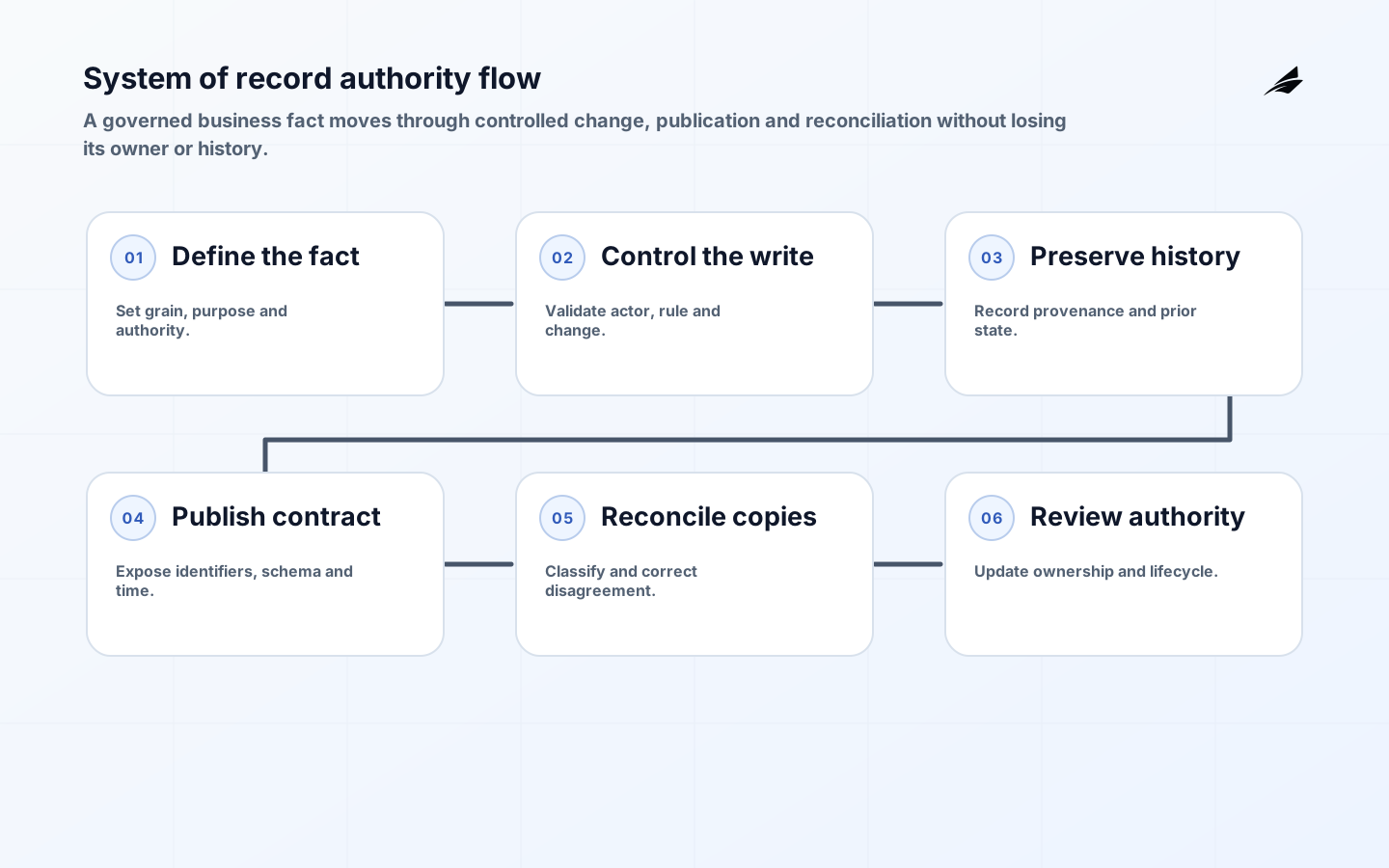
Use an authority-to-consumption flow
The diagram shows the lifecycle of an authoritative fact. A team first defines the record and owner, accepts a validated change through the controlled write path, preserves history, publishes a contract, reconciles material copies, and reviews quality and use. The sequence separates ownership from transport. It also places correction after publication, where real systems need it, instead of assuming a successful API response makes every consumer consistent.

Govern change and retirement
Authority can move. A new finance platform, merger or redesigned customer workflow may change which system owns a fact. Treat migration as a controlled transfer: freeze definitions, map identifiers, cleanse known defects, prove balances or counts, preserve required history, redirect writers, monitor dual-running results, and formally retire the old authority. Avoid silent dual masters. If both systems can accept writes during transition, define which changes win and how conflicts are adjudicated.
Review authority when a business process, regulation, supplier or integration changes. NIST SP 800-53 includes controls for information flow, audit records, configuration management and system integrity that can inform the technical baseline. The point is not to label every operational database a regulated archive; it is to apply controls proportionate to the decisions that depend on its records. A compact register of facts, owners, systems, consumers and reconciliation controls is often more useful than a giant enterprise diagram.
Key takeaways
- Assign authority to a defined fact and purpose, not an entire application by default.
- Separate business ownership, stewardship, system operation and integration responsibility.
- Keep writes controlled while publishing explicit contracts for downstream reads.
- Preserve interpretable provenance and history according to purpose and retention rules.
- Use reconciliation and correction as designed operating capabilities.
- Transfer authority through a controlled migration rather than leaving permanent dual masters.
Frequently asked questions
Is a system of record the same as a source of truth?
The phrases overlap, but system of record is most useful when it denotes formal authority for a defined fact and change process. A dashboard may be a trusted source for a published metric while its inputs remain governed elsewhere.
Can a data warehouse be the system of record?
Yes, for derived or published analytical facts if its model, inputs, close process and correction route are governed. It usually should not become the write authority for operational transactions merely because it contains a convenient copy.
Can one fact have multiple authoritative systems?
Only if the boundaries do not overlap, such as authority by region or effective period. If two systems can independently change the same fact for the same scope, the organization has a conflict policy rather than a single authority and should design reconciliation accordingly.
Conclusion
A system of record is an operating agreement backed by software: this source owns this fact for this purpose, under these rules, with this history and correction route. Define the fact narrowly, place writes behind enforceable business rules, publish contracts for consumers, and make disagreement visible. When authority, provenance and reconciliation are designed together, teams can integrate systems without losing the ability to explain or correct the decisions those systems support.