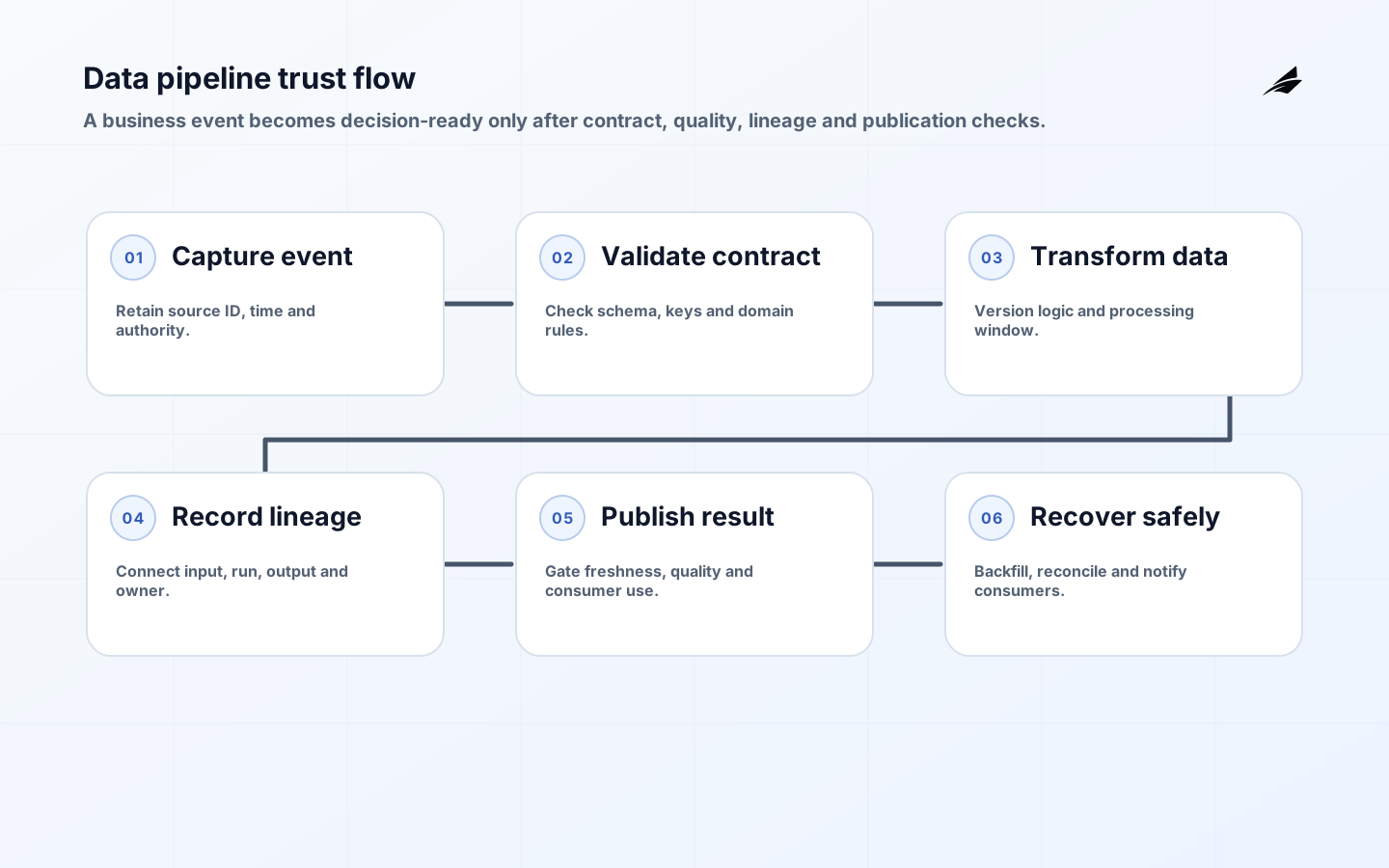
A data pipeline is a managed path that moves data from one or more sources through validation and transformation to a destination where people or software can use it. That definition sounds simple, but a dependable pipeline is not merely a scheduled copy job. It carries a business event, its meaning, its effective time and its provenance across system boundaries. A pipeline is successful only when its consumer receives the right dataset at the promised time and can understand whether it is complete, current and safe to use. This guide explains data pipeline meaning through the decisions teams must make before choosing an orchestrator or warehouse: source authority, contract, transformation, quality, lineage, publication and recovery.
For connected implementation decisions, see What Is a Data Pipeline? Meaning, Architecture, and Operating Controls, System of Record Basics: A Practical Guide for Operations Teams, Workflow Automation Definition: A Practical Product Guide, and Business Intelligence Meaning: A Guide to Decision-Ready Reporting. These guides are most useful when their controls are adapted to the same records, owners and consequences rather than applied as independent checklists.
Treat the pipeline as an operating contract
An orchestrator coordinates work, but orchestration is only one layer. Apache Airflow’s core concepts distinguish DAGs, tasks, runs, dependencies and backfills; teams still need to define what each run is expected to deliver. Write a contract for each published dataset: owner, grain, keys, schema, accepted lateness, refresh cadence, quality rules, retention and consumers. dbt model contracts show how column names and types can become enforceable interfaces, while dbt data tests illustrate assertions such as uniqueness, accepted values and referential integrity. Add domain checks that reflect business truth, because a technically valid table can still contain an impossible order state or an incomplete population.
Lineage should answer more than “which job ran.” OpenLineage provides an event model for jobs, runs and datasets, and the W3C PROV-O recommendation offers a broader vocabulary for entities, activities and responsible agents. Use those ideas to retain source identifiers, code and schema versions, run IDs, input windows and publication receipts. When a number is challenged, an operator should be able to trace it to the source event and the transformation that produced it without reconstructing the pipeline from logs and memory.
What data pipeline meaning means in practice
A data pipeline includes capture, validation, transformation, delivery, storage, and observation, but its real contract is semantic. It must preserve identifiers, time meaning, permitted values, and the distinction between a source fact, a calculated value, and a display copy. A pipeline may move data in batches, streams, or requests; the pattern is secondary to an explicit agreement about what is being delivered and how a receiver should behave when it arrives late, twice, or not at all. Every material field needs an owner and a definition. Without that, reconciliation becomes an argument between dashboards rather than a controlled correction of an authoritative record.
Define scope, ownership, and the authoritative boundary
Choose a thin business journey rather than an entire data estate. For example, follow a confirmed service order from the order system to fulfilment reporting and a customer-status view. Define the stable identifiers, event time and processing time, required fields, acceptable delay, and completion evidence for that one flow. Decide which transformations are allowed and which fields should be passed unchanged. Include the exception cases: a correction to a prior order, a missing customer identifier, duplicate delivery, a receiving system outage, and a recipient that cannot use a new value. Scope personal and sensitive data deliberately, applying minimisation and retention rules before it is copied to analytical or operational destinations.
| Decision question | Decision-ready answer | Risk if omitted |
|---|---|---|
| What is the protected outcome? | A defined business result supported by data pipeline meaning. | The build optimises a feature instead of the operating decision. |
| Who owns the rule? | A named business owner approves policy while technical owners operate the service. | Technical configuration silently becomes business policy. |
| Where is authority? | A documented source record or policy decision is authoritative; displays and copies are not. | Teams resolve disagreement by choosing the most convenient screen. |
| What proves completion? | An observable result, record, and exception route are agreed before release. | A successful request is confused with completed business work. |
| Who repairs failure? | A named queue and response expectation handle failed, disputed, or delayed work. | Staff rely on inboxes, spreadsheets, and undocumented overrides. |
Design the operating path and evidence
Design each handoff as a versioned contract. Capture the event or extract with a correlation identifier, validate required structure and business rules, and retain enough raw context to explain a later transformation. Transform using documented logic with input and output versions, then deliver through a mechanism that is observable and idempotent where retries are possible. Do not assume ordering or exactly-once delivery unless the whole path can prove it; instead design receivers to handle known delivery behaviour. Maintain lineage from a decision-facing value back to the source record, transformation version, and delivery status. That lineage is what lets a team correct an error without overwriting the evidence that exposed it.
Build controls and exception handling into the work
Quality checks should be tied to the decision, not only the schema. Validate completeness, uniqueness, timeliness, allowed values, referential integrity, and unexpected volume changes according to the business consequence. Quarantine or route invalid data to a named owner rather than allowing partial records to blend into a trusted dataset. Restrict write authority, protect credentials, and limit the data sent to each destination. Log processing attempts and failures without creating a second uncontrolled copy of sensitive information. For corrections, preserve source, reason, actor where applicable, and effective time. A delete or redaction request must reach derived stores through a known process, not depend on staff remembering each downstream tool.
| Condition | Required response | Operating evidence |
|---|---|---|
| Required information is missing | Hold or decline the work with an actionable reason. | Validation result, source context, and named follow-up owner. |
| An automated step fails | Preserve context, apply a safe retry rule, and route unresolved work. | Correlation identifier, attempt history, and queue status. |
| Authority is unclear | Do not infer permission; escalate to the accountable owner. | Decision request, approver, and policy reference. |
| A material correction is needed | Correct through a governed path without obscuring the original state. | Reason, actor, effective time, and before-and-after record. |
| A control is bypassed | Contain impact, record the exception, and conduct follow-up review. | Exception evidence, expiry or remediation action, and outcome. |
Deliver a thin, operable first release
Release a pipeline with operational acceptance tests. Reconcile a sample from source to destination, test late and duplicate events, pause a dependency, and run a correction through the complete path. Set alert thresholds for failures and lag, but couple each alert to an owner, runbook, and decision about retry, replay, or hold. During early operation, compare data outputs with the people who handle the underlying cases. Their findings will expose semantic problems that automated checks cannot see, such as a status that is technically valid but operationally misleading. Expand volume and destinations after the team can explain a discrepancy, identify its blast radius, and demonstrate a safe replay or repair.
Measure the operating result, then review it
Measure freshness against the agreed decision window, completeness of required records, reconciliation variance, duplicate rate, invalid-record backlog, delivery latency, replay success, and time to resolve a data-quality incident. Publish definitions with the measure. A nominally green pipeline that is feeding a stale decision is not healthy.
Use governance and procurement evidence to make the decision durable
Before approving a pipeline, require a data contract review that includes business owners and receiving operators, not only engineers. Walk through a small set of representative records and ask what each field means, when it is final, what source can correct it, and how a recipient knows it is late. Agree the ownership of transformation rules and how a change in an allowed value is announced and versioned. Procurement questions should cover connector limits, replay capability, observability, source-data retention, and exportability of lineage information. A pipeline is more resilient when a new team can inspect a record, locate the governing rule, and safely recover a failed handoff without reverse-engineering an old integration.
Keep decision users involved after release. A monthly reconciliation review of a few real cases can expose a changed business definition or source-system practice before it becomes a large reporting or customer-service problem.
Work through a late-order pipeline failure
Consider a daily revenue dataset built from orders, refunds and exchange rates. The warehouse job completes at 06:00, yet one regional order feed arrives two hours late. A scheduler can report success because every executed task passed, while the published total is materially incomplete. A reliable design separates run completion from data readiness. The source contract records the expected partition and watermark; an arrival check identifies the missing region; publication remains withheld or clearly marked provisional; and the owner receives an exception with the affected reporting period and next decision time.

Recovery must also preserve meaning. When the late partition arrives, the team should rerun only the affected window, use deterministic transformations, replace or merge results safely, and issue a new publication receipt. Downstream dashboards and extracts need a defined refresh rule so they do not continue showing the stale version. Acceptance is not “the rerun was green.” It is evidence that the complete population was processed once, reconciled to source totals, republished under a new version and communicated to consumers whose decisions may have used the earlier result.
| Pipeline checkpoint | Question to answer | Acceptance evidence |
|---|---|---|
| Source | Did the expected event population arrive? | Partition, watermark and source count |
| Contract | Does the input match the agreed shape and semantics? | Schema result and domain-rule report |
| Transformation | Can the output be reproduced for this window? | Code version, parameters and run ID |
| Publication | May consumers treat this dataset as ready? | Quality gate, version and receipt |
| Recovery | Can a late or incorrect window be repaired safely? | Backfill plan, reconciliation and consumer notice |
Key takeaways for data pipeline meaning
- Start from a decision and trace back to the source fact.
- Version handoff contracts and preserve identifiers and time semantics.
- Design for late, duplicate, missing, and corrected records.
- Make lineage available from a reported value to its source and logic.
- Route invalid data to an accountable recovery path.
- Prove reconciliation and replay before expanding the flow.
Frequently asked questions
Is a data pipeline the same as an integration?
An integration can be one handoff. A data pipeline is the broader controlled path that captures, transforms, delivers, observes, and explains information used by another process or decision.
Should every pipeline be real time?
No. Choose latency from the decision need. Batch processing can be safer and cheaper when an immediate change is not required, provided freshness is explicit.
Who owns data quality?
The business steward owns the meaning and acceptance of the fact; data and engineering teams operate the controls and make quality evidence visible.
Conclusion
Data pipeline meaning becomes useful when it is connected to a real decision, an accountable owner, a protected operating path, and evidence that a reviewer can understand. Do not begin with a vendor feature list or a generic architecture diagram. Start with the outcome that must be dependable, test awkward cases with the people who will run the work, and make the first release small enough to observe. That approach gives a team a clearer investment basis and a service it can improve without losing control of the business facts that matter.