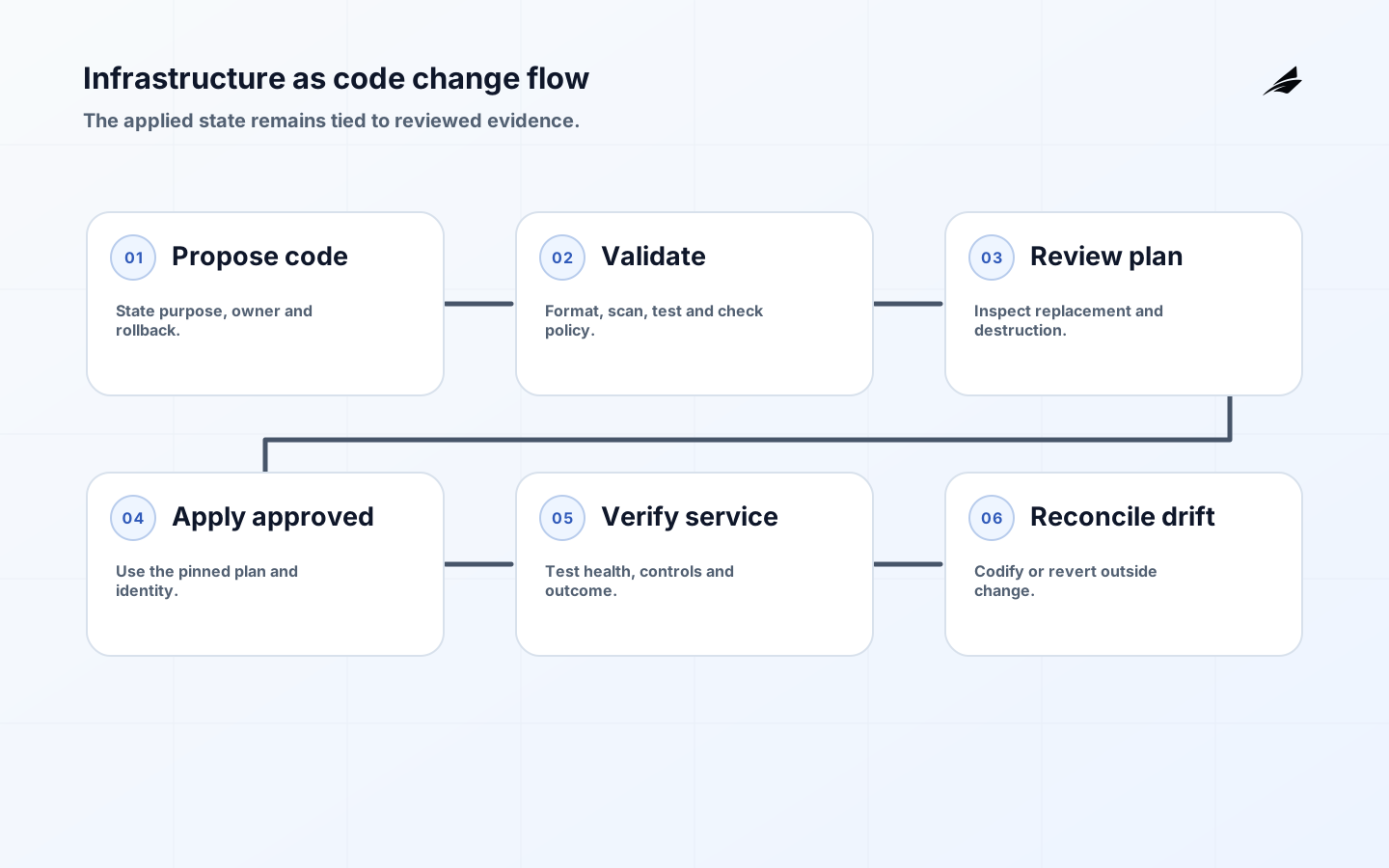
Infrastructure as code standards define how teams propose, review, apply, observe and recover infrastructure changes. They should make the normal path predictable without forcing every repository into an elaborate framework. A useful standard covers ownership, source control, state, provider and module versions, secrets, testing, policy, deployment identity, drift, emergency changes and retirement. HashiCorp’s Terraform style guide recommends readable organization, version pinning, module tests, policy enforcement and clear rules for what must and must not enter version control. Operations teams should turn those ideas into a small enforceable contract and improve it from incidents.
Define what the standard governs
State which resource classes must use code, which toolchains are supported and who may approve exceptions. Include cloud accounts, networks, identities, clusters, databases, monitoring and platform services according to risk. Do not claim full IaC coverage while critical DNS, identity or production flags remain manually owned. Inventory unmanaged resources and migrate them deliberately; importing state without understanding ownership can turn observation into accidental deletion. The internal operations IaC checklist is useful for converting this boundary into a repository-level review.
| Standard area | Required convention | Reason |
|---|---|---|
| Repository | Owner, README, formatting, validation and review rules | A new operator can understand purpose and change path |
| Dependencies | Pinned tool, provider and module constraints | Upgrades are explicit and reproducible |
| State | Remote protected backend, locking and recovery ownership | Concurrent changes and sensitive state are controlled |
| Credentials | Short-lived workload identity or approved secret manager | Long-lived keys do not spread through pipelines |
| Apply | Reviewed plan tied to the approved commit | The executed change matches the decision |
Design modules as stable contracts
Create a module when it captures a repeated, governed pattern with a clear owner, not merely to shorten one file. Keep inputs purposeful, validate constraints and expose only outputs consumers need. Document security and operational assumptions, upgrade policy and examples. Avoid giant modules that provision an entire organization; their broad blast radius makes review and testing difficult. Pin released modules and upgrade through explicit change. The Terraform module security review explains source trust, dependency boundaries and adoption evidence in more depth.
Protect state and execution identity
State can contain resource identifiers, topology and sensitive values even when variables are marked sensitive. HashiCorp explicitly advises against committing state, saved plans with secrets or credential-bearing variable files. Use encryption, access logging, locking, versioning and tested recovery for the backend. Separate state by ownership and blast radius rather than creating one file for the estate. Give the pipeline narrowly scoped, short-lived identity and prevent routine human applies in production. Break-glass change should be rare, time-bounded, logged and followed by reconciliation into code.
| Pipeline gate | Automated evidence | Human decision |
|---|---|---|
| Format and validate | Syntax, provider lock and required metadata | Is the change understandable? |
| Static analysis | Misconfiguration, secret and policy checks | Is the exception justified? |
| Test | Module behavior and representative plan | Does it meet the contract? |
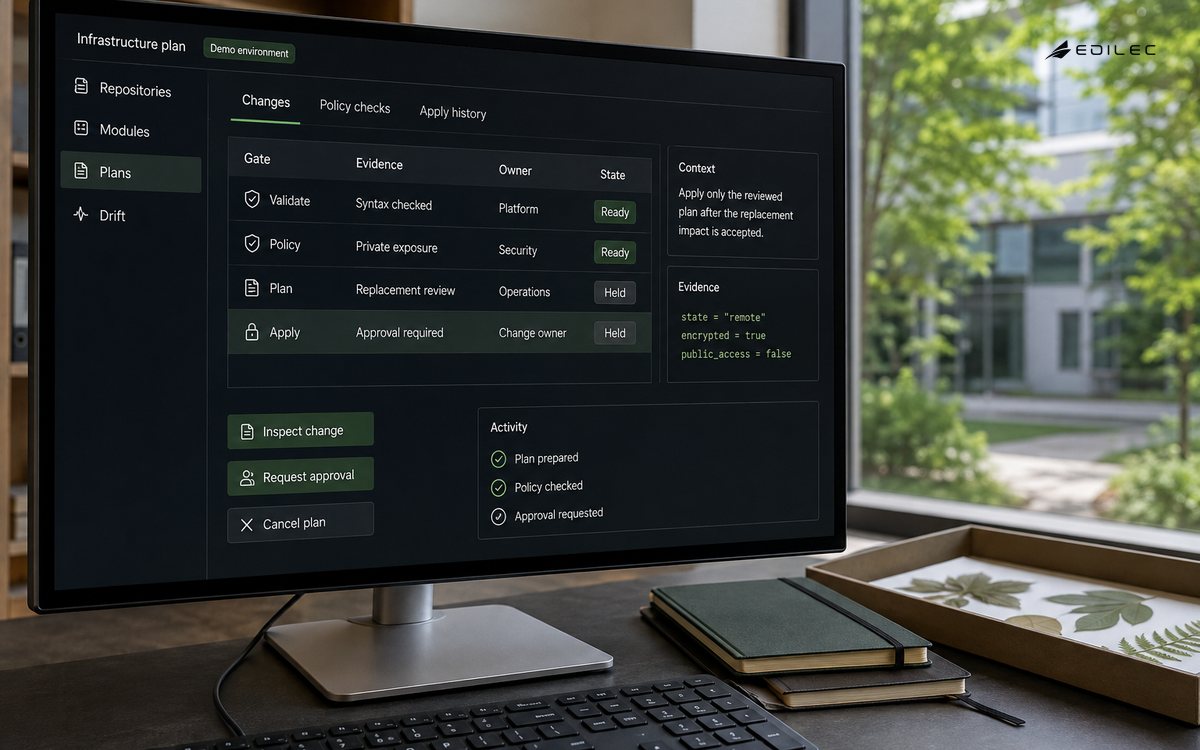
| Plan | Create, update, replace and destroy summary | Is blast radius acceptable? |
| Apply and verify | Approved plan, health checks and drift result | Did the service outcome remain safe? |
Use policy and tests at the right layer
Policy as code is strongest for objective constraints such as allowed regions, public exposure, encryption, tags and prohibited instance classes. HashiCorp documents both Sentinel and OPA policy enforcement with advisory or mandatory outcomes. Keep policy source, tests, ownership and exceptions versioned. Use unit or integration tests for module behavior and a plan review for context-dependent impact. Do not encode every architecture preference as a hard rule; excessive policy pushes teams into bypasses and hides the controls that truly matter.
Manage drift and emergency change
Drift can come from incident response, provider defaults, automation outside the chosen tool or unauthorized edits. Run scheduled plans, classify differences and route them to owners. Microsoft’s guidance on updating landing zones with IaC notes that out-of-band changes must be brought back into code. During an emergency, optimize for recovery but preserve actor, reason and exact action. Afterward, either codify the state or intentionally revert it; never accept a permanent undocumented fork.
- Use a standard pull-request template that names purpose, risk, test and rollback.
- Keep provider lock files and module release notes under review.
- Require explicit approval for replacements and destructive plans.
- Test state recovery and credential revocation on a schedule.
- Deprecate modules with migration guidance and a final support date.
Measure adoption through operating outcomes
Track unmanaged production resources, plan-to-apply time, failed changes, emergency applies, policy exceptions, drift age, module upgrade lag and recovery exercises. Code line count and module count do not show maturity. Review the standard after incidents and when platform capabilities change. The environment strategy guide helps align repository boundaries with development, test and production environments. A good standard becomes shorter where platform defaults become trustworthy and more precise where failures reveal ambiguity.
Organize repositories around change ownership
A monorepo can simplify shared policy and coordinated change, while separate repositories can reduce blast radius and clarify ownership. Choose from team boundaries, deployment cadence and dependency structure rather than fashion. In either model, make cross-repository dependencies explicit and versioned. Avoid copying provider configuration across dozens of estates without an upgrade route. Require CODEOWNERS or equivalent review routing, but ensure reviewers understand the affected service rather than approving by title. Archive retired stacks with final state, export and decommission evidence so an abandoned repository does not imply a live management path.
Make upgrades routine and bounded
Providers, modules and tools evolve. Assign owners for release monitoring and schedule small upgrades before support deadlines force a large jump. Read changelogs, update lock files, run representative plans and apply to lower-risk environments first. Inspect default changes and provider replacement behavior. Keep a compatibility test for shared modules and publish a migration note for consumers. Emergency pinning can buy time, but record the security and support trade-off. Upgrade lag is an operational metric because an estate that cannot absorb routine dependency change is not truly reproducible.
Give destructive change extra friction
Plans that replace or destroy resources deserve a focused review. Surface each destructive action, the data or service it affects, recovery method and expected interruption. Protect critical resources with lifecycle controls where appropriate, but do not use them to conceal an architecture that cannot be changed. Require backups or exports to be verified before stateful destruction. For bulk refactoring, split state moves from functional change and use supported import or moved-resource mechanisms. After apply, confirm both desired resources and removal of obsolete access, routes and cost; successful creation does not prove successful cleanup.
Roll out standards through a paved path
Start with a reference repository that deploys a small, real service through the complete path: remote state, short-lived identity, validation, policy, reviewed plan, apply, verification and drift detection. Document how to clone the pattern and which parts are mandatory. Migrate one willing production team and use its friction to improve the path. Offer office hours and automated migration checks, but keep teams responsible for their resources. Mandates without usable tooling create hidden manual work; optional guidance without enforcement leaves critical controls inconsistent. A paved path succeeds when it is the fastest credible route for ordinary change.
Adopt standards in waves based on consequence. First protect production state, credentials and destructive apply. Then improve module contracts, tests, policy and drift. Finally standardize lifecycle and decommission evidence. Set dates for unsupported patterns and provide migration guidance before blocking them. Review exceptions as a product backlog: several similar exceptions indicate a missing platform capability or an unrealistic rule. Publish changes with examples and a compatibility window. Operations teams should experience the standard as a maintained service with an owner, not a static document handed down once.
Documentation should be generated close to the source where possible but still explain the operational story. A module README needs purpose, owner, inputs, outputs, examples, security assumptions, dependency constraints and upgrade guidance. A stack needs service context, environment, state location, apply route, alerts and recovery. Avoid comments that restate syntax or diagrams that immediately become stale. Validate links and ownership automatically. During incident review, ask which missing explanation slowed diagnosis and add it to the maintained contract. Documentation quality is proved when a different on-call engineer can make a safe change. Review this evidence during handover and after ownership changes so the documented path continues to match how production is actually controlled.
Key takeaways
- Standardize the complete change path, not only file formatting.
- Divide state and modules by ownership and blast radius.
- Use short-lived execution identity and protect sensitive state.
- Reserve hard policy for objective controls with tested exceptions.
- Reconcile drift and emergency changes back into the declared source.
Frequently asked questions
Must every team use the same IaC tool?
Not necessarily. A small supported set can be governed by one contract for ownership, state, testing, policy, identity and recovery. Standardizing outcomes and evidence is often more durable than insisting on one syntax everywhere.
Are manual cloud changes ever acceptable?
Yes for a controlled emergency or a service not yet under code, but they need narrow access, logging, review and prompt reconciliation. Routine portal changes in managed production scope should be prevented or surfaced as drift.
When should a shared module be created?
Create one after a pattern repeats and its owner can support a stable contract. A premature module can freeze uncertain design and impose more upgrade work than the duplication it removes.
Conclusion
Infrastructure as code standards make change reviewable and recovery credible. A restrained contract for repositories, state, identity, policy, testing and drift gives operations teams consistency without turning delivery into framework maintenance.