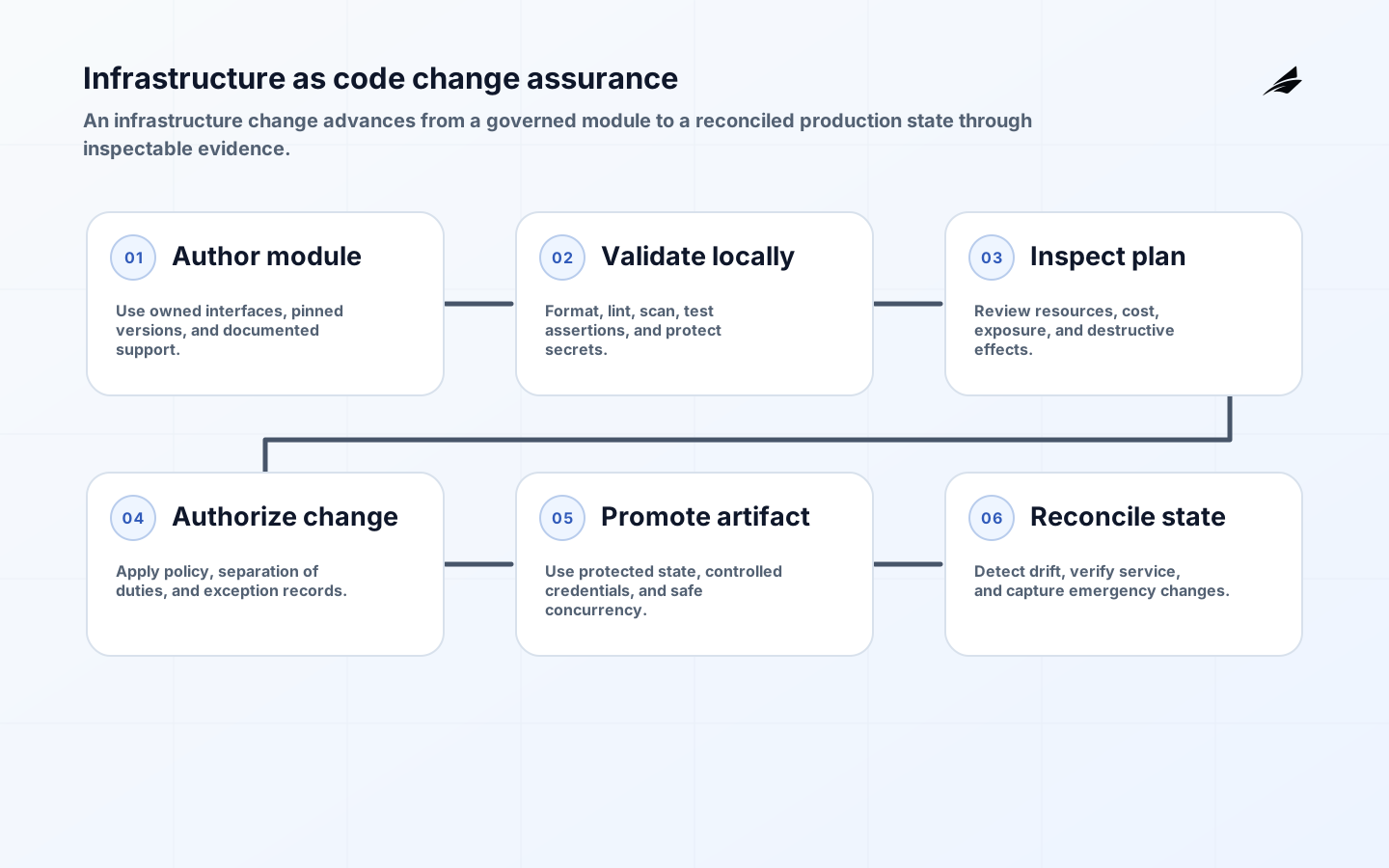
Infrastructure as code standards are most useful when they give a named team a safer, clearer way to make a recurring production decision. Infrastructure as code standards are useful when they reduce uncertainty about what exists, who changed it, and how a team can reproduce or recover it. They should cover ordinary operating work, not just the first provisioning run. This checklist starts from the service and its failure consequences, then turns that context into a bounded design, an operating test, and evidence for the next decision.
Key takeaways
- Start infrastructure as code standards with a specific customer or business outcome and an accountable owner.
- Define the operational boundary before selecting tools, environments, or automation.
- Treat access, change history, and recovery evidence as part of the design, not audit paperwork added later.
- Run a realistic pilot with the people who will operate the service under pressure.
- Use results to improve a supported path instead of standardizing untested local practice.
What infrastructure as code standards needs to solve
A repository can look declarative while production still depends on console changes, unreviewed secrets, and undocumented ordering. That gap makes incidents slower because the intended state and the live state no longer tell the same story.
| Decision area | Checklist question | Evidence that makes it real |
|---|---|---|
| Business outcome | Which customer action or control depends on infrastructure as code standards? | A named service owner agrees on what healthy and harmful look like. |
| Operating boundary | What is included in the first infrastructure as code standards implementation, and what is deliberately excluded? | Dependencies, data, identities, and exceptions are recorded. |
| Decision authority | Who can approve, pause, contain, and validate a material change? | Roles and escalation routes are usable outside normal office hours. |
| Recovery proof | How will the team know the business outcome is restored? | A rehearsal reaches customer or record validation, not only a green technical check. |
Set the first operating boundary
Do not begin infrastructure as code standards as an organization-wide replacement program. Begin with one environment and a defined set of resources that change often or carry meaningful risk. Include identities, network rules, monitoring configuration, and recovery-critical settings, while being explicit about provider-managed or manual break-glass boundaries. Write down the assumptions that would invalidate the choice, including volume, availability, data handling, dependency behavior, and skills. This keeps the first implementation reviewable and prevents a useful control from becoming an open-ended platform promise.
Make the boundary usable by writing a short decision record. It should say why this scope was selected, which alternatives were considered, what evidence is still missing, and the date or event that will trigger reconsideration. For infrastructure as code standards, a decision record is most valuable when it exposes a trade-off before it becomes an incident: a service may accept slower change in return for stronger evidence, or accept a narrower pilot in return for a faster learning cycle. The record should also identify the owner who can accept that trade-off; technical feasibility alone does not settle a customer or control consequence.
Design the infrastructure as code standards operating path
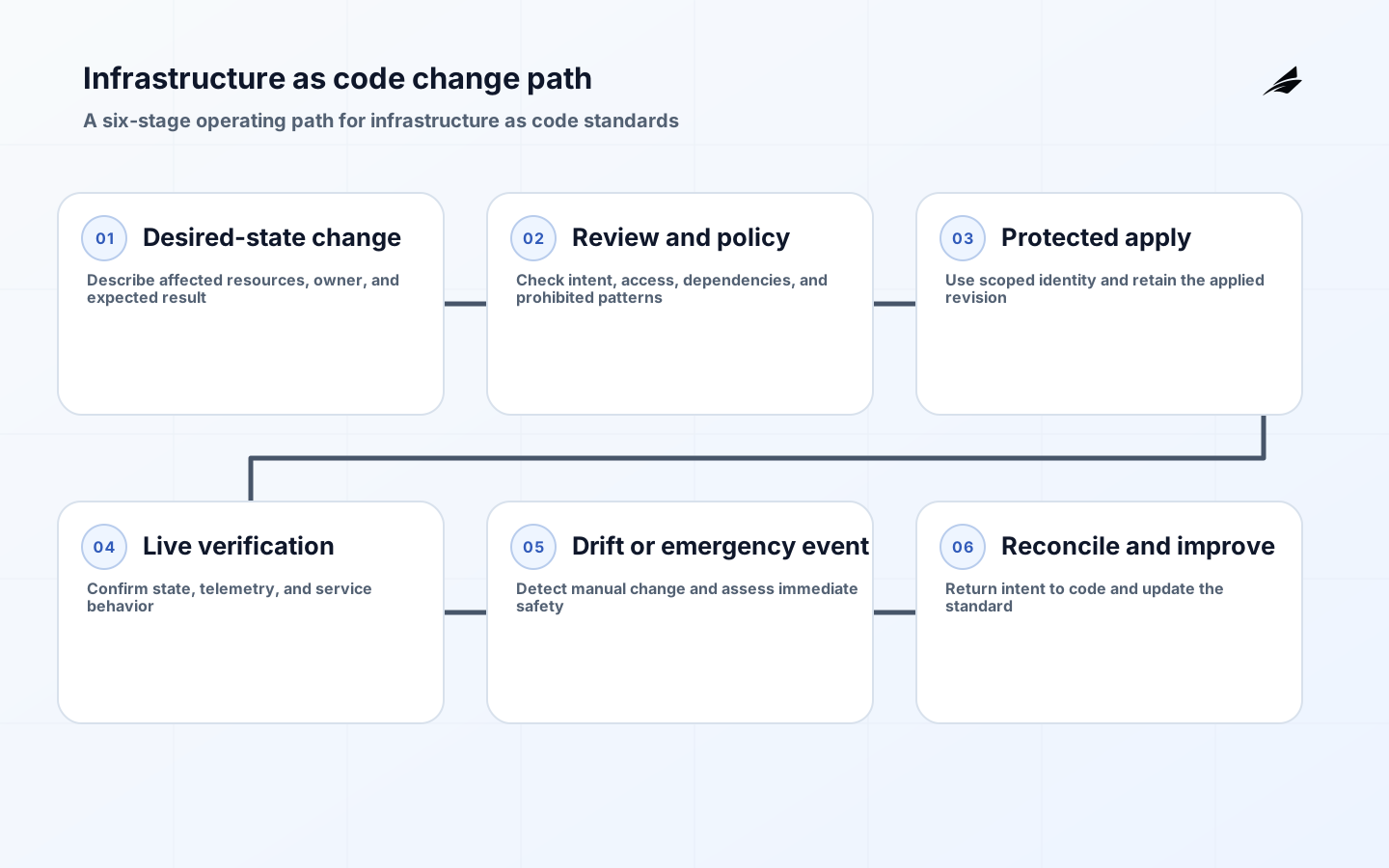
Organize code around stable service or platform boundaries, use modules only where they preserve clarity, and keep environment-specific values separate from reusable logic. Every change should identify the affected resources, expected plan, validation evidence, owner, and recovery approach.
| Design element | Practical decision | Failure to prevent |
|---|---|---|
| Ownership | Name the service, platform, product, and control owners that have a decision to make. | A material issue waits while teams debate responsibility. |
| Change evidence | Keep the intent, reviewed revision, validation result, and exception decision together. | A responder cannot explain what changed or restore a known state. |
| Health evidence | Use customer and service signals with a stated observation window. | A technical success masks a damaged workflow. |
| Recovery boundary | State what can be reversed, what must be reconciled, and who confirms completion. | Traffic recovers while records, access, or downstream work remain wrong. |
Define module, state, and test contracts
A module should represent a coherent capability with a narrow interface, documented ownership, supported versions, and explicit outputs—not every resource that happens to share a provider. HashiCorp’s Terraform style guide covers version pinning, module structure, state sharing, secrets, testing, and policy as parts of a standard workflow. Add organization-specific rules for naming, tags, data classification, network exposure, destructive changes, and upgrade support. Record which rules block a plan and which create a review finding, because an unexplained wall of policy failures encourages bypasses.
Test at the cheapest layer that can prove the claim. Formatting and static checks catch syntax and convention errors; plan inspection checks proposed resources and destructive effects; module tests exercise assertions; a controlled integration environment proves provider behavior and eventual consistency. Terraform’s official testing documentation distinguishes validations that should always hold from tests that exercise conditional behavior. Connect the standard to Edilec’s safe IaC change guide, IaC planning guide, and release management checklist so repository rules, environment promotion, and rollback are designed as one operating system.
Put infrastructure as code standards controls in the normal workflow
Use protected branches, peer review, short-lived credentials, policy checks, state access controls, and a documented emergency path that is reconciled back into code. Secrets should be referenced through approved secret-management mechanisms rather than embedded in state or source.
Design an exception path alongside the ordinary infrastructure as code standards workflow. An exception request should identify the operational reason, the temporary control, the approving authority, the expiry date, and the work needed to return to the supported path. This is more useful than an informal emergency channel because it preserves speed while making accumulated risk visible. When the same exception recurs, ask whether the standard is too narrow, the service has an unaddressed dependency, or the team needs a distinct operating model. Do not normalize a workaround merely because it is familiar.
- Give routine work a documented self-service path and make exceptions visible to the owner of infrastructure as code standards.
- Use scoped identity and short-lived access wherever the underlying platform supports it.
- Record meaningful approvals, overrides, and production changes with enough context for a later review.
- Keep a current runbook that names the signal, first action, escalation route, and business validation step.
- Review recurring friction as a design problem before adding another manual gate.
Pilot infrastructure as code standards under realistic conditions
Choose a change with real consequences, such as a network rule or managed-service configuration. Review the plan, apply through the normal pipeline, verify the live result, then simulate a necessary emergency edit and prove it is detected and reconciled.
| Pilot question | How to exercise it | Decision enabled |
|---|---|---|
| Can the service be operated? | Have the nominated owners use the normal path without private administrator help. | Clarify ownership or reduce complexity before wider use. |
| Can a harmful change be contained? | Introduce a bounded failure or rejected condition and follow the stated response. | Improve stop conditions, access, or automation. |
| Can recovery be proven? | Restore the needed state and verify the actual customer or business workflow. | Accept the recovery objective or redesign the path. |
| Can the evidence be explained? | Ask a reviewer to reconstruct the decision from retained records and telemetry. | Fix gaps in traceability, monitoring, or documentation. |
Measure whether infrastructure as code standards supports better decisions
Track unmanaged drift, failed or manually retried applies, time from approved change to verified state, emergency changes awaiting reconciliation, policy exceptions, and modules that require specialized knowledge to modify. Use the evidence to simplify the standard.
Set a review cadence that matches the rate and consequence of change. During an initial rollout, review evidence after meaningful releases, exercises, or exceptions while details are still available. Once the path is stable, use a regular service review to inspect trends, decisions that were deferred, and controls that no longer match the work. Keep the review small and action-oriented: each material signal should end with an owner, a due date where appropriate, or a recorded decision to accept the current risk. This turns infrastructure as code standards into an operating practice rather than a checklist completed once and forgotten.
Frequently asked questions about infrastructure as code standards
Does infrastructure as code eliminate all manual changes?
No. Emergency actions and provider limitations exist. The standard should make manual work exceptional, attributable, time-bounded, and reconciled so it does not silently become the real operating method.
How much reuse should an IaC module provide?
Reuse a module when it captures a maintained contract with clear inputs and safe defaults. Over-general modules can hide important service decisions and make ordinary changes harder to review.
Keep infrastructure as code standards current after the first rollout
The first accepted implementation is a baseline, not a permanent answer. Revisit infrastructure as code standards when the service gains a new customer journey, regulated data class, region, integration, runtime, or dependency that changes the original assumptions. The review should begin with the evidence already collected: what operators had to do manually, which alerts did not lead to action, which approvals delayed an urgent decision, and whether recovery produced the intended business outcome. Update the owned service record, runbook, templates, and training materials together so that the documented path remains the path people can use. Where a change creates a new risk, repeat a focused exercise rather than relying on an old successful test. Confirm that replacement owners can perform the required actions and find the same evidence without oral handover. This maintenance work is deliberately modest: it preserves the value of infrastructure as code standards by making operational knowledge durable as teams, systems, and responsibilities change.
Conclusion
Good infrastructure as code standards make production configuration easier to explain and recover. Keep the rule set focused, make live-state drift visible, and test the path operators will actually use when pressure is high.