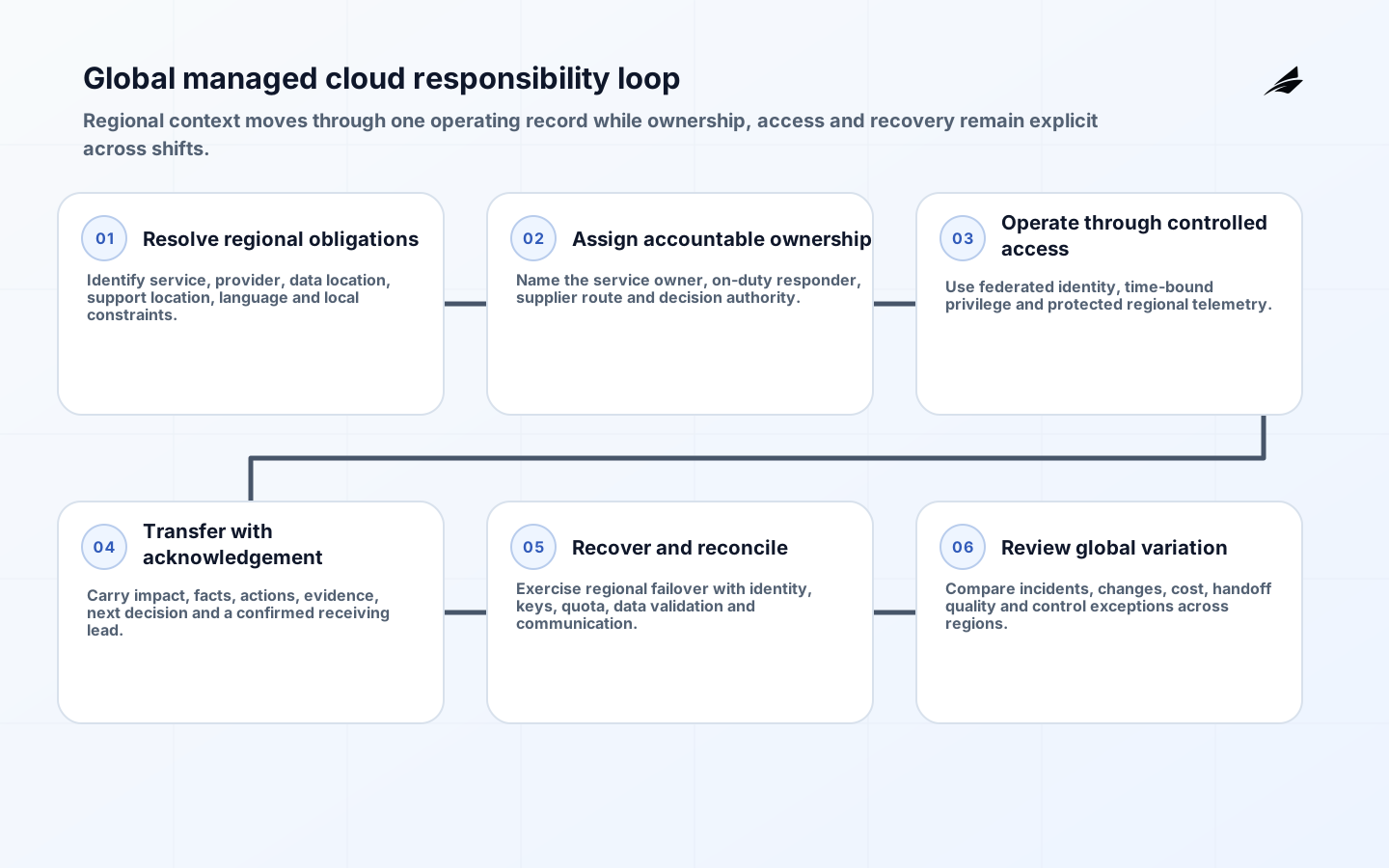
Worldwide managed cloud services coordinate platforms and workloads across regions, providers, business units and time zones. Worldwide should describe an operating capability, not a map of reseller offices. A credible service defines where people and data may operate, how incidents cross shifts, who owns controls and how regional obligations change the standard platform.
For commercial and delivery context, see the worldwide managed cloud scope and delivery plan and worldwide managed cloud implementation checklist. Broader boundaries appear in the managed cloud services FAQ.
What does worldwide managed cloud include?
It commonly combines foundation operations, identity, monitoring, incident response, backup, vulnerability and configuration management, cost governance, supplier coordination and reporting. Scope may cover one provider or several. Application operation, database administration and security operations are not automatic; name each activity with hours and accountability.
Publish a catalog by product and region with provider, consumer, coverage, objective, data access, escalation and exclusions. Do not hide local variants. Residency, retention, support location and change windows may differ. Keep these differences in an operational annex that responders can execute.
| Question | Importance | Record |
|---|---|---|
| Regions and providers | Skills and escalation differ. | Current catalog. |
| Service layer | Incident ownership changes. | Responsibility matrix. |
| Support location | Access creates obligations. | Approved locations. |
| Hours and language | Handoffs require staffing. | Rota and coverage. |
| Provider case owner | Severe cases need authority. | Named commercial route. |
How is responsibility divided?
Use a matrix tied to events, not broad labels. For certificate expiry, identify who monitors, approves, deploys, validates and communicates. Shared-responsibility models divide provider and customer layers but do not divide work among customer teams and the managed service.

Keep one accountable owner when several groups participate. Follow-the-sun support changes the on-duty person, not ownership. Handoffs need impact, actions, evidence, next decision and confirmed receiver. During incidents, separate coordination, technical action and communication.
How are residency and access controlled?
Inventory authoritative stores, replicas, backups, logs, tickets and diagnostic exports by location. Central monitoring can copy identifiers across borders. Define approved fields, redaction and retention for every operational channel. Configure regional policies and test real flows.
Use federated identity, least privilege, strong authentication and time-bound elevation. Record person, purpose, scope, session and actions. Include subcontractors and remote support locations. Verify that in-region commitments apply to staffing and tools, not only cloud resources.
Does multi-region guarantee resilience?
No. Regions can share identity, DNS, control-plane, software, data corruption and deployment failure modes. Define recovery objectives and independent paths where value justifies them. State failover mode and possible data loss. Test application behavior rather than infrastructure creation.
Exercise region impairment, unavailable APIs, corrupt release, failed identity and loss of operational tooling. Include business validation and communications. Verify secrets, quota and operator access in the target. Revisit the design as providers and traffic change.
| Indicator | Meaning | Bad shortcut |
|---|---|---|
| Qualified ownership time | Right team takes control. | Automated acknowledgement. |
| Recovery attainment | Service restored to objective. | Region uptime alone. |
| Change failure by region | Process variation appears. | Global change count. |
| Privileged review | Elevation has valid purpose. | Admin account count. |
| Unit cost by region | Demand and price connect. | Undivided bill. |
| Handoff rejection | Transfer quality is visible. | Tickets moved. |
How should global security operate?
Centralize policy and visibility where useful while retaining regional context and responders. Route findings by asset owner and consequence. A dashboard without remediation authority only looks controlled. Track exceptions with scope, compensating measures and expiry.
Integrate configuration, identity, vulnerability, workload and incident evidence. Protect central logs from alteration and cross-tenant exposure. Define who can isolate a workload, revoke credentials or block traffic. Exercise those actions before incidents and map supplier advisories to affected regions.
How are global costs managed?
Allocate spend using accounts, projects, subscriptions and billing exports. Normalize currency for reporting while preserving invoices. Explain shared network, security and support allocation. Engineering manages consumption, finance handles forecasts and terms, and product owners decide value tradeoffs.
Review unit cost by service and region because transfer, managed-service pricing and commitments differ. Buy commitments only after ownership and demand stabilize. Route anomalies to people who can act. Optimization must preserve reliability and evidence rather than simply remove redundancy.
How is service transitioned?
Discover accounts, owners, contracts, integrations, data classes, recovery objectives, alerts and unresolved risk. Replace shared credentials with named access. Incoming teams should handle a real change, alert, restore and provider case while outgoing experts observe.
Transition by regional waves. Accept inventory accuracy, monitoring, incident routing, backup, cost and communication. Keep fallback support until evidence is stable. Finish by closing old access, duplicate tools and expired obligations.
How does the customer retain control?
Keep architecture, inventory, configuration source, logs, keys, billing exports and recovery evidence available to the customer. Contract for notification, subcontractors, data return, deletion, assistance and exit. Avoid processes only one supplier can operate.
Review recurring failures, manual work, risk, unit cost and improvement backlog, not ticket volume. Maintain an exit plan and test access to essential records. Concentration may be accepted, but its recovery and commercial consequences should be explicit.
Regional change management needs a common control and a local execution view. Record the global release, affected services, local maintenance windows, constraints, rollback decision and validation owner. A change may be technically identical while permitted timing differs. Compare outcomes by region after release, and stop expansion when one location shows unexplained errors rather than allowing schedule to overrule evidence.
Design the incident record so another shift can assume command without replaying chat history. Include impact, confirmed facts, hypotheses, actions and results, current risk, provider cases, decision deadlines and owners. Handoff completes only when the receiving lead acknowledges it and can state the next decision. Measure unacknowledged transfer age and rehearse a handoff during a severe-incident simulation.
Global monitoring needs standardization and local meaning. Use consistent service, environment, region and version attributes, but allow regional objectives where traffic, regulation or dependency patterns differ. Protect central telemetry from becoming an uncontrolled data lake. Define prohibited payload fields, tenant query rights and retention for high-volume diagnostic data.
Capacity planning includes provider quotas, address space, support limits, network bandwidth, logging ingestion and on-call staffing. A failover plan that assumes immediate quota in another region may fail before workloads start. Record quota ownership and lead times, test scaling in the recovery location and include extraordinary event traffic rather than only normal seasonal growth.
Service language affects risk. Translate customer communication and high-impact runbook steps where required, while keeping identifiers and commands unambiguous. Confirm local responders understand severity, authority and escalation terminology. A nominal language capability is insufficient if the on-duty team cannot explain an outage to a regulator, owner or provider support engineer.
Generate audit evidence through ordinary operation. Retain access decisions, control status, recovery exercises, incidents, changes, exceptions and review actions with owners and dates. Sample across regions to detect local workarounds. When a control cannot produce reliable proof, improve the workflow instead of creating a separate manual evidence process.
Time zones change maintenance and approval design. Define whether a local owner must approve a high-impact action, which changes may proceed under delegated authority and when work must wait. Maintain a calendar of regional business peaks, statutory holidays and freeze periods. Automation should honor those windows from controlled data rather than personal calendars held by one coordinator.
Keep a global dependency map covering identity providers, DNS, certificate authorities, source repositories, artifact registries, monitoring, ticketing and communication. These services often sit outside workload regions and can defeat geographic redundancy. Assign recovery objectives and alternative access for the dependencies used to operate recovery itself.
Measure improvement by recurring customer and operator pain. Track repeated incidents, manual reconciliation, noisy alerts, slow access requests and unresolved exceptions by cause. Fund platform or process corrections that remove entire classes of tickets. A managed service should reduce operational uncertainty over time rather than become efficient only at processing the same avoidable work.
Document communications by audience and region. Customers, executives, regulators, responders and suppliers need different levels of detail, but all messages should use the same confirmed impact and timeline. Pre-approve channels, translators and authority for severe incidents. Record issued updates so later reviews can compare what was known, what was communicated and whether commitments were met.
Worldwide managed cloud takeaways
- Define scope by region, layer, coverage and ownership.
- Require confirmed evidence-rich handoffs.
- Map residency across backup, logging and support.
- Test recovery with identity, data and quota dependencies.
- Connect cost to products and regional units.
- Retain customer access to configuration, keys and exit records.
Frequently asked questions
Is multi-cloud required? No. One provider may meet regional needs. Multi-cloud can address specific risks but increases identity, network and operational complexity.
Can a provider own all risk? No. It can own defined operations while the customer retains business, legal and risk-acceptance duties.
What belongs in service review? Customer impact, objectives, changes, incidents, exceptions, recovery, privileged access, capacity, cost and improvement backlog.
Conclusion
Worldwide managed cloud is an operating model, not remote administration. Clear regional scope, attributable handoffs, controlled data access, tested recovery, security authority, transparent cost and customer-held evidence make global coverage credible during routine work and severe incidents across every supported region and service boundary.