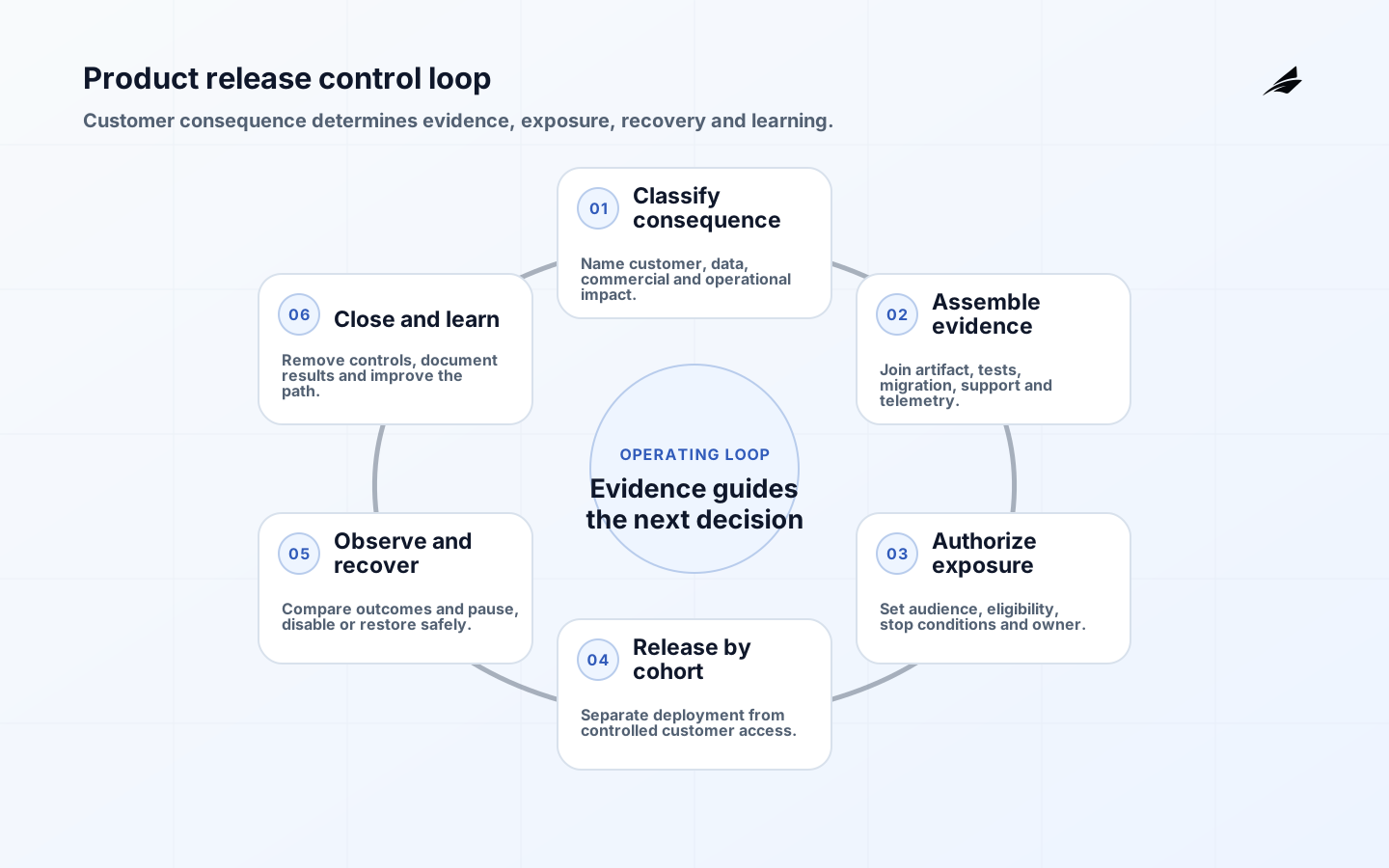
Release management for products is the discipline of controlling customer exposure to change. It joins the product promise, tested artifact, target audience, operational readiness, communication, evidence, and recovery authority in one decision. A release calendar alone cannot do that, and a heavyweight approval board can slow delivery without reducing risk. Product leaders need proportionate controls: routine reversible changes should move quickly, while migrations, pricing, permissions, integrations, or regulated workflows deserve deeper evidence and explicit stop conditions.
Support the release model with Edilec’s feature-flag strategy, CI/CD pipeline guide, and deployment rollback plan. Those guides cover exposure, artifact movement, and recovery in greater technical depth.
Use evidence-based release gates
Define a small set of gates tied to consequence: accepted product scope, automated and manual test evidence, migration and compatibility checks, security or privacy review, support readiness, telemetry, and a practiced recovery route. GitHub deployment environments show how reviewers, branch restrictions, and environment secrets can enforce technical gates. Keep approval close to the decision; a reviewer should see the exact artifact, audience, material change, unresolved risk, and stop authority rather than approve an abstract ticket.
| Release type | Exposure method | Minimum recovery evidence |
|---|---|---|
| Routine reversible UI change | Small cohort or normal rollout | Disable or redeploy previous artifact |
| Backend behavior change | Progressive traffic or tenant cohort | Compatibility and rollback test |
| Data migration | Sequenced migration with checkpoints | Restore or forward-fix rehearsal |
| Pricing or entitlement | Explicit eligibility and communication | Reconcile customer and billing state |
| Security control | Coordinated enforcement plan | Break-glass and affected-user support |
Control exposure independently from deployment
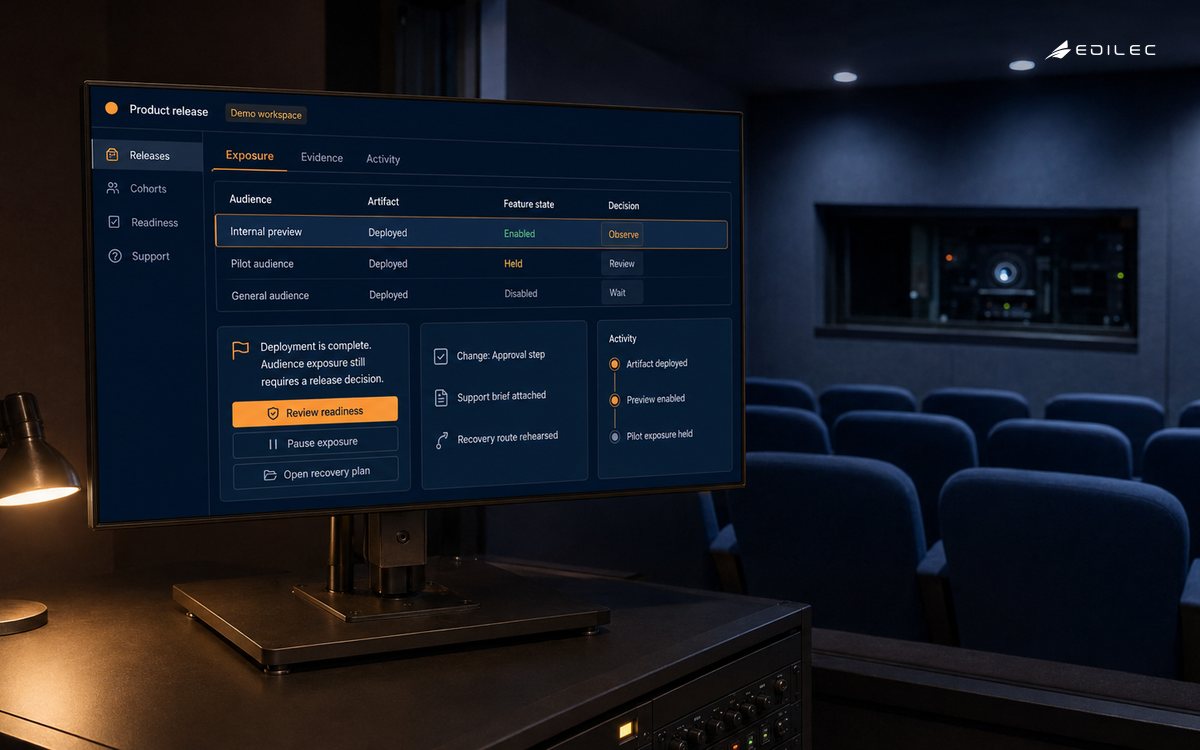
A deployment places an artifact in an environment; a release changes the experience for an audience. Separate the two when it creates a clear safety boundary. OpenFeature’s flag evaluation specification provides a vendor-neutral contract for evaluating flags with context and structured details. Govern each material flag with an owner, purpose, default, targeting rule, expiry date, and removal task. Flags do not make incompatible database changes reversible, so use expand-contract migrations, versioned APIs, or explicit sequencing when state changes outlive the flag.
Measure throughput and instability together
Track release lead time and frequency alongside customer-impacting failures, recovery time, and unplanned rework. The current DORA software delivery performance metrics distinguish throughput from instability, including deployment rework rate. Product measures should add adoption, completion, support burden, and cohort-specific outcomes. A fast rollout that creates hidden manual work is not a successful release. Likewise, a long quiet period may indicate a frozen pipeline rather than reliability.
Rehearse recovery against the actual change
Kubernetes can retain rollout history and support a deployment rollback, as shown in its rolling-update guidance, but application recovery may also require data, queues, caches, contracts, flags, and customer communication. Before exposure, decide whether the first move is pause, disable, roll back, roll forward, or route manually. Assign immediate containment authority to the on-call role and broader product authority to the service owner. Practice the route while the prior artifact and expertise are still available.
Key takeaways
- Treat release management for products as an operating decision with a named owner and explicit evidence.
- Separate the normal delivery path from the exception or recovery path before production pressure arrives.
- Use customer, service, and operational signals together so a technically green result does not hide a failed outcome.
- Improve the supported pattern from incidents, exercises, and recurring exceptions rather than relying on informal memory.
Classify a release by its customer and operational consequence
A useful release classification considers more than code size. A minor interface improvement may be safe to expose broadly, whereas a pricing change, data migration, integration switch, or permission change can create irreversible customer consequences even when the implementation is small. Record the affected audience, the new behavior, dependencies, support implications, reversibility, and the owner of the release decision. This gives teams a shared basis for deciding whether a feature flag, pilot cohort, staged region rollout, or scheduled communication is appropriate.
Separate deploy from enable. Deploying a tested artifact gives the team a stable technical unit; enabling a capability controls customer exposure. The separation lets a team validate infrastructure and performance before changing a workflow for users. It also creates a cleaner rollback: disable the capability while investigating, then decide whether the artifact itself must be reverted. This pattern is not free; flags need ownership and retirement dates. A permanent collection of unknown flags is another form of operational debt.
| Release type | Primary readiness evidence | Exposure approach |
|---|---|---|
| Low-consequence UI change | Usability check and error monitoring | Normal deployment with observation. |
| Workflow change | Completion baseline, support brief, and rollback route | Small cohort or controlled enablement. |
| Data-affecting change | Compatibility test and reconciliation plan | Staged rollout with explicit stop conditions. |
| Contract or pricing change | Legal, support, and customer communication review | Named audience with acknowledgement where needed. |
Create one release record that joins product and technical facts
The release record should answer a responder's practical questions: what customer problem is changing, which version and configuration are involved, who can pause exposure, what customers have been included, what success and harm signals are being watched, and how support learns about the change. Link the relevant decision record, tests, runbook, and communication materials rather than copying them into a long meeting note. The record is most useful when it can be read by a product manager, on-call engineer, and support lead without translation.
Use a readiness review for decisions, not status theatre. Ask whether the launch hypothesis is testable, whether the support route can identify affected customers, whether dependencies have their own rollout plans, and whether the team has authority to pause. Resolve unknowns before the highest-risk audience is exposed. Do not require a large meeting for every release; reserve cross-functional review for changes with customer, data, contractual, or operational consequence. Routine releases should remain routine because the supported delivery path is reliable.
Design the release management for products decision path
The release path begins with change classification and a single release record, confirms readiness across product and operations, exposes the intended audience in stages, observes outcomes, and closes with follow-up work. It keeps release management anchored to customer behavior rather than deployment completion alone.
| Observed outcome | Interpretation prompt | Next decision |
|---|---|---|
| Adoption is low but service is healthy | Did the audience understand or reach the capability? | Improve discovery, message, or cohort criteria. |
| Support contacts rise | Which step or customer group is affected? | Pause exposure or add targeted guidance. |
| Error rate rises in new cohort | Is it correlated with version, flag, or dependency? | Contain, revert, or repair based on evidence. |
| No material change | Was the measure sensitive to the hypothesis? | Continue observation or revisit success definition. |
Build communication and support into the release design
Support teams should receive the customer-facing explanation, expected questions, known limitations, eligibility rules, and escalation channel before the release reaches the first cohort. This does not mean a scripted announcement for every patch. It means the people meeting customers can identify the release and collect useful evidence when it changes a workflow. Product leaders should make the difference clear: a broad availability announcement is a market decision; an operational brief is a delivery requirement.
Avoid using one metric as the release verdict. A conversion lift can conceal support burden; a stable error rate can conceal a confusing permission flow. Pair technical signals with a customer journey measure and a qualitative feedback route. Decide in advance how long the observation window must be for slow workflows such as billing, reporting, or approvals. A two-hour green dashboard is not meaningful evidence for a monthly process. Match release pacing to the time needed to observe the consequence.
Close releases with accountable learning
After meaningful releases, compare the stated hypothesis and readiness assumptions with actual results. Look for gaps in audience targeting, documentation, rollout controls, telemetry, and recovery. Keep actions small and owned: retire the flag, improve an alert, change an eligibility rule, or update the support brief. The review should also record what worked, because successful controls are candidates for the standard release path. Without this step, each launch starts from memory and the organization repeatedly pays for the same discovery.
Track outcome measures at the release level where feasible: time from decision to controlled exposure, percentage of releases with named stop conditions, support escalation rate by cohort, time to pause, and completion of post-release actions. These are not targets for punishing teams. They reveal whether release management is making delivery safer and clearer as product complexity grows. When a metric drives perverse behavior, change the metric rather than forcing a false sense of control.
Worked product release decision
A product team introduces a new approval step in a customer onboarding flow. The code is ready, but the release changes completion time, support scripts, and the data required before an account becomes active. The team deploys the artifact, enables the step for a small set of new customers, and watches onboarding completion, time in the approval queue, and support contacts by cohort. A technical error rate may remain low while users abandon the flow because the explanation is unclear. In that case, the product owner can disable the capability for new customers without undoing the whole release, update the message and support guidance, and retry with a new cohort. The release decision remains reversible at the customer-exposure boundary.
This example is why an availability date is not enough. The meaningful release record identifies what a customer sees, how the old path remains available, which customers are included, and who decides whether evidence is sufficient to expand. It also gives support a route to identify a cohort and protect an affected customer. Those details make the team faster without asking it to predict every issue before launch.
The product team should document the conditions for declaring the cohort successful before looking at the first results. For example, it might require a stable completion rate for a week, no material increase in manual approvals, and support confirmation that common questions have a useful response. The condition gives the team permission to wait for meaningful evidence rather than expanding because a launch date has passed. It also prevents a single enthusiastic customer from becoming proof that the experience works broadly. Where the feature changes a contractual or regulated workflow, the release record should connect to the relevant approval and communication obligations. Product speed improves when these boundaries are known early enough to design the exposure mechanism around them.
Frequently asked questions about release management for products
Who owns the decision to pause a product release?
Name the role before launch. The on-call technical owner should be able to contain immediate harm, while the product or service owner decides the broader customer and roadmap trade-off with current evidence.
Are feature flags always the best rollout control?
No. They are valuable when they create a clear, reversible exposure boundary. Some changes need deployment sequencing, data compatibility work, contractual communication, or all three.
Conclusion
Release management for products should make change easier to understand and safer to expose, not slower by default. Classify consequence, join product and technical evidence, release to observable cohorts, and name the recovery decision before launch. A mature team moves quickly because its boundaries and evidence are dependable.