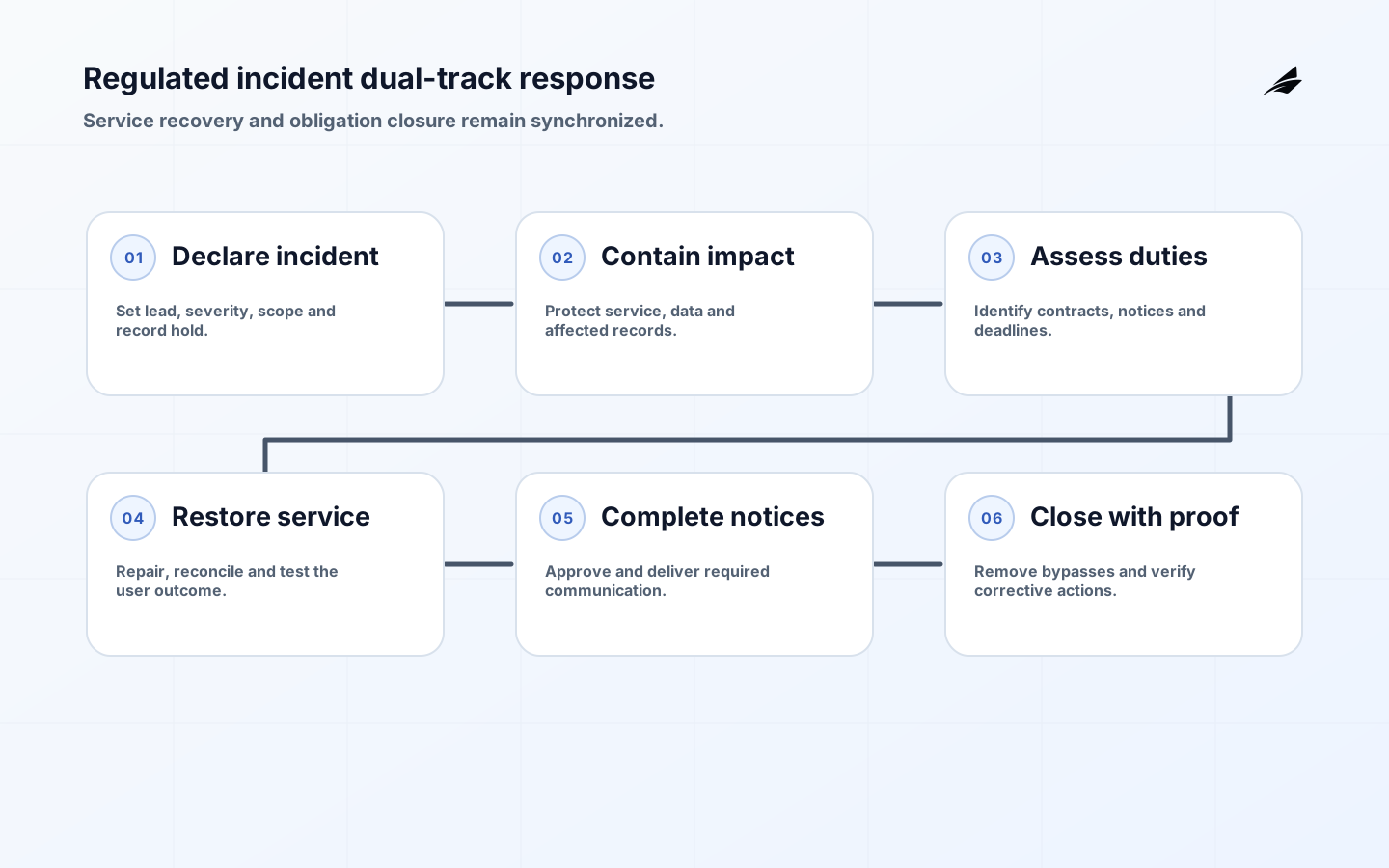
Production incident response for a regulated business process must restore the service without losing record integrity, decision evidence or accountable communication. The objective is not a perfect incident document. It is a controlled path from detection and containment through validated recovery, obligation assessment, notification decisions and learning. This checklist starts with the service and the consequences of failure, then turns that context into command roles, evidence requirements, recovery tests and a defensible closure decision.
Separate service recovery from regulatory closure
NIST SP 800-61 Revision 3 frames incident response as part of cybersecurity risk management, integrated across all six Cybersecurity Framework functions. For a regulated business process, restoring availability is only one track. The response may also need to preserve records, determine whether protected information or controlled decisions were affected, notify legal or compliance owners, meet contractual or statutory deadlines, and retain evidence for later review. An incident can be technically mitigated while these obligations remain open.

Run two synchronized workstreams. The service-recovery stream contains diagnosis, containment, workaround, repair, validation and customer-facing status. The obligation stream contains classification, evidence hold, affected-population analysis, notification decisions, regulator or customer commitments and closure approval. Both should share a stable incident identifier and timeline, but access to sensitive legal analysis or personal data should remain appropriately restricted. Record facts and hypotheses separately; a hurried assumption in the incident channel should not become an untraceable compliance conclusion.
| Response track | Completion question | Closure evidence |
|---|---|---|
| Service recovery | Is the supported user outcome restored and stable? | Health signals, user-path test and observation window |
| Record integrity | Are affected records complete, correct and reconciled? | Population query, correction log and owner sign-off |
| Security and privacy | Was protected data or unauthorized access involved? | Scoped analysis, preserved logs and decision record |
| Notification | Which contractual, customer or legal duties apply? | Deadline, approver, message and delivery evidence |
| Corrective action | What reduces recurrence and who owns it? | Prioritized action, due date and verification plan |
Use the general production response guide for command roles, the recovery planning guide for restoration evidence, and the rollback governance checklist for reversible changes. Before declaring closure, reconcile the affected transaction population, confirm required notices, verify temporary access and bypasses were removed, assign corrective actions and state who accepted residual risk.
Key takeaways
- Start production incident response with a specific customer or business outcome and an accountable owner.
- Define the operational boundary before selecting tools, environments, or automation.
- Treat access, change history, and recovery evidence as part of the design, not audit paperwork added later.
- Run a realistic pilot with the people who will operate the service under pressure.
- Use results to improve a supported path instead of standardizing untested local practice.
What production incident response needs to solve
Restoring a page does not prove that a regulated transaction completed correctly. A responder may need to identify affected records, stop duplicate processing, preserve logs, notify an owner, and reconcile the business process before declaring the incident over.
| Decision area | Checklist question | Evidence that makes it real |
|---|---|---|
| Business outcome | Which customer action or control depends on production incident response? | A named service owner agrees on what healthy and harmful look like. |
| Operating boundary | What is included in the first production incident response implementation, and what is deliberately excluded? | Dependencies, data, identities, and exceptions are recorded. |
| Decision authority | Who can approve, pause, contain, and validate a material change? | Roles and escalation routes are usable outside normal office hours. |
| Recovery proof | How will the team know the business outcome is restored? | A rehearsal reaches customer or record validation, not only a green technical check. |
Set the first operating boundary
Do not begin production incident response as an organization-wide replacement program. Define response for the business process, not only the application. Map the customer action, records of authority, data sensitivity, upstream and downstream systems, recovery objective, notification triggers, and the roles that can make legal, operational, and customer decisions. Write down the assumptions that would invalidate the choice, including volume, availability, data handling, dependency behavior, and skills. This keeps the first implementation reviewable and prevents a useful control from becoming an open-ended platform promise.
Make the boundary usable by writing a short decision record. It should say why this scope was selected, which alternatives were considered, what evidence is still missing, and the date or event that will trigger reconsideration. For production incident response, a decision record is most valuable when it exposes a trade-off before it becomes an incident: a service may accept slower change in return for stronger evidence, or accept a narrower pilot in return for a faster learning cycle. The record should also identify the owner who can accept that trade-off; technical feasibility alone does not settle a customer or control consequence.
Design the production incident response operating path
Maintain an incident plan with severity criteria, command roles, communication routes, evidence handling, containment options, restoration steps, and a business-validation checkpoint. Keep it usable during an outage: references should point to current services, access paths, and owners rather than a generic policy library.
| Design element | Practical decision | Failure to prevent |
|---|---|---|
| Ownership | Name the service, platform, product, and control owners that have a decision to make. | A material issue waits while teams debate responsibility. |
| Change evidence | Keep the intent, reviewed revision, validation result, and exception decision together. | A responder cannot explain what changed or restore a known state. |
| Health evidence | Use customer and service signals with a stated observation window. | A technical success masks a damaged workflow. |
| Recovery boundary | State what can be reversed, what must be reconciled, and who confirms completion. | Traffic recovers while records, access, or downstream work remain wrong. |
Put production incident response controls in the normal workflow
Use least-privilege emergency access with audit records, preserve relevant logs and change history, keep contact routes tested, and separate factual timelines from assumptions. Escalate notification or reporting decisions to the designated authority; responders should not invent obligations during an event.
Design an exception path alongside the ordinary production incident response workflow. An exception request should identify the operational reason, the temporary control, the approving authority, the expiry date, and the work needed to return to the supported path. This is more useful than an informal emergency channel because it preserves speed while making accumulated risk visible. When the same exception recurs, ask whether the standard is too narrow, the service has an unaddressed dependency, or the team needs a distinct operating model. Do not normalize a workaround merely because it is familiar.
- Give routine work a documented self-service path and make exceptions visible to the owner of production incident response.
- Use scoped identity and short-lived access wherever the underlying platform supports it.
- Record meaningful approvals, overrides, and production changes with enough context for a later review.
- Keep a current runbook that names the signal, first action, escalation route, and business validation step.
- Review recurring friction as a design problem before adding another manual gate.
Pilot production incident response under realistic conditions
Rehearse a realistic failure such as delayed processing, corrupted input, unavailable identity provider, or a failed release. Include the business owner and support route, practice evidence capture, and finish by reconciling the transaction population rather than stopping at technical recovery.
| Pilot question | How to exercise it | Decision enabled |
|---|---|---|
| Can the service be operated? | Have the nominated owners use the normal path without private administrator help. | Clarify ownership or reduce complexity before wider use. |
| Can a harmful change be contained? | Introduce a bounded failure or rejected condition and follow the stated response. | Improve stop conditions, access, or automation. |
| Can recovery be proven? | Restore the needed state and verify the actual customer or business workflow. | Accept the recovery objective or redesign the path. |
| Can the evidence be explained? | Ask a reviewer to reconstruct the decision from retained records and telemetry. | Fix gaps in traceability, monitoring, or documentation. |
Measure whether production incident response supports better decisions
Review time to ownership, containment, restoration, and business validation; completeness of incident records; overdue corrective actions; frequency of access break-glass use; and exercise coverage of critical processes. Use the review to strengthen the next response, not to grade people.
Set a review cadence that matches the rate and consequence of change. During an initial rollout, review evidence after meaningful releases, exercises, or exceptions while details are still available. Once the path is stable, use a regular service review to inspect trends, decisions that were deferred, and controls that no longer match the work. Keep the review small and action-oriented: each material signal should end with an owner, a due date where appropriate, or a recorded decision to accept the current risk. This turns production incident response into an operating practice rather than a checklist completed once and forgotten.
Frequently asked questions about production incident response
When is a production incident considered resolved?
Resolution requires technical restoration plus validation that the affected business process and records are correct. Communications, notification assessment, and follow-up actions may continue after the immediate incident is contained.
How should a team handle uncertain incident facts?
Record observations, timestamps, and sources separately from hypotheses. Update the timeline as evidence changes, and route material uncertainty to the appropriate incident or compliance authority.
Keep production incident response current after the first rollout
The first accepted implementation is a baseline, not a permanent answer. Revisit production incident response when the service gains a new customer journey, regulated data class, region, integration, runtime, or dependency that changes the original assumptions. The review should begin with the evidence already collected: what operators had to do manually, which alerts did not lead to action, which approvals delayed an urgent decision, and whether recovery produced the intended business outcome. Update the owned service record, runbook, templates, and training materials together so that the documented path remains the path people can use. Where a change creates a new risk, repeat a focused exercise rather than relying on an old successful test. Confirm that replacement owners can perform the required actions and find the same evidence without oral handover. This maintenance work is deliberately modest: it preserves the value of production incident response by making operational knowledge durable as teams, systems, and responsibilities change.
Conclusion
Strong production incident response is rehearsed, role-aware, and grounded in the real business process. Give responders authority to contain harm, preserve evidence while they work, and close only when the customer and record outcomes are verified.