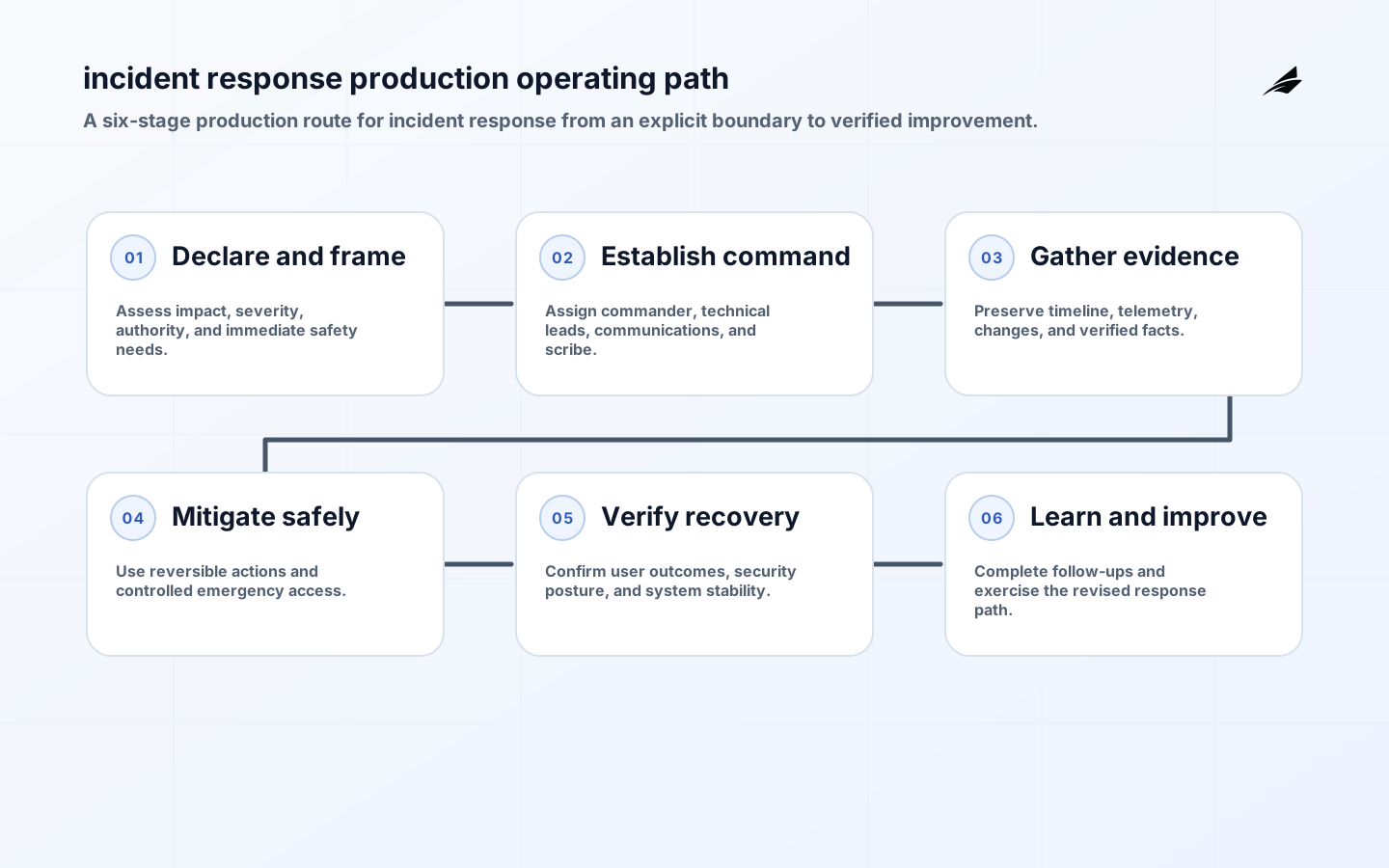
Incident response becomes a production capability when an organization can reduce harm during a real disruption without improvising roles, access, or communication. NIST SP 800-61 Rev. 3 positions incident response within broader cybersecurity risk management, while Google SRE incident guidance emphasizes coordination and learning. That combination matters: technical remediation, customer impact, security evidence, and executive decisions can all be live at once. A chat channel and an on-call rota are not enough unless people know how to establish command, make a record, and recover safely.
Use the primary references as distinct checks: NIST SP 800-61 Rev. 3 for risk-integrated preparation and recovery, Google SRE Managing Incidents for command structure, the Google SRE Incident Response Workbook for operational practice, NIST SP 800-53 Rev. 5 for control evidence, and Google’s Postmortem Culture guidance for learning without blame. The article applies those references to a production service boundary; it does not treat any one document as a substitute for local ownership.
Key Takeaways
- Treat incident response as an accountable production capability with an explicit owner and boundary.
- For this incident command case, use evidence that connects the declared change or event to the effective runtime result.
- For this incident command case, match controls to consequence: protect irreversible, customer-impacting, or security-sensitive actions most strongly.
- Test an unhappy path and a recovery path before expanding exposure.
- For this incident command case, review the operating signals after routine work, not only after a visible failure.
Declare Severity and Command Authority
Define what constitutes an incident for your services and who can declare one. Severity should be tied to user impact, data risk, legal or contractual obligations, and urgency, not to how interesting the technical failure seems. Assign an incident commander, technical leads, communications owner, and scribe roles that can be filled by available people rather than a single hero. Clarify escalation paths for security, privacy, vendors, and leadership. The first minutes are easier when the team can choose a role and a communication cadence instead of debating authority.
| Decision area | Question to settle | Evidence to retain |
|---|---|---|
| Impact | When is coordinated response required? | Severity assessment and declaration record. |
| Command | Who makes and records decisions? | Role assignment and incident timeline. |
| Access | What can responders safely use? | Approved dashboards and break-glass audit. |
| Recovery | When is the event actually over? | Verified user outcome and security check. |
Prepare Evidence, Access, and Communication
Make the First Fifteen Minutes Executable
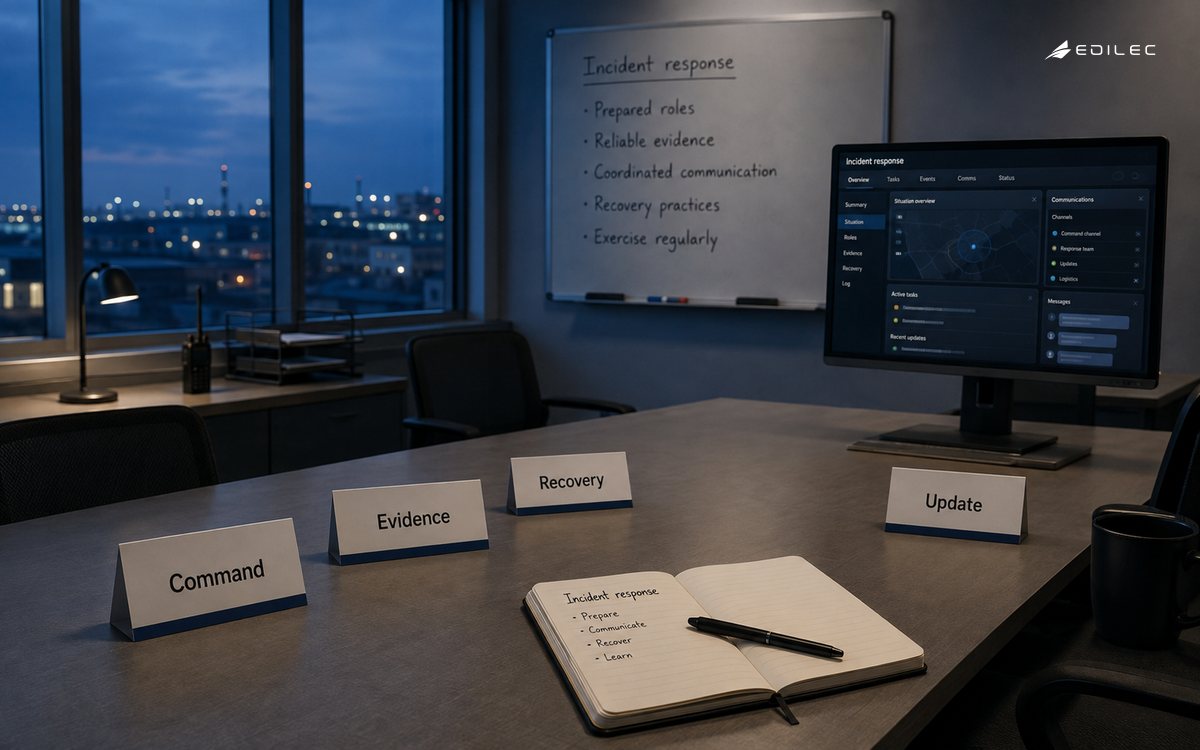
The opening minutes of an incident are an information problem before they are a debugging problem. A responder should be able to find the declaration criteria, open the incident record, name the commander, and publish a short impact statement without asking the most senior engineer to reconstruct the process. For a payment API, the first statement might distinguish failed authorizations from delayed confirmations, identify the start time, and name the customer segment affected. That wording is more useful than “payments are down” because it directs investigation and gives support a safe message. NIST SP 800-61 Rev. 3 places preparation, detection, response, and recovery inside risk management; the local runbook should turn those ideas into visible actions and evidence.
Design the handoff explicitly. The commander owns priority and communication, the operations lead coordinates mitigation, the technical lead forms and tests hypotheses, and a scribe records decisions and timestamps. If one person must hold two roles, state which work is deferred and when another responder is requested. Give each role a replacement and a safe access path to logs, deployment history, feature flags, customer impact, and status tooling. During a drill, inject a misleading symptom or an unavailable dependency so the team has to update its hypothesis. A process that works only when the first diagnosis is correct is not ready for production.
Prepare an evidence and access model before pressure arrives. Responders need safe dashboards, logs, traces, deployment history, runbooks, and a controlled way to obtain elevated access if ordinary permissions are insufficient. Keep a time-stamped incident record with observed impact, hypotheses, actions, decisions, and external communications. Separate confirmed facts from assumptions. This improves handoffs and preserves evidence for security or regulatory review. It also prevents the familiar failure where two responders make conflicting changes because neither can see the current mitigation plan.
Use reversible mitigations first where possible: stop a rollout, reduce traffic, disable a faulty integration, fail over, or isolate a compromised component according to a documented procedure. Do not let urgency excuse uncontrolled data destruction or unrecorded broad access. For security incidents, preserve relevant evidence and coordinate containment with the responsible security function; restoring availability too quickly can erase information needed to understand compromise. A break-glass action should expire, be logged, and be reviewed after the event. Incident response needs guardrails precisely because the stakes are high.
| Control | Practical implementation | Signal to review |
|---|---|---|
| Role clarity | Assign commander, leads, scribe, and communications. | Delayed command establishment. |
| Evidence | Maintain factual timeline and change record. | Conflicting actions or missing decisions. |
| Exercises | Rehearse likely technical and security scenarios. | Unowned follow-ups and stale runbooks. |
Exercise Containment and Recovery
Exercise the process with scenarios that reflect your architecture: dependency degradation, bad deployment, credential exposure, data corruption, region failure, or sustained overload. Run a short tabletop first, then a bounded technical simulation that tests paging, conference setup, dashboards, access, communications, and recovery verification. Rotate facilitation so knowledge is not concentrated in the most experienced responder. Record gaps as owned improvements with dates. A rehearsal is successful when it exposes uncertainty early, not when participants perfectly recite a runbook.
Use signals to operate incident response
Measure the response system with care. Time to acknowledge, time to establish command, time to mitigate user impact, time to restore verified service, alert precision, and follow-up completion can reveal friction, but they are not a scorecard for blaming individuals. Track whether incident records identify impact and decisions, whether runbooks were usable, and whether recurring failure modes receive engineering work. Customer communications should be accurate and timely even when root cause is unknown. Review the process after small incidents too; frequent low-severity events often reveal missing ownership before a severe outage does.
A production failure mode for incident response is a technically correct mitigation delayed by unclear command, conflicting customer updates, missing evidence, or inaccessible emergency controls. For this incident command case, that kind of gap is dangerous because a local success signal can hide an operationally incomplete result. For this incident command case, add the condition to acceptance criteria and state the expected response before the next change. For this incident command case, the record should show who owns the boundary, what evidence proves normal behavior, and how a responder distinguishes a transient delay from a condition that must be stopped. For this incident command case, this turns a surprising edge case into a reviewed part of the operating model rather than a lesson trapped in one engineer's memory.
Use a regular operating review to validate paging, role backups, conference access, dashboards, status communication, vendor contacts, break-glass paths, and handling rules before a major event. For this incident command case, keep the discussion close to a real example rather than an abstract maturity score. For this incident command case, note where the team had to infer missing state, cross a permission boundary, or leave the normal workflow to understand the result. For this incident command case, assign one or two concrete improvements with an owner and date, then inspect them after the next ordinary production change. For this incident command case, this cadence catches accumulated ambiguity early and prevents controls from becoming documentation that no longer describes the live system.
A practical drill should run a scenario where the first mitigation is incomplete so the team must update its hypothesis, communicate uncertainty, and choose a safer action. For this incident command case, include the people and systems that would be involved outside the primary tool: on-call ownership, access approvals, deployment or recovery records, customer communication, and the final verification query. For this incident command case, measure the time needed to reach a safe decision, but also document why it took that long. For this incident command case, the most valuable outcome is a revised procedure that a different responder can follow with the same evidence, especially when the original author is unavailable.
Keep the incident response review bounded but complete. Map declaration, command roles, evidence preservation, mitigation, communications, and verified recovery to the people who can change, inspect, and recover each element. For this incident command case, a responsibility map should identify routine ownership as well as escalation authority, because production work crosses team boundaries at the moment a normal control fails. For this incident command case, document dependencies that are outside the immediate service or tool, including identity providers, registries, queues, cloud accounts, and vendors. For this incident command case, this context lets reviewers judge blast radius before a change and gives responders a starting point when the visible symptom appears somewhere else.
Make verification concrete by retaining the impact statement, decisions made, and completion of follow-up work. For this incident command case, compare it with an agreed baseline and record the decision to continue, pause, recover, or investigate. For this incident command case, verification should happen after the system has had enough time to exhibit the behavior that matters, not only at the instant an API accepts a change. When the evidence is incomplete, say so and keep exposure constrained. For this incident command case, this is how teams preserve learning speed without confusing automation activity with a trustworthy production outcome.
Before relying on an incident plan, verify who can declare, command, communicate, access evidence, mitigate, and confirm recovery. Those roles need working tools and backups, not merely names in a document.
Frequently Asked Questions
Who should lead an incident? The incident commander coordinates people and decisions; they do not need to be the deepest technical expert. When should the team write a post-incident review? After material impact or a significant near miss, once service is stable and facts can be checked. Is every alert an incident? No. An alert is a signal; declare an incident when coordinated response is needed to reduce impact or manage risk. What should a status update say? State known user impact, current mitigation, next update time, and uncertainty without speculating about cause.
The operating model should be legible to people outside the primary engineering team. Customer support needs the impact language and update route; security needs evidence and access boundaries; finance or leadership may need the decision record and recovery estimate. Include those handoffs in an exercise rather than assuming they will appear during a crisis. A response plan that coordinates these audiences can preserve trust even while the technical cause remains uncertain. That is a meaningful production capability, especially for a small organization with limited redundancy in people and systems.
Conclusion
Strong incident response gives people a shared operating language when systems and information are incomplete. Prepare the roles, evidence, access boundaries, and recovery checks while the service is healthy, then improve them through realistic exercises and blameless review. The payoff is not perfect calm; it is faster, safer coordination. Related guides: on-call and incident planning, observability, and backup and restore operations.
Make incident response real in the first fifteen minutes: declare impact, establish command, preserve evidence, mitigate reversibly, and verify the customer outcome. Then exercise the handoffs that fail under pressure, including access, communications, security review, and follow-up ownership. A response capability is ready when another responder can use the record to make a safe decision without reconstructing the process from memory.
A useful follow-up is to compare the incident record with the service’s normal operating boundary. Were the right dependencies visible, did responders have safe access, and did the customer-facing status match the technical state? Record one improvement for command, one for evidence, and one for recovery only when each has an owner. This keeps post-incident work focused and gives the next exercise a concrete way to test whether the organization actually learned.