DevOps onboarding documentation should let a new engineer or operator make a safe, ordinary change without relying on folklore, private messages or broad administrator access. It is not a one-time architecture overview. The useful documentation follows the work: who owns a service, how code becomes a release, where configuration lives, how access is requested, what users experience when it fails and which person has authority to act. Start with a newcomer’s first week and choose a representative task, such as deploying a small change to a nonproduction environment or investigating a nonurgent alert. If the person cannot find the system of record, understand the guardrails and complete the task with review, the documentation is incomplete regardless of how polished the diagrams look.
Document the operating model first
Every service page should state purpose, customer or internal users, accountable owner, supporting team, business-hours expectation, repositories, deployment environments, dependencies, data classification, service objectives and escalation route. Use links to authoritative systems rather than copying volatile details into a wiki paragraph. A newcomer needs to know where a decision is made and who can change it. Explain the boundary between application team, platform team, security and support responsibilities. Ambiguous ownership is particularly dangerous during an incident, when people may assume another team is watching a queue or owns a rollback. Review service metadata as part of the normal release and ownership process, not as an annual cleanup exercise.
| Documentation element | Question it answers | Evidence of usefulness |
|---|---|---|
| Service card | Who owns this and why does it exist? | New operator finds correct contact |
| Delivery guide | How does a change reach production? | Reviewed nonproduction deployment |
| Access guide | How is least privilege requested? | No shared credentials needed |
| Runbook | What is the safe first response? | Exercise completed |
| Recovery guide | How is business state restored? | Restore or rollback test |
Teach the delivery path through a real task
Show the path from a reviewed change to an immutable build artifact, automated checks, environment deployment, verification and production promotion. Explain which controls are automated, which require approval and where the evidence is retained. New team members should learn why a production deploy is blocked by a failing test or policy check, not merely how to request an override. Include one deliberately small change that can be completed in a controlled environment, with a peer reviewing the result. Document common failure modes: a missing secret reference, a failed migration, a health check that never becomes ready, or an artifact that does not match the approved commit. This turns onboarding into demonstrated competence rather than passive reading.
Keep command examples safe and contextual. State the required role, target environment, expected output, rollback implication and where to stop if the result differs. Do not embed long-lived credentials or production secrets in examples. Prefer self-service, time-bounded access and documented break-glass procedures with review. Link operational commands to the service’s configuration source and change record so a newcomer can see the surrounding decision. When tools change, update the task guide through the same review path as the platform change. Stale onboarding instructions are worse than missing ones because they create confidence in a route that no longer has the intended safeguards.
| Newcomer exercise | Skill demonstrated | Reviewer checks |
|---|---|---|
| Trace a request | Use logs, metrics and traces | Finds correct service boundary |
| Deploy to test | Follow pipeline and change control | Uses approved artifact |
| Respond to alert | Read runbook and assess impact | Chooses safe first action |
| Request access | Use role-based process | Avoids excess privilege |
| Restore fixture | Apply recovery steps | Validates state after restore |
Make reliability knowledge actionable
A reliability section should identify critical user journeys, service objectives, dashboards, alerts, known degraded modes and first-response runbooks. Explain which signals indicate customer impact and which are merely diagnostic. Add links to recent incident learning where it changes the operator’s behavior, such as a dependency timeout pattern or a reconciliation step after queue recovery. A new operator should practice a low-risk incident scenario with a mentor: find the current impact, check a trace, follow a runbook, escalate correctly and write a concise update. This exercise reveals gaps in access, terminology and documentation much faster than a quiz. It also signals that careful escalation is an expected skill, not a sign of failure.
- Write service ownership, user impact and escalation before detailed tooling notes.
- Use one reviewed hands-on task to teach the delivery path.
- Keep examples least-privileged, time-bounded and safe to stop.
- Link telemetry to user journeys and tested runbooks.
- Turn incident learning into changed onboarding behavior, not an archive link.
Create a documentation maintenance loop
Documentation stays credible when it has owners, triggers and a feedback path. Assign a steward for each service page and review it when ownership, architecture, access, environment, incident learning or delivery tooling changes. Invite new starters to record where they were blocked, then turn repeated questions into clearer task steps or product improvements. Track a small set of signals: time to first safe change, access-request lead time, onboarding support demand, failed exercises and documentation corrections. Do not optimize for page views. The outcome is a person who can act correctly with normal review and can recognize when they should stop and ask for help.
Scale with templates, not copying
A common service template helps a growing company make important information discoverable, but it should leave room for service-specific reality. Standardize headings, ownership fields, runbook links, delivery evidence and review date. Avoid copying generic architecture or incident prose into every page; it hides the differences an operator needs to know. Use generated inventory data where reliable, then add human explanation for decisions, limitations and exceptions. Periodic quality reviews should sample whether pages match the running service and whether a person outside the owning team can complete the documented task. The best template reduces cognitive load while still making local risk visible.
Key takeaways
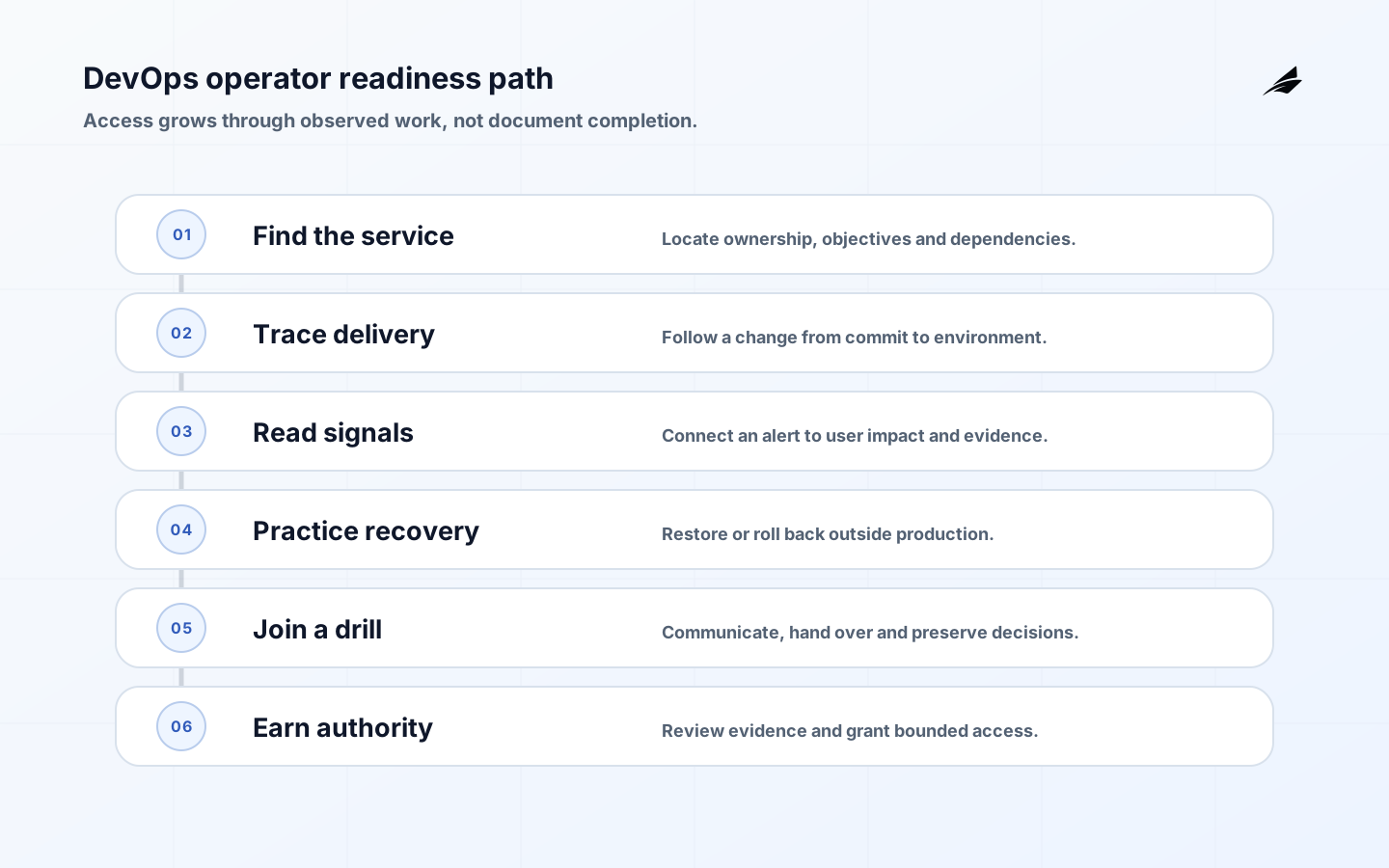
Graduate access through observed operational work
Documentation does not prove operational readiness. A new operator should demonstrate a sequence of increasingly consequential tasks in a safe environment: identify a service owner, trace a release from commit to artifact, find the signals for a user journey, explain an alert, perform a non-production rollback, and join a supervised incident exercise. The DORA continuous-delivery capability guidance connects dependable delivery with keeping software deployable, using fast feedback and automating the deployment process. Onboarding should make those capabilities visible in the actual system rather than describing an idealized workflow that the team no longer follows.

Use an evidence record for each milestone. Capture the task, environment, supervisor, links consulted, result, unexpected finding and follow-up documentation change. This turns onboarding into a test of both the learner and the platform. If three new engineers cannot find the same rollback instruction, the problem is information architecture, not individual memory. If a runbook succeeds only with an administrator’s undocumented access, the exercise has found an operational control gap before an incident exposes it.
| Readiness milestone | Observed task | Required evidence |
|---|---|---|
| Service orientation | Locate owner, objective, dependencies and support channel | Correct service record and escalation route |
| Delivery literacy | Trace a change through build, checks and deployment | Artifact identity, approvals and environment result |
| Signal interpretation | Explain an alert using metrics, logs or traces | User impact, hypothesis and next investigation |
| Recovery practice | Restore or roll back in a controlled environment | Runbook result, timing and reconciliation |
| Supervised operation | Join a drill and hand over clearly | Decision timeline, communication and learning action |
Connect the onboarding path to the CI/CD delivery guide, the monitoring and alerting operating guide, and the backup and restore planning guide. These references let a new operator move from normal delivery to diagnosis and recovery without duplicating entire manuals. Schedule a 30-day review with the newcomer; fresh readers are often the best observers of stale terminology, hidden dependencies and circular documentation.
- Organize documentation around real operating tasks and clear ownership.
- Teach delivery and recovery through reviewed hands-on exercises.
- Make least-privileged access and safe stopping points explicit.
- Connect telemetry, user impact and runbooks for new responders.
- Update pages when systems change and use newcomer feedback as evidence.
- Standardize structure while preserving the service-specific details that matter.
Frequently asked questions
What is the first DevOps document a new hire should read?
Start with the service card for the system they will touch: purpose, owner, user journey, environments, delivery path, access route and escalation. It gives enough context to choose the right next task without overwhelming the person with a full platform history.
How can teams keep documentation current?
Attach review to operational triggers such as a release-pipeline change, ownership change, incident action, new dependency or access-policy update. Give pages accountable stewards and test them through the onboarding exercises they are meant to support.
Measure readiness with observed work
Use observed tasks to learn whether onboarding is producing safe autonomy. A mentor can review a newcomer’s first trace investigation, nonproduction deployment, access request and incident exercise against a clear checklist. Look for whether the person recognizes the service boundary, uses approved tools, checks expected evidence, explains when to stop and knows how to escalate. This is not a productivity ranking; it is a way to discover missing platform affordances and unclear instructions. Over time, compare time to first reviewed change, recurring support questions and exercise outcomes across teams. When a common friction point appears, improve the system or documentation rather than expecting each new hire to invent the same workaround.
Make platform terms consistent
A growing company accumulates overlapping names for environments, releases, services, incidents and access roles. New operators lose time when a runbook says deploy while a pipeline says promote, or when staging means different things to two teams. Maintain a concise glossary near the service inventory and use it in templates, dashboards and incident channels. Define which terms carry authority and which are informal shorthand. This editorial discipline lowers cognitive load during onboarding and makes cross-team escalation more precise. Update the glossary when platform conventions change, and have newcomers flag terms that require translation before they can complete a task.
Conclusion
DevOps onboarding documentation earns trust when it helps people take safe action on a real service. Make ownership, delivery, access and recovery discoverable, then keep the material alive through practice and operational change.