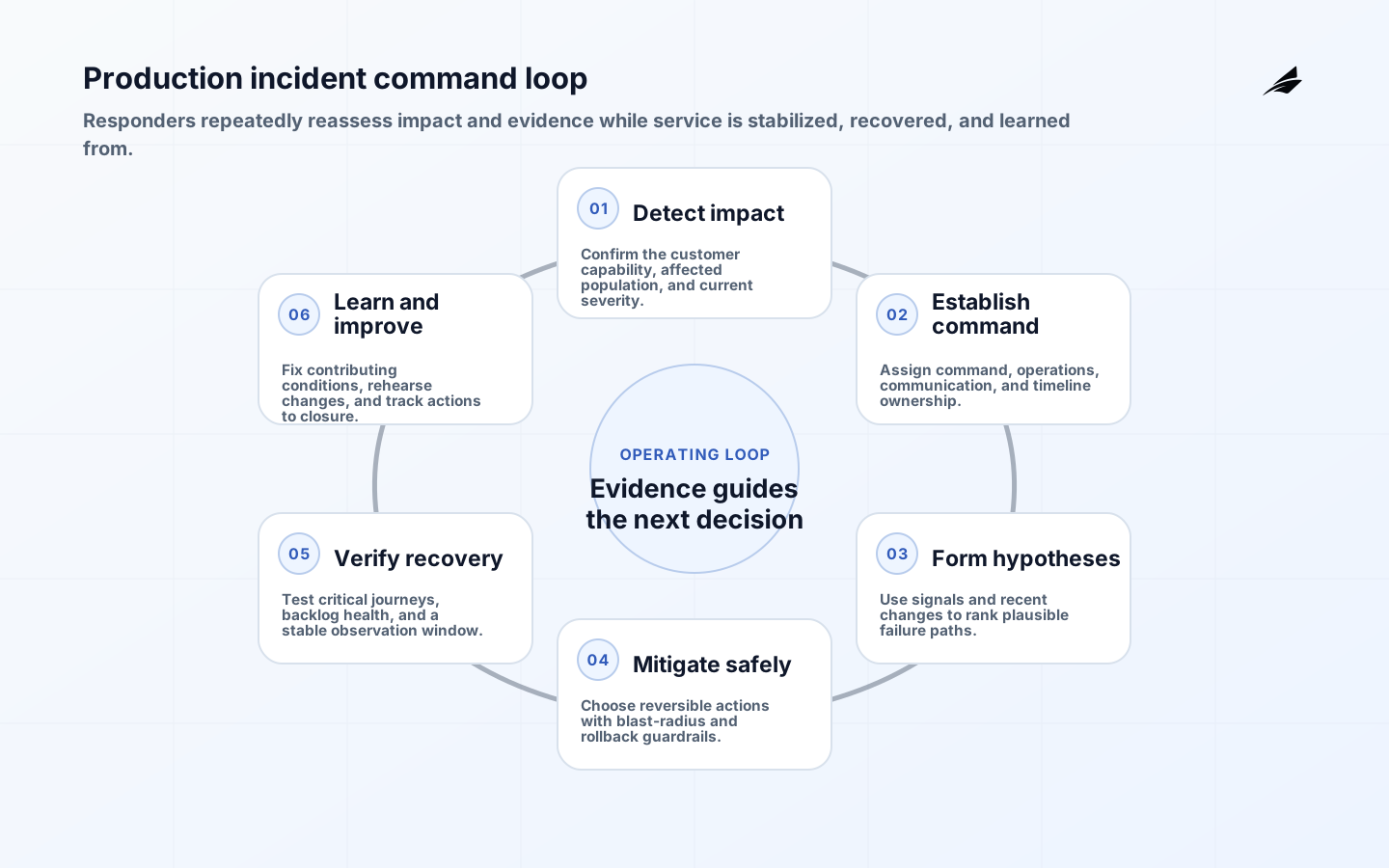
Production incident response is the practiced ability to protect customers and restore a service when normal operation breaks down. It is not a document opened only after an outage. Service businesses need a repeatable way to recognize impact, establish command, reduce harm, communicate honestly, recover the business outcome and learn from the event. Define an incident in customer terms as well as technical terms: completed requests may be delayed, records may be incorrect, or an integration may be accepting data it cannot reconcile. The response should begin before root cause is known. A team that waits for perfect diagnosis often delays the safe mitigation that customers need most.
Prepare the response system
Name the roles that will exist during a material incident: incident commander, technical lead, communications lead, operations or customer liaison, and any domain authority required for a sensitive decision. One person can fill more than one role in a small team, but the responsibilities should still be explicit. Maintain current contact paths, service ownership, dependency maps, runbooks, rollback procedures and customer communication templates. Define severity by customer impact, scope, data integrity and time sensitivity rather than by how alarming an internal graph looks. Train people to declare early, because a declaration creates coordination; it does not assign blame. Regular exercises should include an unavailable primary responder and a third-party dependency failure.
| Role | Accountability | First action |
|---|---|---|
| Incident commander | Coordinate decisions and timeline | Declare severity and cadence |
| Technical lead | Investigate and propose mitigations | Assess blast radius and safe options |
| Communications lead | Keep stakeholders informed | Publish known impact and next update |
| Operations liaison | Protect customer work and queues | Apply approved manual contingency |
| Domain authority | Validate material business decisions | Approve integrity or regulatory actions |
Stabilize before perfect diagnosis
The first objective is containment. Confirm the affected user journey, approximate start time, scope and whether a risky action is still occurring. Then choose the least harmful mitigation available: stop a release, disable a feature, fail over, shed nonessential load, increase manual review, pause a queue or block an integration. Every mitigation needs an owner, expected effect and a check that it worked. Avoid uncontrolled retries, broad restarts and simultaneous changes that erase evidence or worsen the incident. Keep a timestamped decision log with facts, hypotheses, commands or changes, and customer impact. This record supports handoff during a long event and prevents the team from reconstructing critical choices from memory later.
Restoring compute is not necessarily restoring service. Confirm that critical business state is correct: orders have not been duplicated, approvals are not stranded, notifications are not misleading and queued work will resume in an intelligible order. If data repair is needed, treat it as a controlled operation with a backup, validation criteria, peer review and reconciliation. Decide what to do with in-flight requests before reopening traffic. A service can appear available while silently losing or corrupting the work that customers care about. Define a recovery checklist for each critical workflow and make it part of incident closure rather than an optional follow-up.
| Stage | Question | Exit evidence |
|---|---|---|
| Detect | What customer outcome is affected? | Verified impact and severity |
| Contain | How do we stop further harm? | Mitigation effect observed |
| Recover | What business state must be restored? | Reconciliation and health checks |
| Communicate | Who needs what update? | Timed stakeholder messages |
| Learn | What must change? | Owned action items and review date |
Communicate with precision
Good incident communication is factual, regular and proportionate. State what users may experience, which services or cohorts are affected, when the team last verified the information, what safe action users should take and when the next update will arrive. Avoid assigning cause before evidence supports it. Internal updates should distinguish observed facts from hypotheses and decisions from suggestions. Customer-facing messages need not expose every technical detail, but they should not imply recovery until critical user outcomes have been checked. Keep support teams supplied with current guidance so customers do not receive conflicting answers. A communications lead lets technical responders concentrate while still treating customer trust as part of the response.
- Declare early when customer impact is plausible and coordination is needed.
- Assign a commander and separate communication from diagnosis.
- Make mitigation decisions explicit, timestamped and verified.
- Validate business state before declaring recovery.
- Use fixed update times even when there is little new information.
Run a learning review
After the immediate event, hold a review that explains how the system allowed the incident, how people detected and responded to it, and what conditions shaped their choices. A blameless review asks about system design, signals, workload, authority and safeguards rather than looking for a single person to fault. Include the timeline, customer impact, mitigation, recovery verification, communication and the difference between intended and actual behavior. Turn observations into a small number of owned actions with a measurable completion condition. An action such as improve monitoring is too vague; add a journey indicator, exercise the alert and verify the responder can use it. Share relevant learning beyond the immediate team when a dependency or pattern is common.
Keep readiness current
Incident readiness decays as services, people and vendors change. Review ownership, runbooks, backup restoration, access paths, escalation contacts and dependency commitments on a regular schedule. Use lightweight drills to test one capability at a time: can a new on-call engineer find the rollback, can support communicate a known degraded mode, can a team restore a representative record, can a vendor escalation reach the right service level? Track drill findings until resolved. This maintenance work is often less visible than feature delivery, yet it determines whether a difficult day becomes a contained service interruption or a prolonged loss of control.
Keep a decision timeline while the incident is active
An incident timeline should record state-changing facts, not every message. Capture when impact began, how it was detected, affected customer capabilities, severity changes, hypotheses, mitigations attempted, approvals, deployment or configuration changes, dependency updates, customer communications, and the evidence used to declare recovery. Assign a scribe early so the incident commander can coordinate. The timeline supports handover during a long event and prevents the review from depending on memory.
| Timeline entry | Minimum detail | Why it matters |
|---|---|---|
| Impact update | Affected capability, population, geography or tenant, and confidence level | Keeps response and communication tied to customer effect |
| Decision | Owner, options considered, evidence, and expected result | Makes urgent trade-offs inspectable without slowing every action |
| Mitigation | Exact change, operator, start time, guardrail, and rollback trigger | Separates action from assumption and supports safe reversal |
| Communication | Audience, message, timestamp, and next update commitment | Prevents conflicting internal and external narratives |
| Recovery check | User journey, telemetry window, backlog state, and residual risk | Avoids declaring resolution when only one metric recovered |
Detection should combine symptoms and service objectives. OpenTelemetry defines traces, metrics, and logs as observability signals; no single signal is a complete incident view. Pair telemetry with support contacts, business-process failures, dependency status, and synthetic customer journeys. During mitigation, prefer reversible changes with a known blast radius. A rollback, feature disablement, traffic shift, queue pause, or capacity change may restore service before the precise defect is known.
Edilec guides to incident response implementation, incident response questions, and product release management connect emergency response with normal delivery controls. The Google SRE incident guidance provides a useful role model, while its postmortem guidance explains how reviews can improve systems without assigning simplistic blame.
The OpenTelemetry observability primer explains the distinct roles of traces, metrics, and logs; use that model to decide which signals support detection, diagnosis, and recovery verification. NIST defines risk escalation as moving risk decisions to a role with appropriate authority. During an incident, escalation thresholds should therefore name the business or technical authority required, not merely a larger chat channel.
Key takeaways
- Prepare named roles, current runbooks and practiced escalation before an incident.
- Contain harm before waiting for complete root-cause certainty.
- Keep a decision log and validate the business state during recovery.
- Communicate facts, scope and next-update time with discipline.
- Use a blameless review to create specific, owned reliability improvements.
- Maintain readiness through exercises as systems and teams change.
Frequently asked questions
When should an issue become an incident?
Declare when customer impact, data integrity risk, security concern or coordination need exceeds normal support handling. It is usually cheaper to declare and downgrade than to delay a response while the team debates terminology.
Must root cause be known before recovery?
No. Containment and safe recovery should proceed from observed impact and tested mitigation. Root-cause investigation matters for prevention, but it should not delay reversible actions that protect customers and preserve evidence.
Manage third-party and business dependencies
Many production incidents cross an organizational boundary. Keep a current record of critical vendors, internal shared services, contractual support routes, technical health signals, fallback options and business processes that depend on them. During an incident, appoint one person to manage the dependency conversation so engineers are not repeatedly seeking status through different channels. Validate vendor recovery claims against the customer journey and local reconciliation, because an upstream status page may be healthy while queued work remains incomplete. After the event, update the dependency contract or contingency plan where needed. This preparation is particularly important for service businesses whose customer promise depends on a chain of systems they do not fully operate.
Preserve customer work during degradation
A resilient response considers what a customer can still do while the primary path is impaired. Define degraded modes for important journeys: accept and queue a request, show a truthful delay, offer a read-only view, provide an approved manual route or block a risky submission. Test that these modes do not create duplicate work or lose the context needed for later reconciliation. Support staff should know which workaround is safe and when it stops being safe. Include a named owner for the backlog created by the fallback and a trigger for returning to the normal path. Record the capacity limit and customer communication that applies if the fallback itself approaches saturation. Rehearse the handback with a representative queued case before relying on it. Define recovery acceptance criteria before the incident: backlog age must return below the service target, processed records must reconcile to the source count, manual actions must be recorded, and the normal path must pass a fresh user-journey check. Assign a business owner to accept those criteria, because technical restoration alone cannot determine whether customer work is complete. Capturing this design before an incident prevents hurried teams from inventing a bypass that solves a short-term symptom while creating a larger integrity problem after service restoration.
Conclusion
Incident response is a service capability, not an emergency improvisation. Give people authority, evidence and practiced paths to contain harm, restore the customer outcome and improve the system that failed.