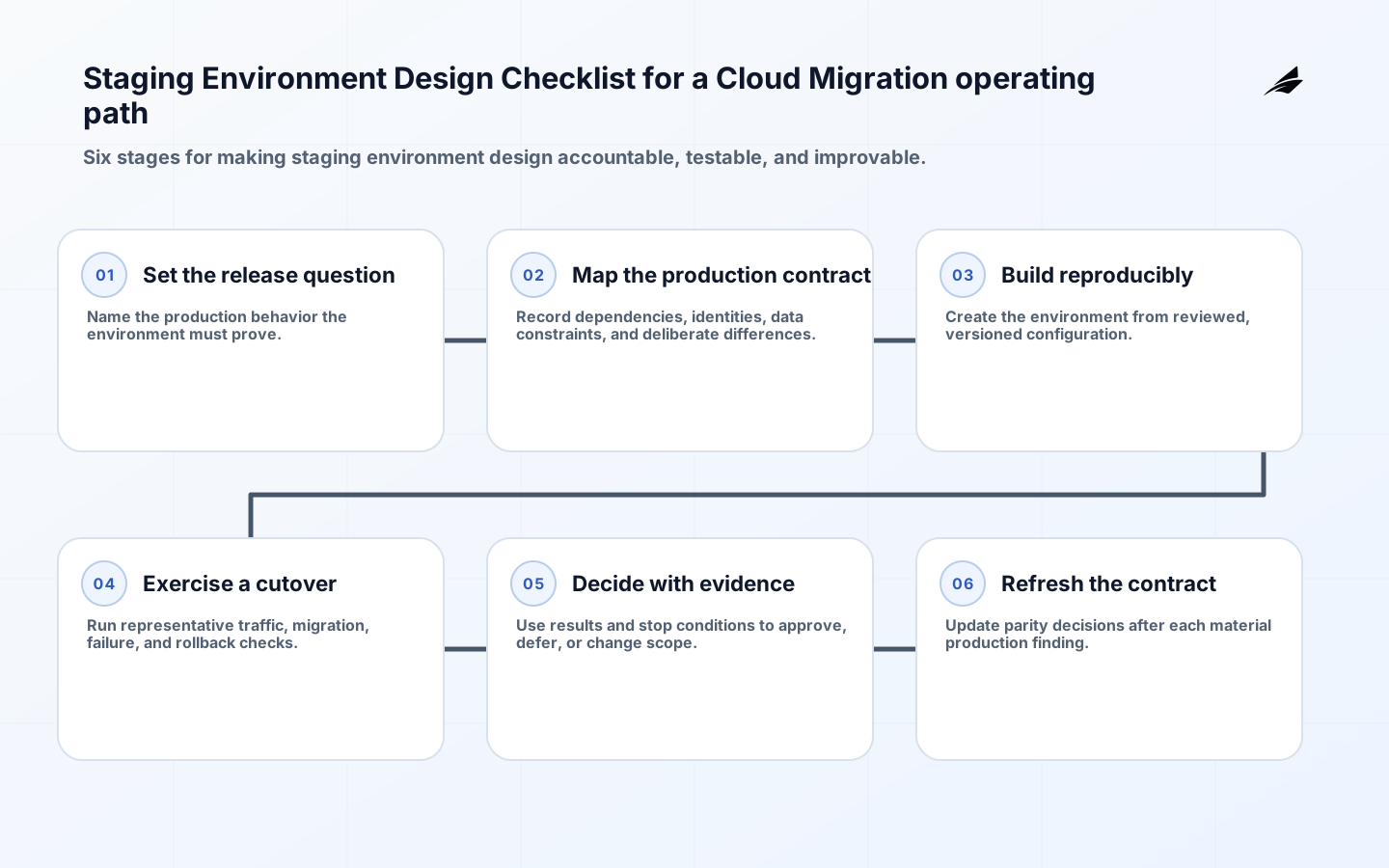
Staging environment design is useful when it makes a consequential operating decision easier to take with evidence, not when it adds a fashionable layer of process. For enterprise migration teams, the practical job is proving that a migrated service, its identity path, network rules, integrations, and operational procedures behave as intended before a production cutover. Treat that job as a service: someone must own the decision, people need a clear next action, and the team must be able to explain what happened when a result is surprising. The central question is therefore not whether a tool can be configured. It is whether the workflow can protect customers and staff while still allowing routine work to move. This guide uses a checklist format to turn that question into boundaries, evidence, tests, controls, measures, and a recovery-minded review habit.
Define the staging environment design operating boundary
Start staging environment design by writing down the actual decision rather than a broad aspiration. In this case, the boundary includes a release candidate, the declared environment configuration, representative non-production data, and the dependencies whose behavior can change the cutover decision. Name what enters the workflow, who has authority to continue or stop it, and what completion looks like. This prevents adjacent work from silently becoming part of the first release. A responsible owner can accept a trade-off, but they also need a defined escalation route when the evidence is incomplete or the risk has changed. Make the normal path visible alongside the uncomfortable path: the dependency that fails after approval, the late change, the missing record, or the operator who cannot proceed. Those conditions reveal whether a checklist is useful under pressure.

| Decision question | Checklist answer | Evidence to retain |
|---|---|---|
| What must this guide govern? | a release candidate, the declared environment configuration, representative non-production data, and the dependencies whose behavior can change the cutover decision | A named owner, scope statement, and dated decision record. |
| What proves a safe outcome? | artifact digest, infrastructure revision, configuration inventory, data-handling decision, dependency versions, test result, and release owner | Links or identifiers for the relevant revisions, checks, and approvals. |
| When must work pause? | Pause when a test environment that looks familiar but cannot reveal production-only permissions, scale limits, network paths, or data migration faults. | A visible reason code, assignee, and next review time. |
| How does work recover? | Use a documented fallback or reversal before expanding staging environment design. | Recovery action, reconciliation result, and restart authority. |
Make evidence usable at the moment of action
Evidence for staging environment design is not an archive of every event. It is the smallest reliable record that lets the next accountable person answer what changed, why it is allowed, and what they should do now. Capture artifact digest, infrastructure revision, configuration inventory, data-handling decision, dependency versions, test result, and release owner. Keep the identifiers close to the decision rather than hiding them in separate dashboards, chat threads, or personal notes. Version relevant instructions, configuration, and operating procedures together so a later reviewer can distinguish an old rule from an implementation fault. Evidence should also be proportionate: preserve enough context to reconstruct a material action while limiting unnecessary access to sensitive data. A concise, current record is more valuable than a perfect-looking document nobody can use during an exception.
Use the evidence to support a decision, not merely to justify one after the fact. The person doing the work should be able to see the authoritative inputs, the important constraints, and the approved next step without assembling a private interpretation. Where a human review is required, give that reviewer sufficient context, authority, and time to disagree. A click-through approval that cannot alter the outcome is not a control. For staging environment design, compare the production contract with the staging contract and explicitly record justified differences. This approach makes the operating rule inspectable by engineering, security, product, and support without asking every group to master the same implementation detail.
Test the real path, including recovery
A plausible demonstration is not proof that staging environment design will behave well in live work. Build test cases from representative activity and include the friction that normally gets solved through experience. For this guide, exercise a migration rehearsal, a degraded dependency, a least-privilege access check, a rollback rehearsal, and a data reconciliation sample. Run the tests through the entire boundary, including identity, configuration, integrations, queues, and the decision to communicate or reverse a change. Agree before testing which result is acceptable, which requires a reviewer, and which must stop the workflow. Keep the result with the evidence so future teams do not repeat the same experiment. A failure found in a rehearsal is useful only when it changes a control, a runbook, a scope decision, or the next test.
| Test condition | Expected behavior | Review signal |
|---|---|---|
| Ordinary permitted work | Complete the defined step and show the evidence needed for the next owner. | Completion quality and elapsed time for staging environment design. |
| Required evidence is missing | Hold or route the work without inventing a safe-looking result. | Aging of blocked cases and reason-code trends. |
| A protected control fails | Deny or limit the action at the enforcement point and preserve context. | Control failures, overrides, and timely remediation. |
| A dependency is unavailable | Use the documented fallback, preserve the case, and reconcile afterwards. | Recovery time and unprocessed or inconsistent work. |
| A reviewer rejects the result | Keep the original trace and convert recurring correction patterns into owned improvement. | Corrections grouped by cause and closure quality. |
Operate staging environment design with visible controls
Controls are most useful when they are part of ordinary work. For staging environment design, establish versioned infrastructure, synthetic or masked data, restricted access, controlled secrets, and a signed cutover record. Make ownership concrete: one person or team owns the business outcome, another owns the technical service where those are distinct, and an escalation route connects them. Review exceptions on a cadence that matches their risk; an old exception becomes an undocumented design choice. Avoid forcing every case through the same heavy gate. The safer pattern is to automate routine, well-understood checks and reserve human attention for ambiguity, high impact, or a departure from the declared boundary. That keeps control work focused and gives the team data about where the standard is too weak or too difficult to follow.
- Observe one end-to-end staging environment design case before choosing more tooling.
- Write the allowed action, stop condition, decision owner, and closure evidence in one short operating contract.
- Make the authoritative source and the person responsible for its freshness visible to the worker.
- Exercise a normal case, a realistic exception, a denied request, and the documented fallback.
- Record material overrides with a reason and review repeated overrides for a design change.
- Retire controls and documents that no longer map to a real decision or owner.
Measure signals that lead to action
Choose measures for staging environment design that help a named owner decide what to change. Track rehearsal defects found before cutover, configuration drift, time to restore staging, and the proportion of production changes first exercised in staging. Define the numerator, denominator, time window, exclusions, and review cadence before publishing a dashboard. Pair a speed measure with a quality or resilience measure, because faster throughput can conceal a rising correction backlog or an untested recovery gap. Review a small sample of completed, blocked, and reversed cases with the people who did the work. Their explanations often identify a missing source, confusing interface, inadequate capacity, or unclear authority that a top-line metric cannot reveal. The point is not to create a score for its own sake; it is to connect service behavior to an explicit improvement decision.
Key takeaways
- Staging environment design should begin with a bounded operating decision and a named accountable owner.
- Evidence is valuable when it supports the next action, not when it only explains the past.
- A production-ready pattern includes an exception route and a practical way to recover.
- Human review only protects the work when reviewers have context, authority, and time to intervene.
- A narrow, exercised workflow earns expansion more reliably than a broad launch with untested assumptions.
Frequently asked questions
How narrow should the first staging environment design implementation be? Keep it narrow enough that one owner can state the outcome, the team can follow the full case path, and an operator can inspect evidence without stitching together unrelated systems. Include an ordinary case and one exception that matters. Exclude adjacent work whose ownership, recovery, or source of truth is unsettled. A constrained first release is not a temporary compromise; it is the fastest way to prove the operating model before more dependencies and users make correction expensive.
How often should the staging environment design checklist be reviewed? Review after a material change, an incident, a recovery exercise, or repeated exception pattern, and set a scheduled review for quieter periods. The review should compare declared behavior with what people actually did. Remove obsolete steps, refresh owners and sources, and add a test where an assumption failed. Treat the checklist as living operational documentation: stable enough to guide work today, but not so fixed that it preserves a known weakness tomorrow.
Conclusion
The durable version of staging environment design is a working agreement that helps people make a safe, explainable choice under normal conditions and during strain. Define the boundary, keep decision-grade evidence near the action, test failure and recovery, and measure the results that prompt an owner to improve the service. Once the team can operate that loop reliably, expanding scope becomes an informed decision rather than a leap of faith.