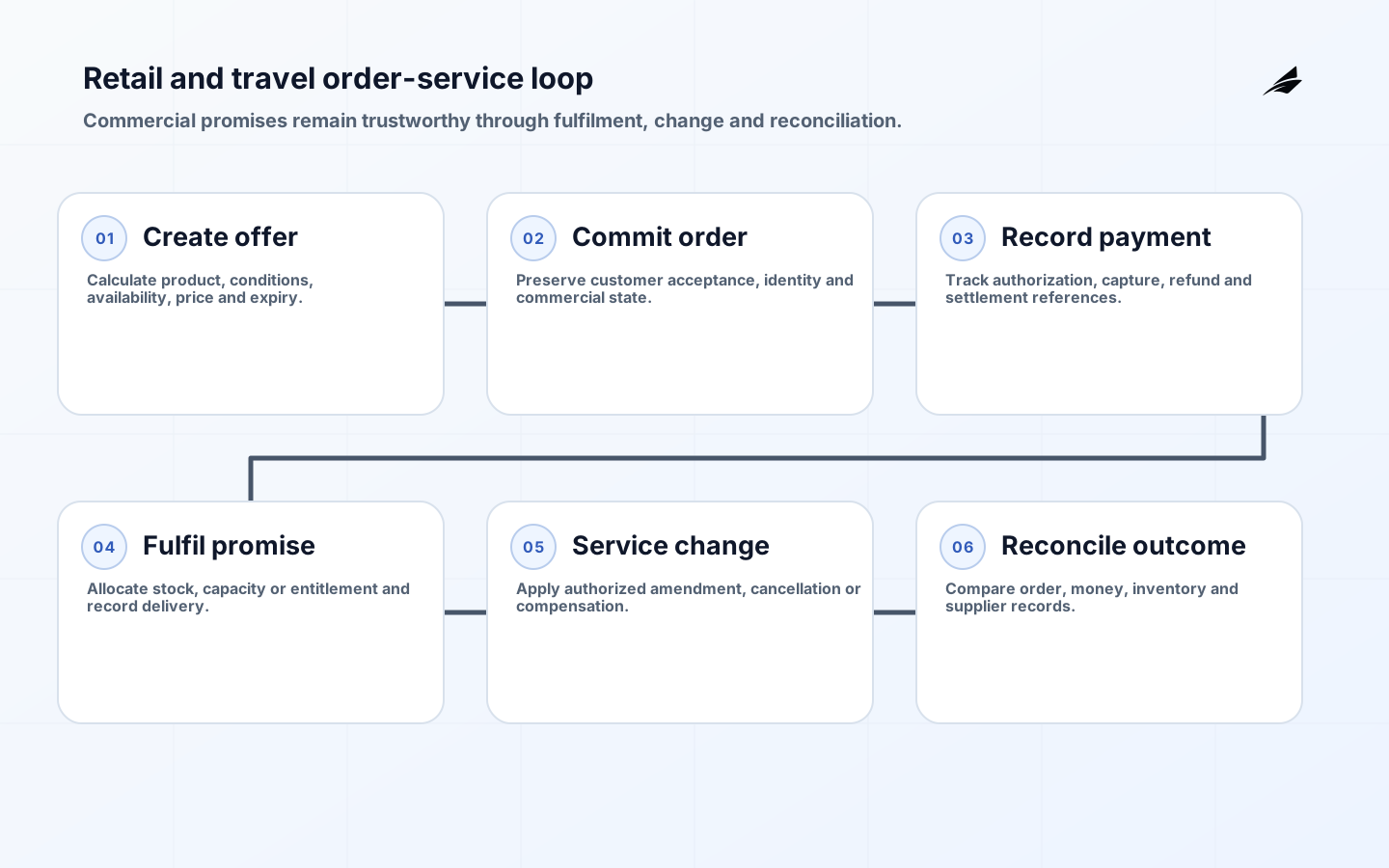
Retail and travel digital systems coordinate promises that change quickly: an item appears available, a fare becomes an offer, payment is authorized, inventory is reserved, and later a customer changes, cancels, collects or consumes what was purchased. The central design problem is not the storefront alone. It is maintaining a trustworthy order across channels, suppliers, fulfilment events and service interventions. This FAQ helps business and technology leaders decide what must be authoritative, what can be integrated and how to modernize without losing operational control.
For a fuller operating model, begin with the practical guide to retail and travel systems and use the implementation checklist before release. Public-service operators with retail-like workflows may also find the public-sector retail systems guide useful. The answers below distinguish shared commerce principles from sector-specific standards; IATA requirements, for example, matter to airline retailing but do not define general merchandise operations.
What is the core system model for retail and travel?
Model the lifecycle as offer, order, payment, fulfilment and service. An offer is a time-bounded proposition with price, conditions and availability. An order is the durable commercial commitment. Payment records authorization, capture, refund and settlement references without turning the commerce database into a card vault. Fulfilment records what was allocated or delivered. Service applies controlled changes while retaining history. In physical retail, stock location and shipment dominate. In travel, schedules, fare conditions, passenger servicing and partner fulfilment add different constraints.

IATA describes modern airline retailing as a move toward Offers and Orders, supported by NDC, ONE Order and related standards. NDC is an open data-exchange standard for communication between airlines and sellers; it is not a complete retail platform. A retailer may instead use GS1 identifiers and traceability events to align product, location and supply-chain data. In either case, the implementation needs stable internal identities and adapters around external schemas so supplier changes do not leak through every workflow.
| Record | Authority question | Typical exception |
|---|---|---|
| Offer | Who owns price, conditions, availability and expiry? | Offer expires during checkout |
| Order | Which record proves the customer commitment? | Channel and supplier disagree on status |
| Payment | Who owns authorization, capture, refund and settlement references? | Payment succeeds but order confirmation fails |
| Inventory or entitlement | What is reserved, where and for how long? | Oversell, stale availability or partner rejection |
| Service history | Who may change, cancel or compensate? | Partial fulfilment needs bounded correction |
How should channels and suppliers be integrated?
Treat each integration as a contract with version, ownership, latency, retry and reconciliation rules. Synchronous calls suit decisions that must complete before the user can proceed, such as confirming current availability. Queues suit work that may complete later, such as notifications or downstream fulfilment updates. Use idempotency for commands that might be repeated after a timeout. Preserve the original message, normalized result and correlation identifier so operators can determine whether a failure occurred before or after an external effect.
How do inventory and availability differ?
Inventory is a record of a resource; availability is a promise calculated for a channel, time and set of conditions. A store can hold five units while exposing fewer because of safety stock, pending picks or channel allocation. A seat can physically exist while not being offered for a route, fare or partner. Keep the underlying quantity, reservation state and offer policy separate. Define expiration for holds and reconcile reservations against authoritative stock or capacity. Never infer successful allocation only from a successful payment.
What payment boundary reduces risk?
Use a qualified payment provider and tokenize card data so the application stores provider references rather than sensitive account data wherever feasible. Confirm the actual PCI DSS scope with an assessor or acquiring partner; outsourcing payment screens does not remove every responsibility. Model authorization, capture, void, refund, chargeback and settlement separately. Reconcile provider transactions to orders and ledger entries, and give operations a controlled path for partial refunds and failed reversals. Payment webhooks must be authenticated, replay-safe and idempotent.
| Control area | Implementation evidence | Operating signal |
|---|---|---|
| Order integrity | Versioned transitions and idempotent commands | Duplicate and illegal transition rate |
| Payment boundary | Current PCI scope, tokenization and webhook verification | Unmatched captures and refunds |
| Partner integration | Contract tests, timeout policy and replay queue | Failure rate and oldest unresolved event |
| Privacy | Purpose, minimization, retention and request workflow | Overdue deletion or access requests |
| Accessibility | Keyboard, focus, labels, errors and status tests | Blocked tasks by assistive-technology users |
How should customer data and personalization be governed?
Separate data required to perform the order from optional profiling and marketing. Record purpose, lawful basis where applicable, source, retention and sharing for each material field. The GDPR includes principles of purpose limitation, data minimization, accuracy, storage limitation and security; other jurisdictions impose different duties. Avoid copying identity and preference data into every channel. Use a governed customer reference and expose only the attributes required for the current task. Sensitive travel requests can reveal health, religion or accessibility needs and require especially careful handling.
Personalization should never silently change an accepted order. Keep the inputs and policy version behind a generated offer so disputes can be investigated. Provide meaningful choices for optional use and a path to correct customer data. Minimize personal data in analytics, logs and test environments. Retention must be executable: deleting a front-end profile while leaving exports, support attachments and vendor copies untouched is not a complete process. Legal and privacy specialists should confirm the policy for each market.
What should happen when a dependency fails?
Define degraded behavior by journey. Search may use a clearly time-stamped cache, but final commitment usually requires current confirmation. If payment status is unknown, do not ask the customer to pay again until reconciliation checks the provider. If a supplier accepts a booking but the local update fails, retain the command and route it to recovery. Set limits on retries to prevent overload. A manual queue needs ownership, priority, safe actions and aging alerts; otherwise it is only a hidden backlog.
How can legacy platforms be modernized safely?
Start by mapping products, orders, customers, payments, inventory and service events across systems. Select one bounded journey and establish a canonical internal model with adapters to legacy records. Run comparison reports before moving authority. Use strangler-style migration only when the routing rule is explicit and reversible. Dual writing is risky unless reconciliation is designed first. For travel standards, pin schema versions and test partner-specific interpretations; conformance to a message format does not guarantee identical business behavior.
- Inventory systems and name the owner of each commercial record.
- Choose one customer journey and define success, recovery and reconciliation.
- Create a stable internal order model and versioned boundary contracts.
- Pilot with controlled channels, suppliers and operational users.
- Compare financial, inventory and service outcomes before transferring authority.
- Retire duplicate paths only after retention, audit and rollback obligations are met.
How should daily operations be organized?
Give order, payment, inventory and partner exceptions separate queues with common identifiers and a shared customer timeline. Define age thresholds, escalation and correction authority. Shift handover should identify unresolved money movement, stranded fulfilment and customer commitments, not only ticket count. Review reconciliation breaks daily and structural causes weekly. Maintain a calendar for supplier schema changes, certificate renewals, seasonal peaks and regulatory updates. Operational staff need sandbox practice for cancellation, partial fulfilment and provider outage before they receive production permissions.
Measure order completion, promise accuracy, unmatched payments, oversell or capacity conflict, service turnaround, manual correction and repeat contact. Segment by channel and supplier to locate boundaries without ranking teams on incomparable work. Track the customer-visible duration from attempted purchase to final outcome, including asynchronous delay. A fast checkout followed by days of reconciliation is not a high-performing journey. Connect each improvement to a baseline and verify that it did not move exceptions into another queue.
Key takeaways
- Design around the durable order and its service history, not only the storefront.
- Keep inventory, availability, payment and fulfilment as distinct states.
- Place versioned adapters around partner and industry schemas.
- Make reconciliation and controlled correction first-class operations.
- Apply payment, privacy and accessibility controls to every channel.
Frequently asked questions
Should retail and travel use one platform?
Use one coherent operating model, but not necessarily one product. A suite can reduce integration work while creating constraints and concentration risk. Best-of-breed services can fit specialized needs while increasing contract, identity and reconciliation work. Decide from record authority, change rate, resilience, portability and team capability rather than from a diagram that claims one database will solve ownership.
Does every integration need to be real time?
No. Use synchronous exchange when the next decision requires current confirmation. Use asynchronous processing where delay is acceptable and resilience matters more than immediate completion. State the freshness shown to users, and provide pending states instead of pretending an uncertain result is final. Every asynchronous flow needs deduplication, monitoring and reconciliation.
Do industry standards remove custom integration work?
They reduce vocabulary and message ambiguity, but organizations still differ in products, policies, versions, optional fields and failure behavior. Test actual partner scenarios, including change, cancellation, partial fulfilment and settlement. Keep mapping decisions versioned and observable. Standards improve interoperability when governance accompanies implementation; they do not transfer operational accountability.
Conclusion
Retail and travel systems become dependable when every promise can be traced from offer to order, payment, fulfilment and service. Establish authority, preserve history and design reconciliation before adding channels or personalization. Modernize one journey at a time, using sector standards at the boundary and a clear internal operating model at the center. That approach lets the business change commercial experiences without losing control of money, capacity, customer data or recovery.