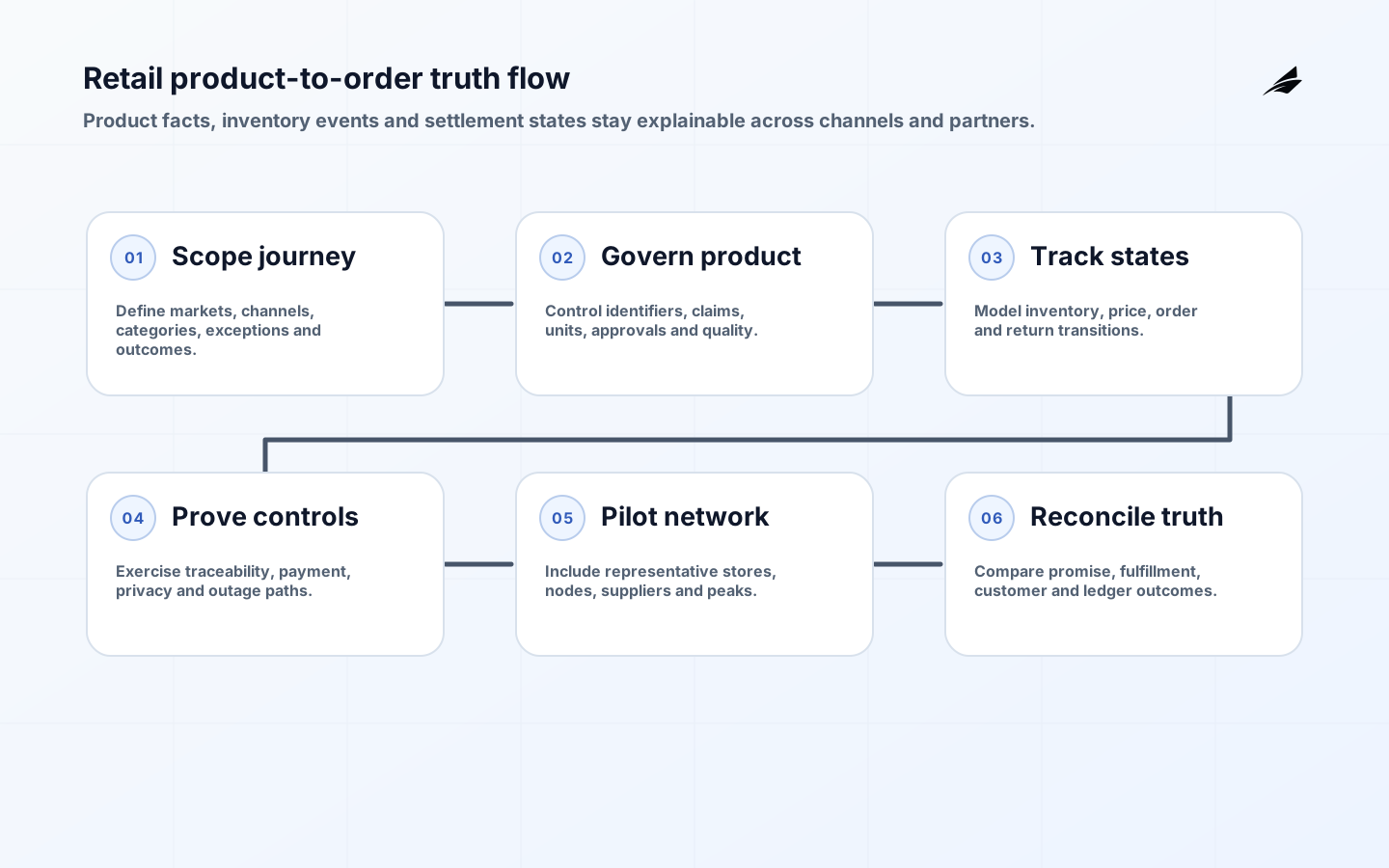
A retail and CPG implementation checklist must preserve truth as products move through suppliers, plants, distribution centers, stores, marketplaces and homes. Customers expect the item, price, promise and return policy to agree across channels. Operators need inventory, lot, order and settlement records they can reconcile. The implementation therefore joins commercial rules, master data, supply-chain events, customer journeys, payments, privacy and store operations.
Use this checklist with the retail and CPG planning guide, the retail and CPG FAQ and the public-sector retail systems guide. Food, alcohol, pharmacy, financial, accessibility, privacy and consumer rules vary by market and product; map the applicable obligations to testable controls before launch.
1. Scope one complete retail or CPG journey
Choose an end-to-end outcome such as launch-to-shelf, browse-to-return, forecast-to-replenish or source-to-recall. Name markets, banners, channels, categories, fulfillment nodes and customer groups. Capture normal and peak volume, substitutions, promotions, split shipments, damaged goods, cancellations, returns and offline store conditions. Explicit exclusions prevent a pilot designed around simple items from being presented as proof for the real estate.
Baseline availability, promise accuracy, conversion, cancellation, pick substitutions, return cycle, waste, margin, support contact and reconciliation effort. Define guardrails for deceptive claims, inaccessible journeys, payment security, food safety and employee workload. Assign one journey owner across merchandising, supply chain, store or plant operations, digital, finance and technology. Local metric optimization often creates the cross-channel failure customers experience.
| Journey decision | Required evidence | Owner | Acceptance signal |
|---|---|---|---|
| Assortment | Market, category and channel rules | Merchandising | Eligible items publish correctly |
| Promise | Inventory, capacity and cutoff logic | Fulfillment | Commitments match actual outcomes |
| Promotion | Eligibility, funding and precedence | Commercial lead | Price and margin reconcile |
| Return | Policy, condition and settlement paths | Operations and finance | Customer and ledger close together |
2. Govern product, party and location data
Define authoritative sources for product identity, hierarchy, dimensions, ingredients, allergens, claims, images, case packs, suppliers, locations and trading relationships. Separate supplier assertions from verified attributes and market-approved content. Version regulated or contractual claims with effective dates. The FTC states that advertising claims must be truthful, non-deceptive and evidence-based; content workflow must preserve substantiation and approval, not only attractive copy.
Use stable identifiers and standards where they support trading-partner interoperability. GS1's traceability standard connects products and locations with critical tracking events and key data elements. Validate identifiers, units and packaging levels at intake. Keep item changes, replacements and discontinuations explicit. A duplicated item or incorrect unit can propagate into ordering, labels, planograms, fulfillment and recall scope.
Establish data quality rules by business consequence: required allergen fields, valid dimensions, plausible weights, image and language coverage, location status and hierarchy consistency. Route failures to accountable stewards and block publication where risk requires it. Provide suppliers a visible correction path. Sample what customers and operators see, because technically valid feeds can still produce misleading pages or unusable pick instructions.
3. Design inventory, pricing and order truth
Document every inventory state and event: expected, received, available, reserved, picked, staged, shipped, returned, quarantined, damaged and adjusted. Name the system of record at each stage and the time at which a promise is made. Design idempotent updates, bounded retries, event ordering and reconciliation. During outage, decide whether a channel stops selling, uses a protected buffer or accepts a controlled risk.
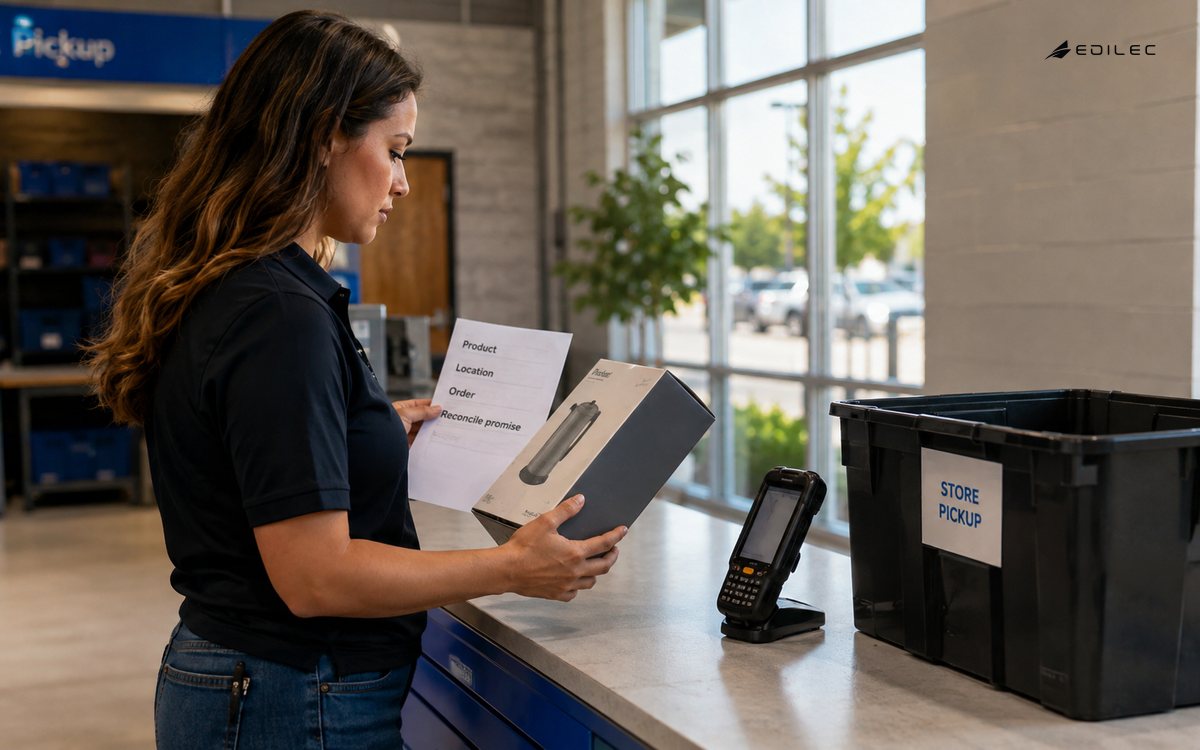
Model price as a time-, market-, channel-, customer- and quantity-dependent decision. Preserve base price, promotion, coupon, tax, fee, funding and override separately so the displayed total, receipt and settlement can be explained. Test overlapping promotions, returns after promotion expiry, partial fulfillment and offline transactions. Finance must reconcile order, payment, tax, gift card, refund and general-ledger events.
Treat an order as a state machine with authorized transitions, not a mutable row. Preserve who or what changed the state and why. Make customer communication derive from committed state. Design cancellation race conditions, partial shipments, substitutions, fraud review and carrier exceptions. Replays after recovery must not create duplicate captures, shipments, loyalty awards or messages.
4. Implement traceability, payment and privacy controls
For covered foods in the United States, the FDA Food Traceability Rule adds recordkeeping for foods on the Food Traceability List; teams should use current FDA guidance and legal advice for applicability and dates. Map critical tracking events and key data elements through partners, test data exchange and run recall exercises. The objective is rapid, accurate scope, not collecting disconnected lot fields.
Reduce payment-data scope through approved architectures and use the current PCI DSS materials in the PCI SSC document library. Segment payment environments, protect administrative access, inventory scripts and third parties, and test incident procedures. Tokenization can reduce exposure but does not remove responsibility for checkout integration, fraud controls, refunds or supplier oversight.
Use the NIST Privacy Framework to assess loyalty, personalization, location, identity and workforce analytics. Collect what serves a defined purpose, provide understandable choices, restrict secondary use and enforce retention. Test export, correction and deletion across data copies. Personalization should degrade safely when consent, identity or profile data is unavailable; it should not block the underlying purchase.
| Control scenario | Test | Evidence | Blocker |
|---|---|---|---|
| Recall | Trace lot across receipt, transformation and sale | Timed scope and contact list | Missing event or ambiguous product |
| Payment | Compromised credential or checkout script | Detection and containment trace | Uncontrolled card-data exposure |
| Privacy | Preference change and deletion request | Propagation and exception record | Continued unauthorized use |
| Recovery | Order replay after outage | Counts, payments and messages reconcile | Duplicate financial or fulfillment event |
5. Roll out around seasons, stores and partners
Pilot with representative stores, fulfillment methods, suppliers and customer needs. Avoid peak blackout periods unless the change specifically requires a peak test and fallback is strong. Rehearse data cutover, store offline operation, help-desk triage, supplier delay and rollback. Train role-specific scenarios at the point of work. Keep enough old-path capacity to protect customers while defects are classified and fixed.
Review availability, promise accuracy, order completion, substitutions, price corrections, return time, waste, recall readiness, payment exceptions, privacy requests, employee effort and unit cost. Segment by channel, store, category, fulfillment node and cohort. A digital conversion increase is not success if cancellations, store labor or support demand rise. Expand only when customer, operational, financial and control outcomes remain within gates.
Rehearse a promotion and fulfillment cutover
- Freeze eligible items and locations, effective times, stacking, funding and return treatment. Test boundary times, tax contexts, offline stores, partial fulfillment, substitutions and returns after expiry. Verify displayed, charged and settled outcomes remain explainable.
- Monitor overrides, abandoned carts, store calls, failed redemptions, substitutions and settlement differences by channel and location. Give customer service exact terms and a correction route. Rehearse withdrawal or rollback before launch.
- Reconcile exposure, orders, fulfilled units, discounts, supplier funding, refunds and loyalty effects. Review sampled customer journeys and employee interventions. This tests product authority, time synchronization, inventory, communication, payments and finance together.
- Classify manual corrections as goodwill, pricing defect, unclear offer, inventory mismatch or training issue. Feed systemic causes to accountable owners. Scaling before reconciliation can multiply small inconsistencies across thousands of receipts and supplier settlements.
Create a launch control room with severity, business and technical owners, supplier contacts and authority to withdraw an offer, stop fulfillment or pause a feed. Review customer harm and financial exposure, not ticket count. Preserve order and price evidence needed to honor expectations.
Test accessibility and assisted service across browse, basket, checkout, pickup and return. Include keyboard, screen reader, zoom, language and low bandwidth. Verify staff can help without bypassing payment, privacy or promotion controls. Channel consistency includes recovery.
Key takeaways
- Implement one complete journey with markets, channels, products and exceptions defined.
- Govern product claims, identifiers, units and packaging from source to presentation.
- Model inventory, price and order states so promises and settlements can be reconstructed.
- Exercise traceability, payment, privacy and outage controls with trading partners.
- Scale by customer and operating outcomes across stores, channels and cohorts.
Frequently asked questions
Can inventory be real time across every channel?
Events can move quickly, but physical reality, late scans, damage and network outages create uncertainty. Define freshness, reservation and safety-buffer policies by item and node. Show customers a promise the operation can honor, and reconcile system stock with counted stock continuously.
How many stores should a pilot include?
Enough to represent format, volume, connectivity, staffing, region and fulfillment variation. Statistical confidence matters for outcome measures, while rare critical scenarios need deliberate tests. A small diverse pilot can reveal more than a large group of nearly identical stores.
Should ERP or commerce own product data?
Ownership should follow capability and attribute. ERP may own financial and procurement fields, while a product information system governs customer-facing content. Define authority at field and lifecycle level, synchronize through controlled contracts and give users one clear correction route.
Plan for partner and platform change. Export product, order, traceability and settlement records in usable forms; document identifiers and semantics; and test parallel reconciliation before switching. Preserve customer service and recall access during transition. Portability is an operational control when marketplaces, payment providers, carriers and commerce platforms sit in the critical journey.
Review post-launch employee workload by role and location. New digital promises can create hidden picking, exception and service work. Measure task time, queue age, safety and training alongside customer conversion. A retail improvement that depends on unsustainable manual intervention will fail during the first representative peak.
Conclusion
Retail and CPG systems earn trust when the product, promise and settlement agree. Scope the whole journey, govern product facts, make inventory and order transitions explicit, test regulated controls and release with store and partner reality in view. That creates an omnichannel operation that can explain and correct what happened.
Review employee workload by role and location after launch. Digital promises can create hidden picking, exception and service work. Measure task time, queue age, safety and training alongside conversion. An improvement dependent on unsustainable intervention will fail at the first representative peak.