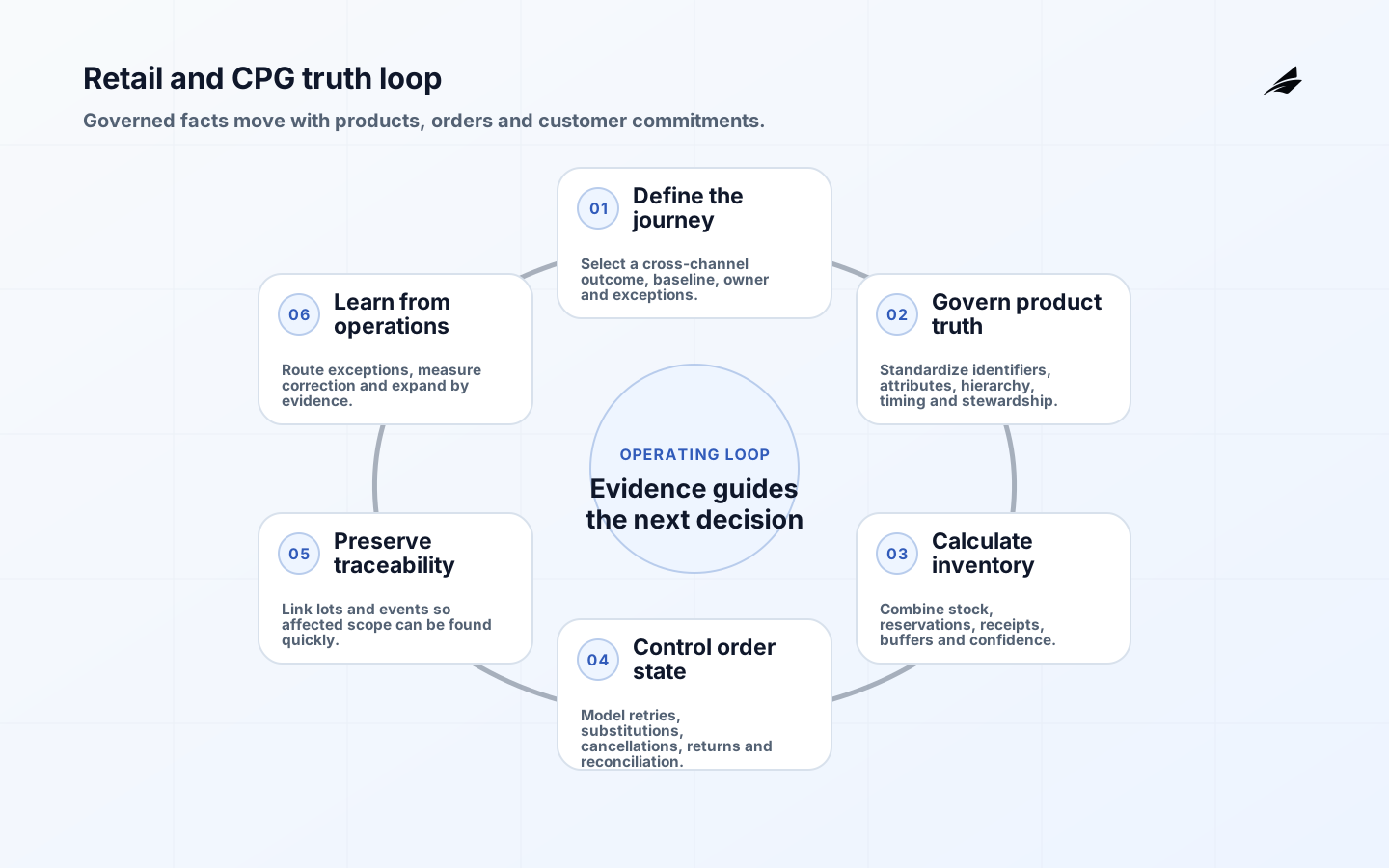
Retail and CPG systems must keep product, location, inventory, price, promotion, order and traceability facts coherent while customers and goods move across channels. A new commerce platform cannot compensate for disputed identifiers or delayed stock updates. Business teams should begin with the moments that matter, define authoritative records and design exception ownership before selecting software. This guide turns those concerns into a practical operating and delivery model.
Use it alongside Edilec's retail and CPG implementation checklist, retail systems FAQ and public-sector retail guide. The core principle is consistent: each business fact needs a steward, system of record, quality rule and path for resolving disagreement.
Start with a cross-channel customer and operating outcome
Select a bounded journey such as introduce a product, promise pickup inventory, fulfill an online order from a store, manage a return or trace an affected lot. Map customer touchpoints and backstage work across brand, supplier, warehouse, store, marketplace, carrier and support. Record baseline completion, latency, manual correction, cancellation and margin. A program described only as omnichannel leaves every team free to optimize a different outcome.
Define decision rights. Merchandising may own assortment, a brand owner product claims, supply chain replenishment and finance recognized revenue, but systems need unambiguous publication and exception rules. Distinguish global policy, market variation and channel presentation. Preserve an audit trail for high-impact changes such as price, allergen, recall, tax and promotion eligibility. Frontline teams need a visible route to correct bad data rather than invent local workarounds.
| Business fact | Likely authority | Critical quality test |
|---|---|---|
| Product identity | Product master and GS1 identifier owner | Uniqueness and hierarchy |
| Sellable content | Brand or merchandising steward | Completeness by market and channel |
| Available inventory | Inventory service from events and reservations | Freshness and reconciliation |
| Customer order | Order management system | State transition and idempotency |
| Traceability lot | Supply-chain event record | Link across critical tracking events |
Create trusted product and location data
Establish identifiers and hierarchies for each, inner pack, case, pallet, location and trading party. Define attribute ownership, validation, effective dates, market variation and approval. The current GS1 Global Data Model describes foundational product attributes used to list, order, store, move and sell goods. Use standards to reduce translation, then add category and regulatory requirements without creating duplicate local definitions.
Treat images, ingredients, dimensions, claims, hazardous handling and digital content as governed records, not marketing attachments. Validate that physical measurements and case hierarchy support warehouse and transport processes. Publish changes through versioned events or interfaces and monitor receiving errors. Product data quality should be measured at the business moment: listing accepted, shelf plan correct, parcel rated accurately or consumer information complete, not merely fields populated in a master system.
Design inventory and order truth for real exceptions
Available-to-promise inventory is a calculated commitment, not the last stock count. It may combine on-hand, reservations, safety stock, expected receipts, damaged goods, channel buffers and fulfillment capacity. Define freshness and confidence by location. When feeds lag, decide whether to reduce promises, extend lead time or stop a channel. Reconcile physical counts, transactional movements and reservations, and assign owners for negative stock and repeated adjustments.
Use an explicit order state model with idempotent commands and durable event history. Cover split shipment, substitution, partial cancellation, payment failure, lost parcel, rejected pickup and return without receipt. Inventory, payment and customer messages must agree on the final outcome, even when systems recover at different times. Test retries and out-of-order events. A happy-path integration demo says little about holiday operations or a carrier outage.
Build lot-level traceability as an operational capability
For covered foods in the United States, FDA's Food Traceability Rule page describes critical tracking events, key data elements and the current enforcement position, including the July 20, 2028 date directed by Congress. Determine legal applicability with counsel, but do not pause data readiness. Supplier identifiers, lot codes, transformation links and sortable records require coordinated design across trading partners.
GS1 EPCIS and Core Business Vocabulary can represent visibility events involving what, when, where, why and how. Decide event granularity, identifiers, correction behavior, access and retention. Run trace exercises from consumer unit to source and from source to destinations. FDA's 2026 traceability tabletop report reinforces the practical need to locate and provide records quickly; measure completeness and retrieval time, not only system availability.
| Scenario | Test data | Pass condition |
|---|---|---|
| Recall | Item, lot, location and transformation events | Affected scope identified without broad over-recall |
| Inventory promise | Counts, reservations, receipts and capacity | Offer matches agreed freshness and confidence |
| Return | Order, tender, item state and disposition | Refund and inventory states reconcile |
| Product change | Old and new attributes with effective dates | Every channel changes at the intended time |
Protect customer and payment journeys
Minimize customer data and separate identity, preference, transaction and analytics purposes. Map consent, retention, subject-rights response and sharing with marketplaces, advertisers, loyalty providers and support vendors according to applicable law. Do not merge profiles solely because records can be linked. Maintain confidence and provenance for identity resolution, and give service agents controlled ways to correct or separate records without broad administrative access.
Reduce payment-data exposure through validated providers and tokenization, while retaining responsibility for the surrounding commerce environment. The PCI Security Standards Council's PCI DSS v4.0.1 publication explains that the revision clarifies requirements without adding or deleting them. Confirm the correct standard version and assessment scope with qualified expertise. Test fraud controls against customer friction and include refund, chargeback and offline-store procedures.
Deliver by business capability and trading event
Sequence work around thin journeys that cross systems. A product-introduction release might create an item, validate attributes, publish to one channel, receive an order and reconcile fulfillment. Use realistic peak volume and supplier variation. Contract-test interfaces and retain replayable events. Create data-quality dashboards with accountable queues. Migration needs field mapping, transformation rules, reconciliation, freeze and rollback; moving incomplete records quickly only accelerates downstream failure.
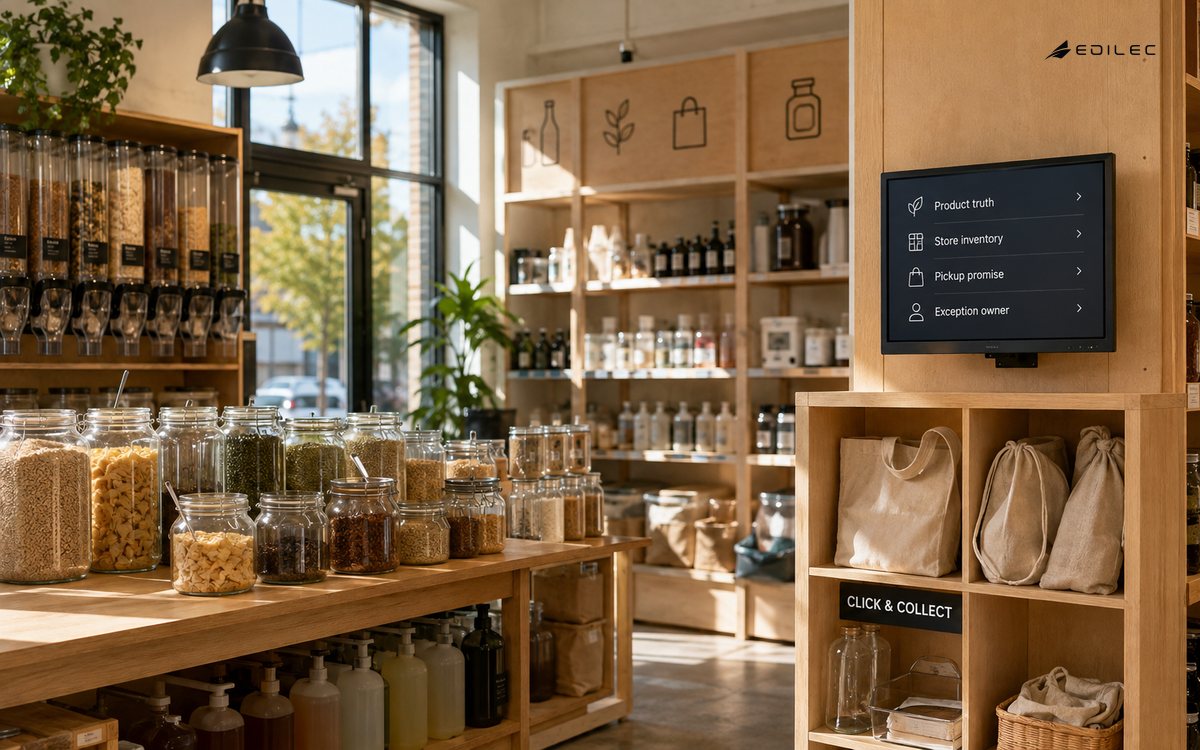
Roll out by category, location, supplier or channel with explicit entry and exit criteria. Train frontline users on exception paths and capture workarounds during hypercare. Rehearse store disconnection, warehouse backlog, stale inventory, failed tender and product-data correction. Track customer completion, cancellation, fulfillment accuracy, margin, inventory adjustment, data-quality exceptions and support demand. Expand when the operating system absorbs exceptions without project-team intervention.
Example: introduce store pickup for chilled products
A retailer adding pickup for chilled products should first define eligible items, store capacity, temperature handling, substitution, promise windows and customer notification. Product records need dimensions, storage and allergen facts; inventory needs freshness and reservation logic; orders need explicit picked, staged, collected and abandoned states. The first release might cover ten stores and a limited category while preserving the existing checkout and refund authority.
Test demand spikes, late delivery, wrong lot, stale inventory, failed payment, customer delay and refrigerator alert. Verify that staff can find the order, record substitution, maintain lot links and return goods to an appropriate disposition. Reconcile reservations with physical counts and payment outcomes. A synthetic end-to-end test should be followed by observed store operation because aisle layout, device connectivity and staffing affect whether the designed workflow is actually usable.
Expansion criteria can include promise accuracy, complete orders, spoilage, substitutions, pickup wait, complaints, inventory adjustments and staff effort. Review results by store and category rather than relying on a network average. When a product attribute or traceability record is wrong, route it to the authoritative owner and measure correction time. This thin journey exercises the same governed facts that later support delivery, marketplace or recall capabilities.
Run a retail and CPG data operating model
Create councils only where cross-functional decisions are needed; keep day-to-day stewardship close to the business process. Publish ownership, quality thresholds, interface contracts, issue severity and escalation. Monitor delayed feeds, rejected records, duplicate identifiers, reconciliation differences and manual adjustments. Prioritize defects by customer, safety, legal and financial impact. A data lake or integration platform does not create governance unless people can resolve the conflicts it exposes.
Review vendors and services for peak capacity, change notice, portability, security, support and exit. Preserve product, order and event history in usable formats. Maintain runbooks for channel suspension, recall, price correction and inventory recalculation. After major campaigns and incidents, examine both system behavior and operating decisions. Retail and CPG architecture should evolve as assortments, regulations and channels change, while identifiers and event semantics remain dependable anchors.
Retail and CPG system takeaways
- Build around a bounded cross-channel journey and measurable outcome.
- Assign authority and quality rules to product, inventory, order and traceability facts.
- Model exceptions and out-of-order events before peak trading.
- Use standards to preserve identifiers and event meaning across partners.
- Minimize customer and payment exposure while keeping support workable.
- Expand releases only when operating teams can resolve exceptions independently.
Frequently asked questions
Can one ERP become the system of record for everything?
Rarely. Different systems may author product, order, inventory, customer and finance records. The important design is clear authority for each fact, versioned interfaces and reconciliation. A consolidated platform can reduce integration, but forcing every operational state into one model can create latency and brittle customization.
Does omnichannel inventory need to be real time?
It needs freshness appropriate to the promise and error cost. High-velocity store pickup may require seconds; slow replenishment planning may tolerate longer. Publish the timestamp or confidence behind availability, use buffers where necessary and define degraded behavior when feeds fall outside the agreed window.
Conclusion
Retail and CPG systems create reliable experiences when they preserve business truth across physical and digital events. Start with outcomes, govern product and location data, calculate inventory honestly, model order exceptions and rehearse traceability. Technology selection follows those decisions. The result is a system that can sell, fulfill, correct and respond under real operating conditions.