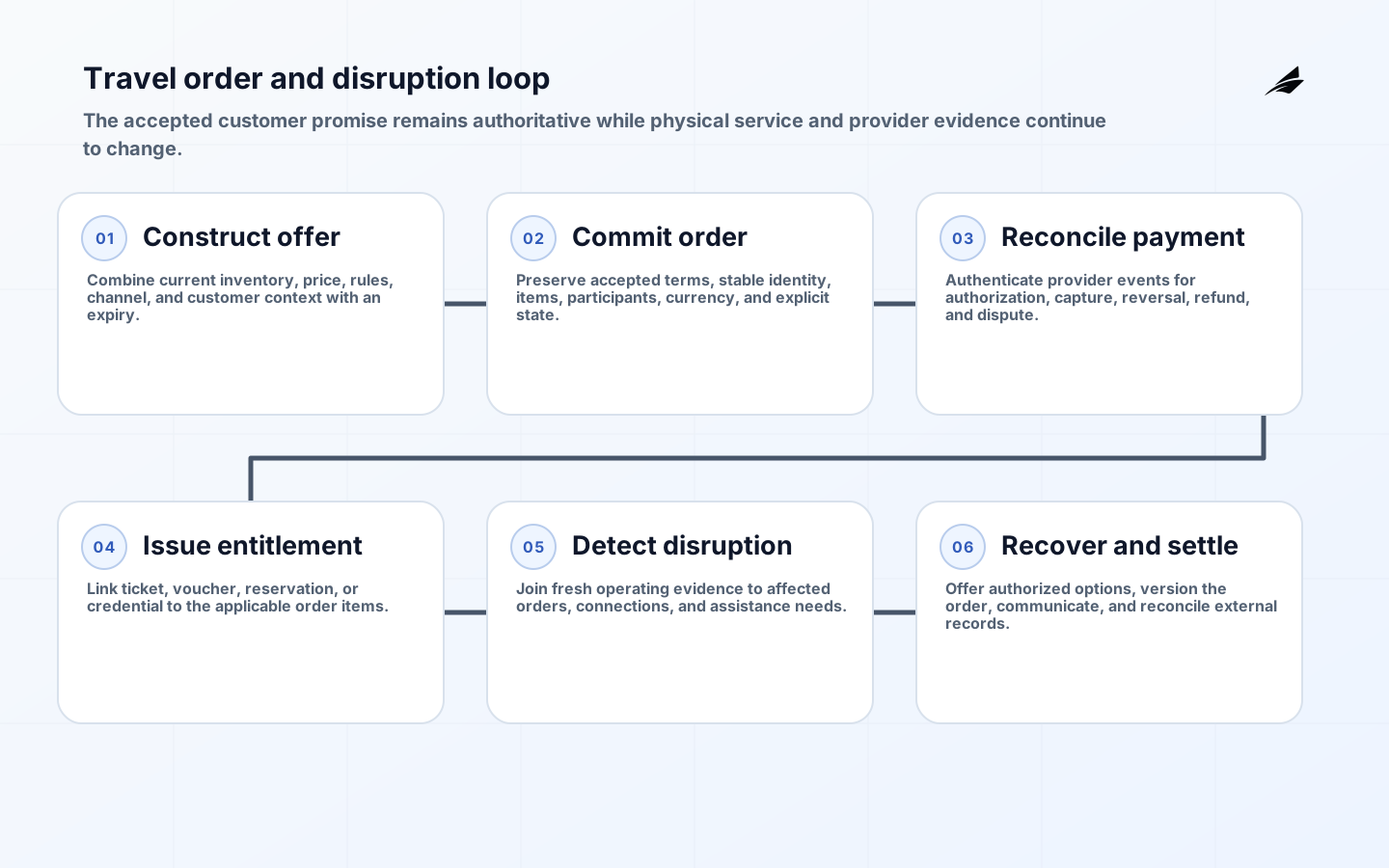
This retail, travel and transportation FAQ addresses systems that must sell a promise now and fulfil it across time, locations, operators, and disruptions. A customer may search an itinerary, accept an offer, pay through a separate provider, receive a ticket or order, cross several operating systems, and request a change after inventory and price have moved. The architecture succeeds when every party can identify the same commercial commitment and explain its current fulfilment state.
The answers focus on decisions for business owners, architects, product teams, and integration leaders. For a broader operating model, read the business guide to retail, travel and transportation systems. Teams entering delivery can use the implementation checklist and compare adjacent channel concerns in the retail and travel digital systems guide.
What capabilities belong in a modern travel retail platform?
Treat the platform as a set of business capabilities, not one enormous reservation application. Typical boundaries include product and schedule content, availability, offer construction, customer identity, order management, payment, ticketing or entitlement, fulfilment, disruption handling, settlement, partner exchange, and customer communication. The authoritative system can differ by stage, but ownership must be explicit. A search index can answer quickly without becoming the authority for a confirmed order.
IATA’s modern airline retailing direction uses Offers and Orders, with NDC as an open exchange standard for offer and order messages. Public transportation commonly publishes scheduled and realtime rider information through GTFS. These standards solve different interoperability problems; neither is a complete operating architecture. Teams still need versioning, identity, payment boundaries, reconciliation, exception ownership, and a customer experience that remains coherent when a provider is delayed or unavailable.
| Capability | Authoritative decision | Failure question |
|---|---|---|
| Search and offer | What can be sold, at what terms, for how long | What happens when availability changes before acceptance? |
| Order | What the customer and seller committed to | Can every modification preserve a complete history? |
| Payment | Whether money was authorized, captured, refunded, or disputed | How are provider callbacks reconciled with the order? |
| Fulfilment | What travel or service entitlement is usable | Can operators verify it during partial connectivity? |
| Disruption | What changed and which recovery choices are available | Who may rebook, refund, or communicate? |
| Settlement | What each party owes after delivered service | Can finance reproduce the amount from durable events? |
How should offers, orders, inventory, and tickets relate?
An offer is a time-bounded proposal assembled from inventory, pricing, rules, customer context, and channel policy. Acceptance should create an order with a stable identifier, recorded terms, currency, taxes, participants, fulfilment items, and version. Do not reconstruct the original promise later from mutable catalog data. Inventory reservation and payment may complete asynchronously, so the order needs explicit pending, confirmed, failed, expired, cancelled, and partially fulfilled states rather than one optimistic success flag.
A ticket, voucher, boarding credential, barcode, or reservation locator can remain necessary for delivery even when the commercial model centers on an order. Model it as an entitlement or fulfilment artifact linked to order items, not as the only customer record. This distinction supports partial exchanges, mixed operators, ancillary products, and refunds. Every state transition should be idempotent, attributable, and reconcilable with external providers; repeated messages must not create a second charge or entitlement.
How do realtime operations and disruption recovery fit?
Realtime data is perishable evidence. Capture source, event time, ingestion time, confidence or uncertainty, and affected service identifiers. GTFS Realtime supports trip updates, service alerts, and vehicle positions tied to the scheduled feed; consumers must distinguish a feed with no entities from a stale or failed feed. Similar principles apply to flight status, hotel availability, shipment milestones, and store inventory. The user interface should show freshness and uncertainty instead of presenting old predictions as facts.
Disruption recovery is a decision workflow, not a notification feature. Determine affected orders, applicable rights and commercial policy, feasible alternatives, inventory holds, customer preference, payment adjustment, and operator authority. Automate low-risk options within policy and queue ambiguous or high-impact cases for an empowered agent. Preserve the original service, observed disruption, options offered, customer choice, resulting order version, and communication outcome so support and settlement see the same history.
| Scenario | Automated response | Human decision trigger |
|---|---|---|
| Minor delay | Refresh prediction and notify through the chosen channel | Connection risk or accessibility assistance is affected |
| Cancelled segment | Identify protected alternatives and hold valid inventory | Multiple operators or policy exceptions conflict |
| Price changes during checkout | Expire the offer and request informed acceptance | Customer disputes whether acceptance occurred |
| Payment callback is late | Keep order pending and reconcile idempotently | Provider and internal records remain inconsistent |
| Partial fulfilment | Protect completed items and calculate remaining options | Refund, loyalty, tax, or settlement result is ambiguous |
What should teams do about payment, identity, and fraud?
Reduce payment-data exposure by using a validated payment provider and tokenization pattern appropriate to the channel, while confirming the organization’s actual PCI DSS scope with qualified specialists. Redirects, hosted fields, wallets, kiosks, call centers, and stored credentials have different trust boundaries. The order service should rely on authenticated provider evidence and reconcile authorization, capture, reversal, refund, and dispute events. Browser return URLs alone are not reliable proof of payment.
Use customer accounts to improve continuity, not to make purchase impossible. Support guest journeys where policy permits, accessible account recovery, and step-up authentication for risky changes. Fraud controls should combine payment, account, device, velocity, itinerary, and fulfilment signals without silently blocking legitimate urgent travel. Give operations reason codes and bounded override procedures. Minimize identity documents and travel history, separate operational need from marketing use, and define retention by purpose and jurisdiction.
How can legacy travel systems be modernized without a big-bang replacement?
Start with one measurable journey and establish a canonical business boundary around it. An anti-corruption layer can translate legacy locators, statuses, and messages into explicit offer, order, payment, and fulfilment concepts while the old system remains authoritative. Publish durable events from committed state, not speculative UI actions. Reconcile new and legacy records daily and expose mismatches to operators before expanding traffic. Translation is temporary architecture only when it has an owner, retirement condition, and measured cost.
Choose a migration slice that can be released and reversed: one market, channel, operator, product type, or customer cohort. Shadow-read first where possible, compare results, then move a bounded write path. Contract-test partner versions and maintain replayable test cases for schedule changes, time zones, currencies, taxes, partial failures, and duplicate messages. A modernization milestone is complete when support, finance, and operations can run the new path, not merely when an API responds.
How should accessibility and assisted service be designed?
Apply WCAG 2.2 to web and mobile booking surfaces, including keyboard operation, visible focus, target size, redundant entry, error identification, and accessible authentication. Test date pickers, seat maps, fare comparisons, countdowns, and disruption dialogs with assistive technology and real users. Accessibility information about stations, vehicles, rooms, or assistance must be structured, current, and carried through search, order, fulfilment, and change workflows.
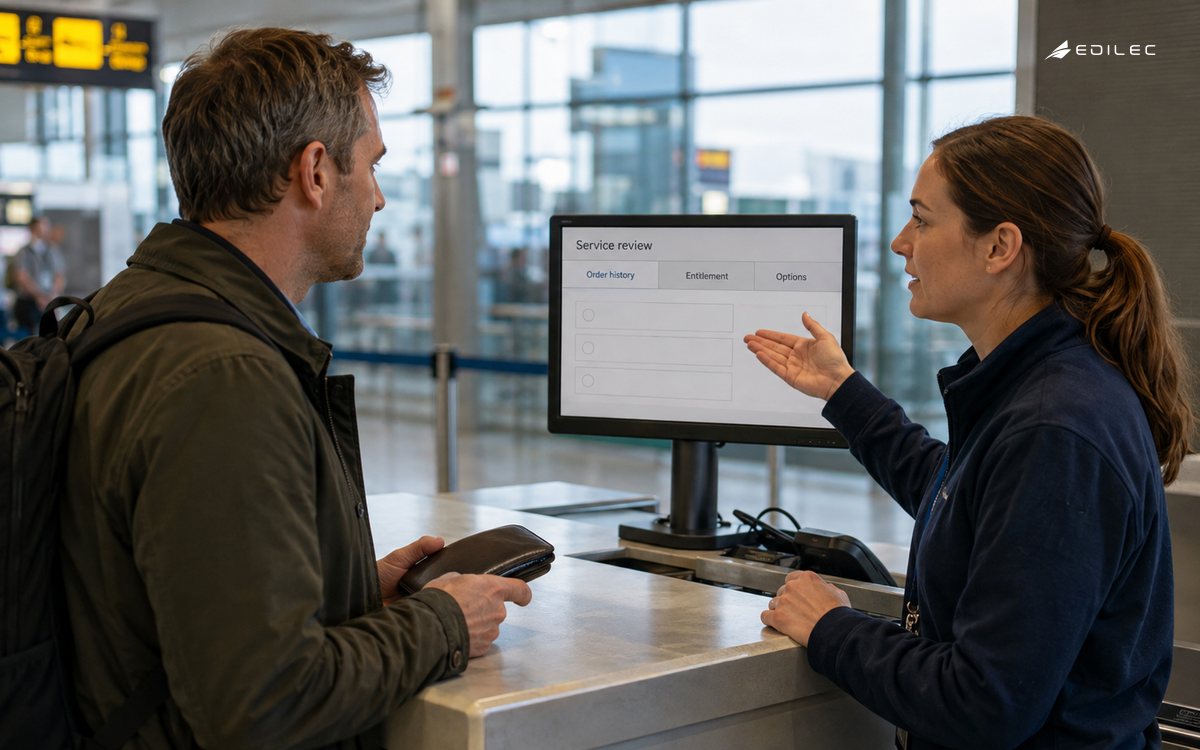
Do not isolate assisted channels from the digital order history. Contact-center and station staff need the same current terms, entitlements, payment state, and disruption options, with appropriately scoped correction actions. Customers should not have to repeat information already supplied unless it is necessary to verify identity or current need. Design degraded modes for low connectivity, provider outages, and device failure, including a way to verify valid entitlement without exposing excessive personal data.
What delivery sequence keeps commercial and operational state aligned?
- Map the end-to-end customer promise and name the authority for each decision.
- Define stable identifiers and explicit states for offer, order, payment, entitlement, and disruption.
- Contract-test standards-based and proprietary partner exchanges with replay and idempotency.
- Release one bounded journey with telemetry, reconciliation, assisted support, and rollback.
- Exercise delayed callbacks, stale realtime feeds, cancellation, partial fulfilment, and provider outage.
- Expand only after customer outcomes, operational exceptions, settlement, accessibility, and unit cost meet agreed thresholds.
Key takeaways
- Make the accepted order the durable record of the customer promise.
- Separate fast discovery views from authorities for inventory, payment, and fulfilment.
- Treat realtime feeds as timestamped evidence and disruption as a governed decision workflow.
- Use industry standards at exchange boundaries without mistaking them for a complete architecture.
- Modernize through reconcilable slices that support customers, operators, and finance together.
Frequently asked questions
Should a travel company buy a platform or build one?
Buy commodity capability when it meets the required workflow, standards, scale, regional, security, and exit needs. Build where proprietary decision logic or customer experience creates durable advantage. Most organizations use both. Evaluate who owns the order and data, how exceptions are operated, how integrations are versioned, and whether records can be exported in a usable form before comparing feature lists.
Does an API-first architecture eliminate integration problems?
No. APIs make contracts visible, but they do not resolve inconsistent identifiers, time semantics, authority, retries, partner downtime, or commercial disputes. An API-first program needs version policy, idempotency, event correlation, contract tests, observability, and reconciliation. The hard question remains which system is entitled to make or correct each business decision.
How much customer data should the platform retain?
Only what supports a documented operational, legal, safety, accounting, or consented purpose, for the approved period. Separate order evidence from optional profile and marketing data. Make deletion and legal-hold behavior explicit across primary systems, analytics, logs, backups, and partners. Requirements vary by jurisdiction and transport mode, so records and privacy specialists should approve the schedule.
Conclusion
Travel and transportation platforms earn trust by keeping a changing physical journey aligned with a precise commercial record. Define capability boundaries, preserve accepted terms in a versioned order, authenticate payment evidence, and make disruptions operable across digital and assisted channels. Standards improve exchange, but durable identifiers, explicit authority, reconciliation, accessibility, and rehearsed failure handling are what make the whole service dependable.