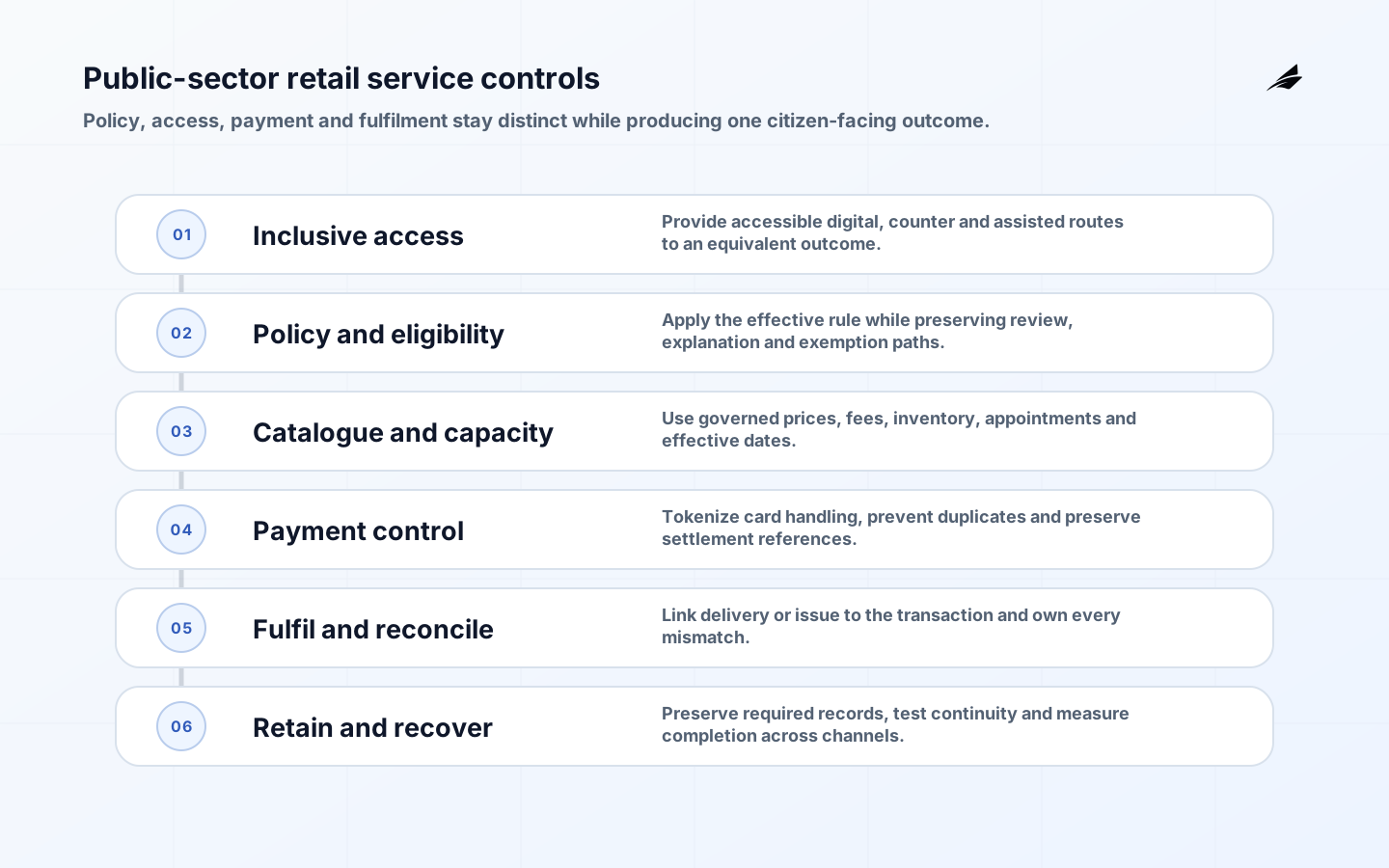
Public sector retail systems sit where public service obligations meet checkout-like workflows. Examples include permits and licences, museum or transit sales, municipal utilities, public pharmacies, benefit-related purchases, fees, bookings and counter services. These systems may resemble commercial ecommerce or point of sale, but the operating requirements are different: eligibility can be governed by law, access cannot depend on one device or payment method, decisions must be explainable, records may be subject to retention rules, and service interruption can exclude people from essential outcomes.
Business teams should define the service before selecting a platform. The U.S. Digital Services Playbook starts with understanding what people need and designing the whole experience, not only the digital screen. Use this guide with the public sector retail implementation checklist and public sector retail FAQ to connect policy, frontline operations, technology and evidence.
Define the public service and its retail boundary
Write the service outcome in plain language: a resident receives a permit after eligibility and payment are confirmed, a visitor buys an admission product, or a customer settles a utility charge through an approved channel. Identify which parts are policy decisions, administrative checks, inventory or capacity decisions, payment events and fulfilment. A platform should not silently turn a discretionary public decision into a checkout rule.
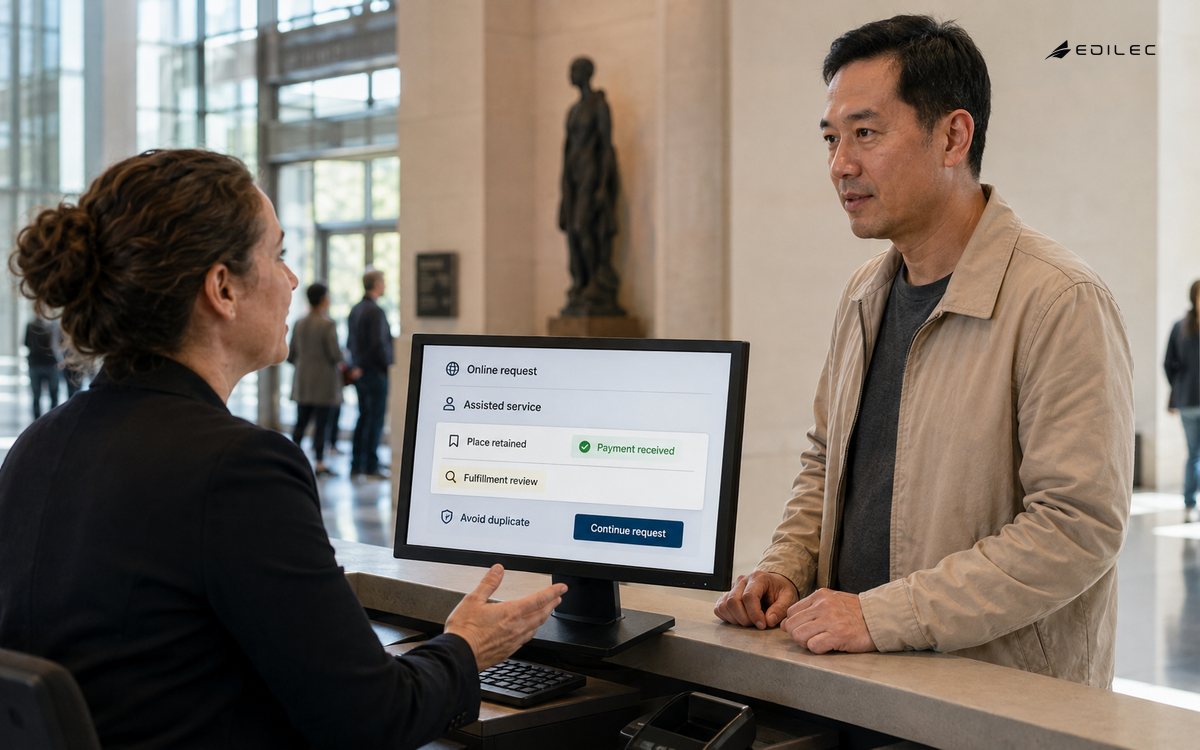
Map every channel: website, mobile browser, counter, call centre, kiosk, partner location and assisted service. Define what happens when a person cannot use the preferred channel, lacks a card, needs an interpreter, disputes eligibility or requires an accessibility accommodation. Keep price, fee, exemption and refund rules in governed configuration with effective dates and approval history.
| Service element | Business decision | Required evidence |
|---|---|---|
| Eligibility | Who qualifies and which exceptions require a caseworker? | Policy version, supplied facts, decision and reviewer. |
| Catalogue | Which products, fees or appointments are available by location and date? | Effective configuration and inventory or capacity record. |
| Payment | Which methods, refunds and reconciliation rules apply? | Gateway reference, amount, status and settlement match. |
| Fulfilment | What proves delivery, collection, activation or issue? | Timestamped fulfilment event tied to the transaction. |
| Assisted route | How can a person complete the service without the digital path? | Equivalent outcome, handoff owner and documented accommodation. |
Make accessibility and assisted service part of acceptance
Use WCAG 2.2 as the current web accessibility standard and test with people who use assistive technology. Cover keyboard operation, visible focus, text resizing, labels, error identification, accessible authentication, target size, contrast and alternatives for time limits or dragging. Automated scans find only part of the problem; conduct manual and task-based testing on the actual purchase and recovery flows.
Design for low bandwidth, older devices, interrupted sessions, language needs and limited digital confidence. Preserve a cart or application safely without exposing it on a shared device. Avoid forcing account creation when the policy does not require identity. Publish contact and assisted-service routes at the point of difficulty. Frontline workers need an interface that explains state and permitted next actions rather than a privileged back door around the public workflow.
Use proportionate identity and privacy controls
Identity assurance should match the consequence of error. Selling a general admission ticket may need only a receipt address, while issuing a regulated licence may require proofing and strong authentication. The final NIST SP 800-63-4 provides current guidance on identity proofing, authentication and federation. Do not collect stronger identity evidence simply because the platform supports it.
Document each data field's purpose, source, access, retention and disclosure. Separate transaction, identity, eligibility and analytics data where different roles or periods apply. Mask sensitive values in staff views and logs. The NIST Privacy Framework can help teams consider effects on individuals as well as organizational compliance. Test correction, access and deletion or retention workflows where applicable.
Design payments and reconciliation as one system
Reduce card-data scope by using approved hosted fields, redirects or terminals and by avoiding storage of sensitive authentication data. Confirm the applicable PCI DSS v4.0.1 responsibilities with the acquiring bank and qualified specialists. Tokenization does not remove every obligation: scripts, administration, access and incident processes still matter. Keep payment success separate from service fulfilment so either event can be retried without creating a duplicate charge.
Reconcile orders, gateway events, settlements, refunds and finance records using stable identifiers. Define how partial payments, chargebacks, cash, waivers and overpayments are handled. Daily reconciliation should produce owned exceptions rather than a spreadsheet emailed to several teams. Refund authority, reason and evidence need separation of duties, especially when frontline staff can change prices or customer records.
| Failure | Customer-safe behavior | Back-office action |
|---|---|---|
| Gateway timeout | Show a pending state; do not invite immediate duplicate payment. | Query by idempotency key before retry or reversal. |
| Payment succeeds, fulfilment fails | Provide receipt and clear recovery expectation. | Queue fulfilment with priority and preserve payment link. |
| Price changes mid-session | Honor or explain policy according to approved rule. | Record price version and effective-time decision. |
| Terminal offline | Offer approved alternate method or deferred procedure. | Reconcile offline transactions and monitor limits. |
| Refund requested | Show status and expected timing. | Require authority, reason, original reference and settlement check. |
Protect transactions without blocking legitimate access
Threat-model account takeover, card testing, bot purchases, inventory abuse, refund fraud, staff misuse, malicious attachments and denial of service. Use rate limits, risk signals and step-up verification proportionately. A risk score should not silently deny a public service. High-impact denials require a review and appeal path, and staff need enough explanation to correct false positives.
Apply least privilege to catalogue, price, refund and configuration changes. Require multifactor authentication for administrators, separate production access, and log material actions. Follow CISA's Secure by Design principle that technology providers should reduce customer security burden through safe defaults. Include vulnerability response, dependency maintenance and security support periods in procurement.
Integrate around authoritative records and explicit states
Identify the system of record for customer, entitlement, catalogue, inventory, payment, fulfilment and finance. Use versioned contracts and idempotent commands. Events should include correlation identifiers, occurred-at time, producer and schema version. Avoid treating a message queue as the permanent transaction ledger or letting several applications independently decide whether a service is complete.
Retention and audit requirements vary by record type and jurisdiction. Preserve the decision and transaction evidence needed without retaining every technical log indefinitely. Make timestamps, policy versions and actor identity consistent. Test reporting against source transactions and explain known timing differences. Public records and legal holds need designed workflows, not emergency database exports.
Plan continuity for digital and frontline operations
Set recovery objectives according to public impact. Document behavior when identity, payment, inventory, notification or fulfilment providers fail. Some services can queue safely; others need a manual route or a clear stop. Test backup restoration, payment reconciliation after outage, terminal replacement and communication to frontline staff. A status page is useful only when the assisted channels receive the same current information.
Operate with service measures that reflect outcomes: successful completion by channel, abandonment at each step, accessibility defects, payment exception age, reconciliation differences, refund time, fraud review accuracy and assisted-service demand. Segment results to detect exclusion. Improvement work should have business and technical owners, a policy check and a measurable expected effect.
Procure for service evidence and controlled change
Procurement should describe the configured public service rather than rely on broad claims that a platform is secure, accessible or compliant. Ask bidders to map requirements to product capability, configuration, custom work, third-party dependency and customer responsibility. Require a demonstration using representative tasks: complete a purchase without a mouse, apply an exemption, recover an interrupted payment, reconcile a refund and trace a material administrative change. Record limitations and planned remediation in the contract. Include support periods, vulnerability handling, subcontractors, data locations, portability, deletion evidence and the process for reviewing significant service changes. A certification can support due diligence, but it does not prove that the buyer's particular workflow, integrations and configuration produce the required outcome.
Build acceptance around scenarios that cross policy, channel and system boundaries. For example, test a resident who begins online, needs assisted service, pays at a counter and receives a digital fulfilment record; then verify that no duplicate account or charge was created. Test a price or eligibility rule that changes while a session is open, an inaccessible error state, a lost network connection and a payment that succeeds while fulfilment times out. Acceptance evidence should identify the release, configuration, test data, result, defect and accountable approver. Keep a small regression suite for every subsequent change. This protects the service from gradual divergence after launch and gives frontline teams confidence that a new release will not remove a lawful route they depend on.
Key takeaways
- Separate policy, eligibility, payment and fulfilment decisions instead of hiding them in checkout logic.
- Treat accessibility and assisted completion as release criteria.
- Use identity assurance proportionate to consequence and minimize retained personal data.
- Design payment, fulfilment and reconciliation for retries without duplication.
- Measure equitable completion and exception recovery across every service channel.
Frequently asked questions
Can a public-sector team use a commercial ecommerce platform?
Yes, if it can satisfy policy, accessibility, identity, records, payment, security, integration and continuity requirements without unsafe customization. Evaluate exit and data portability as well as launch features. Contractual claims should be tested in the configured service, including assisted routes and administrative controls.
Should every customer be required to create an account?
Only when an account is necessary for the service outcome or risk. Guest completion may be more inclusive for low-risk purchases. Where an account is required, explain why, collect the minimum evidence and provide accessible recovery. Avoid using identity proofing intended for high-consequence services on simple transactions.
Conclusion
Public sector retail systems must make transactions convenient without weakening public-service obligations. Design from the whole service, support equal access, separate consequential decisions, protect payment and identity data, and keep every exception recoverable. The result should be easier for residents and frontline teams to use and easier for the organization to govern.