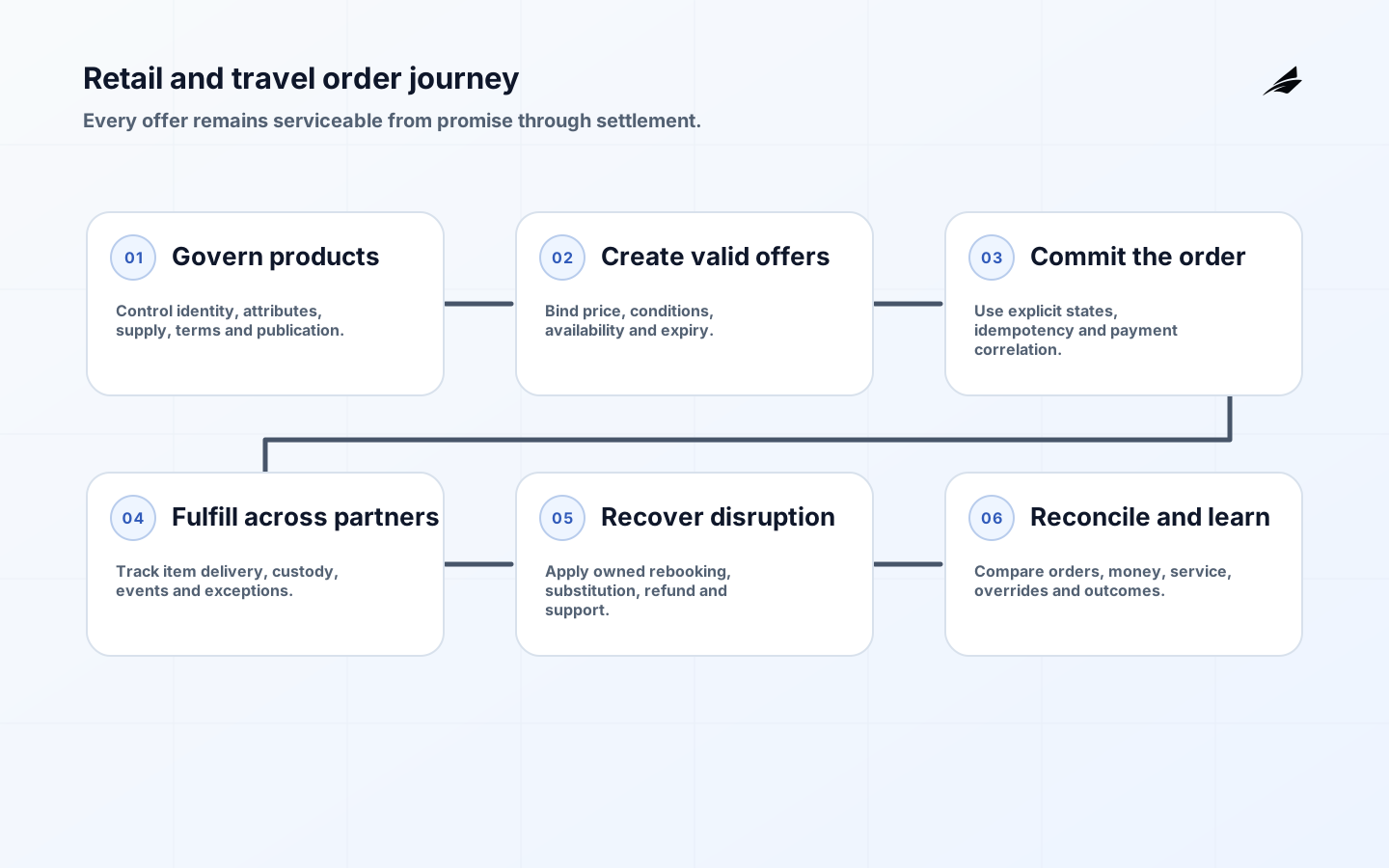
Retail and travel systems connect discovery, offers, availability, orders, payments, fulfillment, disruption, loyalty and service across websites, stores, agents, carriers and partners. Their hardest failures happen between systems: a price is valid but unavailable, a payment succeeds while the order fails, or one channel changes a booking another still presents as active. This retail and travel systems implementation checklist focuses on preserving a coherent customer commitment.
Use it with the retail and travel practical guide, retail and travel FAQ and retail and transportation guide. Establish a business owner for the order lifecycle and separate authoritative state from cached views. A polished checkout cannot compensate for an unreconciled commitment.
1. Define journeys, promises and operating constraints
Map representative journeys from search through after-sales service. Include anonymous and known customers, assisted channels, several currencies and languages, split fulfillment, cancellations, exchanges, refunds, no-shows, disruption, chargebacks and partner handoffs. For each state, record who can change it, which system is authoritative, what the customer has been promised and which evidence resolves a dispute. Identify seasonal peaks and unavailable change windows.
Set outcomes combining commercial and operational truth: offer response time, conversion, confirmed-order rate, inventory accuracy, fulfillment completion, refund time, service-contact rate, reconciliation breaks and recovery objectives. Do not optimize conversion in isolation if downstream failures and support cost rise. Baseline by channel and journey because averages hide high-impact partner or accessibility failures.
| Lifecycle object | Authority to define | Critical invariant |
|---|---|---|
| Product or service | Merchandising, supplier or carrier system | Identity, attributes and eligibility are versioned |
| Offer | Offer or pricing service | Price, conditions, availability and expiry travel together |
| Order | Order management system | Every accepted commitment has one reconstructable state |
| Payment | Payment provider plus finance ledger | Authorization, capture, refund and order remain reconcilable |
| Fulfillment | Store, warehouse, carrier or service provider | Delivery events map to the correct order item |
| Customer record | Approved identity and profile systems | Preferences and rights are not confused with order truth |
2. Govern product, offer and availability data
Create stable identifiers and ownership for products, services, locations, schedules, fares, bundles, taxes, restrictions and fulfillment capabilities. Version time-sensitive terms and preserve the offer accepted by the customer. Establish validation and publication workflows so incomplete attributes or unsupported claims cannot reach a channel. Reconcile channel acceptance and cache state; publishing an update does not prove every seller uses it.
IATA’s Dynamic Offers program describes airline movement from static fare constructs toward contextual offers supported by offer and order management. Whether implementing airline standards or general retail, keep the same discipline: an offer is a bounded proposal with content, price, conditions, availability and validity. Retain evidence to explain what the customer saw without keeping unnecessary behavioral data.
3. Build an explicit order state and integration contract

Define an order state machine and legal transitions. Use idempotency keys for commands that may be retried and event identifiers for duplicate detection. Specify ordering, timeout, compensation and reconciliation for asynchronous partners. Never infer success solely from a client timeout or a sent message. Return an honest pending state when finality is unknown and provide a query or callback route. Correlate events across offer, order, payment and fulfillment.
IATA’s ONE Order aims to consolidate legacy airline booking and ticketing artifacts into a customer-focused order and standardize management through fulfillment and accounting. Adoption is a broad operating transformation, not a schema replacement. Map legacy references, airport and partner processes, accounting, disruption and interline obligations before changing the customer record. Reconcile old and new flows explicitly during transition.
4. Secure payment, identity and customer data
Minimize the cardholder-data environment through suitable hosted or tokenized payment patterns and confirm responsibilities with acquirers and providers. The PCI SSC document library publishes PCI DSS v4.0.1 and supporting material; determine applicability with qualified assessors. Test authorization, challenge, timeout, duplicate callback, partial capture, reversal, refund, currency and chargeback paths. Reconcile money to order and ledger at transaction and aggregate levels.
Use identity confidence proportionate to action. Browsing, viewing an itinerary, spending loyalty value, changing a traveler name and granting corporate access carry different risks. Current NIST digital identity guidance informs proofing, authentication and federation choices. Protect guest journeys while preventing enumeration and takeover. Separate marketing preferences from service messages and required operational records.
- Tokenize payment data where feasible and prohibit sensitive authentication data in logs, support tickets and analytics.
- Require step-up authentication for high-impact changes based on risk and user context.
- Show complete price, material restrictions, refundability and fulfillment terms before commitment.
- Record preference purpose, source and time, with suppression propagated to applicable channels.
- Limit partner and support access to the orders and actions necessary for their role.
- Create a secure, accessible recovery route for customers who lose devices or travel without normal connectivity.
5. Verify accessible omnichannel and disruption service
Test critical journeys across keyboard, screen reader, zoom, mobile, slow network, language expansion and error recovery using WCAG 2.2 as the baseline. Do not make disabled users switch to a phone channel with limited hours. Preserve context when handing off between web, app, store, agent and contact center. The receiving channel should see authorized current state and the customer should not repeat sensitive information.
Design disruption as a core workflow. Model unavailable inventory, schedule change, supplier cancellation, missed connection, store closure, weather event and provider outage. Define eligibility and authority for rebooking, substitution, vouchers and refunds. Queue work by customer consequence and time sensitivity. Communications must be consistent with order state and avoid promising an option inventory cannot fulfill. Provide staff a controlled override with reason and audit.
| Scenario | System behavior to prove | Business evidence |
|---|---|---|
| Payment timeout | Resolve uncertain authorization before retry or duplicate order | Gateway, order and ledger reconciliation |
| Inventory race | Only valid quantity or capacity is committed | Concurrency result and customer response |
| Partner outage | Preserve pending state, retry safely and expose service route | Queue, timeout and fallback exercise |
| Disruption | Apply eligibility and authority consistently across channels | Rebooking or refund journey trace |
| Accessibility | Complete search, purchase and service without blocked interaction | Manual task evidence against agreed criteria |
| Recovery | Restore order history and resume partner processing without duplication | Timed restore and backlog reconciliation |
6. Migrate, roll out and reconcile continuously
Migrate by a bounded product, route, location, partner or customer cohort. Rehearse data mapping and state translation, then reconcile totals and representative histories. Keep legacy access read-only where operations need it and define which system wins during coexistence. Train frontline and finance teams on new states and exception codes. Set rollback around commitments: it may be safer to stop new sales while continuing service for accepted orders.
Operate a cross-functional control room during peak rollout. Monitor offer failures, stale availability, order breaks, payment mismatches, fulfillment lag, service demand, accessibility incidents and partner queues. Reconcile continuously rather than at month-end. Review manual overrides and compensation for product or integration defects. Feed support and financial breaks into architecture and supplier governance. Exercise provider exit and data export before contract renewal becomes urgent.
Key takeaways
Practical example: a travel retailer pilots a new order service on one route and payment method. A customer accepts a time-limited offer, the payment provider authorizes, and the order service records one commitment linked to fulfillment. Testers then delay the provider callback, replay it twice and cancel the supplier segment during servicing. The system shows a truthful pending state, creates no duplicate order, applies the correct rebooking authority and reconciles authorization, refund and ledger records. An accessible keyboard user completes the same disruption journey. The rollout stops new sales when reconciliation breaks exceed the threshold but keeps accepted orders available to agents, protecting customer service while engineers correct the integration.
- Model the complete customer commitment and exceptions across every participating channel.
- Version offers with price, terms, availability and validity so acceptance can be reconstructed.
- Use explicit order states, idempotent commands and continuous cross-system reconciliation.
- Minimize payment and personal data while testing uncertain, reversed and disputed transactions.
- Treat accessibility and disruption handling as core journeys, not edge cases.
- Roll out by bounded cohort and protect accepted orders during rollback or provider failure.
Frequently asked questions
Is IATA ONE Order only an IT integration project?
No. It changes records and processes across distribution, order management, fulfillment, service and accounting, including external partners. Architecture matters, but operating roles, legacy coexistence, disruption and financial reconciliation determine whether migration works. Treat it as a business transformation using technical standards.
Can a cache be the source of inventory truth?
A cache can serve fast availability views if its age, invalidation and oversell behavior are explicit. Final commitment should use an authoritative or reserved state suited to the business. Show honest pending or unavailable outcomes when confidence expires. Monitor divergence and reconcile accepted orders against supply.
What does rollback mean after customers have purchased?
Rollback must preserve accepted commitments and their service routes. Teams may disable new offers, route new sales to the old platform, or continue a contained new-order service while reverting other traffic. Reversing databases blindly can erase valid orders. Define customer, payment and partner reconciliation before launch.
Conclusion
Before adding a channel or partner, run a certification pack covering offer expiry, inventory contention, duplicate request, uncertain payment, order retrieval, cancellation, refund, disruption, accessibility and settlement. Require partner identifiers and timestamps to support correlation, and agree which party communicates to the customer in each failure state. Verify that support can find the same current order the channel displays. A partner that passes the happy path but cannot reconcile or service an uncertain transaction is not production-ready, regardless of its nominal protocol conformance.
Retail and travel implementation is a discipline of coherent commitments. Govern products and offers, make order state explicit, reconcile payments and fulfillment, support identity and accessibility, and rehearse disruption with partners. When every customer promise can be reconstructed and serviced, channel innovation can move faster without sacrificing trust.